- 128 pages
- English
- ePUB (mobile friendly)
- Available on iOS & Android
eBook - ePub
About this book
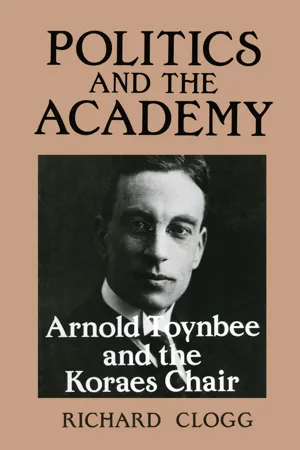
First Published in 2004. Part of the Politics and the Academy series, this volume looks at Arnold Toynbee and the establishment of the Koraes Chair of Modern Greek and Byzantine History, Language and Literature at King's College, London, with an appendix of Toynbee's letter to The Times newspaper in January 1924.
1. The Establishment of the Chair
Any study of the foundation of the Koraes Chair at King’s College, London, must begin with Ronald Burrows, Principal of the college between 1913 and his death in 1920. From the outset, he was the driving force behind its establishment. Burrows was born in 1867 and educated at Charterhouse and Christ Church, Oxford. With a first class degree in Mods and Greats (Greek, Latin and Ancient Philosophy), Burrows’ first academic appointment was as assistant to Gilbert Murray, Professor of Greek in the University of Glasgow, a connection that was to have important consequences in the story of the Koraes Chair. Burrows was subsequently appointed Professor of Greek at University College, Cardiff, and later at the University of Manchester. During these years, Burrows, a Christian socialist, developed a strong interest in modern Greece. In the course of his topographical researches in the Peloponnese he was impressed by the vigour with which the Greeks conducted their politics and was fond of contrasting this with the apathy he had encountered in the municipal politics of Glasgow. At one local election in Pylos he had come across the local citizenry, ‘with many bands and banners’, electing a town council of 15 members. The voters’ roll contained 1200 names and there was a total of 127 candidates.1
During his time at Manchester he demonstrated a keen interest in the Balkan wars of 1912 and 1913 and his enthusiasm for the Greek cause found expression in his ‘Song of the Hellenes to Veniselos the Cretan’, first published in the Manchester University Magazine in January 1913. This strikingly illustrates the way in which Burrows, like so many of his philhellene contemporaries, was bowled over by the charismatic personality of the Greek statesman. The first and last verses run as follows:
Veniselos! Veniselos!
Do not fail us! Do not fail us!
Now is come for thee the hour,
To show forth thy master power.
Lord of all Hellenic men,
Make our country great again!
Veniselos! Veniselos!
Thou’lt not fail us! Thou’lt not fail us!
Righteousness is on thy face;
Strength thou hast to rule our race;
Great in war and great in peace,
Thou, our second Perikles!2
While at the University of Manchester Burrows maintained good relations with the then important Greek community in the city and hoped that at some stage he might be able to persuade the Manchester Greeks to fund a lectureship in Modern Greek.
It was only when he moved to London in 1913 to take up the principalship of King’s College that Burrows was able to give more concrete expression to his philhellenic sentiments. It should, however, be emphasised that while Burrows always had a very particular interest in, and emotional attachment to, Greece, under his principalship King’s College became a powerhouse of academic propaganda in favour of national self-determination for the peoples of Eastern Europe. It was under Burrows’ aegis that the School of Slavonic Studies (now, as the School of Slavonic and East European Studies, an independent institution of the University of London) was founded in 1915 as a part of the college. The most influential member of the staff of the newly founded School was R.W. Seton-Watson. Seton-Watson was an indefatigable champion of the oppressed of nationalities of the Habsburg Monarchy and was a co-founder, with Burrows and others, including H. Wickham Steed, the foreign editor of The Times, and A.F. Whyte, a Liberal MP, of the journal The New Europe. Between 1916 and 1920 The New Europe was influential in helping to shape British policy towards East and Central Europe, and Burrows was a frequent contributor.3
Burrows, by this time both an honorary doctor of the University of Athens and an honorary member of the Archaeological Society of Athens, was closely involved with another committed philhellene, William Pember Reeves, Director of the London School of Economics,4 and two prominent Anglo-Greeks, D.J. Cassavetti and A.C. Ionides, in the foundation in 1913 of the Anglo-Hellenic League. The League had as its declared objectives, inter alia, the defence of the ‘just claims and honour of Greece’ ; the removal of existing prejudices and the prevention of future misunderstandings between the ‘British and Hellenic races’ and also between the ‘Hellenic and other races of South-Eastern Europe’. It also sought to spread information concerning Greece in Britain and to stimulate interest in Hellenic matters, together with the improvement of ‘the social, educational, commercial and political relations of the two countries’. The offices of the League were situated in the Aldwych, convenient for both King’s College and the London School of Economics, which are themselves in close proximity to each other. Virtually from its inception the League came to be identified with the projection of the aspirations of Venizelist Greece and this tendency became all the more pronounced when, on the outbreak of the First World War, the markedly Ententophil sympathies of Eleftherios Venizelos came into sharp conflict with the neutralist views of King Constantine. During the period between Venizelos’ second forced resignation in 1915 and the formal recognition by the Entente Powers of Venizelos as Prime Minister of the whole of Greece in June 1917, the League acted as a vociferous instrument of Venizelist propaganda and argued strongly for the official recognition of the provisional government that Venizelos established in Salonica in the autumn of 1916. The League published numerous pamphlets of Anglo-Greek interest during this period, including a number of an explicitly political character, one of which, The Crisis in Greece (1915), was written by Burrows.
Throughout his principalship Burrows acted as tireless publicist on behalf of Venizelist Greece. He wrote numerous newspaper and periodical articles justifying Greece’s territorial claims in general and Venizelos’ policies in particular.5 Some insight into the nature of Burrows’ philhellenic thinking may be gleaned from this passage from an address that he gave to the Historical Association in 1919:
There are points in common between Greece and Great Britain which exist between us and few of the people with whom we are allied. We are both a ‘Nation of shopkeepers’, and yet we have not been found wanting in the day of battle. We are both … a nation of sailors. At our best we turn out something of the same type of man.
Elsewhere in the same lecture he argued that ‘the Greek race is not decadent, not on the down grade, but on the up grade – fertile, progressive, constantly expanding. It has at its head one of the great men of the century, a man who fulfils in his own person the ideals and aspirations of the race’.6 He meant, of course, Venizelos.
It would appear that the idea of establishing a chair of Modern Greek in the University of London was first mooted at the time of the Balkan wars and that the initiative had come from British scholars, who presumably included Burrows. For D.J. Cassavetti, a member of a prominent Anglo-Greek family that had been established in Britain for some 80 years, writing towards the end of 1913, wrote that the institution of such a chair was ‘one of the most practical suggestions that has been made for furthering the Hellenic cause’ in Britain. An endowment of £10,000 would be the most required to secure the services of ‘one of the most brilliant young Hellenists’. He hoped that Greeks and those of Greek origin settled in Britain would respond to British scholars who had expressed a desire to introduce the study of modern Greek among other modern languages at a great university.7
The earliest documentary evidence that has come to light of Burrows’ involvement in the proposal to found a Modern Greek post at King’s College is contained in a letter of 20 February 1915 that he received from A.M. Andreades, governor of the Bank of Greece and a distinguished economic historian. Andreades appears to have acted as the intermediary between Burrows and Venizelos for he wrote that the Greek Prime Minister had stated in a letter that he would be very pleased to grant £300 per year for the chair of ‘Modern Greek History and Literature’. Venizelos had asked Andreades to approach a certain ‘M’ while passing through Rome on his way back to Greece from Paris. Andreades added that ‘of course I shall speak to M on [s/c] my own name and without mixing you in the least. This is to remain strictly confidential between us, as the details shall be settled and the money secured only when I shall reach Athens that is to say in a month. But as the question is settled in principle the details to be settled will be only of a formal nature’.8
Presumably Burrows and Venizelos had earlier been in contact about the possible establishment of such a chair and the decision to approach ‘M’ had been mutually agreed. The person cryptically referred to as ‘M’ was William Miller. Miller, an acute and sympathetic observer of the Greek scene, was a scholar journalist of independent means who had lived for many years in Athens but who was now based in the Italian capital.9 It would appear that Burrows had already made provision for some teaching of Modern Greek at the college by this time, for there is a letter in the college archives from Nicolas Dioscorides, dated 19 February 1915, to the Principal asking for further information about the post, of whose establishment at the Vasilikon Kollegion tou Londinou he had recently read, of a teacher of Modern Greek.
Andreades’ forecast that the matter would be settled within a matter of weeks was to prove highly optimistic, for by the time he had returned to Greece Venizelos had been forced to resign (in March 1915) by King Constantine I, who did not share the passionately pro-Entente views of his Prime Minister but rather believed that Greece’s interests would best be served by neutrality in the conflict between the Entente and Central Powers. But Andreades was not discouraged by Venizelos’ fall from office. In a letter of 22 May to Burrows he wrote it would be easy to get the subvention, if necessary, from the new Foreign Minister, Georgios Christakis Zografos, who was known for his pro-Entente views. Andreades believed it more practical, however, simply to await Venizelos’ return to office, for he considered it out of the question that he would not return to power.10 In elections held in the following month, June, Venizelos was indeed returned to power with a clear, although somewhat reduced, majority in Parliament. Because of the King’s illness, however, he was not actually sworn in as Prime Minister until 23 August.
Shortly afterwards, on 16 September, Burrows wrote to Andreades that although he well understood that the Prime Minister would be overwhelmed with work at the present time he none the less hoped that Andreades might be able to raise the matter of the subvention with Venizelos. He believed it would be an ‘extraordinarily appropriate and useful act’ to make such a grant at this particular juncture: ‘without in any way prejudicing political issues it would be a graceful act of practical sympathy, and if I were fortunate enough to secure Miller, it would have still further practical effects’. Burrows suggested that the Greek government should undertake to provide £300 a year ‘for the funding of a Lectureship in Modern Greek Literatúre and History at University of London, King’s College’. The advantage of such a wording was that it would leave the choice of the lecturer in the hands not of the university but of the college, ‘which in the case in question would really be my hands’. Such a sum, moreover, would be enough to pay for a readership so that ‘the College could easily secure the more dignified title if it felt satisfied that the man whom it wished to secure would be appointed’. Burrows added that he had already secured endowments for Italian and ‘that the Belgrade government, though this is at present quite confidential, has already made us a grant for Serbian and South Slavonic’. He also had hopes of getting considerable endowments for Russian. ‘It is extraordinarily important that Modern Greek should not be neglected and obscured.’
Andreades duly passed Burrows’ letter on to Venizelos and on 30 September was in a position to reply that ‘the premier thanks you most warmly for everything you are doing for Greece and congratulates you for doing so well your philhellenic work’. As for the chair of Modem Greek History and Literature, Venizelos had asked Andreades to write at once to say that in principle he was ready to make a grant of £300 and was now looking into ways of guaranteeing the payment for seven years. Andreades added that he had also written to Miller to secure his definite acceptance. When he had seen him in Rome the previous March he had been very inclined to accept, but had had some minor objections which he did not think it would be difficult to overcome, the chief of these being the possibility of his renewing his contract with the Morning Post. Andreades, however, had not pushed ‘the thing too far’, for on his reaching Athens Venizelos had been out of power.11
On 2 October Joannes Gennadius, the Greek minister in London, and himself a noted scholar and bibliophile,12 wrote that he had been asked by Venizelos to inform Burrows that the Royal Government wished to guarantee for seven years une chaire d’histoire et de littérature Grecques Modernes. For this a special bill would need to be presented in parliament. Venizelos therefore wished to know urgently if there were any reason why the public should not know that a chair at King’s College was officially subsidized by a foreign government. Two days later, on 4 October, Burrows informed Gennadius that he had consulted the authorities of the college and the Vice-Chancellor of the University of London, who wished to inform Venizelos that they were ‘profoundly grateful to the Royal Government of Greece for the honour it has done us in offering to endow for seven years a Chair of Modern Greek History and Literature at King’s College. The University and College Authorities will be proud to appoint to [a] Chair so endowed, and see no difficulty in the fact of its being publicly known what is the source of the endowment’. Burrows asked that Venizelos be informed of the intense pleasure that he personally felt ‘as an ardent Phil-Hellene’ that it should fall to him as Principal of the college ‘to be the medium of receiving this gift from Greece to England at such a crisis in the history of our two nations’.13
This particular initiative, however, was thwarted by the fact that shortly after Burrows wrote to Gennadius, Venizelos, on 7 October, was forced by King Constantine to resign for the second time. Following the Bulgarian mobilization in the wake of the secret treaty between King Ferdinand of Bulgaria and the Central Powers, Venizelos and his supporters had argued that Greece, under the terms of the Greek-Serbian treaty of 1913, was obliged to go to the assistance of Serbia, the principal target of the Bulgarian mobilization. His opponents had argued that the obligation lapsed in the case of the involvement of a non-Balkan power, namely Austria-Hungary. King Constantine agreed to Venizelos’ request for the mobilization of the armed forces but was still determined to maintain Gre...
Table of contents
- Cover
- Half Title
- Title Page
- Copyright Page
- Table of Contents
- Preface
- 1. The Establishment of the Chair
- 2. The Election
- 3. The Controversy
- 4. The Aftermath
- Appendix: Toynbee’s Letter to the Times of 3 January 1924
Trusted by 375,005 students
Access to over 1.5 million titles for a fair monthly price.
Study more efficiently using our study tools.
Frequently asked questions
Yes, you can cancel anytime from the Subscription tab in your account settings on the Perlego website. Your subscription will stay active until the end of your current billing period. Learn how to cancel your subscription
No, books cannot be downloaded as external files, such as PDFs, for use outside of Perlego. However, you can download books within the Perlego app for offline reading on mobile or tablet. Learn how to download books offline
Perlego offers two plans: Essential and Complete
- Essential is ideal for learners and professionals who enjoy exploring a wide range of subjects. Access the Essential Library with 800,000+ trusted titles and best-sellers across business, personal growth, and the humanities. Includes unlimited reading time and Standard Read Aloud voice.
- Complete: Perfect for advanced learners and researchers needing full, unrestricted access. Unlock 1.5M+ books across hundreds of subjects, including academic and specialized titles. The Complete Plan also includes advanced features like Premium Read Aloud and Research Assistant.
We are an online textbook subscription service, where you can get access to an entire online library for less than the price of a single book per month. With over 1.5 million books across 990+ topics, we’ve got you covered! Learn about our mission
Look out for the read-aloud symbol on your next book to see if you can listen to it. The read-aloud tool reads text aloud for you, highlighting the text as it is being read. You can pause it, speed it up and slow it down. Learn more about Read Aloud
Yes! You can use the Perlego app on both iOS and Android devices to read anytime, anywhere — even offline. Perfect for commutes or when you’re on the go.
Please note we cannot support devices running on iOS 13 and Android 7 or earlier. Learn more about using the app
Please note we cannot support devices running on iOS 13 and Android 7 or earlier. Learn more about using the app
Yes, you can access Politics and the Academy by Richard Clogg in PDF and/or ePUB format, as well as other popular books in History & Historiography. We have over 1.5 million books available in our catalogue for you to explore.