Professional poets spend many hours crafting a finished piece of work, yet we expect children in school to sit down and write when they are told to, whether they feel inspired or not. This series of four books is a toolkit to help you build a positive framework for children to read, write, understand and enjoy poetry - to bring a creative spark to the poetry classroom. A combination of featured poems, creative ideas, structured lesson plans and differentiated photocopiable activity sheets gives the series a uniquely flexible approach - which means you can use the materials in any classroom context.
If you're wary of poetry, if you think it's boring, or if you're nervous about teaching poetry, then you've chosen the right book.
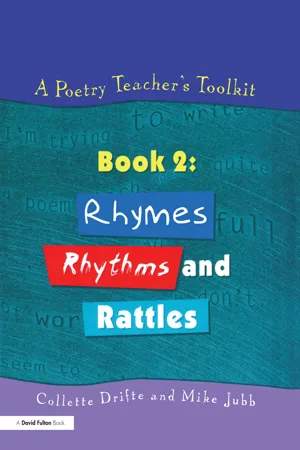
Key themes covered in BOOK 2: Rhymes, Rhythms and Rattles are rhythm and rhyme in poetry, sounds, alliteration, words to create effects, onomatopoeia, and metaphor and simile.
Other books in the series are: BOOK 1: Words andWordplay; BOOK 3: Style, Shape and Structure; and BOOK 4:Language and Performance.
- 156 pages
- English
- ePUB (mobile friendly)
- Available on iOS & Android
eBook - ePub
About this book
Information
1
I Got Rhythm
Featured poems
The Man in the Moon Stayed Up Too Late by J. R. R. Tolkien
From a Railway Carriage by R. L. Stevenson
Extracts from The Song of Hiawatha by H. W. Longfellow
The Pancake by Christina Rossetti
Cool Cat by Mike Jubb
White Knuckle Ride by Jane Clarke
The Last Mermaid by Liss Norton
Daffodils by William Wordsworth
‘Poetry is to prose as dancing is to walking.’ (John Wain)
Rhythm is basic – it’s programmed into us. As individuals, we were enveloped by the rhythms within our mother’s body (her heartbeat was iambic, as a matter of interest). And we are still surrounded by rhythm, and its cousin … pattern.
We Got Rhythm
Rhythm in your breathing, rhythm in your heartbeat,
Rhythm in your clapping and the tapping of your feet;
Rhythm when you swim, rhythm when you run;
Rhythm in the rising and the setting of the Sun;
Rhythm in the rain, and the chattering of teeth,
Rhythm in a caterpillar measuring a leaf;
Rhythm in a clock, and a telephone ringing;
Rhythm in a waterfall, and songbirds singing;
Rhythm in the wavelets lapping on a beach,
Rhythm in writing, rhythm in speech.
A rhythm may be noisy, or it may not make a sound,
Like the Rhythm of the Stars as they slowly dance around. M.J.
This chapter aims to build on the rhythm work started in A Poetry Teacher’s Toolkit Book 1, ‘Words and Wordplay’: in the ‘Syllables’ section of Chapter 2 and in the ‘Onomatopoeia’ section of Chapter 3.
‘Rhythm’ isn’t synonymous with ‘meter’, of course. Meter is rhythm with rules; it establishes a pattern. But poetry was spoken yonks before any rules were written down. So I don’t think we need to bother Key Stage 2 children with meter in the technical sense: iambs and youambs and pentathingies (especially as I’m not too hot on that stuff myself!). Anyway, it would stifle youngsters, which hopefully is why the National Literacy Strategy doesn’t even mention the word ‘meter’.
John Clare’s Pleasant Sounds (p. 103) is a good example of a non-rhyming poem that revels in the natural rhythm of words, but has no formal meter. However, if kids absorb a ‘feel’ for meter along the way (which of course they do) then all well and good. Absorption is the best way of learning. The more they hear and perform poetry, the more the children will absorb. The more they absorb, the better writers they will be (see A Poetry Teacher’s Toolkit Book 4, Ch. 4).
Here is an example of a ‘found’ poem:
Education, Education, Education
It looks as if my ‘old’ school has fallen
into the Blunkett Pit.
The new Head has,
as I expected,
removed all hope
of a humanitarian, joyous
creative, loving
caring, reflective
experimental, peaceful environment,
in favour of
a point-scoring, rigid,
false, regimented …,
Oh how I could go on.
I got out in time,
and so have half the staff,
but the children can’t.
Those words were written to me by a friend, before the 2001 General Election, as part of an e-mail. All I have done is to set them out so that they look like a poem, and I’ve added the title. When I first read the passage, it ‘called’ to me to be a poem. And I believe that it does work as a poem, partly because it came from the heart, but also because ordinary everyday English has a natural rhythm.
It’s this natural rhythm, and not meter or rhyme, that is the essence of all English poetry (see A Poetry Teacher’s Toolkit Book 3, Ch. 2 for more information about ‘found’ poetry and ‘free’ verse).
But, of course, meter and rhyme do join forces to create the sound patterns in many thousands of poems.
J. R. R. Tolkien was a master of rhythm and rhyme. This is the start of a poem called Errantry from his collection The Adventures of Tom Bombadil (see Further Reading):
There was a merry passenger,
a messenger, a mariner:
he built a gilded gondola
to wander in, and had in her
a load of yellow oranges
and porridge for his provender;
he perfumed her with marjoram
and cardamon and lavender.
To me, that is exquisite. Without any full rhymes, it contains so much that I’m trying to encourage throughout this series, and to achieve as a writer myself. Apart from its perfectly flowing rhythm, it has near-rhymes, half-rhymes, assonance, alliteration, enjambment (a line running into the next, see below) and a mid-line caesura (the pause after ‘wander in’, see below).
But listing the separate devices doesn’t tell the half of it, does it? Notice how the word ‘gilded’ has both assonance, echoing the earlier ‘built’, and alliteration with ‘gondola’. This is craftsmanship of the highest order. We haven’t reproduced the whole of this poem in our anthology, but we have included Tolkien’s The Man in the Moon Stayed Up Too Late (p. 35).
Before I talk about that poem, however, I want to mention two important terms: enjambment and caesura. If you’re not familiar with the words, please don’t be put off by the sound of them – they’re dead easy, and they can make all the difference to the writing, the appreciation, and the performance of poetry.
Enjambment and caesura
Enjambment is the continuation of a sentence, without pause, beyond the end of a line; in the fragment from Errantry above, for example, ‘he built a gilded gondola/to wander in’. Caesura means a pause or break; it is often highlighted by punctuation, b...
Table of contents
- Cover
- Half Title
- Title Page
- Copyright Page
- Table of Contents
- Dedication
- The Authors
- Acknowledgements
- Introduction
- A ‘Must Read’ Chapter!
- 1. I Got Rhythm
- 2. Is Rhyme a Misdemeanour?
- 3. Sounds Good
- 4. It’s Like This ...
- Further Reading
- Glossary
- Index
Trusted by 375,005 students
Access to over 1.5 million titles for a fair monthly price.
Study more efficiently using our study tools.
Frequently asked questions
Yes, you can cancel anytime from the Subscription tab in your account settings on the Perlego website. Your subscription will stay active until the end of your current billing period. Learn how to cancel your subscription
No, books cannot be downloaded as external files, such as PDFs, for use outside of Perlego. However, you can download books within the Perlego app for offline reading on mobile or tablet. Learn how to download books offline
Perlego offers two plans: Essential and Complete
- Essential is ideal for learners and professionals who enjoy exploring a wide range of subjects. Access the Essential Library with 800,000+ trusted titles and best-sellers across business, personal growth, and the humanities. Includes unlimited reading time and Standard Read Aloud voice.
- Complete: Perfect for advanced learners and researchers needing full, unrestricted access. Unlock 1.5M+ books across hundreds of subjects, including academic and specialized titles. The Complete Plan also includes advanced features like Premium Read Aloud and Research Assistant.
We are an online textbook subscription service, where you can get access to an entire online library for less than the price of a single book per month. With over 1.5 million books across 990+ topics, we’ve got you covered! Learn about our mission
Look out for the read-aloud symbol on your next book to see if you can listen to it. The read-aloud tool reads text aloud for you, highlighting the text as it is being read. You can pause it, speed it up and slow it down. Learn more about Read Aloud
Yes! You can use the Perlego app on both iOS and Android devices to read anytime, anywhere — even offline. Perfect for commutes or when you’re on the go.
Please note we cannot support devices running on iOS 13 and Android 7 or earlier. Learn more about using the app
Please note we cannot support devices running on iOS 13 and Android 7 or earlier. Learn more about using the app
Yes, you can access A Poetry Teacher's Toolkit by Collette Drifte,Mike Jubb in PDF and/or ePUB format, as well as other popular books in Didattica & Didattica generale. We have over 1.5 million books available in our catalogue for you to explore.