- 350 pages
- English
- ePUB (mobile friendly)
- Available on iOS & Android
eBook - ePub
About this book
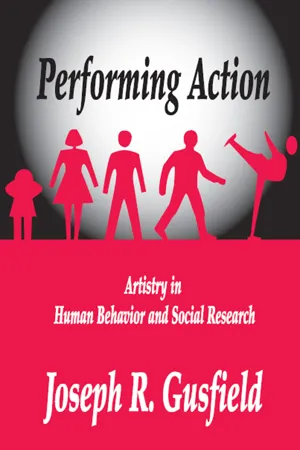
In recent years the social sciences and the humanities have drawn closer to each other in thought and method. This rapprochement has led to new perceptions of human behavior by sociologists, as well as new methodological orientations. Sociologist Joseph R. Gusfield draws upon drama and fiction to show how human action is shaped by the formal dimensions of performance. Gusfield first defines the concept of behavior as artistic performance. He then analyzes routine and classic social research reports as literary performances in qualitative and quantitative terms. Next he moves to social movements and public actions, demonstrating how objects and events are products of the interpretation and reflection of individuals. He draws upon literary and artistic conventions to deal with issues of representation and meaning. In the first and last chapters, Gusfield provides a conceptual summary examining the relation between sociology as science and art, arguing that sociological methods are neither science nor art, but partake of both. Following the philosopher Paul Ricouer, Gusfield shows how human behavior can be read as a text, always telling the participant or observer "something about something." Performing Action will be of interest to sociologists, psychologists, and students of aesthetics and critical theory.
Information
Introduction: Human Behavior as Performance
I begin with a story and a description. The story was told to me by a friend who had been an undergraduate at the University of California at Los Angeles in the late 1940s. An attractive woman came once a week to take a class on the campus. Her walk was so provocative that her presence was soon known to many men. They would time themselves so as to be able to watch her as she came to class. Several years later, she became, and remains even today, the most famous of American sexual icons—Marilyn Monroe.
The description is part of an essay on women’s fashion by the then (1979) fashion critic of the New Yorker magazine, Kennedy Fraser. In an analysis of fashions designed for executive women, Fraser remarks on the male suit:
The suggested fashions for women in business begin with the uniform of men in business—the suit—and then add touches of self-consciousness…it doesn’t simply take itself for granted. The traditional business uniform of men—matching jacket and pants of a neutral color, an easily laundered, simply styled shirt…continues in favor not only because of conservatism but because it is eminently practical. It is a style of dress that can be forgotten about while the people who wear it devote their attention to the work at hand. (Italics mine. Fraser, 1981: 232-33)
What both of these strips of human behavior have in common, for purposes of this analysis, is the capacity for multiple interpretations, for meanings at different levels and of different dimensions. Monroe’s walk was at once both a means of locomotion and an invitation. The male suit is not only a means of covering the body and providing warmth. In its style and material, it also conveys a message of dependability and predictability. It is in the messages conveyed that a great deal of human interaction and observation occurs. There are many ways of walking to and from the same places and many styles for coverage and warmth. That very comparison of possibilities is the background for the creation of meanings in human action.
The Performance Metaphor
In using the metaphor of “performance,” I am borrowing from the stage, the movies, the concert hall and, more recently, the world of visual art and entertainment. In short, from the arenas conventionally associated with art. I do this deliberately because one of the goals of this volume, as in much of my past work, is to forge a closer relationship between art and sociology and, at the same time, to mark out the boundaries and differences between them.
In utilizing the concept of behavior as performance, I am pointing to two similarities between the staged or planned actions of the artistic world and that of what the artist and art critic Allen Kaprow calls “non-theatrical performance” (Kaprow, 1993: 163-81). First, the behavior involves a performer and an audience. Somebody engages in action—whether interpersonal interaction or public actions—where the audience is, to some substantial degree, unknown to the performer. Secondly, the performance is open to the interpretations of the audience. Literary, drama, and art critics have long pointed out and exemplified the diverse meanings with which they and audiences interpret performances.
While the two vignettes that began this chapter are simple and their analysis probably already well understood by my readers, it is in the application of the idea of performance to the wide range of interpersonal and public actions that the concept becomes more useful. I shall argue that the process of interpretation of meanings in behavior is a significant part of human life, central to the work of sociological inquiry, and a valuable part of what sociologists do as observers and critics of societies. It constitutes an activity not too unlike that of the literary critic and the art historian but yet distinctive and unique to the analysis of the social scientist.
There is much similarity in the approach taken here to that of the philosopher Paul Ricoeur whose work has been influential to me. In his seminal essay, “The Model of the Text: Meaningful Action Considered as a Text” (Ricoeur, 1979; see also Ricoeur, 1978), Ricoeur advanced the idea that action can be construed in the same frame as written texts. They are capable of being understood through the same methodologies as those used in examining written texts. While much analysis of written texts has focused on the intentions of the writer this has ignored the ways in which a text creates a multiplicity of potential interpretations:
[T]he meaning of human action is also something which is addressed to an indefinite range of possible “readers”…like a text human action is an open work, the meaning of which is “in suspense.” It is because it “opens up” new references and receives fresh relevance from them, that human deeds are also waiting fresh interpretations which decide their meaning (Ricoeur, 1979: 86).
There are, of course, many precursors both to Ricoeur and to my orientation. Two whose influence has been great are the philosopher-literary critic Kenneth Burke and the sociologist Erving Goffman. From Burke I have utilized the idea that experience is mediated by language and the perspectives which different modes of thought make possible and probable. Of special importance are those of the attribution of motives, the rhetoric of identification, and the symbolic character of action (Gusfield, 1989).
From Goffman, I have derived the idea of self-presentation, akin to my conception of performance (Goffman, 1959). There is much similarity between his usage and orientation (often called dramaturgical) and mine. The metaphor of literary performance is derived from Goffman. Unlike Goffman, however, my focus is not on the performer and the “arts of impression management,” nor on the presentation of self. My focus is more on the process of interpretations and on public events and acts of public officials. The interaction order is only one arena of presentation. My focus is on the performance and the observer rather than the performer.
Elsewhere, as I have written, both Goffman and Burke are frequently grouped together as exponents of a dramaturgical perspective toward human behavior. It is important however to recognize the differences. Burke referred to his viewpoint as “dramatistic,” (Burke, 1968) which he defined as
a method of analysis and a corresponding critique of terminology designed to show that the most direct route to the study of human relations and human motives is via a methodical inquiry into cycles or clusters of terms and their functions. (Burke, 1989: 135)
Burke’s use of the metaphor of “drama” was oriented to the substance of literature as analogous to life as drama—as conflict and dialectic understandable through the perspectives of terminology. Goffman’s use of the stage as metaphor was on “dramaturgy,” on the process of acting. Much of his analyses are of deception in human actions as a means of understanding how it is legitimate selves present themselves as who they claim to be and others accept or reject their presentations. Only much later in his life and work did Goffman and Burke come closer together in Goffman’s Frame Analysis and in Forms of Talk (Goffman, 1974; 1981).
The Limits of the Performance Metaphor
Metaphor serves to surprise, to show similarities where differences or indifferences are conventionally thought to occur. Poets utilize metaphor for aesthetic purposes. Scientists use it to bridge the gap between their thought and popular understandings. Social scientists use it to uncover diverse meanings and perspectives that a strip of action makes possible.
But metaphors can also distort, mislead, and cover as well as uncover. There is considerable difference between the stage and “real life.” Goffman has pointed out some eight ways in which the theatrical performance differs from life outside the theatre (Goffman, 1974: 138-45) The theatrical performance, for example, is cut off from a history and spatially bound. The actors know the ending and the conversation is both explicit and uncluttered. It involves, as Coleridge wrote, the “willing suspension of disbelief.” The performer is both aware of and oriented toward the audience.
Nevertheless, the similarities are pertinent to the understanding of the meanings and significances of action not only for the performer but, most importantly for the sociologist, to the observer.
Kaprow has noted that many nontheatrical activities can also be construed as performances:
[I]t is not difficult to see the performance aspects of a telephone conversation, digging a trench in the desert, distributing religious tracts on a street corner, gathering and arranging population statistics, and treating one’s body to alternating hot and cold immersions. But it is difficult not to conventionalize them…whole situations are brought intact into art galleries, like Duchamp’s urinal, or art audiences taken to the performances as theater. The transformed “artification” is the focus; the “cooked” version of nonart, set into a cultural framework, is preferred to its “raw” primary state. (Kaprow, 1993: 174)
Kaprow is concerned with art as an institution and with opening it up to include nonconventionalized events, “Happenings,” in the term he developed and in this sense conventionalized.
For the sociologist, the distinction between conventionalized and nonconventionalized activity is less important. Some aspects of behavior are manifestly observed by the actor and the observer as performances, as when a teacher conducts a class. Others have a latent element of meaning. Marilyn Monroe may not have thought of her walk as provocative at the time of her appearance on the UCLA campus, nor do men articulate their wearing of a suit as a performance of self or social duty. Ms. Monroe might have thought she was “just walking,” and the wearer of a suit doing so “because it feels right.” It is the meanings attributed to action that renders them into performances.
I can illustrate my usage in a reconceptualization of a theme in my 1963 study of the American Temperance movement (Gusfield, 1963: esp. Ch. 7). In analyzing the American movement to outlaw the sale of alcoholic beverages in the late nineteenth and early twentieth centuries, I suggested that the Prohibition efforts, at the state and national levels, could be viewed as attempts to maintain and defend the social status of traditional Protestant middle classes in the United States. Regardless of its legal goals or its enforceability the very passage of laws established social supremacy by acting out and symbolizing the status system of the society. They answer the question: In whose interests and according to whose values is the government operated? Whatever the actions of people, what are the dominant values of the society, in G. H. Mead’s term, the “generalized other”? (Mead, 1934).
The Problem of Intentionality
There is an apocryphal tale of an author whose book was reviewed in a literary journal. The author wrote back to the journal complaining about the reviewer’s interpretation. “That is not what I meant at all,” wrote the author. The reviewer replied in the next issue: “Sir, you do not understand what you have written.”
Any author, playwright, or visual artist is prepared for the possibility and, more likely, the probability that what he or she intended has not been received as such; that the audience, the reader, has construed the product in different, sometimes opposite ways. In recent years, in literary theories of “reception theory” and deconstructionism there has been a focus on the diverse meanings that written or artistic matter can entail. It has given rise to the view that the text is in the reader not the writer. Any set of material can produce multiple meanings (Fish, 1980: Isler, 1978).
In seeing behavior as text, we place the emphasis on the viewer, on the diverse meanings that a strip of action can convey. However, students of language have long distinguished between denotative and connotative meanings. There are dimensions of meaning. Kenneth Burke begins his volume, A Grammar of Motives, with the question, “What is involved when we say what people are doing and why they are doing it?” (Burke, 1945: 3). To answer that question is not a simple matter.
One response might be to say Ask them. To do so ignores the manifold levels of meaning that are created by action, the “opening up” process about which Ricoeur writes in the above quote. On the denotative, instrumental level we try to gauge the intentions of the actor as goal-oriented in a deliberative fashion. If I drive from my home to my office I am engaged in an act of transportation. I may or may not be conscious of how I appear to others, of how my sense of self is or is not portrayed in my driving.
On the other hand, my act of driving an automobile may be seen by others as a reflection of myself or the entire strip of traffic filled with meanings about American life. It may be seen as replete with symbolic connotations.
Erving Goffman has discussed this issue in his distinction between what is “given” and what is “given off.” (Goffman, 1959: 2-5). What is given is closer to the act of communication—a fit between the intentionality of the actor and the interpretation of the viewer. The wearer of the suit may intend to communicate his dependability in a business world. What is given off is not communication in the usual sense—a fit between the actor and the viewer. Here the action creates the occasion and the opportunity for the viewer to interpret the behavior in terms and understandings that can be unrelated, even contradictory, to the intentions of the actor.
Goffman was especially interested in the ways in which actors attempted to control the interpretations of the viewer. This is what he called “impression management.“
I assume that when an individual appears before others he will have many motives for trying to control the impression they receive of the situation. This report is concerned with some of the common techniques that persons employ to sustain such impressions and with some of the common contingencies associated with the employment of these techniques…I shall be concerned only with the participant’s dramaturgical problems of presenting the activity before others. (Goffman, 1959: 15)
Goffman titled the first chapter of his first book “Performances.” His perspective is different from mine. My concern is with the audience, not the actor, with the play, not the playwright; with the play, not the players.
That very diversity of perspective is central to my thesis in this book. The widely quoted passage from Kenneth Burke’s Permanence and Change is most pertinent: “Every way of seeing is also a way of not seeing” (Burke, 1935: 49).
The Levels of Performance
To this point, I have left unexplicated the distinction between “performance and “non-performance.” I do so because what may be for the actor action unrelated to the audience may be filled with connotations for the viewer; what may be “an individualistic choice of clothing” may be for the observer a comment on how a social organization creates the legitimacy of its participants. To quote Goffman once again, “What’s play for the golfer is work for the caddy.”
Certainly a great deal of human action occurs in an unselfconscious manner and in a one-dimensional form. The wearer of the suit may view it solely in terms of aesthetic tastes and the viewers may also see it in those terms. It becomes “performance” when the audience, the viewer, finds other meanings beyond those that are manifest, as Kennedy Fraser has done in the above quotation.
But actors may often be aware of other, latent meanings, as much of Goffman’s discussion of impression management indicates. At still another level, the latent meanings seen by the viewer may be dimly aware in the mind of the actor. The wearer of the suit, on reading Fraser’s essay, may recognize his, or her, actions and recognize the motivations and inferences as drawn by the observer.
Much of the concern of this book is in the dimension of the actor’s actions as containing unrecognized inferences, even inferences created by the observer. Though bound by the text, the observers can find in it a diversity of meanings. They may bring to it perspectives which are not manifestly and conventionally “there.” At least as old as Simmel’s The Metropolis and the Mental Life (originally published, 1903), this has formed a major part of sociological activity.
Simmel brought to his analysis of the city, as he did in his work on the consequence...
Table of contents
- Cover
- Half Title
- Title Page
- Copyright Page
- Dedication
- Table of Contents
- 1. Introduction: Human Behavior as Performance
- Part 1: Rhetoric
- Part 2: Reflexivity
- Part 3: Symbolism
- Index
Trusted by 375,005 students
Access to over 1.5 million titles for a fair monthly price.
Study more efficiently using our study tools.
Frequently asked questions
Yes, you can cancel anytime from the Subscription tab in your account settings on the Perlego website. Your subscription will stay active until the end of your current billing period. Learn how to cancel your subscription
No, books cannot be downloaded as external files, such as PDFs, for use outside of Perlego. However, you can download books within the Perlego app for offline reading on mobile or tablet. Learn how to download books offline
Perlego offers two plans: Essential and Complete
- Essential is ideal for learners and professionals who enjoy exploring a wide range of subjects. Access the Essential Library with 800,000+ trusted titles and best-sellers across business, personal growth, and the humanities. Includes unlimited reading time and Standard Read Aloud voice.
- Complete: Perfect for advanced learners and researchers needing full, unrestricted access. Unlock 1.5M+ books across hundreds of subjects, including academic and specialized titles. The Complete Plan also includes advanced features like Premium Read Aloud and Research Assistant.
We are an online textbook subscription service, where you can get access to an entire online library for less than the price of a single book per month. With over 1.5 million books across 990+ topics, we’ve got you covered! Learn about our mission
Look out for the read-aloud symbol on your next book to see if you can listen to it. The read-aloud tool reads text aloud for you, highlighting the text as it is being read. You can pause it, speed it up and slow it down. Learn more about Read Aloud
Yes! You can use the Perlego app on both iOS and Android devices to read anytime, anywhere — even offline. Perfect for commutes or when you’re on the go.
Please note we cannot support devices running on iOS 13 and Android 7 or earlier. Learn more about using the app
Please note we cannot support devices running on iOS 13 and Android 7 or earlier. Learn more about using the app
Yes, you can access Performing Action by Joseph R. Gusfield in PDF and/or ePUB format, as well as other popular books in Social Sciences & Customs & Traditions. We have over 1.5 million books available in our catalogue for you to explore.