eBook - ePub
Classroom Management
A Practical Approach for Primary and Secondary Teachers
- 127 pages
- English
- ePUB (mobile friendly)
- Available on iOS & Android
eBook - ePub
Classroom Management
A Practical Approach for Primary and Secondary Teachers
About this book
First Published in 1998. This book is designed to meet the basic classroom management needs of teachers in all phases and types of educational institution. It introduces teachers to the main theoretical approaches to classroom management of learning and behaviour along with their practical applications. In addition, the book considers the needs of particular categories of pupils and other issues that impact on classroom management. It also provides a range of photocopiable forms that will enable teachers to assess, monitor and analyse their management of learning and behaviour in the classroom.
Information
Chapter 1
Introduction to classroom management
Effective teaching and class assessment
Teachers need to consider general points about the bases of effective teaching and the processes of assessment of their pupils in relation to classroom management.
Effective teaching
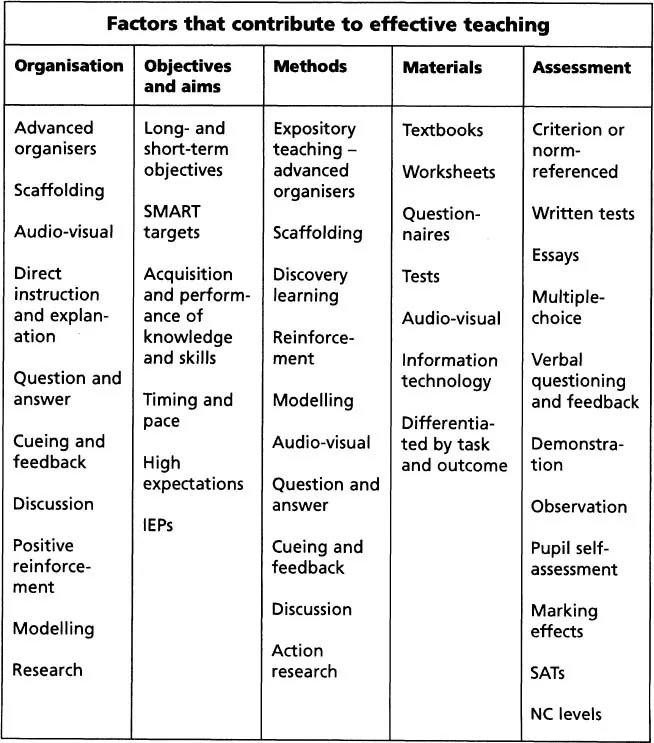
Teachers are recommended to:
• ensure that they are knowledgeable about their curriculum area, have relevant teaching skills, engage in self-appraisal, are empathic and equipped with managerial techniques;
• ensure their lessons are prepared and planned in terms of lesson aims, objectives, content, materials and presentation and are also monitored and evaluated (both in summative and formative terms);
• display effective teaching qualities which include Kounin’s ‘withitness’ (vigilance (1977)), ‘overlapping’ (simultaneous focus on several tasks), ‘smoothness’ (avoiding abrupt transitions) and ‘momentum’ (avoiding a pace that is too slow or too fast);
• ensure that pupils are actually engaged in the learning process, i.e. pupils should be attentive, receptive and feel that the learning is appropriate;
• ensure that there is a balance between exposition and set tasks;
• encourage discovery and experiential learning (use of AVA, role-play, drama and visits), investigations and problem-solving activities;
• use a balance of direct (teacher-structured and organised) and indirect instruction (pupil exercises initiative and responsibility);
• use explanations that are clear, segmented, succinct, interesting, understandable and that elicit feedback;
• use ‘advanced organisers’ and ‘end of lesson reviews’ (Ausubel 1963);
• encourage pupils when appropriate to be both intrinsically and extrinsically motivated;
• ensure that questioning is appropriately targeted, is undertaken using appropriate cues, tone, prompts and pauses, allows feedback and is encouraging and sensitive;
• take account of pupil differences with regard to their ‘ability’, attainment and also underachievement, levels of motivation, gender, ethnicity and special educational needs;
• consider the physical appearance and layout of the classroom and arrange it so that the groupings of pupils facilitate learning, and also consider the effects of setting and streaming on pupils;
• consider the effects of class size on learning and the best use of support staff;
• use appropriately individualised learning programmes (project work, computer-assisted learning and structured work schemes), small-group work (‘collaborative working’ or ‘peer-group tutoring’ in terms of achieving specific tasks or exploration of issues) and whole-class teaching.
Teachers need to be familiar with these recommendations as they can be seen as providing the necessary conditions or bases for teachers to develop effective classroom management. Reduction in pupil misbehaviour can be achieved by implementing these recommendations before considering further specific measures.
Assessment
Assessment is a process that is undertaken with regard to learning and behaviour. It is either criterion or norm-referenced or a mixture of both.
There are various different types of assessment, some of which teachers will not be able to use, but they may come across them in medical, psychiatric or psychological reports. These are neuro-psychological, psychiatric and psychological assessments.
• Neuropsychological assessment uses a combination of brain imaging and tests to detect in children neurological lesions or abnormalities that bring about or contribute to behavioural or emotional problems.
• Psychiatric assessment uses standardised classification systems to diagnose mental or psychiatric disorders. Usually a diagnostic manual is used – either DSM IV or ICD 10. Children are then diagnosed as having a particular disorder, e.g. attention deficit/hyperactivity disorder (ADHD), conduct disorder or separation anxiety disorder. This type of assessment is undertaken through clinical interviews.
• Psychological assessment may use standardised intelligence, reading and personality tests, observation, interviews and rating scales to assess the behaviour and learning of children.
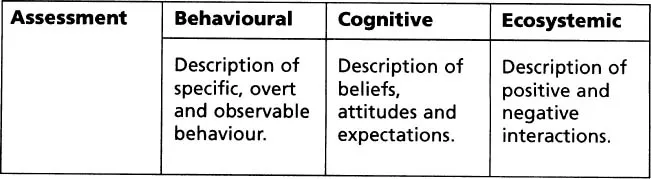
Teachers need to assess the interactions between themselves and their pupils and the interactions between pupils in their classrooms. It is also necessary to assess how the classroom environment, referral and pastoral systems are impacting on their classrooms. The teacher can use behavioural, cognitive and ecosystemic types of assessment, and a general assessment should be undertaken first which will include basic facts about the pupils and the class as a whole including reading ages and National Curriculum levels.
• The aim of behavioural assessment is to describe the specific, overt and observable learning and behaviour of pupils in the class and the antecedents and consequences of behaviours. This can be achieved by using formal and informal observation and the use of behaviour checklists. The ABC, or functional analysis, enables teachers to assess the antecedents and consequences of a given behaviour or the predisposing, precipitating and perpetuating factors that influence behaviour.
• The aim of cognitive assessment is to describe the attitudes and beliefs of pupils towards school, learning, teachers and other pupils. This can be achieved by using structured questionnaires and sociometry.
• The aim of ecosystemic assessment is to describe interactions between teachers and pupils. This can be undertaken through questionnaires that focus on teacher and pupil perceptions of their classroom interactions.
Assessment is undertaken to arrive at a formulation, that is, a statement of why learning and behavioural problems are occurring and why they are continuing.
• A behavioural formulation concentrates on the ways in which pupils’ learning and behaviours are being reinforced and maintained through environmental – in this case classroom – contingencies.
• A cognitive formulation will focus on the ways in which pupils’ learning and behaviours are affected by the attitudes and beliefs they hold about themselves, each other and their teachers. Teachers will need to survey their pupils’ attitudes and expectations with regard to learning and behaviour.
• An ecosystemic formulation will focus on the cycle of positive or negative interactions between teachers and pupils and how these influence learning and behaviour. This requires teachers to engage in self-analyses about their interactions with pupils and to find out from pupils their interpretations of those interactions.
Specifics of classroom management
Task analysis
It is helpful for teachers to undertake task analyses, that is, to plan programmes for pupils that are broken down into their component parts, and that state instructional objectives and skills required of their pupils. The programme should state clear targets, identify the skills required from simple to complex, identify those already available and then proceed, teaching simple skills first.
Expectations
It is also useful for teachers to undertake an analysis of their expectations and those of their pupils.
Teachers develop expectations of their pupils which have a positive or negative impact on their behaviour and/or learning. As indicated in Rosenthal and Jacobsen’s (1968) research, teachers’ expectations may lead to a self-fulfilling prophecy. Particular aspects of pupils – such as their gender, special educational needs and ethnicity – can influence teachers’ expectations.
Pupils’ negative as well as positive expectations should be identified by teachers. These expectations can relate to work, teachers and their peers. Pupils may expect that they will be unable to cope with the work set by teachers or that they will not be able to get on with their teachers or their peers. Peers may exert positive or negative pressure on each other, facilitating or obstructing learning. An anti-learning or behaviourally deviant classroom subculture may develop.
Parental expectations can also influence their children’s behaviour and learning. Parents may have unrealistically high or low expectations of their children’s learning ability, leading their children to feel either under- or overconfident. Teachers should attempt to modify or change parental expectations where necessary.
Planning and teaching
Teachers should develop and implement classroom rules and lesson plans. Classroom rules need to be minimal, positive and have consequences attached, and should be discussed with pupils prior to implementation. Teacher behavioural and learning expectations should be clearly established.
Pupils should be seated so that they can see clearly what the teacher is presenting, so the teacher can see them clearly and so the teacher has easy access to the class. Teaching materials should also be easily accessible.
Pupils should be arranged into small or large groups according to the type of learning required. Small groups are useful for teaching basic skills, particularly to pupils with learning difficulties, as they enable more pupil participation, while large-group teaching is more appropriate for teaching subject content than specific skills.
Where a pupil has learning difficulties with a basic skill teachers should, where possible, provide one-to-one teaching. Peer tutoring is another method of providing this more intensive help to pupils within the classroom. Two pupils are paired in a tutor-tutee arrangement, the aim being to increase the learning but also in some cases the behaviour of the tutee. In order for peer tutoring to be effective, targets and skills should be identified, materials selected, timetables drawn up, procedures established, tutors and tutees trained and progress evaluated.
Cooperative learning involves pupils working together in small groups. This approach places the emphasis on identifying team targets and team success through pupils becoming responsible for the learning of others in the group as well as for their own learning. In order for cooperative learning to be effective, pupils in the group should have a spread of attainments.
Scheduling activities is where teachers plan activities considering such factors as length of tasks, timing of tasks, variety of tasks, difficulty of tasks, preferred and non-preferred tasks, and whether tasks can be completed within lesson time. Activities and teaching materials selected should be differentiated according to the range of ability levels within the class.
Specific approaches to teaching and learning
The behavioural or operant approach
The behavioural or operant approach to teaching exemplified by Skinner (1953) focuses on changing the antecedents and consequences of both behaviour and learning. This approach emphasises techniques such as cueing (providing an antecedent stimulus), prompting (giving another cue after the first) and reinforcement of learning (rewarding an appropriate response). A skill or behaviour can be shaped by reinforcing successive approximations to the target skill or behaviour. This requires a task analysis that breaks down the learning process into small steps.
The cognitive approach
The cognitive approach is exemplified by Bruner, Goodknow and Austin’s (1956) and Ausubel’s (1963) models of learning and teaching.
Bruner focuses on understanding the structure of a subject and the value of active learning and inductive reasoning. Teachers should present problems to their pupils so that their pupils actively explore and discover for themselves the interconnections between subject concepts. Bruner advocates guided discovery for primary and secondary pupils: the teacher provides interes...
Table of contents
- Cover
- Title Page
- Copyright Page
- Table of Contents
- Preface
- 1 Introduction to classroom management
- 2 The concepts of class and group dynamics
- 3 Theoretical approaches and their practical applications to classroom and group management
- 4 Special categories of pupils
- 5 Special topics
- Appendix 1: Case study – a secondary class
- Appendix 2: Customising pro formas
- Appendix 3: Class management forms
- Bibliography
Trusted by 375,005 students
Access to over 1.5 million titles for a fair monthly price.
Study more efficiently using our study tools.
Frequently asked questions
Yes, you can cancel anytime from the Subscription tab in your account settings on the Perlego website. Your subscription will stay active until the end of your current billing period. Learn how to cancel your subscription
No, books cannot be downloaded as external files, such as PDFs, for use outside of Perlego. However, you can download books within the Perlego app for offline reading on mobile or tablet. Learn how to download books offline
Perlego offers two plans: Essential and Complete
- Essential is ideal for learners and professionals who enjoy exploring a wide range of subjects. Access the Essential Library with 800,000+ trusted titles and best-sellers across business, personal growth, and the humanities. Includes unlimited reading time and Standard Read Aloud voice.
- Complete: Perfect for advanced learners and researchers needing full, unrestricted access. Unlock 1.5M+ books across hundreds of subjects, including academic and specialized titles. The Complete Plan also includes advanced features like Premium Read Aloud and Research Assistant.
We are an online textbook subscription service, where you can get access to an entire online library for less than the price of a single book per month. With over 1.5 million books across 990+ topics, we’ve got you covered! Learn about our mission
Look out for the read-aloud symbol on your next book to see if you can listen to it. The read-aloud tool reads text aloud for you, highlighting the text as it is being read. You can pause it, speed it up and slow it down. Learn more about Read Aloud
Yes! You can use the Perlego app on both iOS and Android devices to read anytime, anywhere — even offline. Perfect for commutes or when you’re on the go.
Please note we cannot support devices running on iOS 13 and Android 7 or earlier. Learn more about using the app
Please note we cannot support devices running on iOS 13 and Android 7 or earlier. Learn more about using the app
Yes, you can access Classroom Management by Harry Ayers,Francesca Gray in PDF and/or ePUB format, as well as other popular books in Education & Behavioural Management. We have over 1.5 million books available in our catalogue for you to explore.