eBook - ePub
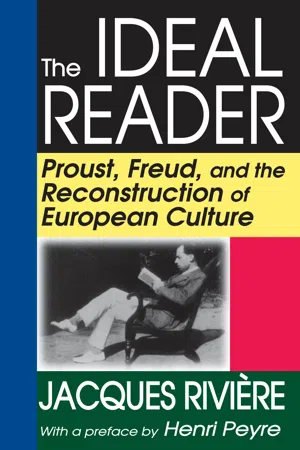
The Ideal Reader
Proust, Freud, and the Reconstruction of European Culture
- 282 pages
- English
- ePUB (mobile friendly)
- Available on iOS & Android
eBook - ePub
About this book
Jacques Riviere knew how to accept art emotionally. No French critic was ever less a traditional pedagogue. Rivibre was an intelligent French writer, who knew that the summit of the intellect is to admit aff ective knowledge, instinct, and intuition. The "heart," or taste, is always superior to raw intelligence.Reviere's supple metaphors are not easily rendered into English. Th e density of his thought, the complexity of his views, the moral and spiritual fervor that vibrates in these pages, further enhances the difficulties the skilled translator must overcome. Literary criticism is often ephemeral; it has served its purpose if it stimulates discussion about the work of art under scrutiny. Not so with essays like these. Th ey demand an active reading, as do the original works themselves. Th ey do not easily yield their signifi cance.Among the critics who came into the French literary scene in the years immediately preceding and following the First World War, Jacques Riviere has been least affected by the attrition of time. His studies of Proust and Rimbaud still rank among the two or three essential works to be read on these authors. Few other critics have gone further in a sensuous perception of these authors' work and the intellectual lucidity in analyzing it. Reviere had few pretensions to profundity and a great purity of style. In an age of slogans and judgments, this volume reminds the reader of the extraordinary role of European critical thought in the twentieth century.
Information
1
Perception
of
New
Trends
of
New
Trends
Foreword
The first group of essays shows Rivière’s keen perception of new trends. As a student of philosophy, he must have known or sensed the changing interpretations of the nature of the human mind which stemmed from the discoveries of Charcot and Janet at the end of the nineteenth century and were being further studied by psychologists abroad. It is quite certain that he had not read the work of Stekel, Rank, and Freud. His discovery of the latter, after the war in late 1921 or early 1922, was one of the great encounters of his intellectual life.
Rivière also saw the need for a new art that would not merely record the new forces, but also explore and interpret them.
“Concerning Sincerity,” dedicated to Jacques Copeau and published in the Nouvelle Revue Française in January 1912, is usually linked with another of Rivière’s essays, “On Faith,” published at the end of the same year. These were both written in a period when Rivière was torn between his hope of regaining religious faith and his conviction that he must remain true to himself. The special interest of the essay lies in its concept of the human “soul,” as Rivière, for lack of a more technical name, terms the totality of psychological personality. He notes the multiple urges of the mind, the ambivalence of feelings, the nonethical character of psychological tendencies, the unifying force in the mind which, by choosing, preserves the identity of the individual.
“The Adventure Novel” appeared in the May, June, and July issues of the N.R.F. in 1913. It proceeds, by induction, from a description of symbolism and the conditions that produced it, to a description of the new conditions and the kind of literature that would be needed to please a new audience. In 1923, Rivière said of this essay: “This article is from 1913, and although I wrote it without having any special book in mind, it appears to me today as the announcement and almost the prophecy of a work that was to see daylight toward the end of the same year: the work of Proust, to be precise.”
“Le Sacre du printemps” is the second of two articles that Rivière wrote about this ballet for the N.R.F. in 1913. He had been delighted with the performances of the Ballet Russe for several years, but his enthusiasm reached a peak when, in 1913, he attended the performance of the Sacre du printemps by Stravinsky, Roerich, and Nijinsky. His first note on the ballet promised a second and longer article in which he would give his reasons for believing in the great importance of this work. This is the promised article.
There is brilliance, excitement, and movement in these early essays of Jacques Rivière. What is sometimes redundant, rhetorical, and metaphorical serves to describe his thought from different angles. Whereas the many restricting phrases translate to some degree the scrupulous and timid love of precision of the young writer, the enthusiastic flow of his words and sentences reveals his daring and accurate appreciation of originality in the arts.
B.A.P.
Concerning
Sincerity
First, a distinction must be made between sincerity toward others and sincerity toward self. We shall not speak of the former. As it is understood in society, it is too easy. (That is probably why it has been made into a virtue.) It consists in never confessing to feelings that the person with whom one is speaking has not been able to foresee; a man is lacking in sincerity toward us when the thoughts he shows us are not those we should have had in his place. Sincerity toward others, as it must be understood, is called confession. But this word awakens so many ideas of such a serious nature that a whole book would be required to develop them.
I
Sincerity toward self is a dangerous virtue. It cannot be recommended; it does not make a man more sociable; it does not ingratiate him with his fellow creatures; it is not one of those good universal duties that molds our tractability. To attempt it, one must be secretly chosen.
It would seem to be sufficient to let oneself go in order to be sincere—not to prevent oneself from feeling, from yielding to one’s spontaneity. We stop being sincere the moment we intervene in ourselves; if I work on myself, I deform myself. Sincerity means yielding to myself, obedience to the natural course of my emotions, an easy inclination, a self-satisfied access to my inner facility. It requires no effort on my part; I shall exercise it by relaxing.
However, it is more exact to say: sincerity is a continuous effort to create one’s soul in its real image. There is nothing more deceitful than what is spontaneous, nothing more foreign to myself. It is never with myself that I begin; the feelings I adopt naturally are not mine; I do not experience them, I fall into them right off as into a rut; they carry me along because they are convenient and reassuring; everybody has already traveled along them; we know where they go; no one has ever come to harm through them. They introduce themselves to my heart right away with their credentials. So clearly do I see advantages in them that I do not dream of doubting their truth. They have just the right amount of declivity to bring me to the level of another person, into agreement with his thoughts; they are calculated to allow conversation. But in spite of these amenities, they have no closer connections with my soul than the formulas of politeness.
My second thoughts are the true ones, those that await me in those depths down to which I do not go. Not the first thoughts alone are thinking in me; in the very depths of myself there is a low, continual meditation about which I know nothing and about which I shall know nothing unless I make an effort: this is my soul. It is feeble and seems almost ideal; it scarcely exists; I sense it as if it were a possible and faraway world. Every man, even those who get along with conventional emotions, is vaguely warned of the depths in himself, vaguely filled with a secret suspicion. There is a faint taste of insufficiency in everything that he experiences; he understands that he could be more authentic than he is, that other more hidden, more astonishing parts of himself could be concerned in the event. But he does not know how to seize this reality which he contains; for it neither invites nor calls to him; and soon he loses even the very desire to find it.
In fact, how my soul disdains me! It is not eager to live, it will make no sign to me. All my feelings, which are still virtual, though already more real than I am, look at me ironically and seem to say: “Will you dare get acquainted with us?” They are enclosed and silent, but not vague; but their terrible precision is slumbering; it is still in imagination. They well know that they can be born only through me: nevertheless they treat me with disdain.
I must spy them out, lay hold of them. Sincerity is a subtle hunt which pursues only silences. It requires an untiring intellectual agility, a pitiless presence of mind. It reigns over all that is silent within me and awakens the necessary feelings. It avoids the most easy ones because they are deceptive; the ones it has to discover are not evident. It tries several paths, and having tried them, turns away from them. It has experience in truth; in other words, it has a hesitant touch which does not make mistakes any more. For each event that befalls me, through a bold, diversified exploration, sincerity assembles all the thoughts I must have; following a mysterious necessity, it composes my soul; with ingenuity, it recognizes the scattered elements of that unedited, strange combination which will be my natural response. Nothing is more unexpected than myself; I should never have imagined such a face. However, when sincerity introduces it to me, I do not for a moment dream of denying it. This is indeed that unknown person I was—and so close to me! How might I have guessed that such opposite, antagonistic feelings could come together and form a single soul so skillfully?
The sincere man is not the one who is always seen bounding forward, always ready to answer, always intimate with his heart and eager to reveal it. The sincere man is not in such a hurry, for he knows how much work he has. He is not a man of first impulses. He does not possess his soul once and for all, he has not learned it by heart. On the contrary, he constructs it anew for every occasion. He doubts, waits, applies himself; he is filled with calculations like a financier; he stops at each level of himself and chooses what he needs to form his truth. Or rather, let us compare him to a fine, joyful hunter who tracks his feelings, follows them, brings them to bay, brings them back. How I like this merry prudence, this lively, tough attention, this contained enthusiasm, this reflective glance from under lowered lids, this smile! Finally he exclaims: “This is what I think!” It is more difficult, more gay to be sincere than to be just.
II
More dangerous, too. Sincerity is not possessed like a piece of property that needs to be thought about only occasionally. If I fail to watch over it for a moment, it turns against me; it makes its evident, pernicious influence felt in my whole soul. This is why it attracts me so strongly: I like active, taut qualities that cannot be left alone for a moment without their beginning to stir, those that are always ready to change into the vices they border on, those that exercise the most intelligent part of my courage; not those that preserve me, but those which consume me.
First I fear that sincerity will take away any faith I have in my feelings. It enters me like a light with a capacity for going around obstacles; it clarifies all my shadows so well that I see my thoughts too perfectly. There is a gleam under each one; someone inside me already knows whence comes the thought, what it wants and looks at it with well-informed eyes; this mysterious double, more informed of myself than I am, is never deceived; however deeply I feel, it has already outdistanced me; it is not unaware of what I am driving at. I must no longer hope in those heavy emotions rising up within me, unknown, laden with wonder, good to discover; no more of those very deep, blind feelings merged with my soul, very close to its foundations. I may no longer suffer at my ease, obscurely and alone. For I have learned to inform myself of everything. One can fight against ignorance, but how can one keep himself from knowing? Consciousness is something that always returns. It lodges in the most unexpected places; sometimes it is so strangely perched that we think we do not perceive it and suddenly we think it has disappeared: now I am truly going to be torn apart! But how does it happen that I have not yet noticed that speck of understanding, that imperceptible raillery choking in the corner of my mind. It says nothing; it need do nothing but stay quiet; it gets the better of me without stirring.
I can escape this first danger of sincerity by force. I need not take this secret knowledge into consideration. Is the spectacle of it any less real because I am present? The sincere man is always a little more true than he thinks. He sees himself, but he is what he sees himself being. O inner division, o interminable scruples! Just the same, I invent nothing; just the same, here I am very guilty and sad; and how is this face, burning with shame, to be composed?
But if I avoid this first danger, another awaits me which I shall not get rid of so easily. I call this danger the integrity of self.
Morality consists in not taking into account certain feelings, in not perceiving them; morality passes by, leaves to one side, knows what must be feared; it is a perspicacious ignorance; it presses upon our bad thoughts before consciousness reaches them and turns us from them. The honest man is the one who does not see the evil of which he is capable; without his knowing it, spontaneously, he governs so that he never encounters it in himself; he even prefers an ugly action quickly buried to admitting a forbidden desire to himself. To be honest is to have only thoughts that can be acknowledged, but to be sincere is to have all thoughts.
All thoughts exist in a soul. Who would dare confess his entire soul at any moment whatsoever to the one who is dearest and closest to him? Two people will live in a close, pitiless union until their death; however, on a certain day, an idea will come to one of them that cannot be confided to the other.
For nothing is impossible within me; there is nothing I have not thought of at least once. A man spoke to me of his wife, whom he loved passionately: “More than once I have wished for her death in the great hope of once again finding that liberty which she took from me, and of once more being ignorant of the future.” And again: “My lowest desire has not spared what I respect most in this world. I have sometimes mingled burning thoughts and the most frightful voluptuousness with the image of a woman whose relationship should have rendered her sacred to me. I have held her body against mine, I have kissed her face with trembling lips, with that mortal despondency of pleasure. I have perhaps not known any beautiful woman to whom I could have spoken all my feelings without shame. However, I am not despicable.” And I add: I harbor not only loves but hatreds which no one dreams of suspecting. The hatred of one who does good to me; it rises abrupt at the very moment when I thank him. A secret rancor because of too sincere a word which has saved me. A ravishing need to let the one I love be lost, when a sign from me would be sufficient to warn him; a desire to trouble his peace simply because I feel that he is not suffering as he stands beside me. Violent attacks of egoism like great cruel inspirations which suddenly make me alone in the world, filled with insult and joy. The long meditation of tiny perfidies whose pricks it would be amusing to try out. Remorse at not having taken advantage of a certain opportunity of doing evil. Calculations so low that it seems as if another were doing them. And in my soul there is also a whole family of ridiculous ideas; they enter sideways like marionettes. They throw themselves across great thoughts like a glance that in the very act of contemplating a vast spectacle, in spite of itself, settles down upon the battered hat of a gentleman who notices nothing. Little misshapen memories of a stupid observation that delight me in spite of myself. A ludicrous wish restrained desperately at the very brink of action; an irresistible desire to flick a finger behind the ear of some stranger who is too serious. The soul is filled with parodies and evil spells; like deep waters, it has its monsters and its clowns. Sincerity draws them up in its net along with the rest of the catch.
I maintain that it is better to know them than to be ignorant of them. A truly great soul will not accept being honest if it means being blindly honest. I consider inner dissimulation, that art of eluding oneself that some would like to have me accept as the primary virtue, to be the most shameful of vices. I hate the fear of self. I shall begin to be worth something only if I start from myself, if I take what I am as the material for my efforts. Therefore, if sincerity disconcerts our moral precautions, I shall not dream of making any complaint against it.
But it can be the source of a more subtle and serious disorder. It augments the importance of all the low thoughts in my soul, of all these wicked jinn, tiny and sly, like little moments of mocking remorse. Sincerity gazes on them one by one and in so doing communicates to them a sort of consecration. Left to their own movement, they would have vanished immediately into deeper and vaster feelings, for their normal direction leads them to extinction. But sincerity protects them against their transitoriness; it takes each one of them, grants it a place, makes a religion of accepting it, almost of respecting it. It protects it against being stifled by the others that dominate it; thus it changes the very essence of the thought which was to flash by in a twinkling of an eye. The soul that it finally forms through equity is very smooth and motionless; its flow has stopped. It is continuously present in every detail. The sincere man no longer dares touch his feelings; he would be ashamed to re-form them, to bend the slightest of them; he thinks he is justifying his acts, stiff and sharp, awkward and cruel, by saying: “I am thus.” He even comes to the point of no longer being able to want to be different. He abdicates all dominion over what his soul proposes to him; he obeys everything in himself without thinking that perhaps his true self would be that one which would subdue his overcomplex inspirations and treat them in an abrupt manner. So he moves imperceptibly away from his true nature because he did not want to neglect any element in it.
We like Stendhal for his bold patience in always exploring himself completely. Never does he encounter any one of his feelings without gaining a thorough knowledge of it. He enters it conscientiously; he goes over it carefully in every direction; he discovers it in passionate and minute detail; he accepts its most comic details as well as its baseness; he undergoes all its calculations. With one feeling, he becomes mean and meddle-some, just as with another, shortly before, he had been magnanimous. Never does he evade any part of himself. However, I cannot like him without some reservations. There is something in him that dampens my enthusiasm; to me he seems to be deformed by that very exercise of sincerity which I admire in him. I see him gradually overcome by isolation, gradually losing communication with events. He is so preoccupied with omitting nothing in the feelings aroused by events that he fails to participate in the events; he extracts from them only what is psychological; they become abstract, indifferent pretexts to him; he asks nothing of them but to set his soul in motion. He is not hired by them; he is not working at their task; he does not know the deep pleasure of using himself, the marvelous forget-fulness enjoyed...
Table of contents
- Cover Page
- Title Page
- Copyright Page
- Contents
- Preface
- Introduction
- 1 Perception of New Trends
- Foreword
- Concerning Sincerity
- The Adventure Novel
- ‘Le Sacre du Printemps”
- 2 Proust and Freud
- Foreword
- The Goncourt Prize
- Marcel Proust and the Classical Tradition
- Marcel Proust and the Positivist Mind
- The Three Main Theses of Psychoanalysis
- A New Orientation of Psychology
- 3 In Defense of Literature
- Foreword
- Concerning a Book on Aesthetics
- In Defense of Intelligence
- “Belphégor”
- Gratitude to Dada
- On Dostoevsky and the Creation of Character
- “Le Bal du Comte d’Or gel”
- An Open Letter to Henri Massis on Good and Bad Sentiments
- 4 Summary
- French Letters and the War
- Notes
Trusted by 375,005 students
Access to over 1.5 million titles for a fair monthly price.
Study more efficiently using our study tools.
Frequently asked questions
Yes, you can cancel anytime from the Subscription tab in your account settings on the Perlego website. Your subscription will stay active until the end of your current billing period. Learn how to cancel your subscription
No, books cannot be downloaded as external files, such as PDFs, for use outside of Perlego. However, you can download books within the Perlego app for offline reading on mobile or tablet. Learn how to download books offline
Perlego offers two plans: Essential and Complete
- Essential is ideal for learners and professionals who enjoy exploring a wide range of subjects. Access the Essential Library with 800,000+ trusted titles and best-sellers across business, personal growth, and the humanities. Includes unlimited reading time and Standard Read Aloud voice.
- Complete: Perfect for advanced learners and researchers needing full, unrestricted access. Unlock 1.5M+ books across hundreds of subjects, including academic and specialized titles. The Complete Plan also includes advanced features like Premium Read Aloud and Research Assistant.
We are an online textbook subscription service, where you can get access to an entire online library for less than the price of a single book per month. With over 1.5 million books across 990+ topics, we’ve got you covered! Learn about our mission
Look out for the read-aloud symbol on your next book to see if you can listen to it. The read-aloud tool reads text aloud for you, highlighting the text as it is being read. You can pause it, speed it up and slow it down. Learn more about Read Aloud
Yes! You can use the Perlego app on both iOS and Android devices to read anytime, anywhere — even offline. Perfect for commutes or when you’re on the go.
Please note we cannot support devices running on iOS 13 and Android 7 or earlier. Learn more about using the app
Please note we cannot support devices running on iOS 13 and Android 7 or earlier. Learn more about using the app
Yes, you can access The Ideal Reader by Jacques Riviere in PDF and/or ePUB format, as well as other popular books in Literature & Literary Criticism. We have over 1.5 million books available in our catalogue for you to explore.