eBook - ePub
Behaviour & Discipline in Schools, Two
Practical, Positive & Creative Strategies for the Class
- 154 pages
- English
- ePUB (mobile friendly)
- Available on iOS & Android
eBook - ePub
Behaviour & Discipline in Schools, Two
Practical, Positive & Creative Strategies for the Class
About this book
First Published in 1999. This handbook is designed to increase teachers' skills in managing pupil behaviour in the classroom. With some adaptations it is intended for use in primary, secondary and special school classrooms. It is suggested that the handbook be used to enable a school to support a process of staff development which is specifically tailored to meet the needs of a particular school.
Information
1
The values that underpin this handbook
The aim of this handbook is to support teachers in the process of developing their skills in managing the behaviour of pupils in the classroom. It presents a simple structure which will help teachers address this potentially complex area. Teachers will bring to this process an asset, their single biggest asset in fact, but one they frequently neither recognise nor appreciate. In short they will bring their knowledge of how teaching and learning takes place and of what needs to happen if this interactional process is to be successful. This is one of the key messages or values* underpinning this handbook. The practical strategies described are supported by a number of other key values. This chapter begins by explaining, in more detail, the nature of the relationship between teaching and learning and managing behaviour. It then describes the other values that underpin the strategies that are recommended. These strategies will be more effectively employed if the reader is aware of the values that support them.
1.1 What teachers know about teaching, learning and the curriculum must be applied to managing pupil behaviour
To write about teaching and learning in a handbook about managing pupil behaviour in the classroom might seem somewhat perverse. Some teachers may not see the link between the two. This is a substantial tactical error. The message is that whatever constitutes good practice in the area of the curriculum must also be good practice in managing pupil behaviour. The text should help teachers think about, as the Elton Report Discipline in Schools (DFE 1989) put it, the process of marginalising bad behaviour by promoting good behaviour. The author is not concerned with describing how teachers might react in a punitive fashion after misbehaviour has occurred, although this is a part of the structure, but rather with the challenge of helping pupils develop and maintain appropriate classroom behaviour. The focus is on describing how good behaviour can be promoted and developed, on how pupils can learn to behave well. As such, it is a handbook about a parallel and integrated behaviour curriculum which complements the ‘academic’ curriculum. The extensive knowledge about how teachers teach and pupils learn can be applied to this challenge.
Because our knowledge is extensive, the association of curriculum and behaviour may appear to make the process of getting good behaviour less rather than more achievable. It has been said that ‘to every complex problem there is a simple solution - and it is wrong’. Perhaps it is more helpful to keep in mind the thought that to every complex problem there are a number of relatively simple solutions that stand a fair chance of being right. The structure of this handbook will help teachers tease out the complexity of the association between curriculum and behaviour and move from this position into a series of practical day-to-day actions. I suggest that there is great comfort in the words of Thomas Harris who wrote the book I’m OK, You’re OK. In 1973 Harris wrote:
A winner takes a big problem
and separates it into smaller parts
so that it can be more easily manipulated;
a loser takes a lot of little problems
and rolls them together
until they are insolvable.
and separates it into smaller parts
so that it can be more easily manipulated;
a loser takes a lot of little problems
and rolls them together
until they are insolvable.
1.2 Psychology has a contribution to make to our understanding of classroom management
Perhaps the idea of ‘winners’ and ‘losers’ sounds a little old-fashioned 26 years later but the basic message remains absolutely relevant. In making sense of the complexity of day to day life in the classroom I have looked to psychology for a structure. As an educational psychologist it is pleasing to make a contribution to supporting the process of developing teachers’ skills in this important area. In an era when the question, ‘What does an educational psychologist do?’ is frequently heard, I welcome the opportunity to identify what our contribution might look like.
I suggest that there are five key areas of psychology which contribute to our understanding of the area of classroom management. Everything the teacher and the psychologist knows about these key areas of teaching and learning can be applied to the process of getting good behaviour in the classroom.
The five key areas are:
- Communication
- Motivation
- Correction
- Organisation
- Experimentation.
The first four areas will probably be recognisable in that they relate, at a very broad level, to the well established notions of what constitutes the basis of good classroom management. These are:
- what expectations does the teacher have of pupil behaviour?;
- how are these expectations reinforced?;
- how is misbehaviour responded to?; and
- how well organised is the classroom to get the behaviour that is expected?
These areas form the basis of Chapters 3, 4, 5 and 6.
1.3 Experimentation is important because we still have much to learn
The fifth area, that of experimentation which underpins Chapter 7, may be less obvious and yet it is equally important. At its simplest, the idea of experimentation needs to be set alongside the other areas because the ‘book is by no means closed’ on what works when managing pupil behaviour. The area of behaviour management offers teachers a golden opportunity to develop their skills - another value that underpins this handbook. There are areas of reasonable certainty but we have a lot left to learn. It can be said with some certainty that effective classroom management will be based on the teacher’s ability to strike a reasonable balance between the art and the science of teaching, between the known and the yet to be known. Perhaps it relates to the notion of ‘man-as-scientist’ engaged in a constant search for understanding, for ever more-effective ways of managing the behaviour of their pupils. The teacher will, in a sense, put the behaviour of their pupils under the microscope, look carefully, interpret what they think they see, act on this hypothesis then consider the results with interest, refine their hypothesis and move on.
Perhaps a richer metaphor is that of the teacher as detective, searching for clues in a crime novel, avoiding red-herrings, forming and testing out ideas, learning and moving on. Perhaps the only difference is that in this novel there is no end to the process of experimentation, no guaranteed guilty party, no ultimate certainties other than the teachers’ joy of continuing to understand and develop strategies to manage the behaviour of the 30 or so pupils who sit in front of them. One message here is not to worry too much about outcomes, which are almost always a disappointment. It is the journey that matters not the destination. The mere fact that the teacher is continually involved in the process of trying to make things better is a measure of success.
To illustrate the idea that there are limited degrees of certainty in managing pupil behaviour, I sometimes ask teachers to imagine ‘a continuum of all human activity’. At one end of the continuum are those activities like painting and sculpture which have few, if any, rules and procedures which must be followed, few certainties. What activities would we put at the other end, the ‘definite’ the ‘absolute’ end? For which areas of human activity may we say with absolute certainty that there is a causal relationship between action and outcome? Where we can say with confidence - ‘if I do this, then this will be the result’? Science, finance, medicine, the law - are these areas of absolute certainty? It would seem not. Death and taxes? Definitely not taxes, perhaps death, I’m not sure. That the sun comes up each day? More likely.
When this question is put to my audiences (as part of presenting my version of classroom management), a popular response is to suggest that mathematics might be an activity having a high degree of certainty within it. And so it does and yet…! Bertrand Russell thought not! He argued with those who regarded mathematics as ‘an obviously successful and unflawed pursuit’. In the book Fermat’s Last Theorem, Russell is quoted by the author Simon Singh (1997) as saying:
‘But’, you might say, ‘none of this shakes my belief that 2 and 2 are 4’. You are quite right, except in marginal cases… the proposition ‘2 and 2’ are 4 is useless unless it can be applied. Two dogs and two dogs are certainly four dogs, but cases arise in which you are doubtful whether two of them are dogs. ‘Well, at any rate there are four animals’, you might say. But there are microrganisms concerning which it is doubtful they are animals or plants. ‘Well then living organisms’, you say. But there are things of which it is doubtful whether they are living or not. You will be driven into saying: ‘two entities and two entities are four entities’. When you have told me what you mean by ‘entity’, we will resume the argument.
If we live in a world where even the proposition that ‘two and two are four’ can be the subject of discussion, then we should be wary of certainties in our attempt to manage the behaviour of the pupils in our classes. While looking out for areas of relative certainty, we need also to be prepared to be creative, to experiment around the considerable edges of this certainty. When dealing with human behaviour, the results are not, and cannot be, entirely predictable. While it may be possible to develop a solid, sensible core to the teaching process, teachers know that they need more, they need the capacity to think on their feet, to be creative and experimental. They need to be constantly searching for better ways of teaching. In an uncertain world we may be certain that there will be times in the classroom when the generally accepted orthodoxy in practice, does not work. Classroom behaviour management systems are interesting and challenging because they can be particularly prone to falling short of expectations. What works in this area of classroom life may be even more elusive than in curriculum areas, especially so for those pupils in the class whose behaviour is particularly challenging, endlessly puzzling. Without a creative, intuitive, experimental component, teaching and learning are always going to fall short, will always disappoint teacher and learner alike.
(The idea of the continuum of certainty of human activity can be used as a warm-up exercise to promote discussion about managing pupil behaviour.)
1.4 Experimentation is closely associated with differentiation
The point about striking a balance between certainty and flexibility has been laboured simply because so many teachers seem consistently seduced by the notion that, in the management of pupil behaviour in the classroom, it is possible to devise and implement systems of management that operate on the grounds of absolute certainty. The message to pupils is - if you commit this crime then this consequence will result, no ‘ifs’ no ‘maybes’, a rule’s a rule, three strikes and you’re out of here, and so on. The concept of zero tolerance, for example, is currently an immensely appealing one outside education as well as within it.
Good practice in the curriculum must constitute good practice in the area of behaviour management because they are both concerned with teaching and learning and a knowledge of what constitutes good practice must be balanced with the willingness to experiment because all is not known. This leads into an interesting and important area of behaviour management - the notion that experimentation relates closely to the practice of differentiation. If differentiation of the curriculum is good practice, then so must be differentiation of the behaviour management system/curriculum. This is an important area for consideration and the teacher’s attitude towards this practice will substantially influence their ability to be successful in managing behaviour in the classroom.
In a handbook about classroom management the concepts of consistency, clarity and certainty are entirely reasonable as guiding principles, but very high levels of consistency or certainty are unhelpful and unachievable and have shaded into inflexibility and rigidity. If this is the case the techniques a teacher must use in the classroom must strike a balance between consistency and flexibility, between certainty and adaptability, between systems and structures and creative problem solving. Systems based on high levels of consistency take unreasonable amounts of teacher time and effort and, most importantly, they do not allow for the degree of differentiation regarded as good practice in the curriculum.
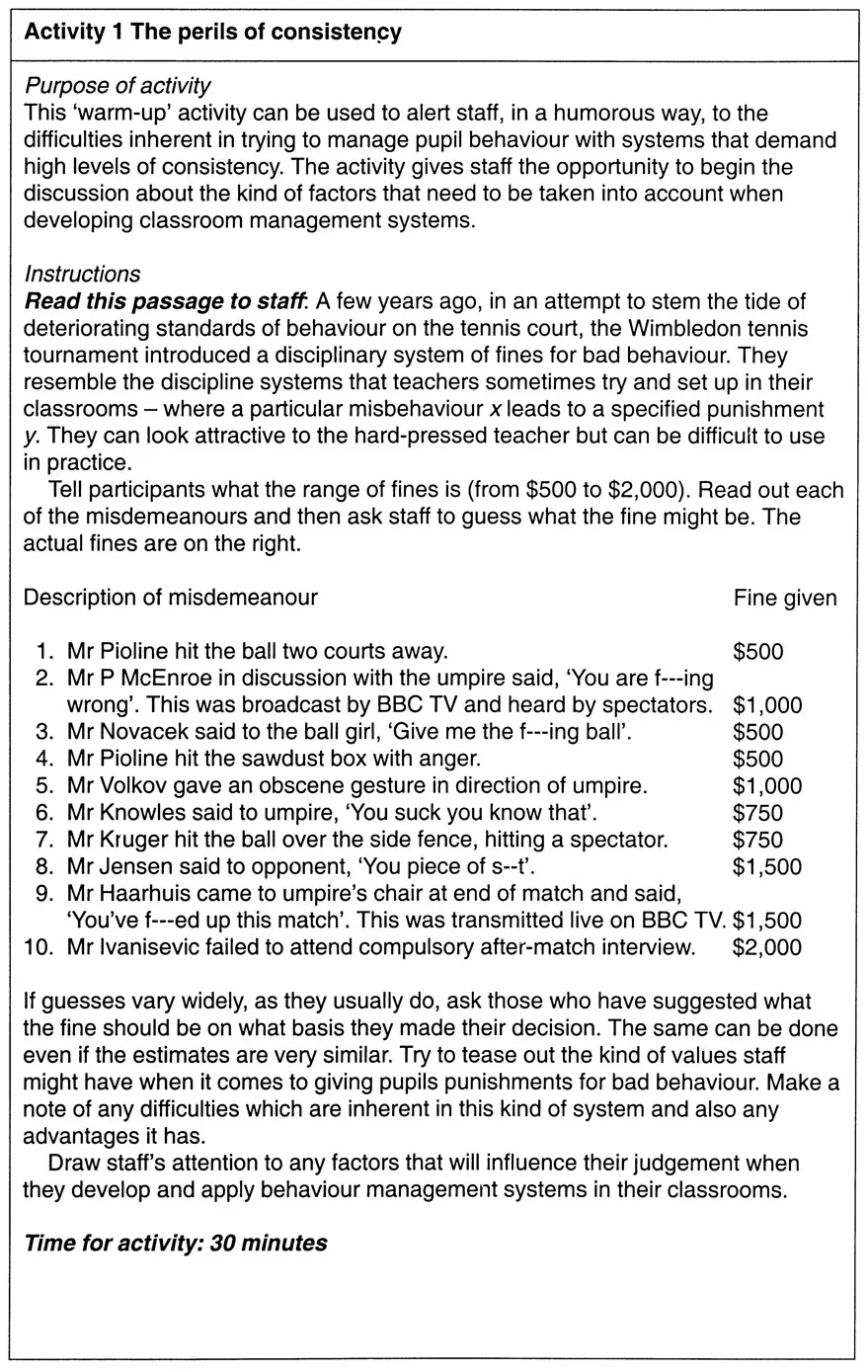
Activity 1 gives teachers the opportunity to discuss, in a light-hearted manner, the perils of high levels of consistency.
1.5 Fairness does not mean everybody getting the same
This is perhaps the greatest challenge in the teacher’s attempts to balance certainty with creativity in the management of pupil behaviour. It is the need to be prepared to differentiate the classroom management system to meet the differing needs of individual pupils and sub-groups of pupils within the class. For some teachers this is a challenging position in that they assume that fairness, in the area of behaviour management, means everybody gets the same. Teachers will, for example, say, ‘I treat everybody the same - boy, girl, young, old, black, white, I see no differences.’ This view makes effective behaviour management just about impossible. Fairness is not about everybody getting the same but rather it is about trying to get everybody to the same place, or at least narrowing the gap. That is the purpose of education, or at least that is one of my values about education. It is not an equal opportunities issue but rather an equal outcomes issue. Equal outcomes means unequal inputs. This is a position accepted quite readily in the area of the curriculum when differentiating the curriculum but is less comfortable in the area of behaviour management because it confuses notions of what is meant by consistency. Pupils are different, teachers do not treat them all the same, nor should they, nor will they. It is more helpful to teachers and pupils if the teacher can from the start ‘factor in’ an acceptable degree of ‘managing difference’ in their system of behaviour management.
It is true that this approach to behaviour management offers more challenges to the teacher than the simple-minded, ‘same for everybody’, ‘three strikes and you’re out’, mentality. The challenge is a worthwhile one. Are we not trying to educate pupils to the view that we live in a world of differences, of people having different needs and that difference is healthy, that we live in a world of unequal opportunity and some people need to have that balance redressed? Life outside of or after school can be a confusing and complex experience for many pupils and now might be a good time to start preparing our pupils for it.
If we are to prepare pupils for a world of uncertainty, we need to develop thoughtful, independent, self-motivated, problem-solving learners who, when faced with a situation they have not encountered before, have the capacity to work out what might be a reasonable course of action. We are not simply educating pupi...
Table of contents
- Cover
- Title
- Copyright
- Contents
- Using this handbook
- 1. The values that underpin this handbook
- 2. Increasing confidence
- 3. Communicating your expectations
- 4. Motivating pupils to achieve expectations
- 5. Correcting mistakes
- 6. Getting organised to get good behaviour
- 7. Managing difficult groups
- Photocopiable handouts
- References
- Index
Trusted by 375,005 students
Access to over 1.5 million titles for a fair monthly price.
Study more efficiently using our study tools.
Frequently asked questions
Yes, you can cancel anytime from the Subscription tab in your account settings on the Perlego website. Your subscription will stay active until the end of your current billing period. Learn how to cancel your subscription
No, books cannot be downloaded as external files, such as PDFs, for use outside of Perlego. However, you can download books within the Perlego app for offline reading on mobile or tablet. Learn how to download books offline
Perlego offers two plans: Essential and Complete
- Essential is ideal for learners and professionals who enjoy exploring a wide range of subjects. Access the Essential Library with 800,000+ trusted titles and best-sellers across business, personal growth, and the humanities. Includes unlimited reading time and Standard Read Aloud voice.
- Complete: Perfect for advanced learners and researchers needing full, unrestricted access. Unlock 1.5M+ books across hundreds of subjects, including academic and specialized titles. The Complete Plan also includes advanced features like Premium Read Aloud and Research Assistant.
We are an online textbook subscription service, where you can get access to an entire online library for less than the price of a single book per month. With over 1.5 million books across 990+ topics, we’ve got you covered! Learn about our mission
Look out for the read-aloud symbol on your next book to see if you can listen to it. The read-aloud tool reads text aloud for you, highlighting the text as it is being read. You can pause it, speed it up and slow it down. Learn more about Read Aloud
Yes! You can use the Perlego app on both iOS and Android devices to read anytime, anywhere — even offline. Perfect for commutes or when you’re on the go.
Please note we cannot support devices running on iOS 13 and Android 7 or earlier. Learn more about using the app
Please note we cannot support devices running on iOS 13 and Android 7 or earlier. Learn more about using the app
Yes, you can access Behaviour & Discipline in Schools, Two by Peter Galvin in PDF and/or ePUB format, as well as other popular books in Education & Classroom Management. We have over 1.5 million books available in our catalogue for you to explore.