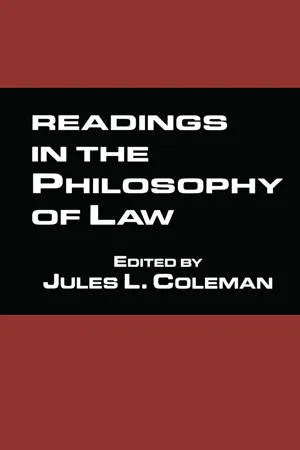
An extraordinary collection of the finest essays in the core areas of legal philosophy, Readings in Philosophy ofLaw is a perfect introduction to the breadth of issues covered in the philosophy of law. The essays are all classic papers chosen as much for their clarity of thought and comprehensiveness as for their distinctiveness and importance to the subject matters of legal philosophy. This collection is ideal for the professional as well as the student, as it brings together classic essays that are not otherwise available in one volume. The reader sees each author's thoughts and arguments unfold naturally within the context of other important works. For breadth of contributions and intellectual rigor, Readings in Philosophy of Law is unrivalled.
- 686 pages
- English
- ePUB (mobile friendly)
- Available on iOS & Android
eBook - ePub
Readings in the Philosophy of Law
Toward Neutral Principles of Constitutional Law †
Herbert Wechsler *
Professor Wechsler, disagreeing with Judge Learned Hand as to the justification for judicial review of legislative action, argues that courts have the power, and duty, to decide all constitutional cases in which the jurisdictional and procedural requirements are met. The author concludes that in these cases decisions must rest on reason- ing and analysis which transcend the immediate result, and discusses instances in which he believes the Supreme Court has not been faith- ful to this principle.
Professor Wechsler, disagreeing with Judge Learned Hand as to the justification for judicial review of legislative action, argues that courts have the power, and duty, to decide all constitutional cases in which the jurisdictional and procedural requirements are met. The author concludes that in these cases decisions must rest on reason- ing and analysis which transcend the immediate result, and discusses instances in which he believes the Supreme Court has not been faith- ful to this principle.
ON three occasions in the last few years Harvard has been hospitable to the discussion of that most abiding problem of our public law: the role of courts in general and the Supreme Court in particular in our constitutional tradition; their special function in the maintenance, interpretation and development of the organic charter that provides the framework of our government, the charter that declares itself the "supreme law."
I have in mind, of course, Mr. Justice Jackson's undelivered Godkin lectures,1 the papers and comments at the Marshall conference,2 and Judge Learned Hand's addresses from this very rostrum but a year ago.3 It does not depreciate these major contributions if I add that they comprise only a fragment of the serious, continuous attention that the subject is receiving here as well as elsewhere in the nation, not to speak of that less serious attention that is not without importance to a university community, however uninstructive it may be.
I should regard another venture on a theme so fully ventilated as a poor expression of appreciation for the hospitality accorded me, were I not persuaded that there is a point to make and an exercise to be performed that will not constitute mere reiteration; and that the point and exercise have special relevancy to the most important of our current controversies. Before I put my point and undertake the exercise it is appropriate, however, that I make clear where I stand upon the larger, underlying questions that have been considered on the previous occasions I have noted, particularly by Judge Hand last year. They have a bearing, as will be apparent, on the thesis that I mean to put before you later on.
† This paper was delivered on April 7, 1959, as the Oliver Wendell Holmes Lecture at the Harvard Law School. It is reproduced without substantial change, except for the addition of the footnotes. The reader is asked to bear in mind that it was written for the ear and not the eye.
* Harlan Fiske Stone Professor of Constitutional Law, Columbia University School of Law. A.B., College of the City of New York, 1928; LL.B., Columbia, 1931.
1 JACKSON, THE SUPREME COURT IN THE AMERICAN SYSTEM OF GOVERNMENT (1955).
2 GOVERNMENT UNDER LAW (Sutherland ed. 1956).
3 HAND, THE BILL OF RIGHTS (1958).
I. The Basis of Judicial Review
Let me begin by stating that I have not the slightest doubt respecting the legitimacy of judicial review, whether the action called in question in a case which otherwise is proper for adjudication is legislative or executive, federal or state. I must address myself to this because the question was so seriously mooted by Judge Hand; and though he answered it in favor of the courts' assumption of the power of review, his answer has overtones quite different from those of the answer I would give.
Judge Hand's position was that "when the Constitution emerged from the Convention in September, 1787, the structure of the proposed government, if one looked to the text, gave no ground for inferring that the decisions of the Supreme Court, and a fortiori of the lower courts, were to be authoritative upon the Executive and the Legislature"; that "on the other hand it was probable, if indeed it was not certain, that without some arbiter whose decision should be final the whole system would have collapsed, for it was extremely unlikely that the Executive or the Legislature, having once decided, would yield to the contrary holding of another 'Department,' even of the courts"; that "for centuries it has been an accepted canon in interpretation of documents to interpolate into the text such provisions, though not expressed, as are essential to prevent the defeat of the venture at hand"; that it was therefore "altogether in keeping with established practice for the Supreme Court to assume an authority to keep the states, Congress, and the President within their prescribed powers"; and, finally and explicitly, that for the reason stated "it was not a lawless act to import into the Constitution such a grant of power." 4
Though I have learned from past experience that disagreement with Judge Hand is usually nothing but the sheerest folly, I must make clear why I believe the power of the courts is grounded in the language of the Constitution and is not a mere interpolation. To do this you must let me quote the supremacy clause,5 which is mercifully short:
This Constitution, and the Laws of the United States which shall be made in Pursuance thereof; and all Treaties made, or which shall be made, under the Authority of the United States, shall be the supreme Law of the Land; and the Judges in every State shall be bound thereby, any Thing in the Constitution or Laws of any State to the Contrary notwithstanding.
Judge Hand concedes that under this clause "state courts would at times have to decide whether state laws and constitutions, or even a federal statute, were in conflict with the federal constitution" but he adds that "the fact that this jurisdiction was confined to such occasions, and that it was thought necessary specifically to provide such a limited jurisdiction, looks rather against than in favor of a general jurisdiction." 6
Are you satisfied, however, to view the supremacy clause in this way, as a grant of jurisdiction to state courts, implying a denial of the power and the duty to all others? This certainly is not its necessary meaning; it may be construed as a mandate to all of officialdom including courts, with a special and emphatic admonition that it binds the judges of the previously independent states. That the latter is the proper reading seems to me persuasive when the other relevant provisions of the Constitution are brought into view.
Article III, section I declares that the federal judicial power "shall be vested in one supreme Court, and in such inferior Courts as the Congress may from time to time ordain and establish." This represented, as you know, one of the major compromises of the Constitutional Convention and relegated the establishment vel non of lower federal courts to the discretion of the Congress.7 None might have been established, with the consequence that, as in other federalisms, judicial work of first instance would all have been remitted to state courts.8 Article III, section 2 goes on, however, to delineate the scope of the federal judicial power, providing that it "shall extend [inter alia] to all Cases, in Law and Equity, arising under this Constitution . . ." and, further, that the Supreme Court "shall have appellate jurisdiction" in such cases "with such Exceptions, and under such Regulations as the Congress shall make." Surely this means, as section 25 of the Judiciary Act of 1789 9 took it to mean, that if a state court passes on a constitutional issue, as the supremacy clause provides that it should, its judgment is reviewable, subject to congressional exceptions, by the Supreme Court, in which event that Court must have no less authority and duty to accord priority to constitutional provisions than the court that it reviews.10 And such state cases might have encompassed every case in which a constitutional issue could possibly arise, since, as I have said, Congress need not and might not have exerted its authority to establish "inferior" federal courts.
If you abide with me thus far, I doubt that you will hesitate upon the final step. Is it a possible construction of the Constitution, measured strictly as Judge Hand admonishes by the test of "general purpose," 11 that if Congress opts, as it has opted, to create a set of lower courts, those courts in cases falling within their respective jurisdictions and the Supreme Court when it passes on their judgments are less or differently constrained by the supremacy clause than are the state courts, and the Supreme Court when it reviews their judgments? Yet I cannot escape, what is for me the most astonishing conclusion, that this is the precise result of Judge Hand's reading of the text, as distinct from the interpolation he approves on other grounds.
It is true that Hamilton in the seventy-eighth Federalist does not mention the supremacy clause in his argument but rather urges the conclusion as implicit in the concept of a written constitution as a fundamental law and the accepted function of the courts as law interpreters. Marshall in Marbury, v. Madison echoes these general considerations, though he also calls attention to the text, including the judiciary article, pointing only at the end to the language about supremacy, concerning which he says that it "confirms and strengthens the principle, supposed to be essential to all written constitutions, that a law repugnant to the constitution is void; and that courts, as well as other departments, are bound by that instrument." 12 Much might be said on this as to the style of reasoning that was deemed most persuasive when these documents were written but this would be irrelevant to my concern about the meaning that Judge Hand insists he cannot find within the words or structure of the Constitution, even with the aid of the historical material that surely points in the direction I suggest.13
You will not wonder now why I should be concerned about the way Judge Hand has read the text, despite his view that the judicial power was a valid importation to preserve the governmental plan. Here as elsewhere a position cannot be divorced from its supporting reasons; the reasons are, indeed, a part and most important part of the position. To demonstrate I quote Judge Hand:
[S]ince this power is not a logical deduction from the structure of the Constitution but only a practical condition upon its successful operation, it need not be exercised whenever a court sees, or thinks that it sees, an invasion of the Constitution. It is always a preliminary question how importunately the occasion demands an answer. It may be better to leave the issue to be worked out without authoritative solution; or perhaps the only solution available is one that the court has no adequate means to enforce.14
If this means that a court, in a case prope...
Table of contents
- Cover
- Title
- Copyright
- Contents
- Introduction
- JURISPRUDENCE
- RIGHTS
- CONSTITUTIONAL LAW AND ITS INTERPRETATION
- CRIMINAL LAW THEORY
- PRIVATE LAW THEORY
Trusted by 375,005 students
Access to over 1.5 million titles for a fair monthly price.
Study more efficiently using our study tools.
Frequently asked questions
Yes, you can cancel anytime from the Subscription tab in your account settings on the Perlego website. Your subscription will stay active until the end of your current billing period. Learn how to cancel your subscription
No, books cannot be downloaded as external files, such as PDFs, for use outside of Perlego. However, you can download books within the Perlego app for offline reading on mobile or tablet. Learn how to download books offline
Perlego offers two plans: Essential and Complete
- Essential is ideal for learners and professionals who enjoy exploring a wide range of subjects. Access the Essential Library with 800,000+ trusted titles and best-sellers across business, personal growth, and the humanities. Includes unlimited reading time and Standard Read Aloud voice.
- Complete: Perfect for advanced learners and researchers needing full, unrestricted access. Unlock 1.5M+ books across hundreds of subjects, including academic and specialized titles. The Complete Plan also includes advanced features like Premium Read Aloud and Research Assistant.
We are an online textbook subscription service, where you can get access to an entire online library for less than the price of a single book per month. With over 1.5 million books across 990+ topics, we’ve got you covered! Learn about our mission
Look out for the read-aloud symbol on your next book to see if you can listen to it. The read-aloud tool reads text aloud for you, highlighting the text as it is being read. You can pause it, speed it up and slow it down. Learn more about Read Aloud
Yes! You can use the Perlego app on both iOS and Android devices to read anytime, anywhere — even offline. Perfect for commutes or when you’re on the go.
Please note we cannot support devices running on iOS 13 and Android 7 or earlier. Learn more about using the app
Please note we cannot support devices running on iOS 13 and Android 7 or earlier. Learn more about using the app
Yes, you can access Readings in the Philosophy of Law by Jules L. Coleman in PDF and/or ePUB format, as well as other popular books in Law & Criminal Law. We have over 1.5 million books available in our catalogue for you to explore.