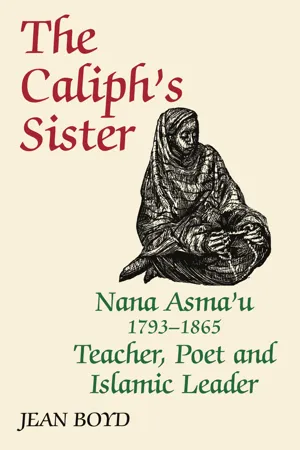
- 192 pages
- English
- ePUB (mobile friendly)
- Available on iOS & Android
eBook - ePub
About this book
A new light is shed on African women of the Sahel in this book about a brilliantly intelligent 19th century woman-jihadist whose legacy of verse contains political and social commentary.
Information
PART ONE
1
ASMA'U'S EARLY LIFE
Nana Asma'u Fodio, a twin, was born in about 17931 in Degel, a small settlement lying 25 miles north-west of Sokoto, which was only an unimportant hamlet in the year of her birth. The twins' father, Shehu dan Fodio, had just returned with his family from an Islamic teaching tour in Zamfara which had occupied him for five years, and where he had written the important book Ihya' al-Sunna which brought him recognition as a great scholar.
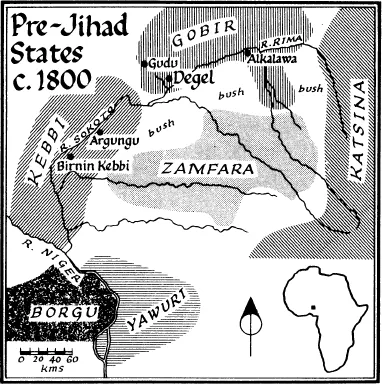
MAP 1
He came from a scholarly family where both men and women were educated. His father Muhammad was known as Fodio (Fodiye in Fulfulde, the language of the Fulani) meaning ‘the learned’, hence the Shehu's own name, ‘dan Fodio’, ‘son of the learned’. His mother, Hauwa and his maternal grandmother Rukayya were also learned and were among the teachers of the community. Two thousand kilometres away in Futa Toro2 there was at least one Mauritanian woman teacher; so women scholars were not unheard of, and there is evidence of notable scholarly women in Timbuktu who had the title ‘Nana’. Nevertheless it is the degree to which women were encouraged to become educated in the Fodio extended family which is unusual and of great interest. Asma'u wrote retrospectively, in 1837, of
Joda Kawuuri, Qur'anic scholar who benefited people in many towns … Yar Hindu the Qur'anic scholar who settled disputes; … Amina Lubel who was acutely intelligent … Aisha saintly and pious … Habiba the teacher of women and a woman of great presence … and many others who had memorised the Qur'an and were of great piety, who preached the beneficial Faith and received great blessings.3
Asma'u's mother, Maimuna, was the Shehu's first cousin: Maimuna's mother and the Shehu's father were brother and sister. However, it seems that Maimuna had been brought up enjoying a degree of freedom which the Shehu thought unwarranted. As a bride she had felt shut in at home and expressed the need to go to the market where she could count on meeting her friends as they came to sell dairy produce in the customary way. The Shehu persuaded her of her folly: he did not accept the habits of his kinsmen and kinswomen any more than he accepted the ways of the Hausa, who comprised the majority of the population. His mission was to revive the sunna (way) of the Prophet Muhammad and to remove customs and innovations which were not sunna. He wrote in Ihya' al-Sunna:
It is obligatory on every learned person not to keep quiet because innovations have appeared and spread … The Hadith says ‘when tribulations appear and the learned one keeps quiet, on him there is the curse of God’ … Most of the people are ignorant of the Shari'a [lawl and it is obligatory … on every faqih [scholar versed in the law]… that they should go out to the people in order to teach them their religion.4
The home into which Asma'u was born, therefore, was unusual: it was unlike the homes of Fulani nomadic herders just as it was unlike those of the sedentary Hausa agriculturalists and merchants. The Shehu as a very young man — he was only about 20 when he married Maimuna — set his own house in order and then made his views known through the Fulfulde poetry which he started writing long before Asma'u's birth.5 In one poem he described what he called ‘the oppressive’ customs of mature married men:
they fail to dress, house and feed their wives adequately, they show favouritism between one wife and another and make unwise and hasty marriages without due thought … They revile their wives … and beat them excessively… they do not educate them and if they divorce them they spread malicious tales about them thereby ruining their chances of remarriage … others refuse to divorce unhappy wives … My goodness! [tir]. All these things are evidence of ignorance.
He went on:
Some women are in trouble … because their husbands think of nothing but sex… some men eat huge meals away from home without caring to know if their wives have enough to eat… they are hot-tempered and when angry refuse to speak to their wives … others never joke happily with them nor do they share their sexual attentions equally amongst them … they sit stroking their beards in contentment outside homes which are little better than hovels … they are hard by nature and fault-finding by disposition … they confine their wives too closely … they neither educate them themselves nor allow them to benefit from being educated by others …A women should protect her honour and stay at home … and show a pleasant and gracious manner to her husband … giving him due respect…
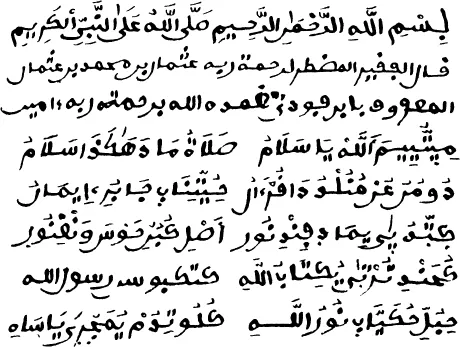
1. A poem by the Shehu dated 1789
accepting any reversal of his fortunes with equanimity … it is compulsory to feed and clothe such a woman and given her her dowry (sadaki). A wife who goes out [without good reason] loses her right to her dowry and cannot claim food and clothing from her husband … Womenfolk take heed! Do not do communal farm work and do not assist in herding … cover yourselves up and spin the thread you need to clothe yourself with… if you go on visits to the tombs of pious saints do not have arguments… and if you have to go to the well to draw water, do not misbehave … if you meet on social occasions do not engage in back-biting gossip … the best thing is to let the men-folk go to the market, but if circumstances compel you to go you must dress in a restrained manner, covering yourself up from head to toe … there is no reason why a wife should not [because of custom] utter the name of her husband or be considered ill-mannered for doing so, nor should she avoid taking her meals with him … Allah sent the Prophet Muhammad to us and we must therefore learn from his example.
One of the pictures which emerges from these poems is of the Shehu's own home, where it seems he enjoyed occasions of relaxed informality with his wives, whom he enjoined to stay at home but who were expected to take advantage of every opportunity to advance their education providing that they dressed in the prescribed way and comported themselves in a sensible manner. In 1793 he had four wives, Maimuna, Aisha, Hauwa and Hadiza, and he already had 21 children, although some of these had died in infancy. Asma'u and Hassan were the 22nd and 23rd of his children; his eldest son Sa'ad was aged 17, and Muhammad Bello, with whom Asma'u was to be so closely associated, was 13.
On the seventh day after their birth the twins Hassan and Asma'u were carried into the entrance hall of the Shehu's home, and in the presence of friends and relatives their names were announced and prayers offered that they would grow up in the Faith. Hassan was given the name of the Prophet's twin grandson; Asma'u the name of the girl who took food to the Prophet when he was a fugitive in hiding — an unusual choice, because it is more traditional to name all twins, male and female, after the historical Hassan and Hussain. Maimuna's children did not thrive well; eight of her 11 children failed to reach adulthood, a surprisingly high number. In contrast, in the same household, all of Hauwa's five children survived.
When Asma'u was very young, Maimuna died and so did the Shehu's fourth wife Hadiza. He remarried because it was his custom always to have four wives: Jumbajjo, Hafsatu, Hajo, Ta-Baraya and Asma'u Fure all had their place in the years 1796–1805 but none had children by him and none had the permanence of Aisha and Hauwa who in all bore 16 children and eventually outlived their husband. Aisha was known as Iya-garka, Hauwa as Inna-garka, to distinguish them from the many other Aishas and Hauwas in the community: both iya and inna mean ‘mother’ and garka, in this context, evidently referred to the Shehu's house. Aisha and Hauwa were buns (ascetics; wno reached the nign-est ranks in the Sufi hierarchy and lived lives of great asceticism. For Asma'u ‘Aisha was saintly and pious, ceaselessly keeping to the path of Allah’, and ‘Hauwa practised almsgiving to the extent that she possessed very little of her own: she meditated in solitude in her room, saying her prayer-beads, keeping silence, indicating replies with her head’. These two women brought up Asma'u in their rooms where prayer, contemplation and...
Table of contents
- Cover Page
- Half Title page
- Title Page
- Copyright Page
- Dedication
- Contents
- Figures
- List of Maps
- Acknowledgements
- Preface How this book came to be written
- An Introductory Note
- Part One Part One
- Notes
- Part Two A Brief Overview of Nana Asma'u's Works
- Glossary of Arabic, Fulfulde, Hausa and other terms
- An Outline Chronology
- Bibliography
- B. Manuscripts
- Index
Trusted by 375,005 students
Access to over 1.5 million titles for a fair monthly price.
Study more efficiently using our study tools.
Frequently asked questions
Yes, you can cancel anytime from the Subscription tab in your account settings on the Perlego website. Your subscription will stay active until the end of your current billing period. Learn how to cancel your subscription
No, books cannot be downloaded as external files, such as PDFs, for use outside of Perlego. However, you can download books within the Perlego app for offline reading on mobile or tablet. Learn how to download books offline
Perlego offers two plans: Essential and Complete
- Essential is ideal for learners and professionals who enjoy exploring a wide range of subjects. Access the Essential Library with 800,000+ trusted titles and best-sellers across business, personal growth, and the humanities. Includes unlimited reading time and Standard Read Aloud voice.
- Complete: Perfect for advanced learners and researchers needing full, unrestricted access. Unlock 1.5M+ books across hundreds of subjects, including academic and specialized titles. The Complete Plan also includes advanced features like Premium Read Aloud and Research Assistant.
We are an online textbook subscription service, where you can get access to an entire online library for less than the price of a single book per month. With over 1.5 million books across 990+ topics, we’ve got you covered! Learn about our mission
Look out for the read-aloud symbol on your next book to see if you can listen to it. The read-aloud tool reads text aloud for you, highlighting the text as it is being read. You can pause it, speed it up and slow it down. Learn more about Read Aloud
Yes! You can use the Perlego app on both iOS and Android devices to read anytime, anywhere — even offline. Perfect for commutes or when you’re on the go.
Please note we cannot support devices running on iOS 13 and Android 7 or earlier. Learn more about using the app
Please note we cannot support devices running on iOS 13 and Android 7 or earlier. Learn more about using the app
Yes, you can access The Caliph's Sister by Jean Boyd in PDF and/or ePUB format, as well as other popular books in Social Sciences & Social Science Biographies. We have over 1.5 million books available in our catalogue for you to explore.