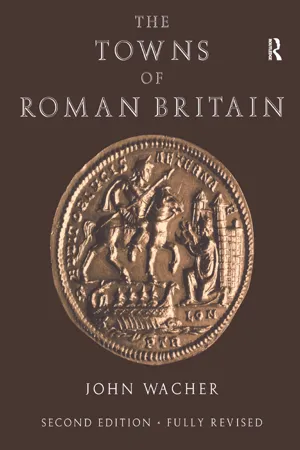
This edition of the text has been rewritten and re-illustrated to take account of the extensive new excavations and interpretations that have taken place since the book was first published twenty years ago. The central section of the text covers the origin, development, public and private buildings, fortifications, character and demise of each of the twenty-one major towns of the province: the provincial capital of London; the coloniae - Colchester, Lincoln, Gloucester and York; the first civitas capitals - Canterbury, Verulamium and Chelmsford; from client kingdoms to civitas - Caister-by-Norwich, Chichester, Silchester and Winchester; Flavian expansion - Cirencester, Dorchester, Exeter, Leicester and Wroxeter; and Hadrianic stimulation - Caerwent, Carmarthen, Brough-on-Humber and Aldborough. The introductory chapters address the general questions of definition and urbanization, while the concluding chapter examines the reasons for the decay and final demise.
There are three types of town to be considered in this book. They are those which had a certain status as administrative centres and were therefore genuinely urban in ancient eyes: they can be classified as coloniae, municipia and the planned vici which became civitas capitals.
During the later years of the Republic it had become the custom often to give allotments of land to retiring legionaries. Augustus introduced the practice of cash gratuities, although land allotments were still made. In order to regulate these grants when a large number of men were discharged in the same area simultaneously, special towns called coloniae were founded from time to time as acts of government policy; each legionary would receive a plot of land in the town together with another in the territorium, the country surrounding the town and attributed to it, the size of the plots depending on rank. The population of a colonia was essentially of Roman citizens, although a non-Roman element, called incolae, was sometimes present as well. On foundation these towns probably received a ‘charter’ (lex coloniae) from the central government (but see Chapter II, footnote 4, p. 36), and their institutions and administration were based on those practised in early imperial Rome itself. In AD 49, the first colonia in Britain was established at Colchester for veterans of one or perhaps more of the legions then serving in the province. It is unlikely that this, the colonia (Claudia?) Victricensis (p. 112), was deliberately intended to be the provincial administrative capital of Britain; a variety of factors prevented it from adequately fulfilling this function and it was soon replaced by London (p. 82). Later in the first century two more coloniae were founded: supposedly between AD 96 and 98 at Gloucester (colonia Nervia Glevensium) for veterans of Legio XX Valeria Victrix or Legio II Augusta (p. 150), and, probably slightly earlier, at Lincoln (Lindum colonia) for veterans of Legio IX Hispana (p. 132). It should be noted that all three occupied the actual sites of earlier legionary fortresses, so that their foundation would primarily have involved land which had been expropriated by the government, and was already imperial property.
Apart from establishing coloniae as new towns, it was also the practice to promote existing settlements which would then be constituted into communities organized on the Roman model. This had been done extensively by Julius Caesar in Gallia Narbonensis, and ultimately it became a fairly common practice to upgrade tribal towns and some other vici to the rank of municipium, followed perhaps by promotion later to colonia. At York, an extra-mural settlement, probably distinct from the canabae, had grown on the opposite bank of the River Ouse to the legionary fortress. It is known to have been a colonia by AD 237, but it is likely that the act of promotion was made earlier by Septimius Severus in the first decade of the third century (p. 167). What is not known for certain, however, is whether the grant of colonial status had been preceded, at some time in the second century, by intermediate promotion to a municipium, as often happened elsewhere in the Empire.1 A reference by Aurelius Victor, in his account of the death of Severus, describes it as such, but it is not entirely reliable.2
Another town which may have been treated in the same way as York was the provincial capital of London (p. 90). While there is no epigraphic evidence relating to its civic status, it would seem inconceivable that a site which became one of the largest towns in the western Empire, which, from about AD 60, became the headquarters of the imperial procurator, and, by the early second century at latest, had become the seat of the provincial governor, and which had a fort specially provided for soldiers attached to the governor’s staff, should not have received a ‘charter’. The most likely suggestion to make, in the absence of detailed evidence, would be that it became a municipium in the first or early in the second century, followed by promotion to a colonia perhaps in the late second or early third century to account for the additional title of Augusta, which it is known to have held by the fourth.
It will have been gathered from the paragraph above that a municipium, although still a ‘chartered’ town, was lower in rank than a colonia. There were, however, additional differences, as municipia could either have full Roman rights or only Latin rights and, in addition, could retain some native laws alongside the ius civile of Rome. The former were towns inhabited mainly by Roman citizens, and therefore differed only in degree from coloniae, although it should be remembered that some coloniae had no more than Latin rights. But promotion to municipal status with only Latin rights could be achieved by an existing town whose inhabitants were predominantly non-citizens. Citizenship would, however, be given to the town’s magistrates, together with their families, so in time the number of citizens might be expected slowly to grow. From the second century, grants were also made in which citizenship might be conferred on the whole council in addition to the magistrates.
Verulamium is the only town in Britain for which there is some evidence suggesting the grant of a municipal ‘charter’, probably with Latin rights (p. 219). Although it probably received its ‘charter’ in the first century, the precise date is not known. According to Tacitus it was a municipium at the time of the Boudiccan rebellion in AD 60,3 and Frere has suggested4 that promotion was given under Claudius. However, he argues else-where5 that the physical indication of the higher classes of a self-governing community, at least in Britain, was the possession of a forum with basilica, and it is known that these buildings at Verulamium date to the early Flavian period.6 Was there an earlier forum, not yet touched by excavation, perhaps smaller in size than the later, and of timber, which had been burnt by Boudicca and which was being rebuilt, like some other parts of the town, after a considerable delay, or was the promotion perhaps not given until early in Vespasiari’s principate? Rivet suggested that Tacitus may have been using the word anachronistically7 of a town which was a municipium by the time he was writing, but not at the time of the event he was writing about. It must be admitted that, even given very rapid development of the town in the first few years after the conquest, there cannot, under Claudius, have been a great deal in existence to promote. It might be better to consider that municipal status was conferred by Vespasian on a definite, established town, as was usually the case, than by Claudius on a town in embryo.8 It is also known that Vespasian was responsible for urban promotions on other provinces, Aventicum being but one example. He was especially active in Spain, where he granted Latin status to all communities not hitherto promoted.
It would be surprising if some other towns in Britain had not been equally promoted in later years. Some indeed may have been, but the evidence is slight and unsatisfactory. In the Antonine Itinerary, a route-list compiled for official purposes in the early third century, the majority of civitas capitals are listed, together with their distinctive tribal suffixes, such as Venta Silurum (Caerwent). There are, however, a small number which lack these suffixes: Verulamium, Canterbury, Dorchester, Leicester and Wroxeter, and this is sometimes considered as a pointer to promotion. Since Verulamium is included, there may be some substance in the suggestion, as we have seen that it was probably a municipium. It should be noted that Cirencester is unfortunately omitted from the list altogether, but there are other reasons which might suggest that it too had received promotion (see p. 314).
Normally a municipium, like a colonia, would have a territorium attributed to it. Unfortunately in Britain there is no evidence for the size of these land allotments. Rivet has drawn attention to the fact that the chief concentrations of villas tend to lie in areas adjacent to fortified ‘small towns’ and not in the areas around civitas capitals.9 He goes on to suggest that the land around the capitals was worked actually from the towns, which is a distinct possibility. But it could mean only that this land was organized in larger estates, and larger estates could mean fewer and more widely scattered villas.
We have so far used ‘town’ to describe the first two classes of sites of which we are writing: coloniae and municipia. It remains to justify its use for the third class, the civitas capitals, or planned vici, and it is here that confusion can arise because of misconception.
The word ‘town’ as applied to settlements in Roman Britain has become synonymous with fortified places of civilian character.10 This umbrella definition, though popular, leaves much to be desired. In the Roman world the nearest equivalent, oppidum, has no strict legal meaning. ‘Town’ can, therefore, be used to cover everything urban, or else artificially restricted to that class in the hierarchy below the chartered coloniae and municipia (usually now more appropriately called cities), i.e. the civitas capitals. Unfortunately, the habit is gradually creeping in whereby the latter are also called cities, despite the very clear-cut legal distinction between them and the chartered towns. This problem of definition is not helped by contemporary Greek and Latin authors being equally imprecise in their use of terms. Ptolemy described many sites in Britain, including hill-forts, as πολεις (cities), while Pliny refers to them as oppida (towns), when few can have had higher legal status than that of vicus or village. This difficulty becomes even more acute when comparing civitas capitals with so-called ‘small’ towns, and the latter with unfortified nucleated civilian settlements of similar or even larger size. There seems no good reason why a settlement covering no more than a few acres, but bounded by a defensive bank or wall, should be called a town, when one undefended, of similar or perhaps greater size, is not. The meaning of ‘small’ town has recently been clarified elsewhere, probably as far as it can be on present evidence,11 with distinctions being drawn between it and lower grades of settlement, for which the word village is not inappropriate. Yet such distinctions are somewhat artificial, since in the Roman world all would legally have been classed as vici, as would also most of the civitas capitals.
What then is the difference between a civitas capital and a ‘small’ town, given that both probably at first possessed the same legal status? As far as the provinces of Gaul, Germany and Britain were concerned, the principal distinctive element was planning, with the civitas capitals possessing, almost from their first foundation, a regular pattern of streets usually set at right-angles to one another, in marked contrast to most ‘small’ towns, where the street systems grew in an uncoordinated and haphazard manner. Other, less clearly marked differences also existed, such as an administrative function and the possession of a level of amenity which was seldom found in the ‘small’ towns; but these will be considered more fully below (p. 33).
The establishment of civitas capitals in Britain to act as the administrative centres for local government closely followed the pattern already established by the Romans in Gaul. Most of the newly constituted civitates were formed from Iron Age tribal groups. The selection of a site as the centre for a civitas may therefore be seen as a deliberate act, involving the choice of what was either a pre-existing native centre or a newly formed village outside a fort. Moreover, it was probably the residence of the most important tribal leaders. Since they were already there, it is not surprising which site was the obvious choice for an administrative capital when the time came. Subsequently, development was chiefly left to the inclinations of the natives, although some governors, notably in the Flavian period, pursued a more active policy of Romanization and showed greater concern over the rate of progress.12 The chief physical difference therefore between a vicus which grew for purely economic reasons and one selected for development as a civitas capital is likely, as noted above, to be in planning. It is obvious from the plans of those British capitals which are known that conscious efforts were made from the first to produce towns cast in the Mediterranean mould, even if the final result fell short of expectations. These plans contrast sharply with the haphazard and piecemeal development of the ‘small’ towns and villages.13 The evidence for coordinated planning provided by civitas capitals entitles them to be called towns, even if their earliest legal status was still that of a vicus. Indeed, some recent studies have attempted to show that Roman systems of land measurement, employing either the pes monetalis or the pes Drusianus, were used in laying out not only the street grid, but also some of the principal buildings, in a number of towns.14 Apart from planning, these ‘developed’ vici were also conceived, probably not consciously, as towns which possessed certain functions: administrative and political, protective, economic and educational, while also containing provisions for the amenities that were considered an essential part of Roman urban life. For the latter, Mediterranean usage was probably adapted to a newly conquered and largely unRomanized province.
But it can be argued that even ‘small’ towns often possessed one or more of these functions; they were undoubtedly economic and protective, while some may also have played a part in provincial or local administration. To arrive, then, at a definition of a town that includes the civitas capitals but excludes ‘small’ towns and lesser settlements in the urban hierarchy, it is necessary to strip away all points of similarity and concentrate on the true differences. Reduced to essentials, these are coordinated planning, as noted above, and the provision of amenities. Most civitas capitals possessed a public bath-house, while many had colonnaded or arcaded streets, covered as well as open-air markets, a supply of ru...
Table of contents
Cover
Half Title
Dedication
Title Page
Copyright Page
Table of Contents
Acknowledgements
List of Illustrations
Preface to Second Edition
Introduction
1 What were towns and how did they develop?
2 What part did towns play in the province?
3 Towns as provincial capitals: London
4 The coloniae: Colchester, Lincoln, Gloucester and York
5 The first civitas capitals: Canterbury, Chelmsford and Verulamium
6 From client kingdom to civitas: Caistor-by-Norwich, Chichester, Silchester and Winchester
7 Flavian expansion: Cirencester, Dorchester, Exeter, Leicester and Wroxeter
8 Hadrianic stimulation: Caerwent, Carmarthen, Brough-on-Humber and Aldborough
9 Town-life or life in towns?
Abbreviations used in the Notes and Bibliography
Notes
Bibliography
Index
Trusted by 375,005 students
Access to over 1.5 million titles for a fair monthly price.
Study more efficiently using our study tools.
Frequently asked questions
Yes, you can cancel anytime from the Subscription tab in your account settings on the Perlego website. Your subscription will stay active until the end of your current billing period. Learn how to cancel your subscription
No, books cannot be downloaded as external files, such as PDFs, for use outside of Perlego. However, you can download books within the Perlego app for offline reading on mobile or tablet. Learn how to download books offline
Perlego offers two plans: Essential and Complete
Essential is ideal for learners and professionals who enjoy exploring a wide range of subjects. Access the Essential Library with 800,000+ trusted titles and best-sellers across business, personal growth, and the humanities. Includes unlimited reading time and Standard Read Aloud voice.
Complete: Perfect for advanced learners and researchers needing full, unrestricted access. Unlock 1.5M+ books across hundreds of subjects, including academic and specialized titles. The Complete Plan also includes advanced features like Premium Read Aloud and Research Assistant.
Both plans are available with monthly, semester, or annual billing cycles.
We are an online textbook subscription service, where you can get access to an entire online library for less than the price of a single book per month. With over 1.5 million books across 990+ topics, we’ve got you covered! Learn about our mission
Look out for the read-aloud symbol on your next book to see if you can listen to it. The read-aloud tool reads text aloud for you, highlighting the text as it is being read. You can pause it, speed it up and slow it down. Learn more about Read Aloud
Yes! You can use the Perlego app on both iOS and Android devices to read anytime, anywhere — even offline. Perfect for commutes or when you’re on the go. Please note we cannot support devices running on iOS 13 and Android 7 or earlier. Learn more about using the app
Yes, you can access The Towns of Roman Britain by John Wacher in PDF and/or ePUB format, as well as other popular books in Social Sciences & Archaeology. We have over 1.5 million books available in our catalogue for you to explore.