- 218 pages
- English
- ePUB (mobile friendly)
- Available on iOS & Android
eBook - ePub
About this book
A consideration of the role of the midwife in childbirth, which currently stands at the point of divergence between two differing philosophies of childbearing. In one, pregnancy and birth belong to the medical profession, in the other it is a part of the experience of ordinary life.
Information
Chapter One
What Is a Midwife?
In 1961, the International Confederation of Midwives, the International Federation of Gynecologists and Obstetricians, and the World Health Organization (WHO) jointly defined a midwife. They wrote:
A midwife is a person who, having been regularly admitted to a midwifery educational programme, duly recognized in the country in which it is located, has successfully completed the prescribed course of studies in midwifery and has acquired the requisite qualifications to be registered and/or legally licensed to practise midwifery. She must be able to give the necessary supervision, care and advice to women during pregnancy, labour and the postpartum period, to conduct deliveries on her own responsibility and to care for the newborn and the infant. This care includes preventive measures, the detection of abnormal conditions in mother and child, the procurement of medical assistance and the execution of emergency measures in the absence of medical help. She has an important task in health counselling and education, not only for the patients but also within the family and the community. The work should involve antenatal education and preparation for parenthood and extends to certain areas of gynaecology, family planning and child care. She may practise in hospitals, clinics, health units, domiciliary conditions or in any other service.
Behind this joint definition lie slightly different definitions of midwifery in different countries. The Swedish definition, for example, states:
A midwife is a person who is qualified to practice midwifery. She is trained to give the necessary care and advice to women during pregnancy, labor, and the postnatal period, to conduct normal deliveries on her own responsibility, and to care for the newly born infant. At all times, she must be able to recognize the warning signs of abnormal conditions that necessitate referral to a doctor, and to carry out emergency measures in the absence of medical help. She may practice in hospitals, health units, or domiciliary services. In any one of these situations, she has an important task in health education within the family and the community, family planning and child care.
The definition in the Federal Republic of Germany specifies that “the practice of midwifery includes advice and assistance to pregnant women, supervision and assistance during delivery and miscarriage, as well as care of lying-in women and newly born infants.” It is stressed that the midwife must deal only with normal situations. In Italy, the midwife is also responsible for “the surveillance of a mother and her child until the latter has attained the age of three years.”
Although the wording and the specified period of care differ, the message is clear: the midwife gives independent care to women who have normal pregnancies and births. Beyond these official definitions of the midwife’s role, there are other important ways of describing her significance to birthing women. For example, Professor G. J. Kloosterman, former director of the Midwifery School in Amsterdam, says, “Throughout the world, there exists a group of women who feel mightily drawn to giving care to women in childbirth. At the same time maternal and independent, responsive to a mother’s needs, yet accepting full responsibility as her attendant, such women are natural midwives. Without the presence and acceptance of the midwife, obstetrics becomes aggressive, technological and inhumane.”
Crucial to the definition of the midwife as the person responsible for giving care to normal childbearing women is the idea that this care consists of emotional support as well as technical skills. This central idea is developed in the book Spiritual Midwifery (1980) by the American lay midwife Ina May Gaskin, who says:
We have found that there are laws as constant as the laws of physics, electricity or astronomy, whose influence on the progress of birth cannot be ignored. The midwife … attending births must be flexible enough to discover the way these laws work and learn how to work within them. Pregnant and birthing women are elemental forces, in the same sense that gravity, thunderstorms, earthquakes and hurricanes are elemental forces. A midwife … needs to understand about how the energy of childbirth flows—to not know is to be like the physicist who does not understand about gravity.
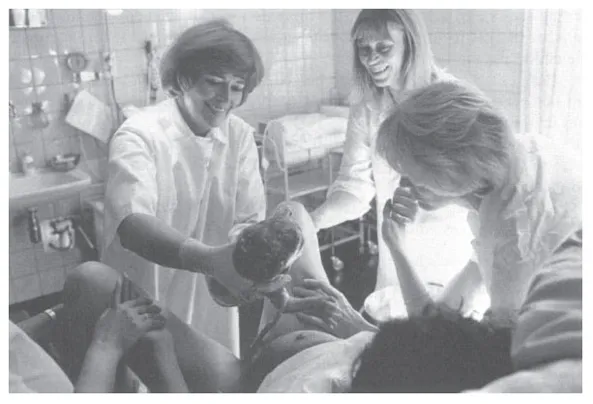
Figure 1 Danish midwife. (Photo by Jo Selsing.)
A Danish midwife writes that “the midwife must know herself, so that she knows what is going on between the woman, the man and the child. It’s easiest if she knows them from the beginning of the pregnancy. She needs to help the woman and the man, making sure that they have just as much help in the postpartum period as they did before and during the birth. They must have peace to get to know the baby and each other in the new situation. This situation is new with every new child that is born.”
The key phrases are: to know oneself, know the family, give people space to know one another. A midwife can judge a couple’s security with each other and their commitment to the child, both before and after it is born. During the labor, they do not need to be constantly told how far the birth has progressed; they are in the process, it belongs to them. They want the midwife and other helpers to join them in this. They want to receive help from them if problems develop, but they are fully aware that they themselves are closest to the child. The midwife has important work to do in the circle around the family. She can see for herself when she needs to go into this inner circle, when others should enter, and when to pull out of the circle again. She is the connection, the person who can get help from outside when necessary. There are different ways of getting such help. For example, the midwife can call someone she knows will help her in a difficult situation. Whatever she does must be best for the mother, the child, and the father.
Besides this, the midwife must be good at her work. The best tools she has are her hands, then her senses (smell, sight, and hearing). Intelligence helps, and intuition is a must.
Another midwife says, “The midwife is a servant, not a goddess. She’s there to serve you and to bring her skills and knowledge, but, beyond that, it’s not her business. The birth belongs to the parents.”
What do parents think of midwives? These are the feelings of some parents about the midwives who have helped them:
A midwife is there to support you and help you.
Our midwife told us all the time what she was doing, and that gives you such a feeling of safety.
A midwife has no routines… . she is in the situation and responds to it individually, and that makes you feel secure.
For me, the midwife was everything… . She was the one I gave birth together with, she was the one I listened to. In a way, I had nothing to say myself, because my body gave me the messages I needed; I followed the needs of my body. My midwife (whom I knew) gave answers and help according to my body’s needs. I was my body, it was she who did the physical things… . To give birth with a midwife I did not know already—I could not imagine that.
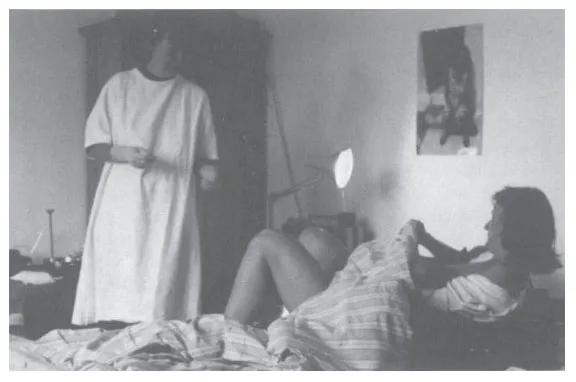
Figure 2 Danish home birth.
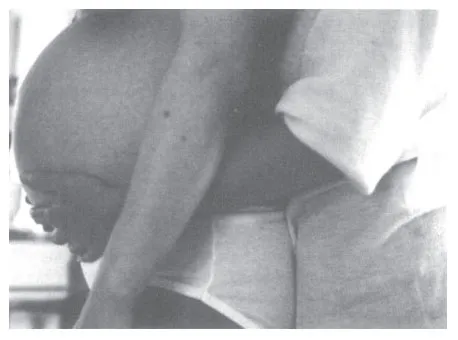
Figure 3 Midwife’s hands
These individual reactions identify key elements in the role of midwives today and in the past: personal support, continuity of care, sensitivity to the mother’s needs. These values are emphasized in more systematic surveys of patient satisfaction. Looking at the North American literature on nurse-midwifery in a study for the U.S. Office of Technology Assessment, Brooks found that mothers readily identify greater ease of communication, and more “patient” control over labor and delivery, as characteristics of midwife care. Women also say that midwives keep their clients waiting for much shorter times than physicians, on average. Women having babies share with all social groups a tendency to be satisfied with the status quo, so that this fact has to be remembered when making sense of the literature on patient satisfaction. Yet what stands out is that women are more likely to feel satisfied and confident about the care given by midwives than about that given by doctors. In North America, these differences in women’s attitudes are reflected in the much lower incidence of malpractice suits for nurse-midwives. A national survey in the United States in 1982 found that 5 percent of certified nurse-midwives, compared with 31 percent of obstetricians, admitted having been sued at some time (20 percent of obstetricians had been sued at least three times).
Midwives on Midwifery
Elisabeth Davis, a California midwife, writes, “Midwifery is a way of life, both grueling and transformative. The continual learning on high levels has definite effects; after a year or so of practice comes the discovery that midwifery is a whole lot more than the joy of catching babies. It makes us work on all levels, either by disintegrating or integrating us.” A West German midwife says, “My work means everything to me, and I hope that none of the women that I help gets the feeling she is just a number. I must help them to experience birth as the greatest, most natural experience that exists.”
Midwifery can be an extremely exhausting occupation. In my (Susanne Houd) own work as a midwife during a time when I was constantly on call for home births, I wrote:
When I work like this, I must have two kinds of readiness: one is a daily readiness; I have to be ready with everything practical. This reminds me of my own pregnancies, when everything had to be ready all the time. Now, arrangements for my children have to be 100% secure, because of my work as a midwife. When I’m home, I spend as much time together with them as possible. I can never promise anything in the future, only what I can do here and now. I feel it is very important that my children don’t get allergic to births.
I can’t begin big projects. I have to be rested all the time. My love life suffers. It’s difficu...
Table of contents
- Cover
- Half Title
- Title Page
- Copyright Page
- Table of Contents
- Foreword
- Preface
- Chapter 1. What Is a Midwife?
- Chapter 2. Midwives in History
- Chapter 3. What Do Midwives Do?
- Chapter 4. Childbirth Today
- Chapter 5. Protest
- Chapter 6. Who Is at Risk?
- Chapter 7. What Is Good Care?
- Chapter 8. The Invisible Vision
- Appendix A: Bibliography
- Appendix B: Midwifery and WHO: A Content Analysis of Midwifery in WHO Publications from 1952 to 1983
- Appendix C: The Role of the Midwife in Perinatal Technology in Kazakhstan, U.S.S.R
- Index
Trusted by 375,005 students
Access to over 1.5 million titles for a fair monthly price.
Study more efficiently using our study tools.
Frequently asked questions
Yes, you can cancel anytime from the Subscription tab in your account settings on the Perlego website. Your subscription will stay active until the end of your current billing period. Learn how to cancel your subscription
No, books cannot be downloaded as external files, such as PDFs, for use outside of Perlego. However, you can download books within the Perlego app for offline reading on mobile or tablet. Learn how to download books offline
Perlego offers two plans: Essential and Complete
- Essential is ideal for learners and professionals who enjoy exploring a wide range of subjects. Access the Essential Library with 800,000+ trusted titles and best-sellers across business, personal growth, and the humanities. Includes unlimited reading time and Standard Read Aloud voice.
- Complete: Perfect for advanced learners and researchers needing full, unrestricted access. Unlock 1.5M+ books across hundreds of subjects, including academic and specialized titles. The Complete Plan also includes advanced features like Premium Read Aloud and Research Assistant.
We are an online textbook subscription service, where you can get access to an entire online library for less than the price of a single book per month. With over 1.5 million books across 990+ topics, we’ve got you covered! Learn about our mission
Look out for the read-aloud symbol on your next book to see if you can listen to it. The read-aloud tool reads text aloud for you, highlighting the text as it is being read. You can pause it, speed it up and slow it down. Learn more about Read Aloud
Yes! You can use the Perlego app on both iOS and Android devices to read anytime, anywhere — even offline. Perfect for commutes or when you’re on the go.
Please note we cannot support devices running on iOS 13 and Android 7 or earlier. Learn more about using the app
Please note we cannot support devices running on iOS 13 and Android 7 or earlier. Learn more about using the app
Yes, you can access Helpers In Childbirth by Ann Oakley,Susanne Houd in PDF and/or ePUB format, as well as other popular books in Medicine & Gynecology, Obstetrics & Midwifery. We have over 1.5 million books available in our catalogue for you to explore.