- 213 pages
- English
- ePUB (mobile friendly)
- Available on iOS & Android
eBook - ePub
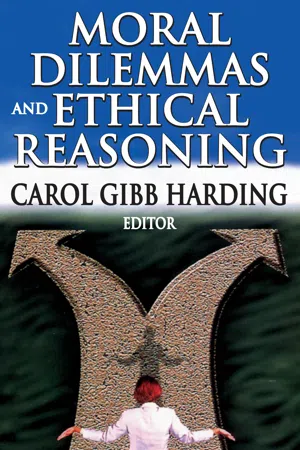
Moral Dilemmas and Ethical Reasoning
About this book
This book deals with moral dilemmas and the development of ethical reasoning in two senses. First, the editor focuses on dilemmas, both real and hypothetical, which require moral judgments. The ""Heinz dilemma,"" part of Kohlberg's scoring system for level of moral development, is in some cases used as a point of departure for discussion. Problems with this particular dilemma as a scoring item are examined in detail, along with problems generated by similar dilemmas for moral reasoning in everyday life.Those who study moral reasoning and its development are in somewhat of a dilemma as they attempt to integrate information from the domains of philosophy and psychology. These essays investigate domain issues in varied cultural settings, and across genders and age ranges for what have been proposed as universals in moral judgment, as well as formulate theories that reflect both empirical evidence and logical process.The essays share a conception of human nature as inherently social, as well as a healthy respect for the problems or dilemmas which human sociality carries in its wake. Some of these problems are theoretical, such as those having to do with the moral reasoning or the classic issues of values justification. Other problems are practical, such as those having to do with distributive justice or methods of moral education. This volume will shed light on the process of resolving dilemmas both within philosophy and psychology.
Information
Four Perspectives on Moral Argumentation
Marvin W. Berkowitz
Over the past decade, moral argumentation has been examined from a range of diverse psychological perspectives. While these endeavors have remained largely isolated from one another, recent interest in the general phenomenon of moral argumentation has led to the beginning of cross-fertilization of these various perspectives. Little in the way of serious integration has been attempted, however. Therefore, I would like to examine the prevailing perspectives on such moral discourse, and, in so doing, to attempt to identify both the underlying communalities and the fundamental incompatabilities of these diverse viewpoints.
My interest is in the verbal interactions of individuals discussing issues of morality (Berkowitz, 1985; Berkowitz & Gibbs, 1983, in press). I refer to this as moral discussion, that is, the discussion of moral topics by two or more individuals. I have used the term moral discourse interchangeably with the term moral discussion and will continue to do so here. Moral argumentation I take to be moral discourse or discussion in which the discussants confront and attempt to resolve differences in their respective positions on the moral focus of the verbal interaction. It is certainly obvious that one may focus on a variety of aspects of this broadly defined phenomenon; indeed, that variability will be the primary concern of this paper. Unfortunately, this variability is also characteristic of the terminology commonly used in different disciplines. I will solve this problem simply by appealing to the reader’s tolerance of my own idiosyncratic terminology.
It should be noted at this point that not all the perspectives to be expounded upon in this chapter are limited to moral argumentation. That is, some of the perspectives on moral argumentation can also apply to logical argumentation or to arguments concerning social conventions. However, in this chapter we shall consider only how these perspectives apply to the domain of morality.
The literature on moral argumentation can be categorized into three groups. This trichotomy is certainly not meant to be perfect in the sense of having clear and consistent definitional boundaries between the categories. Nor is it exhaustive, since it does not account for all possible, or even plausible, perspectives on the phenomena in question. (Indeed, I shall shortly introduce a fourth perspective that represents a somewhat different level of analysis.) I do think, however, that it is a largely accurate and useful categorization of research and thinking about moral argumentation. Furthermore, I would argue that it captures the most essential features of the predominant perspectives on moral argumentation currently influencing research, theory, and practice in moral developmental psychology and moral education today.
I have labeled these first three perspectives (1) Instrumental, (2) Ethical, and (3) Growth-Facilitative. While all three are concerned with discussions of morality, they have quite disparate orientations. Their disparities include, but are not limited to, the fundamental questions being investigated, the methods used in such investigations, the disciplines primarily informing both the question-asking and the method selection, and, consequently, the conclusions reached. Because each of these forms of moral argumentation can be viewed from both a simple descriptive standpoint and a more complex developmental perspective, I shall also introduce a fourth, Developmental perspective, which lies on a somewhat different plane than do the other three, in that it can be applied to each of these other perspectives. I will briefly define the four perspectives, after which they will be treated more thoroughly and related to some of the research now being done that exemplifies each perspective.
One difference between the Instrumental and Growth-Facilitative perspectives taken in joint contrast to the Ethical perspective parallels a classic contrast in ethical philosophy, especially as applied to the question of human growth. This is the contrast between what “is” and what “ought to be.” Since the developmental significance of this contrast has been discussed at length in Kohlberg’s classic essay “From ‘Is’ to ‘Ought’: How to Commit the Naturalistic Fallacy and Get Away with It in the Study of Moral Development” (Kohlberg, 1981), I will say only that the Instrumental and Growth-Facilitative perspectives are concerned with the “Is,” the description of moral argumentation, and the Ethical perspective focuses on the “Ought,” the prescription of moral argumentation. The human growth question adds a new point of view to this contrast, a concern with the issue of development toward a more adequate, or even ideal, end state. The Developmental perspective represents this last point of view.
More specifically, the Instrumental and Growth-Facilitative perspectives refer to efforts to describe actual moral argumentation behavior forms. The former describes forms of moral argumentation whose goal is some instrumental or practical end, such as changing another’s attitude or “winning” an argument. The latter has a quite different focus, i.e., to stimulate an individual to grow to a more mature level of moral understanding. That is, these two perspectives focus on the description of human moral argumentation and its function. The Developmental perspective expands that aim to include the developmental transformations through which the discussion of moral issues passes in the course of human growth. Typically, cross-sectional, but ideally also longitudinal (cf. Oser, 1984, p. 164), comparisons are made of moral discussion at different developmental stages.
In contrast, the Ethical perspective refers to the form that moral discussion ought to take. That is, the focus here is on the way individuals should discuss moral topics, as derived from ethical philosophy and social theory rather than from typical observed psychological patterns (although these patterns may be clearly implicated in the ethical justification). The Ethical perspective is oriented to an ideal end-state toward which human growth moves (although it may not reach it in all or even most individual cases). The Developmental perspective incorporates this theme of growth into the Ethical perspective.
The Instrumental, Ethical, and Growth-Facilitative perspectives are perhaps best differentiated by a functional analysis. The Instrumental perspective focuses on how moral argumentation can serve a desired goal, such as winning the argument. The function of Ethical argumentation is to take the rights of all discussants into account while searching for an ethical solution to the moral problem under discussion. Growth-Facilitative moral argumentation functions to produce individual development by means of the interaction. Correlatively, each of these first three perspectives can be construed as discourse competencies. We can talk about the competence to engage in ethically justified or in instrumentally effective forms of moral argumentation, and so on. By describing these aspects of moral argumentation as competencies, we invoke the fourth perspective, the Developmental perspective. If one can identify a form of competent moral argumentation from a particular perspective, it seems reasonable to ask whether there are varying degrees of such competence. Furthermore, one may question whether such variations in competency represent a developmental trend. However, the Developmental perspective cannot readily be classified function ally, as are the other three perspectives. Relative to these perspectives, it may best be viewed as a meta -perspective, since it describes the developmental path of moral argumentation. For instance, we can study how the ability to facilitate development itself develops, and can perhaps describe stages of the growth of such discourse behavior; or we may describe the development of the ability to win moral arguments, and so on. By now it should be at least minimally clear how these four perspectives are defined. The following sections will serve to elaborate these definitions and to concretize the perspectives via the examination of specific examples of each.
THE INSTRUMENTAL PERSPECTIVE
One way to describe the Instrumental perspective is in terms of conflict resolution. We have defined moral argumentation as discourse centered upon a moral disagreement. Similarly, Miller (1980) points out that “the constitutive task of an argumentation is to develop an argument which gives an answer to a disputed question” (p. 4). We may easily construe such a situation as a verbal moral conflict which the argumentation is intended to resolve. Psychologists have focused on two broad types of such conflict resolution: cooperative and competitive. The former refers to argumentations in which discussants share the same goal, and the latter to argumentations in which discussants have incompatible goals. This incompatibility need not be objectively real; it simply needs to be accepted as an orienting assumption by the discussants. In so-called “zero sum” situations, opponents are faced with objectively mutually exclusive goals, i.e., one’s success implies the other’s failure. However, most situations are not so clearly constrained. The theory of integrative bargaining (Pruitt & Lewis, 1977) is based largely upon the assumption that many apparently competitive situations can be reconstructed to allow for resolutions that fulfill the goals of each side of the conflict. Pruitt and Lewis suggest that a reorienting of the opponents may be all that is necessary to transform a competitive conflict into a cooperative enterprise. With this in mind, let us turn to the literature on Instrumental moral argumentation in order to identify the competitive and cooperative types.
An example of competitive moral argumentation is presented by Mall (1982), a rhetorician who has worked extensively on one side of the volatile social, political, and moral issue of abortion. He has helped bolster the anti-abortion perspective in this debate. In his book In Good Conscience: Abortion and Moral Necessity, he has undertaken the rather interesting task of demonstrating how Kohlberg’s (1984a) theory of stages of moral development can be applied to an analysis of the moral adequacy of abortion argumentations. This may not seem an example of competitive moral conflict resolution, but the fact is that Mall does not fully divorce himself either from his personal position on the abortion issue nor from his training as a rhetorician who attempts to change other people’s attitudes. Hence his book does indeed represent the competitive instrumental perspective, since it uses moral argumentation to help “win” the abortion debate.
Cooperative moral conflict resolution has also been represented in the moral argumentation literature. We will briefly introduce two examples here. First, there is the work of a group of philosophers and educators at Ohio State University who have applied the theoretical work of Bernard Rosen in normative ethics to classroom training in moral conflict resolution, a project entitled “Moral Negotiation as Moral Education: Rational Resolution of Moral Disagreements” (Reagan, 1984). Rosen’s normative ethics model has been used in this project to produce means of argumentation that can be justified as leading to an ethically sound solution to moral disagreements. These forms of argumentation are taught in the classroom in order to increase the number of cooperative resolutions of moral conflicts. The goal, therefore, is to negotiate a shared solution to moral disagreements, and the orientation is cooperative because the means are based on normative ethics.
A different cooperative Instrumental analysis of moral discussion comes from organizational psychology. Argyris (Argyris & Schön, 1974) has analyzed the nature of organizational communication in an attempt to understand the failures and breakdowns that can be corrected through organizational intervention. Argyris and Schön (1974) have defined the goal of training for adequate moral argumentation in the title of their book Theory in Practice: Increasing Professional Effectiveness. Argyris has described two forms of organizational communication which can be considered success (Model II) and failure (Model I) cases. The success form includes three governing values and several behavioral strategies and norms. For Argyris,
the governing values or variables are valid information, free and informed choice, and internal commitment to the choices made. The behavioral strategies associated with Model II include advocacy coupled with inquiry, minimal (covert) face-saving actions, and the making of statements that are testable. The norms include trust, individuality, and openness in such a way that others can produce the same conditions. (Argyris & Argyris, 1978, p. 6)
Argyris claims that the more typical case (Model I) is one of failure to achieve these conditions and ultimately results in organizational breakdown, because in such “closed loop” interactions discussants cannot “step” out of the system and correct it. For example, a non-testable accusation will lead to a retaliation in kind, but cannot lead to a confirmable refutation or synthesis. Therefore, such a sequence cannot lead to a solution of a problem. In Miller’s (1980) terminology, such moral argumentation cannot lead to a mutually acceptable end. Argyris argues that the success case (Model II) offers the potential for adequate moral argumentation. Furthermore, it should be clear that Model II argumentation is cooperative by the very nature of its values, strategies, and norms.
Two points need to be made concerning Argyris’s model. First, Argyris is not centrally engaged in studying moral discourse. He is primarily concerned with organizational success. This leads him to the study of social interaction and to a prescription of the ethical bases of such communications, an extension which borders on the Ethical perspective of moral argumentation. His direct goal, however, is the adequate functioning of an organization, typically a large corporation, a goal similar to that of Habermas’s (1979, 1984) perspective (which will be used to exemplify the Ethical perspective). Like Argyris, Habermas is more interested in the adequate functioning of a social organization than in moral argumentation per se, although in Habermas’s case the organization in question is society as a whole and his orientation initially includes normative ethics along with critical social theory.
Secondly, Argyris has admitted (personal communication) that his theory is not sufficiently informed by a developmental perspective, even though his two models can be construed as representing a two-step developmental progression. Argyris seems to suggest that the only way to develop from the failure case to the success case is through intentional external intervention; the success case does not develop naturally. Here, then, we see a clear distinction between the Developmental perspective and the Instrumental perspective.
Instrumental perspective investigations of moral argumentation focus on how moral discussion can produce a specific desired outcome through the resolution of a moral conflict. The form of the moral argumentation may be either competitive or cooperative. We have presented only a few examples of this perspective here; however, the reader can probably imagine a variety of other exampies that would serve equally well to illustrate this category. It should be noted that we have taken no position on the quality of the discussants’ intentions, other than with reference to the competition-cooperation dimension. One could incorporate an ethical dimension into this motivation, differentiating, for example, a sociopathic con-artist’s moral argumentation from a therapist’s attempts to help a family find a fair and just alternative to its mutually destructive decision-making strategies. This kind of analysis, however, exceeds the intended scope of this chapter; we recommend to the reader Powers’s (1982) study of family moral argumentation for an analysis of varying ego modes of orienting to such interactions.
THE ETHICAL PERSPECTIVE
In direct contrast to the Instrumental perspective on moral discussion, which tends to describe actual forms of moral argumentation, the Ethical perspective prescribes the ethically ideal form of moral argumentation. As noted earlier, these two perspectives have a potential relationship to each other in the same sense that Kohlberg’s (1981) stages of moral development relate to the ethical justification of his highest stage, i.e., the relationship of “is” to “ought.” I will briefly describe two endeavors that exemplify the Ethical perspective on moral discussion.
Perhaps the clearest and most highly developed position on the ideal form of moral discussion comes from the work of Jürgen Habermas (1979, 1984). From the perspective of a social theorist, Habermas has critiqued Marxist theory by pointing to the confusion between production and social interaction. The former, accentuated in Marxist theory, must be understood and evaluated according to standards of efficiency. Habermas argues that the latter, largely neglected in Marxist theory, should be understood and evaluated from the point of view of interactive competence. Habermas’s reconstruction of critical theory is based largely upon this latter notion, which he terms “communicative competence.”
Habermas delineates four essential components of ideal communicative competence (McCarthy, 1978). These four validity claims, which must be met for effective interactions to occur, are (1) comprehensibility, (2) truth, (3) truthfulness, and (4) appropriateness. Hence, Habermas has prescribed the form that communication ought ethically to take, whereas Argyris, Reagan, and Mall have described the forms that communication does instrumentally take. It should be pointed out, however, that Habermas has attempted also to tackle the Developmental question of the growth of ideal communicative competence. In so doing, he points to sta...
Table of contents
- Cover Page
- Half title
- Title Page
- Copyright Page
- Contents
- List of Contributors
- Introduction
- 1. Four Perspectives on Moral Argumentation
- 2. Abraham, Socrates, and Heinz: Where Are the Women? (Care and Context in Moral Reasoning)
- 3. Intention, Contradiction, and the Recognition of Dilemmas
- 4. Emotion, Morality, and Understanding
- 5. Resolving, Moral Conflicts within the Just Community
- 6. Growth and Regression in Cognitive-Moral Development of Young University Students
- 7. The Moral Adequacy of Kohlberg’s Moral Development Theory
- 8. Children’s Conceptions of Morality, Societal Convention, and Religious Prescription
- 9. Religious Dilemmas: The Development of Religious Judgment
- Index
Trusted by 375,005 students
Access to over 1.5 million titles for a fair monthly price.
Study more efficiently using our study tools.
Frequently asked questions
Yes, you can cancel anytime from the Subscription tab in your account settings on the Perlego website. Your subscription will stay active until the end of your current billing period. Learn how to cancel your subscription
No, books cannot be downloaded as external files, such as PDFs, for use outside of Perlego. However, you can download books within the Perlego app for offline reading on mobile or tablet. Learn how to download books offline
Perlego offers two plans: Essential and Complete
- Essential is ideal for learners and professionals who enjoy exploring a wide range of subjects. Access the Essential Library with 800,000+ trusted titles and best-sellers across business, personal growth, and the humanities. Includes unlimited reading time and Standard Read Aloud voice.
- Complete: Perfect for advanced learners and researchers needing full, unrestricted access. Unlock 1.5M+ books across hundreds of subjects, including academic and specialized titles. The Complete Plan also includes advanced features like Premium Read Aloud and Research Assistant.
We are an online textbook subscription service, where you can get access to an entire online library for less than the price of a single book per month. With over 1.5 million books across 990+ topics, we’ve got you covered! Learn about our mission
Look out for the read-aloud symbol on your next book to see if you can listen to it. The read-aloud tool reads text aloud for you, highlighting the text as it is being read. You can pause it, speed it up and slow it down. Learn more about Read Aloud
Yes! You can use the Perlego app on both iOS and Android devices to read anytime, anywhere — even offline. Perfect for commutes or when you’re on the go.
Please note we cannot support devices running on iOS 13 and Android 7 or earlier. Learn more about using the app
Please note we cannot support devices running on iOS 13 and Android 7 or earlier. Learn more about using the app
Yes, you can access Moral Dilemmas and Ethical Reasoning by Carol Harding in PDF and/or ePUB format, as well as other popular books in Philosophy & Ethics & Moral Philosophy. We have over 1.5 million books available in our catalogue for you to explore.