eBook - ePub
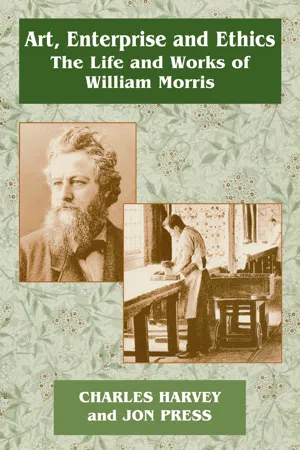
Art, Enterprise and Ethics: Essays on the Life and Work of William Morris
The Life and Works of William Morris
- 256 pages
- English
- ePUB (mobile friendly)
- Available on iOS & Android
eBook - ePub
Art, Enterprise and Ethics: Essays on the Life and Work of William Morris
The Life and Works of William Morris
About this book
The life and works of William Morris continue to excite the imaginations of fresh generations of scholars working in many traditions, from the history of art and design to literary criticism and the history of socialism and socialist thought. This book concentrates on Morris's social and political acheivements as well as his artistic talents.
Trusted by 375,005 students
Access to over 1.5 million titles for a fair monthly price.
Study more efficiently using our study tools.
Information
Topic
ArtSubtopic
Art et politique1
Morris and his Biographers
NEARLY A hundred years after its publication, John William Mackail’s Life of William Morris remains essential reading for Morris scholars. Mackail was an Oxford classics don1 who married Margaret, the daughter of Morris’s closest friends, Sir Edward and Lady Georgiana Burne-Jones. He remained a valued friend and advisor to Morris’s younger daughter May until her death in 1938. As an intimate of the Morris circle, he had access to key people and sources, and his detailed knowledge of Morris’s private and public life enabled him to weave a detailed and attractive chronological narrative. His account of Morris’s early life, for example, draws upon the reminiscences of Morris’s sister, Henrietta, and brother, Stanley, and from Oxford friends like Richard Watson Dixon.2 Further information was provided by the friends and associates of Morris’s mature years, like his publisher and executor, Frederick Startridge Ellis. Particularly valuable was the detailed description of Morris and the firm compiled by his former manager, George Wardle, which is reproduced in Chapter 5.
It is a truism that biographies often reveal almost as much about their authors as their subjects, and it is not surprising therefore that Mackail’s biography reflected many of his own interests and predilections. There are some areas for which he pulled together sufficient details for the purposes of his narrative, but little more. For example, he has little to say upon the operation of the Morris business – a theme to which we return later in this chapter. Nor did he claim expertise in many of the fields in which Morris had made a mark, such as the design and manufacture of textiles. Moreover, at times there are errors in the detail of Mackail’s story. Ray Watkinson has pointed out the inaccuracies in the account of the work done at Red House, Morris’s home at Upton, Kent from 1860 to 1864 – inaccuracies which led him to doubt whether Mackail had ever visited the house.3 Evidently, at times Mackail rearranged details and selectively drew upon his sources to ‘maintain his flow of description and keep it stylistically consistent’.4 Such errors, though perhaps relatively minor in themselves, are significant because of the way that Mackail’s account has for long held sway as the ‘standard story’, repeated in numerous books and articles over the years.
More seriously, Mackail’s freedom for manoeuvre was constrained and determined by his relationship with those who had commissioned the biography. He was to produce a celebratory work, a tribute to a great man, something not just for public consumption but also directed at the surviving family and friends. In doing so, he was to contribute to what Fiona MacCarthy has termed a ‘conspiracy of memory’5 about his subject. It is now well known that there are significant lacunae in the narrative woven by Mackail. For example, Morris’s contribution to socialist thought and action, though not ignored, does not occupy the central place it deserves, because neither Mackail nor his father-in-law sympathised with Morris’s political beliefs. The impression Mackail tends to convey is one of a temporary aberration, rectified towards the end of his life when working on the Kelmscott Chaucer with Burne-Jones. Likewise, having close ties with the Morris family meant that Mackail could not speak out about the difficulties of Morris’s private life – his wife Jane’s prolonged affair with Rossetti and the illness of his elder daughter, Jenny. Only on rare occasions did he give readers a hint of the true state of affairs, such as when he remarked that an autobiographical element might be found in Morris’s poetry. In reading through Mackail’s correspondence and research notes, one sometimes glimpses the frustration which he felt at the constraints placed upon him: ‘how extraordinarily interesting one could make the story’, he once remarked, ‘if one were going to die the day before it was published.’6
The general acceptance of what may be termed the ‘Mackail story’ was encouraged by Sydney Cockerell, who had been appointed Morris’s secretary at the Kelmscott Press in 1894. He became Director of the Fitzwilliam Museum in 1908, a post he held until 1937, and was knighted in 1934. Despite his careful and dedicated work as one of Morris’s literary executors, Cockerell’s influence was not always a beneficial one. He was generally doubtful of the value of Morris scholarship, believing that all the best letters had been published in Mackail – ‘the only life of Morris worth anything at all’. He once told Philip Henderson that ‘unfortunately other people are now taking it upon themselves to pry into matters which do not concern them’, by which he meant Jane Morris’s relationship with Rossetti. He described Morris as a ‘giant’, quoting Ruskin’s remark that ‘Morris is beaten gold’. Henderson commented that ‘from the low reverent tone of Sir Sydney’s voice and the hushed atmosphere of his study, I felt as though we were both taking part in a religious ceremony, an act of devotion to his beloved friend and master’.7 Cockerell believed that mere business records would be of no interest to succeeding generations of scholars, and in the same spirit discouraged May Morris from including the unpublished Socialist lectures in her 1910–15 edition of Morris’s Collected Works.
Not surprisingly, May herself followed a similar line, though she did in fact publish a few of the lectures. In 1938, shortly before the end of her life, she wrote a letter to Cockerell in which she spoke of the acrimony which surrounded the break-up of Morris, Marshall, Faulkner & Co. in 1874–75: ‘W.M. however hurt would never want gossip-mongers to pick up anything in the future, so I always took care to write nothing that might go counter to Mackail’s statements.’8 At the William Morris Gallery in Walthamstow there is the text of a speech written by May Morris in 1934 (and edited by Mackail), which she delivered to celebrate the centenary of her father’s birth. She began by conjuring up a happy image of Morris and his young friends beautifying Red House: ‘All the friends must help ... the rooms were alive with happy workers, the garden gay with flowers and altogether Red House was slowly being made as Burne-Jones said “the beautifullest place on earth”.’ She recognised that ‘youthful days cannot last’, but characterised the 1870s as ‘a peaceful life for some years, with the same friends round him: and the work of the firm of Morris & Co. growing in fame’. Then she described the way in which he came to question the contradiction between his hopes of ‘an art made by the people and for the people as a joy to the maker and the user’ and the restriction of his wares to a relatively small and privileged middle-class market. She noted his commitment to socialism and the drain on his physical and mental resources which this entailed. Yet she concluded that ‘Morris lived a life of work unhindered by disappointments and enriched by generous and unclouded friendships: surely, though he died before his time, he may be called a happy man, leaving as he did such a memory in the hearts of those who knew him’.9 No one would present such an interpretation today; on the contrary, most would agree with Fiona MacCarthy’s assessment of his personal life: ‘the full extent of his unhappiness, and his fortitude and generosity in facing it, is only now being revealed.’10
In retrospect, the unbalanced and incomplete picture presented by Mackail, Cockerell and May Morris is neither reprehensible nor difficult to understand. After the passage of a century, and secure in the knowledge that Morris’s influence and reputation has survived, we can afford to see him as a whole. This was not the case in the 1920s and 1930s, when his family and friends were struggling against the odds to keep his memory alive. In 1934 Mackail noted sadly that ‘now, nearly forty years after Morris’s death, his work has been superseded in favour, fallen largely into neglect, even in certain quarters into contempt’.11 Mackail’s biography remains a work to be admired and respected; the shortcomings of his story are by no means as large as his critics have sometimes assumed. We should be grateful to those who sought to preserve Morris’s memory during the early decades of the twentieth century – not least for their efforts in ensuring the survival of many documents and artefacts essential to later research.
There is a good deal of evidence of a decline in interest in the man and his work after the First World War. The waning of the Morris firm was no doubt partly due to poor management and lack of vision on the part of Morris’s successors, but equally it was indicative of general trends in design and interior decoration. Meanwhile, the number of publications about Morris’s life and work fell to an all-time low between 1913 and 1932.12 Few books from that period have proved of enduring worth. Compton-Rickett’s William Morris: A Study in Personality (1913) and Clutton-Brock’s William Morris: His Work and Influence, published in the following year, are worth dipping into, though they do not add very much to our knowledge of Morris.13 More valuable is Henry Halliday Sparling’s The Kelmscott Press and William Morris, Master Craftsman of 1924. Though Sparling’s own connections with the Morris family had long been severed – his disastrous marriage to May in 1890 had lasted just four years – and he was writing long after the events he described, his reminiscences nevertheless contain important insights into Morris’s work practices and the operation of the Kelmscott Press in the last years of his life.14 John Bruce Glasier’s William Morris and the Early Days of the Socialist Movement, published in 1921 with a foreword by May Morris, demonstrated that there were those in the labour movement who continued to treasure Morris’s memory. However, it was written in the last months of his life when under the influence of narcotics, and the accuracy of Glasier’s interpretation is regarded as suspect by later writers.15
The task for succeeding generations has been to identify and fill in the gaps in Mackail’s story. Over the years, Morris has attracted the interest of many scholars who have sought to add to our understanding. Some have tried, like Mackail, to portray the whole man, and do justice to his multi-faceted talents; others have drawn upon their specialist expertise to illuminate particular aspects of his life and work. The process may be said to have begun with the celebrations to mark the centenary of Morris’s birth in 1934, which included the first exhibition of Morris’s work at the Victoria & Albert Museum. However, the interest which this engendered soon ebbed away, and it was not until the second half of the 1950s that a growing enthusiasm for Morris became evident. In the 1960s the stream of Morris studies swelled to a veritable flood, which shows no sign of abating. The average number of publications on Morris appearing each year roughly doubled in the 1970s, and doubled again in the 1980s. By 1985, when Gary L. Aho’s William Morris: A Reference Guide was published, the volume of books, articles and catalogues relating to William Morris ensured that this comprehensive bibliography would immediately become an essential research tool.16
Of course, numbers are not everything. Most of the books and articles which appeared in Morris’s centenary year have not stood the test of time. However, a few of them did make a significant impact upon the course of Morris scholarship. The Studio, though it had long ago made a shift away from the decorative arts, produced a large format special issue by Gerald Crow to mark the centenary. Crow provided a reliable and detailed account of Morris’s work, and, unlike most previous writers, he recognised the ‘inevitability’ of his adherence to socialism. Particularly valuable for later readers, however, are the many illustrations; Crow reproduced many of Morris’s working drawings, which at that time were still held by Morris & Co. at Merton Abbey.17
Most important of the 1934 crop of publications were those of G.D.H. Cole and Robin Page Arnot. Cole had been a member of the Labour Research Department before moving to Oxford to take up a distinguished career in academia. His William Morris: Selected Writings was published in Bloomsbury by the Nonesuch Press. It includes a wide and well-chosen selection of Morris’s stories in prose and verse, and the lectures and essays on social criticism and socialism. There is also a chronology of Morris’s life and a 14-page introduction. The prose stories which Cole chose were A Dream of John Ball and A King’s Lesson of 1888, News from Nowhere (serialised in the Commonweal in 1890, and published in book form the following year), and, less predictably, the early and little-known Story of the Unknown Church, which Morris published in the Oxford and Cambridge Magazine in 1856. Under the heading ‘Stories in Verse’, Cole included The Pilgrims of Hope of 1886, and followed it with a goodly selection of shorter poems: half a dozen or so from The Defence of Guenevere and Other Poems (1858), one from The Earthly Paradise, and a number of later works. Cole commented that he could happily omit the rest of Morris’s poetry with the exception of Sigurd the Volsung, which was too long for inclusion and defied abbreviation. Sigurd, he believed, was unlike anything else in the English language, revealing a side of Morris which was not to be found in any of his other poetry. Along with the Iceland Journals, which Cole considered to be ‘one of the most revealing things he wrote’, it demonstrated the essential contribution which Iceland and Icelandic literature made to the development of Morris’s ideals. One short poem which Cole did include, Iceland First Seen, had to stand ‘for all that vital part of his work’.18 The volume concludes with a large and judiciously chosen selection of lectures and essays, including ‘The Lesser Arts’ (1877), ‘The Beauty of Life’ (1880), ‘A Factory as It Might Be’ (1884), ‘Useful Work versus Useless Toil’ (1884), ‘How We Live and How We Might Live’ (1884), and ‘How I Became a Socialist’ (1894). Cole made no apology for including so many of Morris’s lectures and essays, stressing their importance in charting the development of Morris’s thought from social criticism to socialism. Though most of Cole’s selections were already available to those who could afford May Morris’s edition of Morris’s works,19 the Nonesuch collection made them widely accessible for the first time. Reprinted several times during and after the Second World War, Selected Writings was be found on the shelves of many university and public libraries, affording many people the opportunity to hear Morris’s authentic voice for the first time.
Arnot’s work was not so widely known but arguably it has had an even more significant impact u...
Table of contents
- Cover Page
- Title Page
- Copyright Page
- Contents
- List of Plates and Figures
- Picture Credits
- Preface
- 1. Morris and his Biographers
- 2. The Origins of the Morris Family Fortune
- 3. The Business Career of William Morris
- 4. William Morris and the Experience of Iceland
- 5. George Wardle’s ‘Memorials of William Morris’
- 6. Morris & Company at the Boston Foreign Fair of 1883
- 7. Morris, the Ionides Family and I Holland Park
- 8. William Morris and the Royal Commission on Technical Instruction
- 9. John Ruskin and the Ethical Foundations of Morris & Company
- 10. Morris and the Making of an Earthly Paradise
- Postscript: The Work of the William Morris Society
- Index
Frequently asked questions
Yes, you can cancel anytime from the Subscription tab in your account settings on the Perlego website. Your subscription will stay active until the end of your current billing period. Learn how to cancel your subscription
No, books cannot be downloaded as external files, such as PDFs, for use outside of Perlego. However, you can download books within the Perlego app for offline reading on mobile or tablet. Learn how to download books offline
Perlego offers two plans: Essential and Complete
- Essential is ideal for learners and professionals who enjoy exploring a wide range of subjects. Access the Essential Library with 800,000+ trusted titles and best-sellers across business, personal growth, and the humanities. Includes unlimited reading time and Standard Read Aloud voice.
- Complete: Perfect for advanced learners and researchers needing full, unrestricted access. Unlock 1.5M+ books across hundreds of subjects, including academic and specialized titles. The Complete Plan also includes advanced features like Premium Read Aloud and Research Assistant.
We are an online textbook subscription service, where you can get access to an entire online library for less than the price of a single book per month. With over 1.5 million books across 990+ topics, we’ve got you covered! Learn about our mission
Look out for the read-aloud symbol on your next book to see if you can listen to it. The read-aloud tool reads text aloud for you, highlighting the text as it is being read. You can pause it, speed it up and slow it down. Learn more about Read Aloud
Yes! You can use the Perlego app on both iOS and Android devices to read anytime, anywhere — even offline. Perfect for commutes or when you’re on the go.
Please note we cannot support devices running on iOS 13 and Android 7 or earlier. Learn more about using the app
Please note we cannot support devices running on iOS 13 and Android 7 or earlier. Learn more about using the app
Yes, you can access Art, Enterprise and Ethics: Essays on the Life and Work of William Morris by Charles Harvey,Professor Jon Press,Jon Press in PDF and/or ePUB format, as well as other popular books in Art & Art et politique. We have over 1.5 million books available in our catalogue for you to explore.