- 392 pages
- English
- ePUB (mobile friendly)
- Available on iOS & Android
eBook - ePub
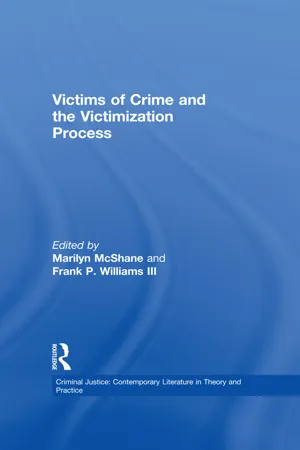
Victims of Crime and the Victimization Process
About this book
Volume 6 in the 6-volume series titled Criminal Justice: Contemporary Literature in Theory and Practice. This compilation of articles attempts to fill gaps in existing resources with some of the best current statements on the topic. Subjects include the characteristics of victims, the effects of crime on victims, and some contemporary theories of victimization. Also included are evaluations of a variety of victim-oriented policies and programs, such as victim assistance, peace-making, and victim-impact statements. This title will be of great utility to students, scholars, and others with interests in the literature of criminal justice and criminology.
Information
Understanding Theories of Criminal Victimization
Abstract
Current theories of victimization have generated a sizable body of empirical research, mostly within the last two decades. The two most widely known perspectives, lifestyle-exposure and routine activities theories, have been the object of much current thinking and empirical testing, but their maturation has been hampered by many of the same problems impeding theories of criminality. These include inadequate attention to variation by type of crime, compartmentalized thinking, poor links between theory and data, inadequate measures of key concepts, and failure to specify clearly functional relationships between sets of variables. Many of these problems can be addressed by closer examination of the interrelationships among victims, offenders, and criminal situations. Victimization theories should be incorporated into comprehensive integrated theories of crime.
Victimization theories are now a common feature of criminological work, but it has not always been so. In spite of their obvious appeal, perspectives on victim behavior have only recently gained sufficient scholarly respectability to join forces with the mainstay of the criminological arsenal, theories of offender behavior. Work that has incorporated victim perspectives, such as Wolfgang’s (1958) research on homicide and especially Amir’s (1971) related work on rape, encountered political difficulty because it appeared that the victim bore some responsibility for the crime. This was an idea that smacked of “blaming the victim,” a cornerstone of liberal crime control ideology and something to be avoided at all scholarly cost, even truth. But the impediments to a defensible notion of victim involvement in crime were more long-standing than this, and even relatively unenlightened criminologists must surely have known that no picture of predatory crime can ever be complete without information about the victim of these offenses. Only in the last two decades have victimization theories generated empirical, as well as anecdotal, support, most notably in the form of lifestyle-exposure (Hindelang, Gottfredson, and Garofalo 1978) and routine activities theories (Cohen and Felson 1979). This long road to respectability is hard to explain, but the high (or low) points can at least be identified.
In this essay, we argue that the current popularity of and support for victimization surveys is well deserved but that investigators must also consider the major limitations of the theoretical and empirical work that has been done on victimization. Although it is beyond the scope of this essay to provide a complete critique of victimization studies, we do note that much previous research has suffered from a number of problems, including the use of inadequate measures of key concepts, few statistical controls, and the absence of multilevel models and contextual effects that could provide alternative explanations for the results of victimization research. We also note that, while some versions of victimization theories suggest that victims and offenders are tied together in a broader social ecology of crime, these theories do not provide testable propositions about the conditions of offending and victimization to permit adequate predictions of crime. In spite of these problems, we are encouraged about the current status of victimization surveys.
We begin our analysis by examining the historical context of victimization theories in Section I. We also identify major sources of information concerning these theories, predominantly victimization surveys. Section II identifies major current theories of victimization with particular attention to lifestyle theories and routine activities theories. Alternative models of victimization are identified in Section III, and major concepts used in victimization theories are examined in Section IV with an eye toward improving conceptual clarity. Section V discusses what we consider to be major problems with victimization theories. The context of crime plays an important role in modeling victimization, and its effects are discussed in Section VI. We discuss the prospects of integrating theories of victimization with theories of criminality in Section VII. Conclusions are offered in Section VIII.
I. Historical Foundations for Current Victimization Theories
The use of such expressions as “the victim-offender problem” (Mac-Donald 1939), “the duet frame of crime” (Von Hentig 1948), “the penal couple” (Ellenberger 1955), and, more generally, “the victim-offender relationship” (Von Hentig 1940; Schafer 1968; Schultz 1968) clearly indicates the significance of crime victims to the understanding of crime. Garofalo (1914) was one of the first to note that a victim may provoke another into attack, whereas Mendelsohn (1956) developed a victim typology that distinguishes victims who are more culpable than their offenders from those who are considered totally guiltless. Von Hentig (1948) described general classes of crime victims (e.g., the young, females, the old, the mentally defective, the depressed, the acquisitive, the lonesome and heartbroken) and some of the characteristics associated with these personal attributes that increase their vulnerability to crime.
Such a list of phrases is not a history, and it would be incorrect to claim that modern victim theories are merely the latest variants in a long lineage of earlier victim theories. These early writers did not propose theories, and even some of the concepts they used were primitive. Furthermore, it is speculative at best to attempt to sketch a victim theory ancestry since there seem to be few connections among these early works. Although it is difficult to trace the origins of any particular theoretical perspective, two fairly recent research traditions appear to be the antecedents to current theories of victimization. These include research on victim precipitation and the development of victimization surveys.
A. Victim Precipitation
The first systematic study of victim involvement in crime was conducted in the late 1950s by Marvin Wolfgang. The term he introduced, “victim precipitation,” became a popular descriptor for all direct-contact predatory crime (e.g., murder, assault, forcible rape, robbery). When applied to homicide, victim precipitation is restricted to those cases in which “the victim is the first in the homicide drama to resort to physical force against the subsequent slayer” (Wolfgang 1958, p. 252; see also Wolfgang 1957). A similar definition is used in the case of aggravated assault except that insinuating language or gestures might also be considered provoking actions (Curtis 1974; Miethe 1985). Victim-precipitated robbery involves cases in which the victim has acted without reasonable self-protection in the handling of money, jewelry, or other valuables (Normandeau 1968; Curtis 1974), whereas this concept in forcible rape applies to “an episode ending in forced sexual intercourse in which the victim first agreed to sexual relations, or clearly invited them verbally or through gestures, but then retracted before the act” (Amir 1967; Curtis 1974). Under each of these definitions, there is an explicit time ordering of events in which victims initiate some type of action that results in their subsequent victimization.
Previous studies using police reports suggest some level of victim involvement in a large proportion of violent crimes. The extent of victim precipitation, however, varies widely by type of offense. Estimates of victim precipitation range from 22 to 38 percent for homicide, 14 percent for aggravated assault, between 4 and 19 percent for rape cases, and about 11 percent of armed robberies are characterized by carelessness on the part of the victim (see, for review, Curtis 1974). These figures are best considered low estimates of the rate of victim involvement because of the fairly restrictive definition of victim precipitation for some crimes (i.e., murder, assault) and the large number of cases with incomplete information. The national survey of aggravated assaults reported by Curtis (1974), for example, had insufficient data for determining the presence of victim precipitation in 51 percent of the cases. Nonetheless, the importance of the notion of victim precipitation is clearly revealed in many cases of homicide where who becomes labeled the victim and who the offender (Wolfgang 1957) is a matter of chance or circumstance.
There are several reasons why previous research on victim-precipitated crime was influential in the emergence of current theories of victimization. First, the prevalence of victim precipitation signified the importance of victims’ actions in explaining violent crime but also brought attention to the less direct ways by which citizens contribute to their victimization. These less direct forms of victim involvement would include such acts as getting involved in risky or vulnerable situations, not exercising good judgment when in public places, leaving property unprotected, and interacting on a regular basis with potential offenders.
Second, the notion of victim precipitation, by definition, attributes some responsibility for crime to the actions of its victims. That victim-precipitation researchers had to deal directly with such an unpopular public and political stance may have made it easier for subsequent scholars to examine victim culpability and how the routine activities and lifestyles of citizens provide opportunities for crime. Thus, current theories of victimization may have benefited greatly from the prior work on victim precipitation.
The implication of blame in victim-precipitation analyses has inhibited full development of the concept. When Wolfgang’s student Menachim Amir (1971) adopted the concept in a study of forcible rape that parallels Wolfgang’s research on homicide, it caused a major political controversy. Amir, like Wolfgang, used official police reports in the city of Philadelphia; he also used the subculture of violence as a unifying theoretical notion to explain this crime. But Amir was not sufficiently sensitive to the differences between murder and rape in using the idea of victim precipitation. While it is neither counterintuitive nor politically contentious to acknowledge that murder victims sometimes strike the first blow or otherwise provoke a violent response, it was politically aberrant to suggest that rape victims were provocative, at least in the same sense. In suggesting the nature of victim precipitation in rape, Amir reported that 20 percent of the victims had a prior record for some sort of sexual misconduct (usually prostitution or juvenile intercourse) and another 20 percent had “bad reputations” Wolfgang’s research offered a promising idea to further explore the relationship between offender and victim, but Amir’s study blunted the promise by not developing the idea beyond Wolfgang’s pioneering work.
Actually, Amir was either too far ahead, or too far behind, his times. The 1970s were politically charged in criminology as well as in society at large with much concern about victim blaming and women’s rights. Research on rape would shortly be done correctly only by women. The idea that men had anything reasonably objective to say about rape was not given much credence. Surely this overstates the matter, but there is no mistaking the fact that there were very few male authors on rape, and Amir himself took an academic assignment in Israel never really to publish on rape again. The concept of victim precipitation remained comatose under the feminist assault never to resurface, even for homicide.
In fairness, the concept of victim precipitation was never really defined very well, and Amir’s application of the concept to include “bad reputation” was a serious mistake scientifically. Such an indicator clearly smacked of subjectivity, and no validity checks were made of the Philadelphia Police Department records in which this phrase appeared.
B. Victimization Surveys
The second major contributor to the emergence of current victimization theories is the development of large-scale victimization surveys. Prior to the advent of victimization surveys in the late 1960s and early 1970s, official reports on crimes known to the police and self-reports of offending were the only systematically available data on criminal activities. However, neither of these sources give any systematic information about the actions and characteristics of crime victims. Although it is possible to understand crime without directly surveying its victims (e.g., by interviewing offenders about their choice of crime sites, doing observation studies of areas with high rates of crime), victim surveys provide information about aspects of the criminal event that is not routinely collected from other sources.
There were three early studies: one by Reiss of business victimization; Biderman’s study in Washington, D.C.; and Ennis’s survey through the National Opinion Research Center (NORC) (President’s Commission on Law Enforcement and Administration of Justice 1967, pp. 38–43). These surveys, thoroughly reviewed by Sparks (1982), paved the way for more systematic studies. Of these initial efforts, one deserves more than passing comment.
The first national project was sponsored by the President’s (Lyndon Johnson) Commission on Law Enforcement and Administration of Justice. The report was published in the commission proceedings the following year, and the findings were startling even to criminologists, let alone citizens (Ennis 1967). This first systematic survey of victims used a probability sample of nearly ten thousand households. The major conclusions included the findings that forcible rape was three and a half times more frequent than the reported rate, burglaries were three times the reported rate, and robbery was 50 percent higher than the reported rate. Thus, not only were most crimes underreported to a significant degree, the extent of underreporting varied from crime to crime. This meant that official estimates of crimes were not only “off” by some factor but that the degree to which they were off was variable and could not be estimated without separate surveys for each crime category.
The largest current victimization survey, the National Crime Victimization Survey (NCS), involves yearly reports based on surveys of from between 59,000 and 72,000 U.S. households in which questions are asked to identify personal attributes of crime victims and characteristics of the offense. The interviews are conducted by Bureau of the Census personnel, and the results are coordinated by the Department of Justice. Actually, the NCS is a series of surveys rather than a survey at a single point in time. The NCS series involves probability samples of households that are interviewed a maximum of seven times at six-month intervals. Started in 1973, the NCS series involves interviews with persons over twelve years of age. Persons who move out of a household are not followed to their new address, but, if a new family or person moves into a sampled housing unit between waves, they are interviewed as part of the series. Skogan (1990) outlines the major changes in the implementation of the NCS series.
Even at their earlier stages of development, victimization surveys addressed fundamental questions about crime. Victim surveys represent an alternative barometer of the extent and distribution of crime. They also identify factors associated with reporting crime to the authorities, and they yield detailed information about the consequences of crime for the victim. For present purposes, however, the major contribution of victimization surveys is that they provide detailed information about the ecology of crime (e.g., where it occurred, type of injury, victim-offender relationship) and about the demographic characteristics of victims. It is the distribution of crime and the characteristics of victims identified in victimization surveys that are the social facts to be explained by current theories of victimization.
II. Current Major Theories of Victimization
Like theories of the behavior of criminals, theories of the behavior of crime victims are many and variable. Some, like the notion of victim precipitation, are little more than an idea, let alone a scientific concept. Others either are little more than victim typologies (Von Hentig 1948; Mendelsohn 1956) or highlight the distribution and characteristics of individuals who have repeat or multiple victimization experiences (Nelson 1980; Gottfredson 1981; Sparks 1981; Skogan 1990). Two major theories considered here are more sophisticated and have been the object of substantial empirical testing. The two most advanced theories are the lifestyle-exposure perspective and the routine activities theory. There are points of conceptual and explanatory overlap between them, but they each offer a distinctive view of the role of victims in the crime process.
A. Lifestyle-Exposure Theories of Victimization
One of the first systematic theories of criminal victimization was the lifestyle-exposure approach developed by Hindelang, Gottfredson, and Garofalo (1978) less than twenty years ago. This theory was originally proposed to account for differences in the risks of violent victimization across social groups, but it has been extended to include property crime, and it forms the basis for more elaborate theories of target-selection processes.
The basic premise underlying the lifestyle-exposure theory is that demographic differences in the likeli...
Table of contents
- Cover
- Title Page
- Copyright Page
- Table of Contents
- Series Introduction
- Volume Introduction
- Fighting Fire with Fire: The Effects of Victim Resistance in Intimate Versus Stranger Perpetrated Assaults Against Females
- Determining Police Response to Domestic Violence Victims: The Role of Victim Preference
- The Effects of Victim Impact Statements on Sentencing Decisions: A Test in an Urban Setting
- Juvenile Victimization and Delinquency
- From Crime Policy to Victim Policy: The Need for a Fundamental Policy Change
- The Psychological Adjustment of Recent Crime Victims in the Criminal Justice System
- The Hate Crime Statistics Act of 1990
- Ecological and Behavioral Influences on Property Victimization at Home: Implications for Opportunity Theory
- A Portrait of Crime Victims Who Fight Back
- United States Crime Victim Assistance: History, Organization and Evaluation
- Radical Victimology: A Critique of the Concept of Victim in Traditional Victimology
- Understanding Theories of Criminal Victimization
- Psychological Distress Following Criminal Victimization in the General Population: Cross-Sectional, Longitudinal, and Prospective Analyses
- Advice to Crime Victims: Effects of Crime, Victim, and Advisor Factors
- Long-Term Consequences of Victimization by White-Collar Crime
- Cross-Site Analysis of Victim-Offender Mediation in Four States
- New Wine and Old Wineskins: Four Challenges of Restorative Justice
- Acknowledgments
Trusted by 375,005 students
Access to over 1.5 million titles for a fair monthly price.
Study more efficiently using our study tools.
Frequently asked questions
Yes, you can cancel anytime from the Subscription tab in your account settings on the Perlego website. Your subscription will stay active until the end of your current billing period. Learn how to cancel your subscription
No, books cannot be downloaded as external files, such as PDFs, for use outside of Perlego. However, you can download books within the Perlego app for offline reading on mobile or tablet. Learn how to download books offline
Perlego offers two plans: Essential and Complete
- Essential is ideal for learners and professionals who enjoy exploring a wide range of subjects. Access the Essential Library with 800,000+ trusted titles and best-sellers across business, personal growth, and the humanities. Includes unlimited reading time and Standard Read Aloud voice.
- Complete: Perfect for advanced learners and researchers needing full, unrestricted access. Unlock 1.5M+ books across hundreds of subjects, including academic and specialized titles. The Complete Plan also includes advanced features like Premium Read Aloud and Research Assistant.
We are an online textbook subscription service, where you can get access to an entire online library for less than the price of a single book per month. With over 1.5 million books across 990+ topics, we’ve got you covered! Learn about our mission
Look out for the read-aloud symbol on your next book to see if you can listen to it. The read-aloud tool reads text aloud for you, highlighting the text as it is being read. You can pause it, speed it up and slow it down. Learn more about Read Aloud
Yes! You can use the Perlego app on both iOS and Android devices to read anytime, anywhere — even offline. Perfect for commutes or when you’re on the go.
Please note we cannot support devices running on iOS 13 and Android 7 or earlier. Learn more about using the app
Please note we cannot support devices running on iOS 13 and Android 7 or earlier. Learn more about using the app
Yes, you can access Victims of Crime and the Victimization Process by McShane in PDF and/or ePUB format, as well as other popular books in Social Sciences & Criminology. We have over 1.5 million books available in our catalogue for you to explore.