eBook - ePub
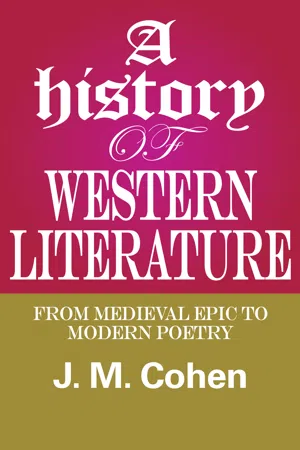
A History of Western Literature
From Medieval Epic to Modern Poetry
- 381 pages
- English
- ePUB (mobile friendly)
- Available on iOS & Android
eBook - ePub
About this book
This book begins in a narrow territory, strictly Western, and extends with the passage of time to include the poetry, plays, novels, and works of speculation of the great authors of the past and present, from Russia to Mexico. His objective is to tell the whole story of Western writing in languages other than English from the twelfth-century Chanson de Roland to Evtushenko's poetry of the 1960's.Cohen not only presents a factual account of historical growth. The book reflects the author's own judgments and valuations, arrived at in the course of almost forty years' reading in the main European languages. A work of original criticism, "A History of Western Literature" immediately became a standard reference when first published. In this new edition, the author has included revisions covering the most important recent writers and their work.
Information
Chapter One
EPIC TALES AND ROMANCES OF ADVENTURE
EUROPEAN Literature was born fully mature towards the beginning of the twelfth century. It was contemporary with the Crusades, and it was the product of the same conflict of forces. It arose, that is to say, from the impact of the non-Christian upon the Christian world. On the one side the Romance languages had developed so far as to be virtually independent of the debased Latin from which they had evolved; on the other hand the Dark Ages had not themselves produced from the relics of classical culture any fresh myths which could be the subject of poetry in the vernacular. Priests and monks continued to compose epics and treatises, chronicles and hymns, in Medieval Latin, but their inspiration had run dry. What is more, a new public had appeared, that had little or no Latin. The feudal princes who were leading the great counter-offensive against the infidels had leisure. They had furthermore contact in many places with these same infidels, whose level of civilization was higher than theirs. Their courts – perhaps in imitation of the more cultured Moslem – were becoming more luxurious, and they demanded entertainment. Some of their ladies, indeed, quickly set themselves up as patronesses of the almost non-existent literary arts. The lords of the Frankish world wanted to hear their own praises sung; not by way of personal adulation, however, for this was not an age of personality worship. What they asked of their jongleurs or minstrels was an idealized picture of the Christian mission which they had assumed. They demanded a presentation of the Christian way of life that they were defending, and their own age offered them no compelling idea. So from outside the narrow Latin world were called in the heroic sagas of the Teutons, the romantic legends of the Celts, and that spiritualized cult of courtship, which was probably taught them by the infidels themselves, but which came to its second and European birth in the courts of Central and Southern France.
Now the jongleur could sing of knightly virtues, of beauty in women, of constancy in love, and of adventure in strange lands to grasping feudal chieftains, who saw themselves, as they listened, making a last stand with Roland in the pass of Roncesvalles, or – more realistically – reconquering the Spanish peninsula piecemeal with the Cid, and loading an ungrateful king with the spoils – of which however, sufficient remained in the conqueror’s hands to make him a rich man. Alternatively, at one degree farther from reality, some young knight in the draughty hall of a Norman castle might set out, in his imagination, with Lancelot or Percival in search of that mysterious Graal, the bringing of which to King Arthur’s court would usher in a new age; or, in a more private dream, he might see himself glorified in the shape of Tristan, mad for the love of Queen Iseult, or as Lancelot martyred by the triumph and shame of his passion for Guenevere. The new literature supplied living myths for the emergent knightly caste. The chansons de geste (Songs of the great Deeds of old) presented the pettiest baron to himself as a Christian hero; the poems that told of the ‘ Matter of Britain’, the central theme of which was the history of King Arthur and his knights, transformed him into a romantic adventurer; and the lyrical poetry, which arose contemporaneously with the epic, showed him to himself in the light 6f a lover, approaching his mistress with mingled awe and desire. Here, for the first time in Western poetry, sexual feeling was raised to the level of a transcendent emotion, and the theme of ideal love, unknown to the poets of Greece and Rome, was added to those of great poetry. The poetry of the twelfth century, indeed, contained from the outset four of the five principal ingredients of the European poetic tradition. Heroism, love, the worship of God and the search for the unknown, were all treated by the epic and lyric poets of France and Spain, while the fifth ingredient, the analysis of the poet’s own feelings and motives, and the dramatization of his own personality, though on the whole missing until the Renaissance began to stress the importance of the individual and his private vision, appeared sporadically even at that time among the lyricists of the West, and most recognizably in the Danube valley, among the Minnesänger, the German poets of courtly love.
Twelfth-century poetry, nevertheless, is on the whole virtually anonymous. Just as we hardly know the names of the architects who, in the same age, were building the great Cathedrals, so we know very little about the troubadours or trouvères – as they were called in Provence and Northern France respectively – who made the songs which the joglars or jongleurs sang. Even the name which they assumed suggests that the composers of the chansons de geste thought of themselves as nameless craftsmen rather than as poets to compare with the almost legendary ancients, Homer, Virgil, and their favourite Statius. For the word trouvère means no more than finder, or at best inventor. The troubadour of the South, on the other hand, though the name makes no greater claim to poetic individuality, leaves on his songs the imprint of a personal mannerism, if not of a fully independent style; and we have at least some anecdotes, if no very full biographical information, about the chief poets of Provence. But most often such stories as can be extracted from his work have little reference to the composer’s own life.
The vernacular literature of the twelfth century was not designed for reading. The epic poems were composed for recitation to the simple music of a primitive fiddle, and the lyrics for singing to more complicated tunes, sometimes with refrains, or as a voice and fiddle accompaniment to a dance. There was, consequently, a very close relationship between the metres used and the traditional dance steps; and since most of the dances were popular in origin it was at this point that the cultivated lyric touched the folk-song, with the result that in some districts, in Northern France and Spain in particular, poems began to be devised on less sophisticated subjects by the jongleurs themselves, independently of the trouvères, to be sung at the festivities of the common people. It was the dance that bridged the gap between the art-forms proper to each caste.
The jongleur, who recited the trouvère’s poetry at the feudal courts, or at stages on the much frequented pilgrimage roads to Jerusalem, to St James of Compostela, and to the shrines of the many lesser saints, was probably a cleric. For, in this age, only a cleric was able to read and write; and his poem was almost certainly not recited out of his head, but learnt from a parchment copy. In the earliest days he may well have been a decent monk, entrusted with the job of entertaining passing pilgrims for the benefit of his monastery funds. But by the twelfth century his activities were by no means confined within institutional walls, or to the mere recitation of poetry. He was by then a general wandering entertainer, a singer, a conjuror, an acrobat, and even an actor in crude knock-about farces, for the amusement either of gentlemen and their ladies in their castles or of the crowd in the market place. Originally, the chief items in his repertory had been poems on the lives of saints and miracle stories, of which some fragments have survived which predate the chansons de geste. These were the only form of religious literature then circulating, for the Church discouraged its priests from giving readings from the Bible, and such partial translations into the vernacular as existed were rare. Among these miracle stories one of the favourites in all countries was the story of St Alexis, a verse rendering of which, attributed to a canon of Rouen Cathedral, is one of the oldest monuments of Northern French literature; it dates from the eleventh century, but begins with a characteristically backward glance to a golden age, long years before that:
The world was good in the times of old,
For then there was faith and justice and love
Those were the days in which wealthy Christians like Alexis would abandon the secular fife and wander the pagan world, begging crusts from the tables of the great and taking beatings from their servants, amidst an efflorescence of miracles. Legends of the Saints, Bible stories, and apocryphal tales about the Virgin Mary, whose cult was then rapidly spreading, made up the jongleur’s early repertory, and these continued to be written until well on into the thirteenth century. But, as has been suggested, to the extent that the jongleur’s repertory extended his reputation declined: and soon ecclesiastical dignitaries began to protest against the disgrace which he brought on the clergy; soon his ranks came to be recruited only from among unfrocked or disreputable priests, or from laymen who had somehow managed to pick up a clerk’s education.
The jongleur, however, was not – as has been noted – usually the composer of the poems or stories that he recited. The composer, the troubadour or trouvère, was either a respectable cleric or a landed nobleman or, at worst, the rackety younger son of some aristocratic house. It is true that, especially in Southern France, the troubadour might sink so far as to recite his compositions himself, which would bring his status down to that of a mere baron’s retainer. But he was divided by the widest of social cleavages from the disreputable jongleur, who wandered like St Alexis, sometimes as far abroad as Hungary or Cyprus, though for less laudable reasons than that blessed saint and martyr.
The first trouvère whose name we find attached to an important work signs with the Latinized form of his name, Turoldus: ‘Here ends the geste, for Turoldus grows weak’. The obvious interpretation of this last line of the Chanson de Roland is that one Théroulde, to give his Norman name its French form, claims to be its author. Scholarship, however, is by no means unanimous in accepting this reading: nor can any of the Thérouldes living in England or Normandy in the first half of the twelfth century be associated with any certainty with this first great work of Romance literature. The general assumption is that he was a cleric of some eminence and of wide reading, and some have gone so far as to see in the Chanson parallels to various passages in the Aeneid. The poem indubitably bears evidence of at least some acquaintance with Virgil, an author very little read at that time and known chiefly for his reputation, mysteriously acquired in the Dark Ages, as a practitioner in magic.
The version that we have is certainly not the first treatment of the story. We learn, indeed, from a verse chronicle that a jongleur named Taillefer recited a song of Roland and Oliver before William the Conqueror on the field of Hastings. But this is not our poem, which we know from a copy made in England about the middle of the twelfth century from an original probably quite recent. For though the jongleur’s practice was, no doubt, to graft new material on old, and himself to alter the poem in the course of memorizing it, or even to adapt it to the particular local interests of his hearers, this poem bears every sign of being a completely new version retelling the old story, but supplemented by new material drawn from a history of the Franks (fiesta Francomm) which is several times mentioned in the text. It is of these gesta that some scholars believe Theroulde to have been the author; the meaning of the line quoted would then be, Here ends the geste for Theroulde (my authority) gives out.
The basis of the Chanson is unhistorical. Charlemagne made only a very perfunctory show of fighting the Saracens; he did not succeed in taking Saragossa, a Moslem town, but did sack Pamplona, a Christian one; and the rearguard action in the pass of Roncesvalles, in which a certain knight Hruoland – Count of the Breton marches – fell, was in fact fought against the local Basques, not against the infidel at all. However, the legend of Charlemagne’s Saracenic wars was by the eleventh century firmly established, and the Roland poem had a great topical appeal. For now once more all the knights of Christendom were gathering to fight the infidel, this time in defence of the newly reconquered Floly Places. There is even a theory that Theroulde’s Chanson was composed as recruiting propaganda at a moment when the nobles of France and England were losing interest in the Eastern war.
The tale tells of the heroic defence of Roncesvalles by Charlemagne’s headstrong nephew Roland and his more sober comrade Oliver, of their death after the slaughter of countless foes, of Charlemagne’s tardy arrival on the battlefield and of his revenge upon the enemy. It is a story of battle and treachery, of honour, loyalty, and superhuman endurance; and its passages of deepest feeling are those which record the friendship of Roland and Oliver, and lament their successive deaths. Apart from the mutual loyalty of these two knights, the theme of love occurs only once, at the end, when the fair Aide falls dead on learning that Roland will never return to marry her; and there are few supernatural incidents except for Charlemagne’s prophetic dreams, for Gabriel’s appearance at the moment of Roland’s death, and for the moment when the sun stands still in the sky for him as it did for Joshua. But the numbers of the slain and the prodigious valour of Roland’s rearguard are hugely, if not supernaturally, exaggerated.
The poem’s religious angle is that of a combative Christianity of the most unspiritual kind. Archbishop Turpin, who shares the hero’s role with Roland and Oliver, is the most vigorous of chaplains, who gives absolution to his own side with the same wholesale efficiency as he devotes to the slaughter of the Saracens. The Chanson is, in fact, though written by a priest, deliberately addressed to the knightly caste, and is concerned not with the good life in general, but with certain specific problems of feudal obligation. At what point, it asks, does disinterested duty end and the desire for personal glory begin? Roland willingly agrees to take charge of the fatally weak rearguard when his treacherous stepfather proposes that it shall be entrusted to him, for it would be dishonourable to protest. Nor will he take the large reinforcements which Charlemagne, suspecting treachery, offers him as he departs. Destiny is not portrayed as blind; here Roland is given two chances of saving himself. But he could not have accepted either without appearing as a coward in his own eyes. Then, when at the pass of Roncesvalles he sees the Saracens’ strength and knows that his men will be overwhelmed, he refuses yet again to purchase safety, this time by blowing his marvellous horn, the olifant, to summon Charlemagne with his great army to his aid.
Now this is desmesure or rashness. Roland displays an over-fidelity to his obligations which bears the taint of pride, and he must atone for it, as Oliver reminds him, by his death. At this point, says the poet, in effect, the selflessness of a true vassal passes over into headstrong worship of his own image. That is the poem’s central theme. Its ethics, in fact, are based on the ideal of disinterested action, as exemplified by Achilles in the Iliad or by Krishna’s counsel to Arjuna in the Bhaga-vadgita.
But in the end Roland atones for his sin, as he lies dying beneath a pine, his face turned towards Spain. ‘“True Father,” he prays, “who hast never lied, who raised Lazarus from the dead, and protected Daniel from the lions, protect my soul from all perils from the sins I have committed in my life.” Then he stretched his right gauntlet towards God, and Gabriel grasped it in his hand.’ The theme of feudal obligation is for a moment transcended for that of personal destiny. But Roland’s death and atonement are but one incident in the Chanson and we return to the greater question: ‘Will the true God in the end be vanquished by Mahomet?’
The poem tells its story in a straightforward way, with copious declamations by each character, who is endowed with a rough-and-ready individuality. But there is little figurative language, hardly more, indeed, than a single simile throughout. The landscape is barely indicated, by the frequent refrain-like repetition – inserted, no doubt, as an aid to the reciter’s memory – of such occasional and magical lines as:
High are the mountains, tall and dark
or,
Roland gazed at the mountains, and over the plain;
So many of the Frankish army lay there slain,
And like a noble knight he wept for them
All the poem’s colour lies in its martial descriptions, of armies on the move, of the heroes in action, of their weapons and of the blows they strike. It is built up in stanzas or laisses, normally of fourteen lines, all of which end on the same assonance. Each laisse, moreover, is devoted to a single incident, and many of them rise to some sort of climax, sometimes to a sententious speech, sometimes to words of foreboding. These laisses are frequently connected by the repetition of phrases, but the assonance of each differs from the last. The general effect is one of roughness. It has even been suggested that the poem’s author was deliberately writing in an archaic style. Moreover to modern ears the Chanson’s music is somewhat monotonous, as indeed it would have been to its original audience. For the jongleur had only two tunes for his accompaniment, one for the odd and one for the even lines, and these he endlessly repeated, twanging them on his fiddle or on its successor the cifoine, which was a kind of hurdy-gurdy. This at least is the usual scholar’s theory. The tunes were no doubt taught orally, for they are not noted down on the manuscript.
The Chanson de Roland is the best of the chansons de geste that have survived, but there were many others. One tells of Charlemagne’s legendary journey to Constantinople and Jerusalem, and a whole group is concerned with the historical figure of Count William of Orange and his exploits against the Saracens. Here, as in the Chanson de Roland, events are seen from the standpoint of the vassal rather than of his overlord. Most of Count William’s deeds are more fantastic than those of Roland and Oliver, and are interrupted by much discursive matter, among it an attempt to explain the Roman cemeteries around Aries as the burial places of a whole people slaughtered in battle.
The epic tradition in France is hard to account for. Heroic songs had been traditional among the Germanic peoples since pre-Christian times, and it is possible that it was the Viking invaders of Normandy or the Germans of the Holy Roman Empire who gave the French trouveres their first impetus. But in default of documents, any attempt to trace the genealogy of the chansons de geste must be speculative.
There can be no doubt, however, that its emergence in Spain, a country then far removed from Teutonic influences, w...
Table of contents
- Cover
- Half Title
- Title Page
- Copyright Page
- Dedication
- Table of Contents
- FOREWORD
- 1 Epic Tales and Romances of Adventure
- 2 The Theme of Courtly Love
- 3 The Rebirth of Italy
- 4 Mysticism, Mannerism, and Popular Poetry
- 5 The Birth of the Drama
- 6 The Later Italian Renaissance
- 7 Reformation in Germany and Renaissance in France
- 8 The Great Age of Spain and Portugal
- 9 Italian Epic, Spanish Drama, and German Poetry
- 10 The Great Age of France
- 11 The Early Novel, The Reign of Reason, and The Birth of Sensibility
- 12 Italian Revival and the Age of Goethe
- 13 The Romantics
- 14 The Novel in its Prime
- 15 Poetry after the Romantics
- 16 The Great Scandinavians and the Modern Theatre
- 17 The Novel Loses Focus, and a Hope for Poetry
- A NOTE ON TRANSLATIONS
- LIST OF DATES
- INDEX
Trusted by 375,005 students
Access to over 1.5 million titles for a fair monthly price.
Study more efficiently using our study tools.
Frequently asked questions
Yes, you can cancel anytime from the Subscription tab in your account settings on the Perlego website. Your subscription will stay active until the end of your current billing period. Learn how to cancel your subscription
No, books cannot be downloaded as external files, such as PDFs, for use outside of Perlego. However, you can download books within the Perlego app for offline reading on mobile or tablet. Learn how to download books offline
Perlego offers two plans: Essential and Complete
- Essential is ideal for learners and professionals who enjoy exploring a wide range of subjects. Access the Essential Library with 800,000+ trusted titles and best-sellers across business, personal growth, and the humanities. Includes unlimited reading time and Standard Read Aloud voice.
- Complete: Perfect for advanced learners and researchers needing full, unrestricted access. Unlock 1.5M+ books across hundreds of subjects, including academic and specialized titles. The Complete Plan also includes advanced features like Premium Read Aloud and Research Assistant.
We are an online textbook subscription service, where you can get access to an entire online library for less than the price of a single book per month. With over 1.5 million books across 990+ topics, we’ve got you covered! Learn about our mission
Look out for the read-aloud symbol on your next book to see if you can listen to it. The read-aloud tool reads text aloud for you, highlighting the text as it is being read. You can pause it, speed it up and slow it down. Learn more about Read Aloud
Yes! You can use the Perlego app on both iOS and Android devices to read anytime, anywhere — even offline. Perfect for commutes or when you’re on the go.
Please note we cannot support devices running on iOS 13 and Android 7 or earlier. Learn more about using the app
Please note we cannot support devices running on iOS 13 and Android 7 or earlier. Learn more about using the app
Yes, you can access A History of Western Literature by J.M. Cohen,G. Mitchell in PDF and/or ePUB format, as well as other popular books in Literature & Literary Criticism. We have over 1.5 million books available in our catalogue for you to explore.