- 250 pages
- English
- ePUB (mobile friendly)
- Available on iOS & Android
eBook - ePub
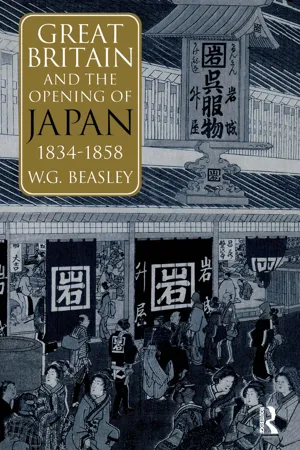
Great Britain and the Opening of Japan 1834-1858
About this book
Reissue in paperback (with new Introduction) of the 1951 classic analysis of the crucial years leading up to the Meiji restoration in which Britain provided Japan with its wealth and power model.
Chapter I
Company and Crown
DURING the greater part of the eighteenth century British merchants made no attempt to renew their former connection with Japan. The closing decades of the century, however, saw a revival of interest in the north Pacific and the China seas stemming from a variety of political and economic causes. British successes in the Seven Years War freed the East India Company for a time from its enforced preoccupation with the affairs of India. The loss of the American colonies accentuated the growing emphasis on commercial rather than colonial development, while the failure to find new markets in Terra Australis, and the phenomenal increase in trade with China,1 concentrated attention on the possibility of commercial expansion in areas where a start had already been made. That, in its turn, almost inevitably brought to mind the " closed " markets of Siam, Cochin China and Japan. Four times between 1791 and 1819, British ships reached Japan in search of trade.
The story of the Hirado factory and the voyage of the Return continued to play a part in moulding British attitudes towards the Japan trade. Detailed accounts of both were made readily accessible to English readers. In 1793, for example, the East India Company published a report on the Japan trade which outlined much of its early history.2 A diary of the Return's voyage appeared in John Pinkerton's Collection of Voyages and Travels (London, 1808), and in 1822 Peter Pratt published his History of Japan, which included long excerpts from the Company's seventeenth century archives. The privileges granted to the Company by Tokugawa Ieyasu were even referred to in the correspondence columns of The Times during 1846 and 1847. Not everybody, of course, drew the same conclusions from the facts available. The Company argued that the market was difficult of access and that history showed it to be unprofitable. Others rejected all such evidence and chose to assume the value of the trade. They urged, rather, that since the withdrawal of the Hirado factory had been a peaceful and voluntary act, the privileges of 1613 still entitled Britain to trade and would, indeed, operate to overcome Japanese objections. Both points of view were still in evidence in 1834, when the Foreign Office assumed responsibility for the direction of British policy in the China seas. The conviction with which they were urged, however, and by the same token the degree to which they were likely to influence the Foreign Office, was largely conditioned by the plans and voyages of the period 1790 to 1830.
One characteristic of this period was the active interest shown by private merchants. Their first venture arose out of the newly-established fur trade across the Pacific between Nootka and Canton. In May 1790 James Colnett, in command of the ship Argonaut, reached Canton with a cargo of pelts, only to find that the Chinese officials would not allow him to sell them there. Daniel Beal, his company's agent at Macao, suggested that a market might be found for them in Korea and Japan, and in July 1791 gave him instructions to make a voyage to those countries. His plans envisaged something more than a single voyage. If the Japanese did not immediately turn him away, Beal wrote, Colnett must be particularly careful to inform them that his ship and crew were English and that he came ' for the purpose of obtaining permission to trade Annually to the Port of Nangasaque or any other belonging to Japan.'3
During August 1791 Colnett cruised up the west coast of Kyushu and at several points tried to establish communication with the Japanese. On each occasion, Argonaut or the boats she sent away towards shore were met by Japanese craft which signalled them to depart. Her Chinese interpreter proved useless. At last, Colnett wrote in his journal that he had made six such overtures ' without any prospect of communication or Trade with the natives, but by force of Arms, which in my present situation ... I did not think proper to attempt.'4 The failure led him to certain general conclusions. He could see small prospects of success for any private venture to open trade with Japan. The attempt, if made, he thought, should be in a vessel sufficiently well-manned and well-armed to command respect, but it was even so ' too doubtful and hazardous an Undertaking for two or three Merchants to Enter into, nor should it be thought on without an exclusive privilege to the trade granted by Charter.'5
Although Colnett's only published reference to this voyage6 was much less calculated to discourage further efforts than the opinions expressed in his journal, the experiences of two other expeditions tended to confirm the difficulties in the way of trading with Japan. In 1803 Captain Stewart, an American who had visited Japan in the service of the Dutch, persuaded some merchants in India to fit out two ships for Nagasaki. When the attempt was made, however, Stewart's British colleague, Captain Torey, was dismissed without ceremony and Stewart himself was eventually turned away without permission to trade.7 Fifteen years later, Captain Peter Gordon of the brig The Brothers stood into Edo Bay in search of trade. He had chosen his destination with care, hoping that at the capital he might find more willingness to relax the seclusion laws than among hidebound provincial officials at Nagasaki, but in the event he achieved no more than Colnett or Torey. His views on the subject were quoted by the Quarterly Review in the following year. Like the Java factors in 1627, he believed that if access were once obtained, the severity of the Japanese winter would ensure a demand for British woollens and that Japanese ore would supply an ample return. But the Quarterly completely disagreed. It regretted Britain's failure to establish relations with Japan, but this was ' not so much because we lost the opportunity of extending our commerce (for we believe the wants of this people are few and their superfluous produce neither great nor valuable), as that we let slip the occasion of convincing this proud and jealous government that the few Dutchmen, on whom they were long accustomed to trample, are not the best specimen of Christian Europe.'8 There was little in this to encourage further ventures. Even the Whig Edinburgh Review viewed the trade with indifference.9
If private merchants had tried and failed, the East India Company was little disposed to try at all. In 1792, at the government's request, it had produced a report on the Japan trade10 which made it abundantly clear that in the Company's view the trade could never become ' an Object of Attention for the Manufactures and Produce of Great Britain'. In a singularly unconvincing argument, the report pointed out that even at the time of the Hirado factory japan had never provided a market for British goods, while the returns from the trade, if any, must largely be in copper, a commodity that would compete in India with the output of British mines. Thus, any profits made by the Company would be at the expense of the mining interests at home. Moreover, the Hirado factory had never made any profits. To the Company, such considerations were unanswerable.
It is not surprising, then, to find that no fresh plans were made at East India House. The fact that British ships found their way to Japan under the Company's colours in 1813 and 1814 was due entirely to the energy and enthusiasm of Thomas Stamford Raffles, one of the Company's officials in the East whom Lord Minto appointed Lieutenant-Governor of Java when that island was conquered from the Dutch in 1811.
It is not clear what caused Raffles' interest in japan. It is certain, however, that it existed some months before he reached Java. In June 1811 he wrote to Lord Minto from Malacca urging that an attempt be made to open an English trade with Nagasaki. He admitted that the Japan trade was ' by no means equal to that of many neglected countries in Asia ', but still thought it worth a trial because of ' the prospect of it being opened on a more extensive scale, an event . . . very likely to be accelerated by the aggressions of Russia '. He said, too, that the intrigues and misrepresentations of the Dutch would condemn to failure any open attempt to trade. The attempt must therefore be made ' by gaining to our interest the present Dutch Resident in Japan and the Japanese Corps of Dutch interpreters, at whatever price it may cost '.11
As Lieutenant-Governor in Java, Raffles was in a position to put this plan into practice, and in 1813 he sent two ships to Nagasaki. Waardenaar, a Dutchman formerly at the Deshima factory, went as ostensible Chief, but he was accompanied by Dr. Ainslie, who was to assume command as soon as it seemed safe to reveal that a British trade was openly to be substituted for the Dutch connection. In fact, the latter object was never attained. Hendrik Doeff, the opperhoofd at Deshima, refused to take orders from Raffles and persuaded Ainslie that any attempt to reveal the truth of the situation would jeopardise both the safety of the ships and the lives of their crews. With the connivance of the Japanese interpreters, trade was carried on under Dutch colours, but Doeff remained at Deshima. An attempt to remove him in 1814, when Raffles sent Waardenaar back with one ship, met with no greater success.
Meanwhile Raffles was meeting considerable opposition in India. Minto had returned home in 1813, and the new Governor-General objected to both the scope and the nature of the Japan project. He wrote to Java deprecating the great expense, undertaken ' without having more satisfactory-grounds for assuming that the experiment was likely to succeed and that the advantages to be derived . . . were likely to be such as to justify great pecuniary sacrifices in the prosecution of the attempt'. Moreover, any plan that depended for its success on deceiving the Japanese must be fraught with danger. In fact, the letter summed up, ' the Governor-General in Council is of opinion that the attempt to establish an intercourse should have been open and avowed, that it should have been in the first instance at a small expense, and that if serious obstacles were found to exist the idea should for the time have been relinquished'.12 Some months later, when the reports and balance-sheet of the 1813 voyage reached India, the reaction was still more hostile. The Accountant-General in Calcutta claimed that money had been lost on the venture and objected that he could see more difficulties than advantages in the trade; the Governor-General ordered Raffles to take no further steps ' without special authority and instructions from the Supreme Government or from the Public Authorities in England .'13
Raffles remained optimistic, however. He maintained that the voyages, especially that of 1814, had shown a respectable profit, and that future prospects far outweighed present disadvantages. Unable to convince the authorities in India, he appealed to the Company in England. In London, of course, his plans aroused little enthusiasm. The Court of Directors expressed a hope that the Japan connection would be maintained if at all practicable, but in May 1815, some weeks before the arrival of Raffles' letter, the Governor-General had been informed that the final decision would be left to his discretion, in the expectation that he would be guided by the results of the 1814 voyage.14 Before any action could be taken on these instructions, the war with France had come to an end and preparations were being made to hand Java back to the Dutch. Thereafter, to Raffles' mind, further interference in Japan became impossible.
Raffles' attempt sprang from a very personal enthusiasm. More typical of the Company's servants were the views expressed in India and England. Responsible officials were willing to admit that the opening of japan was a desirable objective, but they did not think it an important one, certainly not one in which the returns were likely to repay the outlay of any great effort or expense. A similar attitude characterised the actions of the British government.
In the years 1791 and 1792 the government had shown signs of taking steps to end Japanese seclusion. Late in 1791, with the Company's monopoly under fierce attack from merchants in England, it had called for reports on the trade with China, Persia and Japan to enable it ' to judge what prospect there may be of extending or opening such Trade with any of those Countries .'15 The discouraging report produced by the Company was not enough to stifle this ambition. It had already been decided that Lord Macartney should go to China and try to effect so...
Table of contents
- Cover
- Title
- Copyright
- Contents
- ERRATA
- PREFACE TO THE PAPERBACK EDITION
- JAPANESE NAMES, TITLES AND DATES
- INTRODUCTION: THE SEVENTEENTH CENTURY
- CHAPTER I COMPANY AND CROWN
- " II THE OPIUM WAR IN ANGLO-JAPANESE RELATIONS
- " III SECRET PLANS
- " IV THE PERRY EXPEDITION: 1852-54
- " V THE STIRLING CONVENTION: 1854-55
- " VI SIR JOHN BOWRING AND THE FOREIGN OFFICE: 1854-57
- " VII THE ELGIN MISSION: 1857-58
- RETROSPECT AND CONCLUSIONS
- APPENDIX A THE ANGLO-JAPANESE CONVENTION OF 14 OCTOBER 1854
- " B DRAFT EXPOSITION HANDED BY REAR ADMIRAL SIR JAMES STIRLING TO THE NAGASAKI BUGYŌ, 11 OCTOBER 1855
- BIBLIOGRAPHY
- INDEX
Trusted by 375,005 students
Access to over 1.5 million titles for a fair monthly price.
Study more efficiently using our study tools.
Frequently asked questions
Yes, you can cancel anytime from the Subscription tab in your account settings on the Perlego website. Your subscription will stay active until the end of your current billing period. Learn how to cancel your subscription
No, books cannot be downloaded as external files, such as PDFs, for use outside of Perlego. However, you can download books within the Perlego app for offline reading on mobile or tablet. Learn how to download books offline
Perlego offers two plans: Essential and Complete
- Essential is ideal for learners and professionals who enjoy exploring a wide range of subjects. Access the Essential Library with 800,000+ trusted titles and best-sellers across business, personal growth, and the humanities. Includes unlimited reading time and Standard Read Aloud voice.
- Complete: Perfect for advanced learners and researchers needing full, unrestricted access. Unlock 1.5M+ books across hundreds of subjects, including academic and specialized titles. The Complete Plan also includes advanced features like Premium Read Aloud and Research Assistant.
We are an online textbook subscription service, where you can get access to an entire online library for less than the price of a single book per month. With over 1.5 million books across 990+ topics, we’ve got you covered! Learn about our mission
Look out for the read-aloud symbol on your next book to see if you can listen to it. The read-aloud tool reads text aloud for you, highlighting the text as it is being read. You can pause it, speed it up and slow it down. Learn more about Read Aloud
Yes! You can use the Perlego app on both iOS and Android devices to read anytime, anywhere — even offline. Perfect for commutes or when you’re on the go.
Please note we cannot support devices running on iOS 13 and Android 7 or earlier. Learn more about using the app
Please note we cannot support devices running on iOS 13 and Android 7 or earlier. Learn more about using the app
Yes, you can access Great Britain and the Opening of Japan 1834-1858 by William G Beasley,William G. Beasley in PDF and/or ePUB format, as well as other popular books in History & Japanese History. We have over 1.5 million books available in our catalogue for you to explore.