eBook - ePub
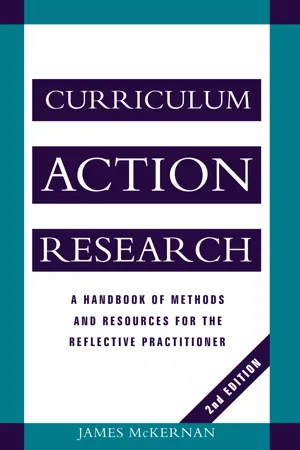
Curriculum Action Research
A Handbook of Methods and Resources for the Reflective Practitioner
- 292 pages
- English
- ePUB (mobile friendly)
- Available on iOS & Android
eBook - ePub
Curriculum Action Research
A Handbook of Methods and Resources for the Reflective Practitioner
About this book
A handbook of research techniques for teachers, this book documents the historical development and changing nature of action research in the curriculum and aims to encourage teacher development through curriculum inquiry. It describes 57 action research tools, ten of which are new.
Information
Part 1
Curriculum Action Research – The Context
The central thesis of this work is that the curriculum can be improved through action research and that teachers and other practitioners are best placed to conduct such inquiry. The main thrust of the book is devoted to the development of the research methodology by which this task can be sustained.
Part 1 sets the context for the development of action research and, more precisely, the impact of the reflective professional in educational action research. Chapter 1 explores the historical and philosophical foundations of the action research movement — suggesting sustained scientific problem solving as a major feature of action research that extends from the influence of the nineteenth-century Science in Education movement up to the present time, and noting shifts in emphasis and philosophy, including scientific, practical-deliberative initiatives, and the more recent impact of critical-emancipatory action research. Second, it outlines various attempts at theorizing about action research and offers a new model to guide inquiry. Finally, it offers up a portrait of the countenance of action research by defining a number of concepts. Chapter 2 discusses the teacher as a researcher and a professional, and offers criteria for a professional code of ethics to govern practice.
1 Action Research — Historical and Philosophical Background
Research that produces nothing but books will not suffice.
Kurt Lewin (1948) Resolving Social Conflicts
The action research movement offers practitioners a research stance towards their work and is now enjoying a resurgence of interest as practitioners continue to expand their notion of what counts as good curriculum research. Action research offers exciting new beginnings for the development of the curriculum, the profession and the person. The importance of the practical contributions that can be made through this form of inquiry, and the methodology of research and logic in pre-service training and inservice education of practitioners, should never be underestimated. Action research, as a teacher-researcher movement, is at once an ideology which instructs us that practitioners can be producers as well as consumers of curriculum inquiry; it is a practice in which no distinction is made between the practice being researched and the process of researching it. That is, teaching is not one activity and inquiring into it another. The ultimate aim of inquiry is understanding; and understanding is the basis of action for improvement.
This chapter has three aims: first, to define and offer a rationale for action research; second, to examine and explore the evolution of separate conceptions of action research; and finally, to review theories, models and concepts that disclose the ‘countenance’ or character of contemporary curriculum action.
Action Research
Action research has attempted to render the problematic social world understandable as well as to improve the quality of life in social settings. Action research has been used in industrial, health, educational, and community behavioural settings (Clark, 1976; Marsh et al., 1984; McKernan, 1988a; Selander, 1987; Wallace, 1987). Curriculum has no monopoly on action research.
The aim of action research, as opposed to much traditional or fundamental research, is to solve the immediate and pressing day-to-day problems of practitioners. Elliott (1981) has defined action research as ‘the study of a social situation with a view to improving the quality of action within it’. Action research is carried out by practitioners seeking to improve their understanding of events, situations and problems so as to increase the effectiveness of their practice. Such research does not have the writing of research reports and other publications as a primary goal.
Action research aims at feeding the practical judgement of actors in problematic situations. The validity of the concepts, models and results it generates depends not so much on scientific tests of truth as on their utility in helping practitioners to act more effectively, skilfully and intelligently. Theories are not validated independently of practice and then applied to curriculum; rather they are validated through practice. Action research is thus grounded curriculum theory.
One of the most cited definitions is that of Rapoport (Rapoport, 1970:499): ‘action research aims to contribute both to the practical concerns of people in an immediate problematic situation and to the goals of social science by joint collaboration within a mutually acceptable ethical framework.’ Rapoport sees action research as a special type of applied research which involves participants experiencing problems directly in the search for a solution and also feeds social science with some theoretical pay-off.
Halsey (1972) defined action research as a ‘small-scale intervention in the functioning of the real world … and the close examination of the effects of such interventions’.
Action inquiry is often undertaken to improve social settings, as is evident in Bogdan and Biklen’s (1982:215) definition: ‘Action research is the systematic collection of information that is designed to bring about social change.’
Carr and Kemmis (1986:162) postulate a definition rooted in critical-emancipatory terms: ‘Action research is simply a form of self-reflective enquiry undertaken by participants in social situations in order to improve the rationality and justice of their own practices, their understanding of these practices, and the situations in which the practices are carried out.’
A curriculum is at base an educational proposal, or hypothesis, which invites a critical response from those who implement it. A curriculum then invites teachers and others to adopt a research stance towards their work, suggesting rigorous reflection on practice as the basis of further professional development. Stenhouse defined research as ‘systematic and sustained inquiry, planned and self-critical, which is subjected to public criticism and to empirical tests where these are appropriate’ (Stenhouse, 1981:113). The key idea is that each classroom or work space becomes a laboratory for testing, empirically, hypotheses and proposals that are the planned and implemented curriculum. Every practitioner is thus a member of a critical community of educational scientists.
A minimal definition of action research would be:
action research is the reflective process whereby in a given problem area, where one wishes to improve practice or personal understanding, inquiry is carried out by the practitioner — first, to clearly define the problem; secondly, to specify a plan of action — including the testing of hypotheses by application of action to the problem. Evaluation is then undertaken to monitor and establish the effectivness of the action taken. Finally, participants reflect upon, explain developments, and communicate these results to the community of action researchers. Action research is systematic self-reflective scientific inquiry by practitioners to improve practice.
This definition stresses two essential points: first, action research is rigorous, systematic inquiry through scientific procedures; and second, participants have critical-reflective ownership of the process and the results.
A rationale for action research
The rationale for action research rests, initially, on three pillars: first, that naturalistic settings are best studied and researched by those participants experiencing the problem; second, that behaviour is highly influenced by the naturalistic surroundings in which it occurs: and third, that qualitative methodologies are perhaps best suited for researching naturalistic settings. Taken as a triad, these hypotheses suggest a rationale in the form of a critical-participant observation mode of practitioner inquiry.
1. Teacher as researcher
Leading on from the belief that the participant is best placed to conduct inquiry into pressing professional problems, then it follows that practitioners must engage in curriculum inquiry to improve their art and practice. Research on this view is a form of self-critical inquiry.
It was not always considered so. Teachers and administrators with questions most often turn to outside professionally trained researchers skilled in social science discourse and methodology for answers. Some turn to philosophers and theologians for answers through the belief in divine revelation and traditional authority.
The most recent conception of teacher as researcher is that deriving from the naturalistic, ‘field’, or case study paradigm of research. It has arisen largely due to the failure of positivistic ‘basic research’ and conventional disciplines within the ‘foundations of education’, such as psychology, sociology, history and philosophy, to contribute meaningfully to questions concerning problems of practice in teaching and learning. Now, teacher education programmes are still highly dominated by the foundations of education but since the early 1970s this field has been on the decline, in Europe at least.
John Elliott (1987) reminds us that the ultimate test of the usefulness of the disciplines as sources of ideas is whether teachers can indeed use them to construct a workable theory of the case in question. The notion of ‘workability’ is instructive in the sense that not only is curriculum theory a goal, but because practical reflection should lead to an improved form of human action.
The present status of curriculum action research has arisen out of the problems met by teachers and curriculum collaborator-developers in trying to improve practice. It is more centrally focused upon improving the quality of human action and response than it is with formulating theories for action. One of the most interesting developments in the teacher-researcher movement is that it has been turned into a vehicle for the effective inservice education and training of practitioners and pre-service teachers. The disciplines have had to give way to a new field which is loosely held together as ‘Curriculum Studies’. It would be a danger if it is only seen as another contributing ‘discipline’ taking a place alongside traditional foundation disciplines in education. The movement towards the ‘practical’ is now well under way with the seminal work of Schwab and Reid in curriculum philosophy; work at the Centre for Applied Research in Education at the University of East Anglia by Stenhouse, Elliott and MacDonald, most notably the Humanities and Ford Teaching Projects; the emerging ‘critical’ emancipatory style of teacher research advocated by Wilfred Carr in the UK and his coauthor Stephen Kemmis in Australia; and the case study tradition of curriculum evaluation of folk like Lawrence Stenhouse at East Anglia, Robert Stake of the University of Illinois, and Elliot Eisner of Stanford.
The teacher as researcher has shifted in the past few decades from problem solving, using quantitative measurement tools, to naturalistic research, using descriptive-illuminative designs based on case study and social anthropological designs. More recently, the movement towards a practical theory has shifted to favour European critical theory as espoused by the ‘Frankfurt School’ of philosophy, most notably Hans Gadamer and Jurgen Habermas, thus lending a philosophical interpretive-reflective note to our text. This has appeared the natural direction to take given the emphasis on personal understanding. The search seems to be for the best models and theories of understanding, and hermeneutics and critical theory were likely candidates.
2. The naturalistic and practical perspective
We begin with the idea that human behaviour is highly influenced by the surroundings in which it occurs. One must ask, ‘How does the setting influence the actors? What roles, traditions and norms dictate regularities in behaviour?’ Participants are aware of these norms and role expectations (Sarason, 1971) in the culture of the school. External researchers affect behaviour and interfere with the research setting. To counteract these effects unobtrusive methods have been advocated (Webb et al., 1966). A key premise therefore in the rationale is that behaviour must be studied in the field or, as they say, in situ, by the practitioner, who may be helped by a collaborating team.
3. The primacy of field study and qualitative methodology
Naturalistic field research seeks understanding and description while sacrificing some measurement and prediction. The emphasis is therefore on heuristics, realism and relevance. This type of work is known as ‘ex post facto’ research. Some researchers of the symbolic inter-actionist and phenomenological persuasion would argue that one cannot understand human behaviour unless one understands the framework within which the actors construct their thoughts, beliefs and actions.
Naturalistic research refers to investigations of phenomena within and in relation to their naturally occuring contexts. The assumption is that there is some driving natural theory in the research setting which creates the order that we observe and which is independent from our theorizing. Barker (1965) has suggested that nature is the inducer and the researcher the transducer in this phenomenon. A major issue in field study work is the objectivity-subjectivity issue. Researchers need to find ways of reducing the role of bias and subjectivity — in devising a scheme for coding verbal behaviour in the classroom, for example. Yet it should be pointed out that coding schemes are arbitrary — any number could be adopted.
Traditional quantitative-empiricists would trust their senses as opposed to those of their subjects; while the qualitative participant observer would give primacy to the feelings, narrative and values of the subjects in the setting. It is not enough to collect facts and feelings — the researcher must come to see these through the eyes, and from standing in the shoes, of the subjects. The qualitative participant field study researcher allows the data to emerge on their own, without any preconceived theories or forced structures imposed on the study, and looks for meaning in the events.
Research is action research to the extent that it can solve practical problems. But one point seems crystal clear: practitioners must be engaged in curriculum research and have control over the process and results of such inquiry. The practitioner1 is a participant observer and it ought to be difficult to deny the teacher research possibilities.
Historical and Philosophical Foundations of Action Research
Action research has developed from a complex web of scientific and social enterprise. A number of writers (Chein, Cook and Harding, 1948) argue that Kurt Lewin was the ‘founding father’ of action research through his work in the Group Dynamics movement of the post-war reconstructionist period. Careful study of the literature (McKernan, 1988a) shows quite clearly and convincingly that action research is a root derivative of the ‘scientific method’ reaching back to the Science...
Table of contents
- Cover
- Title Page
- Dedication
- Copyright Page
- Table of Contents
- Acknowledgements
- Preface
- Introduction
- Part 1: Curriculum Action Research – The Context
- Part 2: Action Research Methodology
- Part 3: Analysis and Issues in Action Research
- Epilogue
- References
- Author Index
- Subject Index
Trusted by 375,005 students
Access to over 1.5 million titles for a fair monthly price.
Study more efficiently using our study tools.
Frequently asked questions
Yes, you can cancel anytime from the Subscription tab in your account settings on the Perlego website. Your subscription will stay active until the end of your current billing period. Learn how to cancel your subscription
No, books cannot be downloaded as external files, such as PDFs, for use outside of Perlego. However, you can download books within the Perlego app for offline reading on mobile or tablet. Learn how to download books offline
Perlego offers two plans: Essential and Complete
- Essential is ideal for learners and professionals who enjoy exploring a wide range of subjects. Access the Essential Library with 800,000+ trusted titles and best-sellers across business, personal growth, and the humanities. Includes unlimited reading time and Standard Read Aloud voice.
- Complete: Perfect for advanced learners and researchers needing full, unrestricted access. Unlock 1.5M+ books across hundreds of subjects, including academic and specialized titles. The Complete Plan also includes advanced features like Premium Read Aloud and Research Assistant.
We are an online textbook subscription service, where you can get access to an entire online library for less than the price of a single book per month. With over 1.5 million books across 990+ topics, we’ve got you covered! Learn about our mission
Look out for the read-aloud symbol on your next book to see if you can listen to it. The read-aloud tool reads text aloud for you, highlighting the text as it is being read. You can pause it, speed it up and slow it down. Learn more about Read Aloud
Yes! You can use the Perlego app on both iOS and Android devices to read anytime, anywhere — even offline. Perfect for commutes or when you’re on the go.
Please note we cannot support devices running on iOS 13 and Android 7 or earlier. Learn more about using the app
Please note we cannot support devices running on iOS 13 and Android 7 or earlier. Learn more about using the app
Yes, you can access Curriculum Action Research by James McKernan in PDF and/or ePUB format, as well as other popular books in Education & Education General. We have over 1.5 million books available in our catalogue for you to explore.