eBook - ePub
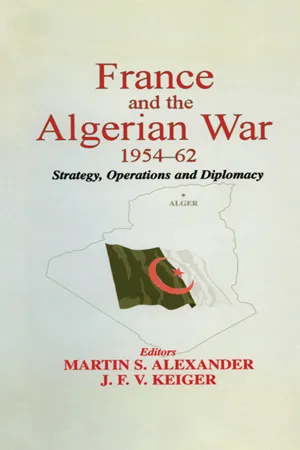
France and the Algerian War, 1954-1962
Strategy, Operations and Diplomacy
- 176 pages
- English
- ePUB (mobile friendly)
- Available on iOS & Android
eBook - ePub
France and the Algerian War, 1954-1962
Strategy, Operations and Diplomacy
About this book
The French Army's war in Algeria has always aroused passions. This book does not whitewash the atrocities committed by both sides; rather it focuses on the conflict itself, a perspective assisted by the French republic's official admission in 1999 that what happened in Algeria was indeed a war.
Information
1
France and the Algerian War: Strategy, Operations and Diplomacy
From Unknown to Acknowledged War
The Algerian War (1954-62) – which until 1999 was denied by France as a war or just known as the ‘War with no Name’ – in fact saw fighting on a massive scale. It was a war that lasted nearly eight years. It was a war that involved some two million French soldiers, as well as thousands of aircrew, sailors, gendarmes and police.1 In the present collection, new research situates the battles of the Algerian war in their contexts of strategy, operations and diplomacy
Remarkably enough, the fighting in Algeria has been among the least considered aspects to the war. Indeed, before the late 1980s the Algerian war in general evoked little interest among historians, particularly French ones.2 This began to change, and interest was especially heightened in 1997-98 when Maurice Papon was brought before French justice. Papon was arraigned for his part as a French bureaucrat who had worked for France’s Vichy regime of 1940-44, collaborating with Nazi Germany. But it soon became plain to the media in the courtroom that Papon was a catalyst. His trials obliged French people to re-examine continuities between two controversial wars for them – World War II and the Algerian War.
The Papon case opened up the long-suppressed scandal of the extra-legal repression and killing by agents of the French state – this time agents of the Republic – in the Algerian War of 1954-62. Specifically, unsavoury details were uncovered about Papon’s roles as an administrator in Morocco in 1949-53, as deputy Prefect of Police for Paris in 1953-56, as IGAME (Inspecteur-général de Vadministration en mission extraordinaire) for the Constantine département of Algeria in 1956-58, and as Prefect of Police for Paris after March 1958. In this last position, he had provided ‘executive protection’ for the violence meted out in October 1961 by Paris policemen on Algerians protesting peacefully against the war – violence that led to nearly 200 Algerian deaths and corpses being thrown into the River Seine.3
The controversies stirred by new evidence of the outrages perpetrated by agencies of the French Republic in the Algerian War gathered pace in 2000-2001. First there were dramatic confrontations between veteran senior French officers from the Algerian War era, General Jacques Massu and General Marcel Bigeard, in the French newspaper Le Monde, over violations of human rights and war crimes by the army, police and administration.4 Then in May 2001 a book was published, Services Spéciaux: Algérie, 1955-1957, by General Paul Aussaresses, that admitted to torture and murder of Algerians suspected of working for the National Liberation Front (FLN). The overriding preoccupation of French and Algerian commentators during this emotive re-examination of the Algerian war was with the misconduct of the French military in Algeria, and the complicity of French officials, politicians and police. Together the interviews and publications of 2000-2001 definitively confirmed the systematic and routinized practice of torture by French military and security forces throughout the conflict.5
Despite these disclosures – or perhaps because of them – the nature of the media debate risks a distortion of perspectives on the war. Only a limited understanding can be gained as to what the war in Algeria entailed if the focus rests solely on accusations and counter-accusations prompted by confessions from ageing French generals.6 Happily the 1990s witnessed a major easing of access to the archives of the French armed forces for the era of the Algerian War.7 This will be further facilitated in the wake of the ‘Aussaresses affair’.8
The 1990s also saw several important scholarly colloquia take place. These provided outlets for original and wide-ranging research by historians of many nationalities and disciplines, some of it drawing on the recently opened documents. The first colloquium was organised by Jean-Pierre Rioux, on ‘The Algerian War and the French’ (1990).9 Then in March 1996 the doyen of French scholars of decolonization, Charles-Robert Ageron, convened another, on ‘The Algerian War and the Algerians’.10 Most recently, paying tribute to Ageron, Algerian and French historians convened in Paris from 23 to 25 November 2000 to consider work on ‘The Algerian War in the mirror of France’s decolonizations’.11
The new readiness of veterans to investigate the contradictions and complexities of both the Algerian war and their own memories of the war has been a turning point – one now supported by contributions from historians.12 Methodologically and thematically, the approaches to the study of the war have broadened. They now embrace the standpoints of intellectual history, gender history and social history, as well as film and literary studies.
The present collection marks another step in presenting new research and perspectives. Some of its pieces were first read at a conference organized by the European Studies Research Institute at the University of Salford, in Manchester, England, in October 1996. This occasion included witness panels where veteran opponents of the war debated with former French army officers. Some of these protagonists were sharing an auditorium for the first time since their confrontations during the war itself, 40 years earlier.13
The light shed at that symposium was as strongly evident in the research presented at Militaires et guérilla dans la guerre d’Algérie, a colloquium held at the Université Paul-Valéry (Montpellier III) in May 2000.14 Publications and conferences such as these have clarified the social and professional experiences of French conscripts and reservists (all of whom may properly be tagged ‘citizens in uniform’). This was overdue, for the 1970s and 1980s saw a flood of autobiographies that recounted the experiences and outlooks of career officers. Representations of the war in film and literature have also attracted wide attention.15
The Algerian Experience as Real War
To be sure, other stones need to be turned on the Algerian War as a lived or ‘experienced’ phenomenon, and as an imagined one. Yet to venture too far into the socio-cultural phenomena of the Algerian conflict risks ignoring the paths that direct us to any war’s fundamental characteristics: its strategies, military operations, intelligence and diplomacy (or ‘the international context’). This collection firmly returns the research spotlight to military (or ‘warlike’) aspects of events in Algeria.16 Indeed it reaffirms the importance of examining the convulsions of that time in Algeria as a war. Paradoxically the official French admission in 1999 that a state of war did indeed exist between 1954 and 1962 assists a refocusing of research upon the adversaries’ war aims (and thus diplomatic efforts), war strategies, and war making.
Ironically, it was the insurgent Army of National Liberation (ALN) who had always thought it was fighting a war. Their clarity of purpose contrasted with years of obfuscation by the French authorities. The latter’s denial handicapped the ‘war’ effort, preventing them from formulating and articulating clear war aims and mobilizing domestic opinion in metropolitan France.17
The purpose, here, is to emphasize and interpret dimensions of the war liable to be overlooked if the Algerian conflict is reconstructed entirely through the prisms of ‘memory’, representational imagery, or the cultural and literary perspectives of the ‘social imaginary’. There is a paradox about the protracted ‘official silence’, the denial by the French authorities that events in Algeria were a war: for those experiencing it at the sharp end were in no doubt. What was taking place in Algeria was bloody, violent, dangerous and undeniably militarized. Politicians and bureaucrats in Paris might seek to employ a softer, euphemistic discourse, typically characterizing the Algerian crisis as a ‘problem of the maintenance of order’ or a ‘judicial-policing matter’. But books and articles written by those close to the danger – civilians and soldiers alike – suggest an altogether more brutal grasp of what was going on. Le Maghreb en feu (’The Maghreb in Flames’) was how Marshal Alphonse Juin, a French North African orpiednoir born in Bone, who had been Resident-General in Morocco from 1947 to 1951, titled his book in 1957 about the Algerian situation.
The previous year Roger Delpay, a widely-read Indochina veteran and war correspondent, depicted Algeria as a graveyard for French soldiers under a Soleil de Mort (a ‘Sun of Death’). Indeed, in a history of the French army published in 1963, the year after Algeria won independence, the well-informed journalist Paul-Marie de La Gorce wrote that, from 1956 on, the FLN’s militarization of the struggle for independence meant that ‘It was, therefore, a war that was being waged in Algeria.’ Consequently, he added: ‘The task of the French army was first and foremost to make war.’18
War and Pacification
In the first essay, Alexander Zervoudakis, a specialist on French counter-insurgency and intelligence operations, takes us to the heart of the French army’s pacification effort in Algeria. He argues that even undisciplined and poorly trained units (his example being the 584th Transport Battalion) could be galvanized by inspirational, intelligent, no-nonsense leadership such as the 584th experienced when it was taken over by Major Jean Pouget, a celebrated Dien Bien Phu veteran.
The case of the 584th in their remote post at the Bordj de 1’Agha in the Sahara reveals the capability of units that were very definitely non-elite to pursue effective pacification – and at a time when the recall of reservists, seething with resentment at having to resume military duties, presented as great a threat to France’s counter-insurgency strategies as did the FLN-ALN.
Of course, crucial to pacification were the SAS (Sections Administratives Spécialisées) or ‘Blue képis’. These were originally established in May 1955 as part of the reform package that year ordered by Jacques Soustelle, then the Governor-General of Algeria. The SAS were expanded eventually to 5,000 personnel at 800 rural centres. Arabic-speaking volunteers, the SAS were initially intended by Soustelle ‘to try and bridge the yawning gap between the administration and the poorer inhabitants’.19
Typically young lieutenants, occasionally captains, who were brave and idealistic, many SAS officers urged closer integration and extended political and constitutional rights for Muslims, within the framework of a remodelled but durable Algérie Française (French Algeria). The SAS experience was one of great danger, in isolated villages deep in the interior. For their security they depended on the Muslim ‘self-defence sections’ (Groupes d’auto-défense, GAD), with whom they lived. Periodically a blood-chilling incident occurred where either the GAD turned on its SAS officer, sometimes accompanied by his wife, and massacred them, or where a SAS and its GAD were hit by an ALN squad and wiped out.20
SAS personnel had to win over the ‘hearts and minds’ of the Muslim villagers, to eliminate the ‘water’ in which the Algerian nationalist ‘fish’ (in classical Maoist insurgent warfare terminology) could swim, be oxygenated, and multiply. As Alistair Home intimated 25 years ago in his widely-read book, A Savage War of Peace, there were ‘too few képis bleus with all the numerous qualifications that the job required; and, inevitably, there were the bad ones who transformed the SAS into “intelligence centres” where torture was not unknown’.21
Yet there was more to the SAS than showing the ‘human side’ of the French colonial apparatus. Sometimes ...
Table of contents
- Cover Page
- Frontmatter Chapter1
- Half Title page
- Title Page
- Copyright Page
- Dedication
- Contents
- Chronology
- Maps and Figure
- 1 France and the Algerian War: Strategy, Operations and Diplomacy
- Part I Strategy and Operations
- Part II Diplomacy
- Abstracts
- List of Contributors
- Index
Trusted by 375,005 students
Access to over 1.5 million titles for a fair monthly price.
Study more efficiently using our study tools.
Frequently asked questions
Yes, you can cancel anytime from the Subscription tab in your account settings on the Perlego website. Your subscription will stay active until the end of your current billing period. Learn how to cancel your subscription
No, books cannot be downloaded as external files, such as PDFs, for use outside of Perlego. However, you can download books within the Perlego app for offline reading on mobile or tablet. Learn how to download books offline
Perlego offers two plans: Essential and Complete
- Essential is ideal for learners and professionals who enjoy exploring a wide range of subjects. Access the Essential Library with 800,000+ trusted titles and best-sellers across business, personal growth, and the humanities. Includes unlimited reading time and Standard Read Aloud voice.
- Complete: Perfect for advanced learners and researchers needing full, unrestricted access. Unlock 1.5M+ books across hundreds of subjects, including academic and specialized titles. The Complete Plan also includes advanced features like Premium Read Aloud and Research Assistant.
We are an online textbook subscription service, where you can get access to an entire online library for less than the price of a single book per month. With over 1.5 million books across 990+ topics, we’ve got you covered! Learn about our mission
Look out for the read-aloud symbol on your next book to see if you can listen to it. The read-aloud tool reads text aloud for you, highlighting the text as it is being read. You can pause it, speed it up and slow it down. Learn more about Read Aloud
Yes! You can use the Perlego app on both iOS and Android devices to read anytime, anywhere — even offline. Perfect for commutes or when you’re on the go.
Please note we cannot support devices running on iOS 13 and Android 7 or earlier. Learn more about using the app
Please note we cannot support devices running on iOS 13 and Android 7 or earlier. Learn more about using the app
Yes, you can access France and the Algerian War, 1954-1962 by Martin S. Alexander,J.F.V. Keiger in PDF and/or ePUB format, as well as other popular books in Politics & International Relations & African History. We have over 1.5 million books available in our catalogue for you to explore.