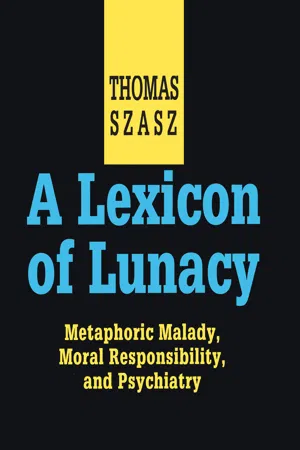
Thomas Szasz is renowned for his critical exploration of the literal language of psychiatry and his rejection of officially sanctioned definitions of mental illness. His work has initiated a continuing debate in the psychiatric community whose essence is often misunderstood. Szasz's critique of the established view of mental illness is rooted in an insistent distinction between disease and behavior. In his view, psychiatrists have misapplied the vocabulary of disease as metaphorical figures to denote a range of deviant behaviors from the merely eccentric to the criminal. In A Lexicon of Lunacy, Szasz extends his analysis of psychiatric language to show how its misuse has resulted in a medicalized view of life that denies the reality of free will and responsibility. Szasz documents the extraordinary extent to which modern diagnosis of mental illness is subject to shifting social attitudes and values. He shows how economic, personal, legal, and political factors have come to play an increasingly powerful role in the diagnostic process, with consequences of blurring the distinction between cultural and scientific standards. Broadened definitions of mental illness have had a corrosive effect on the criminal justice system in undercutting traditional conceptions of criminal behavior and have encouraged state-sanctioned coercive interventions that bestow special privileges (and impose special hardships) on persons diagnosed as mentally ill. Lucidly written and powerfully argued, and now available in paperback, this provocative and challenging volume will be of interest to psychologists, criminologists, and sociologists.
- 214 pages
- English
- ePUB (mobile friendly)
- Available on iOS & Android
eBook - ePub
About this book
Information
Part I Language and Lunacy
1 Shakespeare’s Plays
Let us consider Shakespeare’s masterpiece, Hamlet… It was not until the material of the tragedy had been traced back by psychoanalysis to the Oedipus theme, that the mystery of its effect was at last explained.
—Sigmund Freud, The Moses of Michelangelo
There are more than two dozen references to madness in Hamlet, and many more in Shakespeare’s other plays. Yet, despite his superbly rich language, Shakespeare uses a mere handful of terms to describe persons for whose abnormal mental conditions we now have thousands. We attribute this difference to scientific progress that now permits us to understand that persons such as Hamlet or Lady Macbeth are, in fact, literary examples of mentally ill persons displaying the symptoms of schizophrenia and depression. In his introduction to the Pelican series edition of Hamlet, Willard Farnham states: “Hamlet, indeed, may seem to have been shaped to order for psychoanalysis.”1 But, surely, this is a case of putting the cart before the horse, by all of three centuries. “Twentieth-century psychologies,” Farnham adds, “invite us to see within Hamlet some severe seizure of the soul which is close to disease, if not actually disease.”2 But the leap from a seizure of the soul to a disease of the body is no less prodigious than the leap from religion to science, from mental disease to brain disease.
I reject this modern, medicalized view of Hamlet’s behavior. Instead, I regard our psychiatric vocabulary as a type of pseudoscientific slang. American English thus contains two classes of slang terms for mental illness—one professional, the other popular; each of these classes contains hundreds of words, doing essentially the same work Shakespeare accomplished with just a handful. Because our psychiatric-diagnostic terms conceal human tragedies behind a veil of pseudomedical jargon, and because our colloquial slang terms for lunacy divert us with imaginative metaphors, both distract us from the painful realities of the human condition. In contrast, by using language at once direct and allusive, unadorned yet rich, Shakespeare exhibits not only the method in, and the meaning of, madness, but also the motives of those who seek to define others as mad, thus illuminating the conflicts intrinsic to the human condition. To illustrate this thesis, I shall cite, with a minimum of commentary, some of Shakespeare’s most powerfully moving psychiatric observations.3
Early in Hamlet, Polonius diagnoses Hamlet as mad:
Mad call I it, for, to define true madness,
What is’t but to be nothing else but mad?
(2.2. 93-94)
Is Shakespeare telling us, at the very birth of the modern idea of insanity as illness, that there is no such thing as mental illness—that there is, in fact, nothing to define? I think so, for he has Polonius adding: “But let that go” (line 95).
Observe that when we describe a person as brave or cowardly, loyal or disloyal, we expect no additional definitions of conditions anterior to the behavior so classified that serve as its causes. A person behaves bravely because he is brave, not because braveness or some other condition causes him to do so. Shakespeare uses the word mad the same way we use the word magnanimous—that is, as an adjective to describe certain kinds of behaviors. What kinds? Actually, Shakespeare attaches the adjective mad to several behaviors, such as:
- Behaviors that seem strange to some persons, but not to others—for example, Othello’s jealousy,
- Behaviors whose motives seem obscure, perhaps because they are deliberately concealed—for example, Hamlet’s suspiciousness,
- Behaviors that appear to be bizarre or meaningless, perhaps because they hide a guilty secret—for example, Lady Macbeth’s hallucinations,
- Behaviors that are the results of tragic miscalculation, leading to disappointment, frustration, and helplessness—for example, King Lear’s depression,
- Behaviors that, though eccentric, endear the subject to, rather than alienate him from, those around...
Table of contents
- Cover Page
- Title Page
- Copyright Page
- Contents
- Preface
- Acknowledgments
- Introduction
- Part I Language and Lunacy
- Part II Metaphoric Malady, Moral Responsibility, and Psychiatry
- Epilogue
- Notes
- Index
Trusted by 375,005 students
Access to over 1.5 million titles for a fair monthly price.
Study more efficiently using our study tools.
Frequently asked questions
Yes, you can cancel anytime from the Subscription tab in your account settings on the Perlego website. Your subscription will stay active until the end of your current billing period. Learn how to cancel your subscription
No, books cannot be downloaded as external files, such as PDFs, for use outside of Perlego. However, you can download books within the Perlego app for offline reading on mobile or tablet. Learn how to download books offline
Perlego offers two plans: Essential and Complete
- Essential is ideal for learners and professionals who enjoy exploring a wide range of subjects. Access the Essential Library with 800,000+ trusted titles and best-sellers across business, personal growth, and the humanities. Includes unlimited reading time and Standard Read Aloud voice.
- Complete: Perfect for advanced learners and researchers needing full, unrestricted access. Unlock 1.5M+ books across hundreds of subjects, including academic and specialized titles. The Complete Plan also includes advanced features like Premium Read Aloud and Research Assistant.
We are an online textbook subscription service, where you can get access to an entire online library for less than the price of a single book per month. With over 1.5 million books across 990+ topics, we’ve got you covered! Learn about our mission
Look out for the read-aloud symbol on your next book to see if you can listen to it. The read-aloud tool reads text aloud for you, highlighting the text as it is being read. You can pause it, speed it up and slow it down. Learn more about Read Aloud
Yes! You can use the Perlego app on both iOS and Android devices to read anytime, anywhere — even offline. Perfect for commutes or when you’re on the go.
Please note we cannot support devices running on iOS 13 and Android 7 or earlier. Learn more about using the app
Please note we cannot support devices running on iOS 13 and Android 7 or earlier. Learn more about using the app
Yes, you can access A Lexicon of Lunacy by Thomas Szasz in PDF and/or ePUB format, as well as other popular books in Medicina & Psichiatria e salute mentale. We have over 1.5 million books available in our catalogue for you to explore.