- 430 pages
- English
- ePUB (mobile friendly)
- Available on iOS & Android
eBook - ePub
About this book
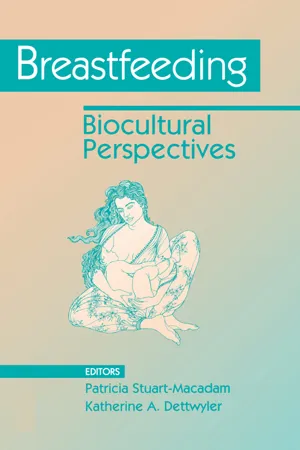
Breastfeeding is a biocultural phenomenon: not only is it a biological process, but it is also a culturally determined behavior. As such, it has important implications for understanding the past, present, and future condition of our species. In general, scholars have emphasized either the biological or the cultural aspects of breastfeeding, but not both. As biological anthropologists the editors of this volume feel that an evolutionary approach combining both aspects is essential. One of the goals of their book is to incorporate data from diverse fields to present a more holistic view of breastfeeding, through the inclusion of research from a number of different disciplines, including biological and social/cultural anthropology, nutrition, and medicine. The resulting book, presenting the complexity of the issues surrounding very basic decisions about infant nutrition, will fill a void in the existing literature on breastfeeding.
Information
1
Biocultural Perspectives on Breastfeeding
INTRODUCTION
The biological anthropologist has a unique way of viewing the world: a cross-cultural and evolutionary perspective that acknowledges that there are both biological and cultural components to human behavior. A survey of the existing breastfeeding literature reveals that, in general, this perspective has not been widely adopted. For example, much of the literature has focused either on cultural aspects, such as the style of breastfeeding, and the cultural milieu in which it occurs, or biological aspects, such as breast milk properties and composition. As biological anthropologists, the editors of this volume feel that it is essential to approach the topic of breastfeeding with a perspective that views breastfeeding within a biocultural, cross-cultural, and evolutionary framework. The main goal of Breastfeeding: Biocultural Perspectives is to use this type of approach, both to explore a number of issues relating to human lactation and breastfeeding and to illustrate the perils of ignoring the “bio”factor of the biocultural equation. Another goal of the book is to integrate data from diverse fields to present a more holistic view of breastfeeding. These goals are accomplished through the inclusion of the work of researchers involved in a number of different disciplines, including biological anthropology, cultural anthropology, history, nutrition, and medicine. The contributors to this volume have different attitudes and opinions, depending on their philosophy, training, and research interests, but all are aware of the biocultural nature of breastfeeding and strive to put this message across in their writing.
In Chapter 2, “A Time to Wean: The Hominid Blueprint for the Natural Age of Weaning in Modern Human Populations,” Dettwyler examines comparative mammalian data on weaning age and comes to some conclusions that refute the commonly held beliefs on the “natural” weaning age of humans. According to Dettwyler, the range of weaning age for humans, variously estimated by gestation length, as a function of birth weight, adult weight, or adult body dimension, or by timing of eruption of first permanent molar, should be between 2.5 and 6 years, depending on the method used. This is substantially different from the weaning age of between 9 months and 1 year that has, until now, been cited as the “natural” weaning age of humans. Dettwyler says that human cultural traits, such as the modification of food with heat, or the processing of cereal products, would have resulted in a weakening of the strong association between biological variables such as the eruption of the first permanent molar and weaning age. However, as she states “It is reasonable to assume that 5–7 million years of evolution as hunting and gathering hominids on the East African savannah has resulted in genetic coding that leads the human infant to expect nursing to continue for several years after birth, and for the urge to suckle to remain strong for this entire period.”
Acknowledgment and understanding of this fact are important, particularly in light of the peculiar bias against, and even disparagement of, “extended” nursing prevalent in contemporary North American society. This discrimination has also occurred in other times and cultures; Wickes (1953) describes the case of a woman living in nineteenth-century Britain who suckled a child for three and a quarter years and then developed epilepsy. The attendant physician wrote: “The worst symptoms of debility at last attended this monstrous proceeding.”
In my chapter (Chapter 3), “Breastfeeding in Prehistory,” I synthesize data from a number of sources including bone chemistry, history, ethnology, and demography to develop a picture of breastfeeding patterns and practices in prehistory. Some data, such as that obtained from chemical studies on archaeological bone, are highly technical and probably new to the reader; some, such as that obtained from historical and ethnographic sources, are more general in nature and widely known. I show that culture, in the form of differing infant feeding practices, can have an enormous impact on the health, morbidity, and mortality of contemporary infants, and that undoubtedly there was a similar effect for infants in prehistoric times. A synthesis of the various types of data brings me to the conclusion that, as in modern and historical times, breastfeeding practices in prehistory must have varied according to temporal, geographic, cultural, and even idiosyncratic factors. However, it does appear that in many prehistoric cultures substantial supplementation with foods other than breast milk, if not actual weaning, took place between 2 and 3 years of age.
In Chapter 4, “The Culture and Biology of Breastfeeding: An Historical Review of Western Europe,” Fildes presents a fascinating survey of breastfeeding practices in preindustrial and industrial western European societies. She argues that although there are a number of factors that affect the health of mothers and infants, the method of infant feeding was not only one of the most important determinants of early childhood morbidity and mortality, but it also affected maternal health. She focuses on several infant feeding variables that have had an impact on health and disease patterns of mothers and infants throughout history: whether or not an infant was breastfed, and if breastfed, for how long; and the timing and type of supplemental and weaning foods. She concludes that there are very complex interactions between the biology and culture of breastfeeding that can have a profound effect on both maternal and infant health.
Quandt’s chapter (Chapter 5), “Sociocultural Aspects of the Lactation Process,” puts breastfeeding into the context of a feeding behavior that is regulated by the social and structural milieu in which the participants interact. She considers three important dimensions of breastfeeding: (1) whether or not, and when, breastfeeding is initiated, (2) the duration of exclusive breastfeeding, and (3) the frequency, duration, and timing of breastfeeding episodes. Quandt reviews the biobehavioral interactions of breastfeeding, and illustrates how these have been shaped by social and cultural factors into a diverse array of contemporary infant feeding practices. She touches on breastfeeding behaviors and birth-spacing, “breastfeeding style,” and the “insufficient milk” controversy. Finally, she proposes a model that links the biology of lactation to social and cultural factors through specific breastfeeding behaviors.
Van Esterik takes a political stance to breastfeeding and tackles the advocacy issue head-on in Chapter 6, “The Politics of Breastfeeding: An Advocacy Perspective.” She traces the development of infant feeding as a public policy issue and follows the path of the struggle against obstacles to breastfeeding that began at a grass roots level and resulted in global initiatives leading to the Innocenti Declaration. She describes a number of issues and organizations that arose along the way, including La Leche League, INFACT (the Infant Formula Action Coalition), and IBFAN (the International Baby Food Action Network). Van Esterik concludes with a discussion of advocacy and anthropology and says that “Breastfeeding is simultaneously biologically and socially constructed, deeply embedded in social relations, and yet cannot be understood without reference to varying levels of analysis including individual, household, community, institutional, and world industrial capitalism.”
In Chapter 7, “Beauty and the Breast: The Cultural Context of Breastfeeding in the United States,” Dettwyler reminds us that we, are, indeed, mammals. The class Mammalia actually derives its name from the mammae, or mammary glands, which distinguish mammals from other classes of animals. The function of mammae is to nourish young with the secretions of the gland. Dettwyler poses the question “Why do women have breasts?” and illustrates how far women in Western, particularly North American, culture have drifted from their mammalian heritage in terms of the function of breasts. In that culture, breasts are not considered to be organs for the feeding of young, but, instead, sexual objects for the titillation of men. This underscores how cultural beliefs can mask biological function. Dettwyler explores a number of assumptions underlying beliefs about breasts and emphasizes that North American attitudes toward breasts (and, as a consequence, breastfeeding) are the result of learned, not innate, behavior. As she says, “breastfeeding is both a ‘simple and natural’ process that flows from our human biological status as mammals, and a heavily culturalized behavior that can be so modified by cultural perceptions away from a ‘natural process’ as to be almost unrecognizable.” Dettwyler ends with a discussion of ways in which North American women can “take back their breasts” so that both mothers and infants can enjoy the benefits of breastfeeding.
In Chapter 8, “Baby-Controlled Breastfeeding: Biocultural Implications,” Woolridge presents data on the physiological repercussions of imposing arbitrary schedules on the process of breastfeeding. He supports the concept of “baby-controlled” feeding on the premise that infants are individuals who have differing nutritional requirements and are capable of regulating their own food intake. Data from his studies show that not only the volume but also the quality of milk is amenable to manipulation. By taking an individual rather than a populational approach, he is able to identify a number of predictors (behavioral) of the fat concentration of milk (physiological). He shows that feed frequency and duration have a direct effect on milk fat concentration.
In Chapter 9, “Breastfeeding: Adaptive Behavior for Child Health and Longevity,” Cunningham presents a summary of the health advantages of breastfeeding and the potential health problems associated with formula feeding. Data from a number of studies show that formula-fed babies are at increased risk in terms of morbidity and mortality. For example, in Latin America, the risk of mortality for bottle-fed infants is at least 10 times higher than for breastfed infants. Even in the western world, where living conditions are generally good, the risk of fatal and nonfatal respiratory infections is 2-to 5-fold higher among bottle-fed infants. Cunningham shows that otitis media, bacteremia, and meningitis occur more frequently among infants who are not breastfed. The relative risk for bottle-fed infants in sudden infant death syndrome (SIDS) is more than fivefold, which translates into 4000 crib deaths every year in the United States. He observes that autoimmune diseases, subtle immune deficiencies, systemic vasculitis, and allergic diseases are immunoregulatory diseases that are influenced by the method of infant feeding, and can be triggered by exposure to cow’s milk (in the form of infant formula) early in life. Cunningham also presents evidence that psychomotor and neural development are advanced in breastfed babies relative to formula-fed babies. Although there are some contraindications for breastfeeding, primarily related to the mother’s diet or use of drugs, there is a long list (Table 9.3) of threats to the health of formula-fed babies that can result from errors in the manufacture or preparation of formulas. In conclusion, Cunningham still feels that “breast is best.”
McKenna and Bernshaw’s chapter (Chapter 10), “Breastfeeding and Infant–Parent Co-sleeping as Adaptive Strategies: Are They Protective against SIDS?,” presents a detailed discussion of the relationship between SIDS and infant feeding practices, one of the issues raised by Cunningham in Chapter 9. They point out that the physiological effects on infants of breastfeeding and adult proximity during sleep have not been appreciated by researchers. They show that populational differences in SIDS incidence, knowledge of the disorder itself, and an understanding of infant physiology can provide clues to why some infants die from SIDS and others do not. McKenna and a co-investigator have been actively involved in laboratory research monitoring physiological processes of mother–infant co-sleeping and breastfeeding. They have discovered that co-sleeping and breastfeeding infants spend less time in deep stages of sleep, and that co-sleeping creates more variable physiological experiences for the infant. These observations have important implications for understanding the complex etiology of SIDS.
Ellison, in Chapter 11, “Breastfeeding, Fertility, and Maternal Condition,” writes about the relationship between breastfeeding and lactational infertility. It is astounding to realize that modern science has only recently elevated this phenomenon from “old wives tale” to acceptable dogma. This, even though the relationship between breastfeeding and temporary infertility appears to have been known for centuries; it was acknowledged by Aristotle (Anderson, 1983), and was well known in later historical times (Fildes, 1986). However, as Ellison states, it was not until the 1970s (Tyson, 1977), that the endocrinological basis for this relationship began to be understood. Every time a baby stimulates the nipple by sucking, prolactin is released by the hypothalamus. It was recognized that prolactin was linked to the suppression of ovarian function in lactating women. Ellison states “As Henry (a French demographer) had originally suspected, natural fertility variation appeared to be a reflection of variation in biological functions, albeit an aspect of reproductive biology intimately connected with behavior.” Using data from a number of studies, Ellison identifies some of the cultural factors that can affect the duration of lactational amenorrhea, including the frequency with which the infant is fed, the duration of breastfeeding, whether night feeding occurs, and when supplementary food is introduced. Depending on these cultural factors, menses can resume almost immediately, within a few months, or be delayed for between 1 and 2 years. Once again, culture is shown to have a profound effect on biology.
In Chapter 12, “Breast Cancer, Reproductive Biology, and Breastfeeding,” Micozzi illustrates that overall breast cancer risk is associated with a very complex array of cultural and biological factors. Breastfeeding appears to confer protection against breast cancer in two major ways: first, through being breastfed as an infant, and second, through breastfeeding as an adult. The first follows from Micozzi’s observation that dietary events relevant to breast cancer risk probably occur early in life. If a woma...
Table of contents
- Cover
- Halftitle Page
- Title Page
- Copyright Page
- Dedication
- Table of Contents
- Foreword
- Acknowledgments
- Chapter 1. Biocultural Perspectives on Breastfeeding
- Chapter 2. A Time to Wean: The Hominid Blueprint for the Natural Age of Weaning in Modern Human Populations
- Chapter 3. Breastfeeding in Prehistory
- Chapter 4. The Culture and Biology of Breastfeeding: An Historical Review of Western Europe
- Chapter 5. Sociocultural Aspects of the Lactation Process
- Chapter 6. The Politics of Breastfeeding: An Advocacy Perspective
- Chapter 7. Beauty and the Breast: The Cultural Context of Breastfeeding in the United States
- Chapter 8. Baby-Controlled Breastfeeding: Biocultural Implications
- Chapter 9. Breastfeeding: Adaptive Behavior for Child Health and Longevity
- Chapter 10. Breastfeeding and Infant-Parent Co-Sleeping as Adaptive Strategies: Are They Protective against SIDS?
- Chapter 11. Breastfeeding, Fertility, and Maternal Condition
- Chapter 12. Breast Cancer, Reproductive Biology, and Breastfeeding
- Chapter 13. Commentary
- Chapter 14. Commentary
- Chapter 15. Commentary
- Biographical Sketches of Contributors
- Index
Trusted by 375,005 students
Access to over 1.5 million titles for a fair monthly price.
Study more efficiently using our study tools.
Frequently asked questions
Yes, you can cancel anytime from the Subscription tab in your account settings on the Perlego website. Your subscription will stay active until the end of your current billing period. Learn how to cancel your subscription
No, books cannot be downloaded as external files, such as PDFs, for use outside of Perlego. However, you can download books within the Perlego app for offline reading on mobile or tablet. Learn how to download books offline
Perlego offers two plans: Essential and Complete
- Essential is ideal for learners and professionals who enjoy exploring a wide range of subjects. Access the Essential Library with 800,000+ trusted titles and best-sellers across business, personal growth, and the humanities. Includes unlimited reading time and Standard Read Aloud voice.
- Complete: Perfect for advanced learners and researchers needing full, unrestricted access. Unlock 1.5M+ books across hundreds of subjects, including academic and specialized titles. The Complete Plan also includes advanced features like Premium Read Aloud and Research Assistant.
We are an online textbook subscription service, where you can get access to an entire online library for less than the price of a single book per month. With over 1.5 million books across 990+ topics, we’ve got you covered! Learn about our mission
Look out for the read-aloud symbol on your next book to see if you can listen to it. The read-aloud tool reads text aloud for you, highlighting the text as it is being read. You can pause it, speed it up and slow it down. Learn more about Read Aloud
Yes! You can use the Perlego app on both iOS and Android devices to read anytime, anywhere — even offline. Perfect for commutes or when you’re on the go.
Please note we cannot support devices running on iOS 13 and Android 7 or earlier. Learn more about using the app
Please note we cannot support devices running on iOS 13 and Android 7 or earlier. Learn more about using the app
Yes, you can access Breastfeeding by Patricia Stuart-Macadam in PDF and/or ePUB format, as well as other popular books in Social Sciences & Gynecology, Obstetrics & Midwifery. We have over 1.5 million books available in our catalogue for you to explore.