Writing primarily for student and newly qualified teachers, whose classroom experience is necessarily limited, the author takes pains to elucidate why to assess, what to assess and how to assess.
eBook - ePub
Monitoring, Assessment, Recording, Reporting and Accountability
Meeting the Standards
- 148 pages
- English
- ePUB (mobile friendly)
- Available on iOS & Android
eBook - ePub
Monitoring, Assessment, Recording, Reporting and Accountability
Meeting the Standards
About this book
Information
Chapter 1
An introduction to MARRA
The most important single factor influencing learning is what the learner already knows. Ascertain this and teach him accordingly.
(Ausubel 1968}
1.1 What is MARRA?
To be awarded Qualified Teacher Status (QTS), those training to teach must meet nationally defined Professional Standards (DfES/'TTA 2002). To successfully complete the induction period Newly Qualified Teachers (NQTs) must meet nationally defined Induction Standards (DfES/TTA 2003). The title of this book, Monitoring, Assessment Recording, Reporting and Accountability MARRA - originates from the initial version of the national standards (DfEE 1998a; TTA 2000).
MARRA is evident across the QTS and Induction Standards, from setting 'high expectations of all pupils' and communicating 'sensitively with parents and carers', to 'understanding how pupils' learning can he affected by their linguistic development', planning from evidence of 'past and current achievement' and promoting "active and independent learning'. It is considered in greater detail in the section named "Monitoring and Assessment'.
All aspects: of MARRA relate to assessment, which in turn relates to learning. Monitoring is the skill of effectively overviewing and analysing a learning situation. Assessment is the closer examination of pupils' learning. Recording enables teachers to keep track-of areas identified by monitoring and assessment including pupils' strengths and weaknesses and their attainment of learning targets. Reporting is the process of informing others about the learning which has taken place. Accountability enables others to evaluate the work of the organisation by analysing the results of assessment.
MARRA underpins professional practice. The national standards that trainee teachers and NQTs must meet provide a starting point for this, focusing on the development of effective practice in assessment and learning coupled with knowledge of, and increasing experience in, the statutory requirements in assessment and reporting. Experienced practitioners build upon these standards to enhance their practice and to make use of statutory assessment results in and beyond the school for the purposes of professional accountability.
1.2 What is the purpose of MARRA?
The purpose of MARRA is to enable learning, teaching and accountability through the effective use of assessment. The Task Group for Assessment and Testing (TGAT), which was convened to consider how the two areas would develop within a national framework, stated that the four purposes of assessment were formative, diagnostic, summative and evaluative (DES 1988).
Formative assessment informs future teaching and learning and is at the heart of practice in the classroom. For example, the teacher may discover, when questioning pupils, that several have misunderstood an explanation. She may decide to intervene and provide teaching which will address the difficulty and so improve pupils' learning. The time taken between assessment and action will vary. Sometimes action is taken almost immediately, with the act of assessment being barely discernible to the untrained observer. At other times the teacher will reflect at length upon pupils' work and design a new or modified teaching programme to enhance learning.
Diagnostic assessment diagnoses the cause of a particular problem and is usually related to individuals rather than groups of pupils. It may take several stages before a diagnosis of a problem is made. For example) when marking the teacher may notice a number of errors occur when a pupil is undertaking word problems in mathematics. While observing she may see that the pupil is riot impeded by his reading ability but is far from confident in deciding which method to apply. When she questions the pupil she may discover that he is looking for clues in the individual words rather than considering the problem as a whole, assuming that 'altogether' means 'add' without considering how it is used in the question. The diagnosis can now provide the teacher with sufficient evidence upon which to base teaching which will help the pupil tackle his difficulty, hi more extreme cases a: teacher may be unable to effectively diagnose a difficulty and call upon the help of the school Special Education Needs Coordinator (SENCO) or an external expert, who in turn may draw upon a range of commercially produced diagnostic assessment material to determine the specific needs of a pupil in a given area of learning. This may in turn lead to a more formalised Individual Education Plan (IEP) which sets specific targets for the pupil's learning.
Summative assessment provides a summation of learning, usually at an end point or on a particular date as in the case of statutory End of Key Stage assessments of the core subjects (see Table 1.1). Summative assessment often marks the point when pupils' results, scores, grades or marks are presented to those beyond the classroom, such as the pupils' parents. If summative assessments occur regularly and relate to one another, parents can experience an overview of their child's learning. If a series of summative assessments do not relate to one another however, parents are left with no more than a meaningless assortment of numbers and letters.
Evaluative assessment focuses upon evaluating the progress of the institution by collating and analysing the progress made by individuals or groups of pupils at and between statutory assessments. In a school situation this process will usually involve the head teacher, senior teachers and the governing body rather than all members of staff, but all teachers should be aware of the issues pertaining to this area, as the results of analysis are used to justify the work of the institution to parents and the wider community. Evaluative assessment enables accountability.
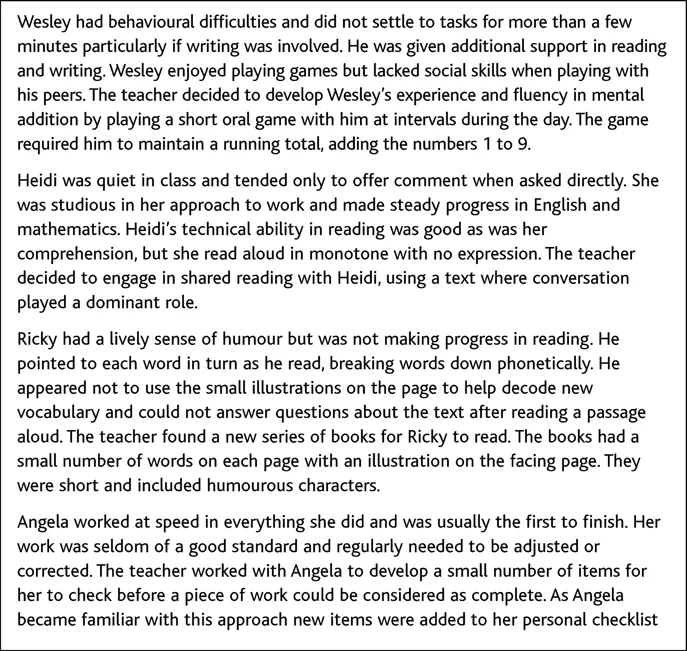
The QTS and Induction standards draw upon the lour TGAT purposes hv indicating the knowledge, skills and understanding required of new entrants to primary teaching in monitoring, assessment, recording, reporting and accountability. The key to MARRA is not simply knowing and understanding the processes involved and developing the requisite skills in each area, but also having the ability, willingness and flexibility to relate them appropriately to individual pupils, classes, schools and situations. For trainee teachers and NQTs this necessarily begins by working with pupils in the classroom and developing skills in formative and diagnostic assessment. As the examples in Figure 1.1 illustrate, the learning needs of pupils in a class may differ considerably and the teacher needs to use her knowledge of individuals to determine what to teach and how to teach. The planning and assessment cycles detail the processes involved.
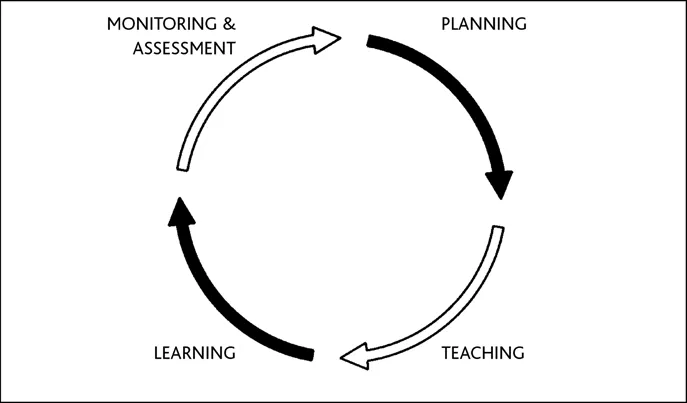
Figure 1.1 The learning needs of four pupils in a Y3 class
1.3 What are the planning and assessment cycles?
The planning cycle (Figure 1.2) is the process by which teachers address pupils' learning needs. The four stages of the planning cycle are evident within the pupil descriptions of Figure 1.1 Firstly, the teacher monitors and assesses the present state of the pupils' learning, to determine which aspects of the curriculum are most relevant to their learning needs and how these should be taught. Secondly, the teacher plans a new learning experience by developing appropriate learning objectives and activities and deciding how pupils' learning is likely to be evidenced. Thirdly, she puts this into action by teaching. The teacher may at this stage decide to alter her original plan due to assessment she makes while teaching. If, for example, she discovers that pupils are unfamiliar with vocabulary she had assumed they understood the teacher may decide to use different words.
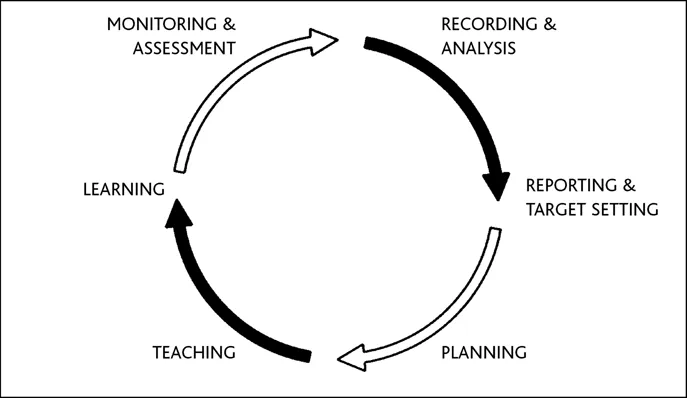
Figure 1.2 The planning cycle
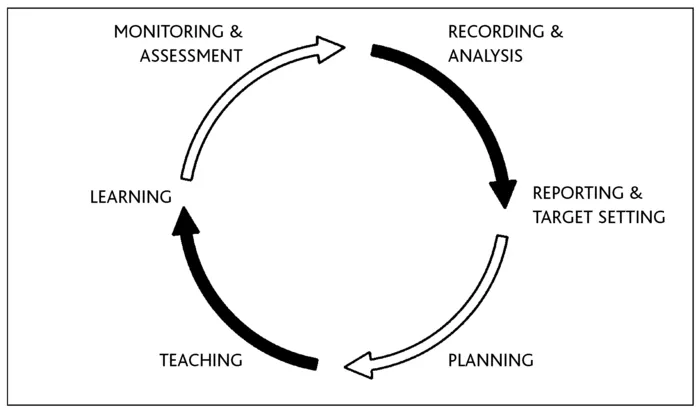
Figure 1.3 The assessment cycle
This, fourthly, enables the pupils to learn. The teacher then assesses pupils' teaming in order to plan for the next stage in the cycle. With each revolution of the planning cycle the teacher becomes more familiar with the pupils' learning needs and is able to make plans which are increasingly matched to their needs. The planning cycle iS formative as it informs future teaching and learning.
The assessment cycle (Figure 1.3) provides greater detail by extending the planning cycle and relating it to more formalised practice. The assessments made by the teacher are, where appropriate, recorded. The records are analysed and form the basis of reporting and target setting with pupils, parents or other teaching professionals. The targets are then built into future plans which inform teaching and learning. The assessment cycle is formative but may be summative, providing a summation of learning at a given point, for example, when statutory assessment has been undertaken.
1.4 What is statutory assessment?
Statutory assessment is assessment that must be undertaken by law. The Foundation Stage Profile is an assessment that takes place as pupils begin their school careers and is based upon the Early Learning Goals of the Foundation Stage (QCA 1999a www.qca.org.uk/ca/foundation). The End of Key Stage 1 and Key Stage 2 assessment is based upon the Attainment Targets of the National Curriculum (www.nc.uk.net) and is described numerically using 'levels'. Parents receive details of statutory assessments in relation to their own children through oral and written reports.
A wider audience can access details of the percentages of pupils at each National Curriculum level through the Governors' Annual Report to Parents and Office for Standards in Education (OFSTED) inspection reports of individual schools. Primary Performance Tables are also published for Key Stage 2, focusing solely on results in the core subjects of English, mathematics and science, not the formative and diagnostic work undertaken regularly to improve the learning of individual pupils across the curriculum.
1.5 Who is involved in MARRA?
Beyond die classroom MARRA involves a range or individuals and organisations including the Department for Education and Skills (DfES), which encompasses the Qualifications and Curriculum Authority (QCA), test development and marking agencies, LEA advisory and psychological services, the school governing body, the head teacher and teaching staff. The roles of individuals and organisations are wide ranging, from writing test questions for the use of all 11 year olds across the country, to assessing the needs of an individual pupil through an IEP.
Within the classroom the teacher has a leading role in MARRA, assisted by Learning Support Assistants (LSAs) and visiting professionals and supported by the expertise and advice of other teachers. Teachers work within the time constraints of the school day and individual lessons, particularly in literacy and numeracy lessons which follow the formats and subdivisions of those recommended in the National Literacy Strategy (NLS) and National Numeracy Strategy (NNS) (DfEE 1998b; 1999a). Classes are diverse in their pupil make-up and may include a range of abilities, needs and social and cultural backgrounds. Pressures to develop curriculum areas are never far away as knowledge and technology grow together. Amid all of this, the teacher must focus upon the learning needs of pupils, to ascertain what they know, understand and can do and to provide effective and appropriate learning experiences. MARRA should not be seen as an addition to teaching and learning but as an essential part of it.
Similarly pupils should be encouraged to take a significant role in monitoring, assessment, recording, reporting and accountability to enable them to grow as learners. Learning how to learn, metacognition, requires pupils to become actively involved in the learning process, to be aware of their learning strategies and thinking processes (Nisbet and Shucfcsmith 1986; Fisher 1990), rather than simply being passive recipients of teaching. Pupils can engage in this process with the help and guidance of the teacher through their cognitive, affective and conative responses, which focus upon knowledge, emotion and motivation respectively.
1.6 MARRA: meeting the standards
The aim of this book is to enable trainee teachers and NQTs, whose classroom experience is necessarily limited, to link the theory and practice of MARRA both to meet the standards and to enhance their professional practice. The main chapters focus upon Monitoring, Assessment, Recording, Reporting and Accountability, building one upon the next to introduce terminology, issues and strategies. The book provides an analysis of each aspect of MARRA and gives references throughout the text to encourage readers to explore specific issues in greater depth through a range of literature, from the education press to academic journals and texts.
To gain the most from the text readers should work through the activities, discussions and case study questions contained in each of the main chapters. The activities, some of which are school based, develop theoretical and practical understanding. The discussion points encourage readers to reflect upon and question issues of theory and practice in MARRA. The case studies describe real situations in each area of MARRA. The questions which follow them raise areas for further debate and consideration and model the types of questions which students and NQTs should ask when engaging with MARRA in taught courses and in school-based work. Some of the activities, discussion points and case studies can be used by individuals but they will become more meaningful if used with one, two or more colleagues, within a group tutorial, seminar, in-service training (INSET) session or staff meeting. Such interaction provides a greater range of experience, with each colleague m...
Table of contents
- Cover Page
- Title Page
- Copyright Page
- Contents
- Foreword
- Acknowledgements
- Abbreviations
- 1 An Introduction to MARRA
- 2 Monitoring
- 3 Assessment
- 4 Recording
- 5 Reporting
- 6 Accountability
- 7 Moving forward with MARRA
- Appendix A Subject Monitoring Sheet
- Appendix B Mark Monitoring Sheet
- Appendix C General Assessment Sheet
- Appendix D Focused Assessment Sheet
- Appendix E Individual Pupil Record
- Appendix F Action Sheet
- Glossary
- References
- Index
Trusted by 375,005 students
Access to over 1.5 million titles for a fair monthly price.
Study more efficiently using our study tools.
Frequently asked questions
Yes, you can cancel anytime from the Subscription tab in your account settings on the Perlego website. Your subscription will stay active until the end of your current billing period. Learn how to cancel your subscription
No, books cannot be downloaded as external files, such as PDFs, for use outside of Perlego. However, you can download books within the Perlego app for offline reading on mobile or tablet. Learn how to download books offline
Perlego offers two plans: Essential and Complete
- Essential is ideal for learners and professionals who enjoy exploring a wide range of subjects. Access the Essential Library with 800,000+ trusted titles and best-sellers across business, personal growth, and the humanities. Includes unlimited reading time and Standard Read Aloud voice.
- Complete: Perfect for advanced learners and researchers needing full, unrestricted access. Unlock 1.5M+ books across hundreds of subjects, including academic and specialized titles. The Complete Plan also includes advanced features like Premium Read Aloud and Research Assistant.
We are an online textbook subscription service, where you can get access to an entire online library for less than the price of a single book per month. With over 1.5 million books across 990+ topics, we’ve got you covered! Learn about our mission
Look out for the read-aloud symbol on your next book to see if you can listen to it. The read-aloud tool reads text aloud for you, highlighting the text as it is being read. You can pause it, speed it up and slow it down. Learn more about Read Aloud
Yes! You can use the Perlego app on both iOS and Android devices to read anytime, anywhere — even offline. Perfect for commutes or when you’re on the go.
Please note we cannot support devices running on iOS 13 and Android 7 or earlier. Learn more about using the app
Please note we cannot support devices running on iOS 13 and Android 7 or earlier. Learn more about using the app
Yes, you can access Monitoring, Assessment, Recording, Reporting and Accountability by Rita Headington in PDF and/or ePUB format, as well as other popular books in Bildung & Bildung Allgemein. We have over 1.5 million books available in our catalogue for you to explore.