- 182 pages
- English
- ePUB (mobile friendly)
- Available on iOS & Android
eBook - ePub
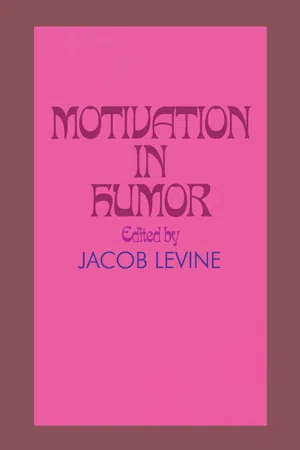
Motivation in Humor
About this book
This is not a funny book--but it is the first to bring together contemporary experimental studies on humor. The fourteen scholarly papers included here mark an important breakthrough in this vital, complex, and largely unexplored subject. Motivation in Humor shows that humor is researchable by scientific methods and indicates the difficulties involved in such work. Here are samples of the important parameters of behavior and attempts at defining the factors that influence the humor response as well as the effects of this response upon subsequent emotional states. In his expert introductory chapter, Jacob Levine traces the progress of humor research and analyzes the papers that follow. To summarize a few of his findings: Three basic research models--three conflicting models of the motivation of man--have been used to explain the motivational sources of humor: one is positive, one negative, and one mixed. These are: (1) cognitive-perceptual theory, which stresses the successful and surprising resolution of an incongruity, paradox, or double entendre; (2) behavior theory, with its emphasis on stimulus-response learning and the reduction of base drives; and (3) psychoanalytic theory, which emphasizes the gratification of the primary unconscious drives of sex and aggression in conjunction with the pleasures of mental activity that sometimes involve regression to infantile modes of thinking. The development of humor reflects an interaction between innate psycho physiological processes and learned response patterns. Evidence indicates that humor is influenced by such diverse situations and individual dispositions as interpersonal anxiety, prior emotional set, and social setting. Studies also point to the cathartic effects of humor appreciation, particularly with aggressive or tendentious humor. The considerable research prompted by these ideas has begun to throw some light on the positive motives, a reflection of the new approaches to motivation theory. Teachers will fi
Information
I: Personality Dispositions in Humor Preferences
1: Humor and Anxiety
Following Kris’ lead,4,5 various analytically oriented writers3,6,7,9 have pointed out that Freud’s position as stated in Wit and Its Relation to the Unconscious1 implies a relationship between humor and anxiety. These writers have emphasized the aggressive and sexual, as well as the nonsensical, aspects of humor. This literature raises the experimental question as to whether subjects differentiated on the basis of a self-rated anxiety scale respond differently to humorous stimuli.
Method
A self-rated general anxiety questionnaire was administered during regular class sessions of introductory psychology courses to 419 Yale men and 197 Connecticut College women. From the distributions of scores on this questionnaire, for each of the respective colleges, extreme groups of high anxious (HA) and low anxious (LA) subjects (Ss) were selected. The Yale Ss were selected from within the upper and lower 6 per cent of their distribution and the Connecticut Ss were selected within the upper and lower 9 per cent. There were 56 Ss in all, 28 HA and 28 LA. Each anxiety group contained equal numbers of men and women. The Ss were not told that their selection for participation in the humor section of the study was based upon the anxiety questionnaire that they had filled out several months previously. Participation in the humor study was on a volunteer basis but of all students approached only three refused to serve.
The humor stimuli were cartoons selected from the Mirth Response Test,9 which consists of cartoons from The New Yorker and similar magazines. The cartoons of the Mirth Response Test were given to a group of 15 psychiatrists, psychologists, and psychiatric social workers who rated each cartoon on the amount of aggression, sex, and nonsense in the cartoon. The ratings were made on graphic scales which were descriptively labeled to indicate increasing amounts of the characteristic being rated, and subsequently scored in equal linear units from 1 through 9. The ratings were then averaged for each cartoon and three groups of six cartoons each were selected from the original 31, each composed of cartoons in which either the sexual, aggressive, or nonsensical aspect of humor was respectively predominant. Thus, the six aggressive cartoons received a mean rating of 7.8 on aggression, 1.4 on sex, and 5.9 on nonsense. The sexual cartoons were rated 3.6 on aggression, 7.0 on sex, and 5.4 on nonsense. Ratings on the nonsensical cartoons were 3.2 on aggression, 1.4 on sex, and 6.8 on nonsense.
In the experimental situation the cartoons were presented to S one at a time in a standardized order that intermingled the various content categories of aggression, sex, and nonsense. The S’s vocal and facial responses to the cartoons were rated by the examiner on a 6-point scale from disapproval to pronounced pleasure. After the S had examined all cartoons he was asked to go over them again indicating his degree of preference on a graphic rating scale extending from Very Much Disliked to Very Much Liked. The S was then asked to describe the point of each joke. The examiner (E) wrote down this description and it was later scored for comprehension of the cartoon.
There were two examiners, one male and one female. Each examiner tested 28 Ss: 7 men and 7 women from each of the anxiety groups. An effort was made to select the Ss in such a fashion that at the time of testing the examiner would not know whether the S being tested belonged in the HA or LA group. With the exception of four cases this was possible.
Results
The Ss’ explanations of the cartoons were first scored for comprehension according to criteria established on the basis of the investigators’ previous experience with the cartoons. These criteria, with minor modifications, were similar to those recommended by the originators of the Mirth Response Test. The investigators were able to score independently a sample of 144 cartoon interpretations with 95 per cent agreement.
Scoring of the cartoon interpretations revealed that approximately 85 per cent of the 5s misunderstood two of the sexual cartoons. It was decided to remove these cartoons before scoring the preferences of the Ss. The point of the joke being missed, it seemed invalid to compare Ss on their appreciation of the humor; and since Ss in HA and LA and male and female categories had equal difficulty in comprehension, it was felt that there was no connection between failure to understand these cartoons and the major variables and categories of interest. For the remaining cartoons there were only a few scattered cases of misinterpretation equally divided between groups, and for purposes of further analysis these few instances were treated exactly as the rest of the data. It was assumed, and inspection of the data lent support to the assumption, that the preference scores of the Ss in these few instances did not materially distort the means of the groups.
For each of the cartoons retained for further analysis, S had a rating from 0 to 15 representing his preference on the graphic scale and a rating from 0 to 5 based on E’s judgment of his mirth response. The respective means of these ratings on each set of sexual, aggressive, and nonsensical cartoons, and on all 16 cartoons combined, were considered to be S’s preference and mirth-response scores. Comparisons between the anxiety groups were then made on the bases of these scores.
In terms of the average preference scores the HA group showed a tendency (.10 > p > .05) to give lower average ratings than the LA group on all types of cartoons combined. On the aggressive cartoons the preference scores of the HA group were lower (.05 > p > .02) than those of the LA group. There were no reliable differences between the groups on the nonsensical and sexual cartoons.
Closer examination of the data revealed, however, that not all members of the HA and LA groups were contributing equally to the obtained differences. Rather, it was those Ss tested by an examiner of the opposite sex that contributed the major part of the difference. The Ss were therefore classified not only according to their anxiety grouping but also according to the conditions of administration. In the opposite condition the male E administered cartoons to female Ss and the female E administered cartoons to male Ss. In the same condition the male E administered cartoons to male Ss and the female E administered cartoons to the female Ss. It is now noted that differences between HA and LA Ss exist only in the opposite condition for the nonsensical (.05 > p > .02), aggressive (.01 > p > .001), and all cartoons combined (0.5 > p > .02). No significant difference is found in the same condition for nonsensical, aggressive, and all cartoons, nor in either condition for sexual cartoons.
Mirth-response scores were treated in the same manner as preference scores. There were no differences between total HA and LA groups in the average mirth-response scores. Since analysis of the data according to conditions of administration proved enlightening for the preference scores, however, a similar analysis was carried out for the mirth-response scores, which revealed a rather similar pattern to that obtained with the preference scores. There were no differences between the anxiety groups in the same condition of administration while there was some tendency of the HA group to score lower than the LA group in the opposite condition. However, only in the case of the nonsensical cartoons (.05 > p > .02) was the difference significant. All differences for the same condition were negligible.
Discussion
Two results seem to stand out in this experiment. First, for this group of Ss, there seems to be a relationship between S’s rating of his susceptibility to anxiety as determined by a general anxiety scale and his preference rating for cartoons of aggressive content. Second, this relationship depends upon the social context of the humor stimuli; i.e., results depend upon which S is tested by which E.
This interrelationship of anxiety, preference rating, and social context also seems to be present in the case of nonsensical cartoons, although evidence is not as clear-cut as with the aggressive cartoons. In the case of the sexual cartoons, there was no differentiation of HA and LA groups under any condition. It may be that the smaller number of sexual cartoons made for less reliable measurement. Further study is necessary to explain this failure of the sexual cartoons to differentiate.
These results suggest that further study of the relationship between humor and anxiety may be profitable. They strongly indicate, however, that such experimentation should not focus exclusively on the stimulus materials, i.e., jokes or cartoons, per se. The social context appears to be crucial. In this, the results parallel those of Perl,8 who demonstrated that Ss rated jokes differently when tested alone than when tested in a group. In our study, the personalities of the Es must have provided cue differences which altered the situation for S. Standardized administration procedures and E’s lack of knowledge concerning the anxiety classification of Ss during testing suggest that these cue differences were not the result of E’s consciously altering his behavior for the different groups of Ss. (During the test administration the examiners attempted to classify the Ss they saw as either HA or LA. Their success in this classification did not exceed chance expectations.) While the exact nature of these cue differences cannot be determined on the basis of this experiment, the sex difference would seem most immediately obvious to the Ss, and appears worth further investigation. Such an investigation would, of course, require a more representative sample of experimenters than the design of this study permitted.2
That the mirth-response score did not discriminate as well as the preference score is of interest in view of the fact that other investigators6 found a mirth-response score adequate for discrimination within a patient population of HA and LA Ss who were selected on the basis of E’s estimate of their anxiety level while in the test situation. Further study would seem to be indicated to determine the relative merits of these two scores in humor studies, as well as the alternative techniques of selecting anxiety groups.
References
1. Freud, S. Wit and its relation to the unconscious. The basic writings of Sigmund Freud. New York: Modern Library, 1938.
2. Hammond, K. R. Representative vs. systematic design in clinical psychology. Psychol. Bull., 51 (2), 1954, 150–159.
3. Jacobsen, Edith. The child’s laughter, theoretical and clinical notes on the function of the comic. In The psychoanalytic study of the child, vol. 2. New York: International Universities Press, 1946, pp. 39–60.
4. Kris, E. Ego development and the comic. Int. J. Psychoanal., 19, 1938, 77–90.
5. Kris, E. Laughter as an expressive process. Int. J. Psychoanal., 21, 1940, 314–341.
6. Laffal, J., Levine, J., Redlich, F. C., and Fierman, Ella. The relationship between anxiety and responses to humorous cartoons dealing with hostile aggression. Paper read at East. Psychol. Assoc., Boston, April, 1953.
7. Laffal, J., Levine, J., and Redlich, F. C.. An anxiety-reduction theory of humor. Amer. Psychologist, 8, 1953, 383. (Abstract.)
8. Perl, Ruth. The influence of a social factor upon the appreciation of humor. Amer. J. Psychol., 45, 1933, 308–314.
9. Redlich, F. C., Levine, J., and Sohler, T. P. A mirth response test: preliminary report on a psychodiagnostic technique utilizing dynamics of humor. Amer. J. Orthopsychiat., 21, 1951, 717–734.
From Journal of Abnormal and Social Psychology, Vol. 53, 1956, pp. 59-62. Copyright 1956 by the American Psychological Association. The tables accompanying the original article do not appear here. Interested readers are referred to the issue of Journal of Abnormal and Social Psychology noted above.
2: Humor as a Disturbing Stimulus
Problem
The primary intent of most stimuli that are designed to be humorous is to amuse. Nevertheless, there is hardly a joke or a cartoon that to some individuals is not only not amusing, but may even be very disturbing. It is indeed commonplace to see how broad is the range of responses to humor; the same stimulus may evoke hilarious laughter in some and utter revulsion in others. As Malcolm Muggeridge, editor of Punch has expressed it:4 “One thing at any rate I have learned— that what seems uproariously funny to one man can seem devastatingly unfunny to another.” Yet the basis for these extreme individual differences in responses has not been established nor has it really been investigated.
Recent studies3 have confirmed these everyday observations of the wide variations in responses to humor. These studies have demonstrated how ostensibly funny cartoons proved to be not only amusing to some but highly disturbing to others; normal sophisticated subjects as well as psychiatric patients were used. Perceptual disturbances and distortions were frequently found to occur in association with the painful affects evoked by them. On the basis of even this small amount of evidence, it appears that humorous stimuli, whatever the mechanism of humor, may be and often are powerful instigators of affective responses, ranging from very pleasant to very unpleasant ones.
In some recent studies of responses to humor1, 5 an attempt was made to connect the variations in responses which these stimuli produced with the vicissitudes of anxiety which the individual was dealing with at the time of the stimulation. Several working notions were formulated, based upon Freud’s theory of humor,2 which attributed the pleasurable effects of humor stimuli to need gratification and tension release. On the basis of this theory, it was assumed that one of the primary elements in the pleasurable reaction to humorous stimuli is a reduction in anxiety. It was further assumed that where the humorous stimuli evoked not a pleasure response but one of displeasure, an increase rather than a decrease in anxiety was involved. The intensity of the pleasure or the displeasure evoked by such stimuli was assumed to be a funct...
Table of contents
- Cover Page
- Title Page
- Copyright
- Contents
- Approaches to Humor Appreciation
- I Personality Dispositions in Humor Preferences
- II The Effects of Experimental Arousal on Humor Responses
- III Cognition and Humor
- IV Social Aspects of Humor
- Index
Trusted by 375,005 students
Access to over 1.5 million titles for a fair monthly price.
Study more efficiently using our study tools.
Frequently asked questions
Yes, you can cancel anytime from the Subscription tab in your account settings on the Perlego website. Your subscription will stay active until the end of your current billing period. Learn how to cancel your subscription
No, books cannot be downloaded as external files, such as PDFs, for use outside of Perlego. However, you can download books within the Perlego app for offline reading on mobile or tablet. Learn how to download books offline
Perlego offers two plans: Essential and Complete
- Essential is ideal for learners and professionals who enjoy exploring a wide range of subjects. Access the Essential Library with 800,000+ trusted titles and best-sellers across business, personal growth, and the humanities. Includes unlimited reading time and Standard Read Aloud voice.
- Complete: Perfect for advanced learners and researchers needing full, unrestricted access. Unlock 1.5M+ books across hundreds of subjects, including academic and specialized titles. The Complete Plan also includes advanced features like Premium Read Aloud and Research Assistant.
We are an online textbook subscription service, where you can get access to an entire online library for less than the price of a single book per month. With over 1.5 million books across 990+ topics, we’ve got you covered! Learn about our mission
Look out for the read-aloud symbol on your next book to see if you can listen to it. The read-aloud tool reads text aloud for you, highlighting the text as it is being read. You can pause it, speed it up and slow it down. Learn more about Read Aloud
Yes! You can use the Perlego app on both iOS and Android devices to read anytime, anywhere — even offline. Perfect for commutes or when you’re on the go.
Please note we cannot support devices running on iOS 13 and Android 7 or earlier. Learn more about using the app
Please note we cannot support devices running on iOS 13 and Android 7 or earlier. Learn more about using the app
Yes, you can access Motivation in Humor by Jacob Levine in PDF and/or ePUB format, as well as other popular books in Psicologia & Storia e teoria della psicologia. We have over 1.5 million books available in our catalogue for you to explore.