- 132 pages
- English
- ePUB (mobile friendly)
- Available on iOS & Android
eBook - ePub
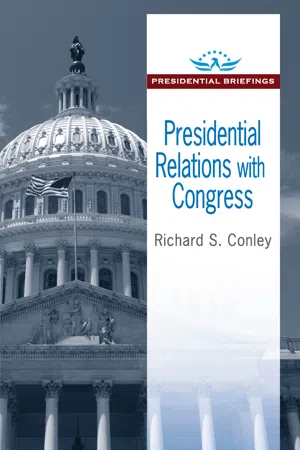
Presidential Relations with Congress
About this book
The presidential-congressional relationship is the most important and vivid of all the inter-branch relationships. It defines presidential activities, priorities, and successes. No president, from Eisenhower to Nixon to Reagan, has been able to ignore or denigrate that relationship. Presidential Relations with Congress provides a succinct analysis of contemporary presidential-congressional relations in the post-World War II era. Richard S. Conley underscores what scholars have learned about presidents' interactions with Congress over time, the factors that account for success, and the methodologies that can measure success. He weaves the "bargaining", "institutional constraint", and "personality" perspectives of presidential relations with Congress alongside case studies of individual presidents' approaches, including agenda success, veto politics, and Supreme Court nominations. Presidential Relations with Congress emphasizes the changing nature of internal dynamics in Congress, as well as the importance of party control of both the White House and Capitol Hill. This engaging addition to the Presidential Briefings series provides students, scholars, and observers of presidential politics with an accessible and readable tool for analyzing and evaluating presidents' varied styles, successes, and failures in their relationships with Congress. Each chapter features specific examples of past presidents' approaches to influencing Congress.
Information
ONE
Introduction
An oft-cited metaphor about dynamics on Capitol Hill is that trying to lead Congress is like herding cats. Indeed, from their vantage point in the Oval Office modern presidents must sometimes feel like the poor fellow in a recent television advertisement who is sinking in desert quicksand under the watchful eye of an indifferent feline. The four-legged misanthrope, mel-ancholically wagging its tale next to the pit, is seemingly as full of contempt as apathy for the despondent man's misfortune. He implores the cat to go get help as a highway full of cars is visible close by, but the temperamental mouser just stares unflappably at the doomed anti-hero. The advertisement underscores the importance of insurance when calamities strike. But for the American chief executive there is no policy that can be purchased to insure a majority in Congress, the cooperation of legislators on either side of the aisle, or ultimately legislative success.
One reality of the American political system is that much—if not most—of what presidents wish to accomplish in policy terms requires congressional assent. Unilateral actions, notwithstanding the president's role as commander in chief, require an existing statutory framework for executive orders. The other, perhaps more stark reality is that the constitutional separation of powers imposes a unique set of constraints on legislative leadership not found in many other Western industrialized democracies. In parliamentary systems like Canada or Great Britain that rely on the Westminster model of governance, prime ministers are "first among equals" and alongside cabinet members direct the lion's share of the legislature's business by fashioning policy proposals that are subsequently sent to the parliament for ratification—which is all but assured with a typical majority government in which party discipline is expected and enforced.
Such a "top-down" policy process is inverted in Washington. As the saying goes, "Presidents propose and Congress disposes." American presidents rarely direct the legislative process. Rather, as George C. Edwards (1989) accentuates, they must find ways to facilitate it. The president has to locate (and sometimes cajole!) a member of Congress to introduce a bill on his behalf. But that is just the beginning of a long, often arduous process. Unity in the president's party can never be taken for granted. Moreover, the proposal may be challenged or superseded by legislation sponsored by other members. Further, the proposal may be subject to a host of proposed amendments or alterations in a bicameral environment that, in the final analysis, may render the president's objectives unrecognizable upon passage. Even when Congress is controlled by a majority of his own party, the president's success is scarcely guaranteed. Members may introduce their own bills that run counter to the president's policy objectives. Finally, the frequent condition of "divided government," in which the opposite party controls Congress has proven increasingly aggravating for chief executives in an era of growing institutional partisanship and ideological polarization. The majority may declare the president's agenda "dead on arrival," supplant the president's policy goals, and force showdowns dominated by the only major constitutionally enumerated legislative tool at the president's disposal: The veto power, and by extension, veto threats.
This briefing book is an epistemological exercise with respect to the legislative presidency. What do scholars know about the factors that contribute to presidential success or failure in dealing with Congress, and how can we account for the wide variation in post-World War II presidents' interactions with members on Capitol Hill? Our quest must commence with an understanding of the "bargaining," "institutional constraint" (Congress-centered), and "personality" perspectives on presidential legislative leadership. The larger analysis spans presidential agenda and roll call success to Supreme Court nominations. It is critical across our analysis to grasp the impact of organizational reforms and internal dynamics in Congress, differences in domestic and foreign policy contexts, and other factors such as electoral conditions in order to assess variation in presidential strategies over time. Let us commence our journey through the lens of theories that have guided scholars in the bid to assess the nature of presidential leadership of Congress.
Theorizing About Presidential-Congressional Relations
Political scientists interested in the presidency and Congress have approached the subject from three general angles. The first is the "bargaining" perspective most notably articulated by Richard Neustadt (1960), a former advisor to Presidents Truman and Kennedy. Simply put, Neustadt rebuffed arguments concerning the formal, constitutional powers of the presidency enumerated in Article II and asserted instead that the president's real power lay informally in persuasion. From this perspective the president must be careful to cultivate the prestigious trappings of the nation's highest office and guard his personal power as a means of winning over members on Capitol Hill by influence rather than by command. Influencing policymaking, both in Congress and in the executive branch, obliges the president to fully utilize his position atop "separated institutions sharing power." His professional reputation among the public and within the inside-the-beltway Washington establishment is paramount. He must always be careful not to appear weak or indecisive. Resistance to his policy agenda in Congress may be surmounted when legislators hold his views in esteem and the president meets policymakers' expectations of leadership. The president's major advantage, therefore, from the combination of his exceptional position in the constitutional order, public prestige, and reputation within the policymaking community is to bargain and bring members of Congress closer to his positions.
It is axiomatic in studies of the legislative presidency that scholars emphasize the need for the nation's chief executives to seize the moment when they come to the Oval Office. Scholars urge them to "hit the ground running," as they have only a narrow window of opportunity to exploit the good will, in Congress and the public (including those who may not have voted for the president) that typically follows an election (Pfiffner 1996). Presidents assuredly lose public and congressional support over time as decisions are likely to frustrate or alienate various constituencies. Despite mixed empirical evidence, many researchers suggest a "honeymoon" effect by which the public and the inside-the-beltway establishment, including members of Congress, give the president the benefit of the doubt and are more willing to hear him out and bargain on his policy proposals.
Using the "bully pulpit" effectively in the first six months in office is critical from this standpoint. Indeed, as William Leuchtenburg (1993) suggests, the "shadow" of Franklin Roosevelt's remarkable legislative accomplishments just months into his first term is cast long and wide over public, media, and inside-the-beltway evaluations of a new president as expectations of leadership have risen with the advent of the modern presidency. Every April following the November election of a new president the media scurry to interview professors and pundits and prod them to evaluate the "first hundred days" of the new administration. Such reviews are almost always mixed. Not all presidents have governed under crisis situations such as the Great Depression or World War II, nor do all presidents have extensive agendas, enjoy majorities in Congress, or profit from prosperous economic times. And the days of fireside chats by the radio have been replaced by dwindling television audiences for presidential addresses. As Genovese, Belt, and Lammers (2014) contend in their detailed study of domestic policymaking settings for presidents, opportunity contexts for the accomplishment of durable policy legacies have varied greatly.
Still, the bully pulpit can be used in ways that contravene the bargaining perspective. "Going public"—appealing over the heads of members of Congress directly to the electorate-violates the fundamental tenets of Neustadt's leadership model. With the ubiquity of television by the 1950s, presidents have often circumvented bargaining—whether by nationally televised addresses, press conferences, or via an extensive communications apparatus in the White House—by appealing directly to the public. The goal is to mobilize grassroots constituencies, which in turn (theoretically), will pressure members of Congress to follow the president's policy lead (Kernell 1997). The notion implies a considerable threat: Comply with the president or face electoral retaliation. Especially in states (Senate) and electoral districts (House) where the president was not himself electorally popular, or failed to run ahead of members of Congress (a "coat-tail effect"), the strategy may fail. In fact, there is no systematic empirical evidence that such a strategy has enabled post-World War II presidents to prevail on their policy stands on Capitol Hill. The problem is that members have little incentive to follow the president if they have nothing to gain with compliance.
Sometimes "going public" backfires in spectacular fashion. George H. W. Bush's televised address to the nation on the 1990 budget agreement actually reversed public support for his agenda, and the budget was gutted by both conservative Republicans and liberal Democrats in Congress. Similarly, public opinion data suggest that Bill Clinton's health care reform proposal in 1993-94 became less popular the more he made public appeals and attempted to explain the details (Edwards 2003).
There are several anecdotal exceptions that we shall take up in chapter 3. Lyndon Johnson's public appeals for passage of the 1964 Civil Rights Act may well have helped pressure Congress to enact the landmark bill. Another is Ronald Reagan's public campaign for passage of the Economic Recovery and Tax Act in 1981. In both cases, pleas to the electorate were complemented by savvy, steadfast, behind-the-scenes individual lobbying by the president. Regardless, some scholars suggest that "staying quiet," rejecting the temptation of "going public," and maneuvering out of public view to negotiate with Congress, as Dwight Eisenhower and Lyndon Johnson were known to do on many issues, have strategic advantages more in line with the bargaining approach (see Covington 1987). Drawing attention to potentially conflictual issues between the branches may make it harder to reach consensus or allow for face saving among congressional leaders and rank-and-file members, particularly in the opposition party.
A second track of scholarly analysis focuses on legislative support of the president by individual legislators or voting coalitions in Congress. From the perspective of the "Congress-centered" or "institutional constraint" model, legislators hold relatively fixed ideological positions over which the president has little influence. From this theoretical angle, presidential "skill" in bargaining or use of the bully pulpit is not much of a factor in the aggregate. To cite an old Texas saying, "you have to dance with the one who brung you." According to Jon Bond and Richard Fleisher (1990, 13):
Presidential success is determined in large measure by the results of the last election. If the last election brings individuals to Congress whose local interests and preferences coincide with president's preferences, then he will enjoy greater success. If, on the other hand, most members of Congress have preferences different from the presidents, then he will suffer more defeats.
Presidents may not have much in common ideologically or otherwise with many of their congressional dance partners, especially under divided party control of national institutions. And members are not likely to alter fundamentally their ideological positions after a presidential election. But as in any card game, presidents must play the hand they are dealt—in this case, by the electorate.
As we will explore in more detail in chapter 2, many studies following the Congress-centered perspective evaluate presidential "success" on floor outcomes in Congress (roll call votes). Presidents routinely take positions—"yea" or "nay"— on legislation pending a roll call. Some scholars posit that the president's positions play a peripheral role at best relative to cue taking for members' decisions on floor votes, and "honeymoon" effects are minimal or nonexistent. Scholars have embarked on a long and often frustrating trek to locate evidence of presidential influence on position votes. Presidents not only compete with members' ideological preferences but also the influence of other important partisan cue givers, including the Speaker of the House or Senate majority leader, members of the whip system, and/or committee chairs, not to mention constituents and interest groups. Generally the most that can be said is that the percent of position votes on which the president prevails in any given year reflects "concurrence" with Congress, not necessarily influence (Ragsdale 1996).
The implications of the "Congress-centered" model are straightforward and accentuate relative constraints on the president's legislative success. Presidents who have a majority of their own party members in Congress are more likely to prevail in their positions on legislation (though exceptions abound). Presidents who face an opposition Congress, especially in the contemporary era of heightened ideological and partisan polarization, are likely to lose on their positions frequently. A host of studies, as well as empirical data we will analyze in chapter 2, bear out this conclusion. At most, presidential influence on congressional roll call outcomes appears marginal. It is ideological overlap with members of Congress that matters most.
Finally, the "personality" (or sometimes "psychological") perspective is not mutually exclusive with respect to the other two models of presidential leadership of Congress. The penultimate question is the degree to which the president's personality characteristics may aid or detract from persuading legislators to follow his lead. From how the president structures executive-legislative relations in the White House to particular styles of individual lobbying, personality may play a central role.
Several examples highlight the ways in which the president's individual traits may impact relations with Congress. Dwight Eisenhower, a man with hero status as the former Supreme Allied Commander in Europe during World War II, drew from his career military background to organize White House operations. The structure of the White House was pyramidal in nature, and regulated by a strong chief of staff, Sherman Adams. Eisenhower established an Office of Congressional Relations (OCR) that included a coterie of advisors that was to liaise largely behind the scenes with members and aid the president to remain above the partisan fray. As a result, as Fred I. Greenstein (1982) asserts, Eisenhower was largely able to reconcile the contradictory role of the president as head of state and partisan leader. Lyndon Johnson was one of the most spectacularly successful twentieth century presidents in terms of his legislative agenda. Drawing from his experience as Senate Majority Leader—a position he transformed into an untold position of power and prestige in the 1950s—Johnson was renowned if not feared for the art of personal lobbying and persuasion. His "treatment" of legislators, a style predicated upon intimate relations with members of Congress, "in your face" threats, inveigling, and appeals to patriotism, was legendary. Whatever the personal toll on the member of Congress, Johnson's tactics were often highly effective. Richard Nixon, whose presidency ended in the ignominy of one of the worst political scandals in US history, was notable for his antipathy for the media and "enemies lists." James David Barber (1993) typecast Nixon as an "active-negative" personality who put much into the job and derived little out of it emotionally. Nixon saw himself as an executive administrator and was loathe to reach out individually to members of Congress, a shortcoming allegedly the product of his "world view" shaped by experience. Finally, the ever-optimistic Ronald Reagan routinely brought members to the Oval Office, handed out jelly beans and presidential cufflinks, and often picked up the telephone to goad legislators to support his positions. Reagan's buoyant and friendly relations with leaders and rank-and-file members of both parties are thought to be a cornerstone of his early legislative successes.
The major shortcoming of the personality approach is the relative impossibility of systematically analyzing presidents' psychological dispositions from afar, let alone pinpointing the causes. Connecting personality traits to legislative success or failure risks subjectivity and perhaps incorrect preconceptions about the sources and influences on presidents' attitudes and innermost beliefs. Intuitively, however, personality is not inconsequential to the management of relationships on Capitol Hill.
Conceptualizing Presidential Relations with Congress: Context Matters
It is vital to grasp that the contexts under which presidents have arrived in the Oval Office have varied greatly in the post-World War II era. Some, like Eisenhower and George H. W. Bush had scant domestic agendas. Others, like Lyndon Johnson and Barack Obama had sweeping domestic objectives. Which factors, beyond agenda scope, explicate the president's strategic position vis-à-vis Congress? Intersecting with the president's agenda goals are two other important contexts: the extent of congressional unity and unified or divided control of the presidency and Congress. Though other variables are certainly important at critical junctures, including the electoral setting, foreign policy crises, and the economic environment, these three factors—the scope of the president's agenda, congressional unity, and party control—are paramount in shaping the general nature of executive-legislative interactions. For example, in the 1940s and 1950s, the "textbook" Congress evidenced low party unity and significant ideological divides within both parties. In this "bipartisan conservative era" the so-called conservative coalition of southern Democrats and Republicans joined together to frustrate Democratic presidents like John F. Kennedy, while Dwight Eisenhower was often able to turn the congressional setting to his advantage. There were divides not just between liberal, northern and conservative, southern Democrats. Conservatives, moderates, and liberals in the Republican Party were divided as well on matters ranging from economic to foreign policy. In this bygone era, savvy presidents were variably able to forge coalitions in Congress for their policy positions, frequently on an ad hoc basis, to find common ground with members of both parties. Eisenhower, and to some extent Truman (on foreign policy), were able to do so despite divided government.
Beginning in the 1970s, majority of Democrats in Congress sought to reorganize and implemented reforms aimed at enhancing control over legislative procedure and floor outcomes. The process began following during the presidency of Richard Nixon as the endgame to the Watergate scandal played out and was reinforced following Ronald Reagan's stunning legislative successes in 1981. The effect was most prominent in the House of Representatives, although the Senate has not been immune from heightened partisanship and the use of procedural mechanisms (such as the filibuster) that have complicated the bid for presidential influence. Reforms in th...
Table of contents
- Cover
- Half Title
- Title Page
- Copyright Page
- Dedication
- Table of Contents
- 1 Introduction
- 2 The Long View From the White House: Historical Trends in Presidential Relations with Congress
- 3 Presidential Agendas and Congressional Challenges: Case Studies and Lessons on Success and Failure
- 4 Presidential Vetoes and Congressional Challenges: Cases of Presidential Success and Failure
- 5 Epilogue
- Bibliography
Trusted by 375,005 students
Access to over 1.5 million titles for a fair monthly price.
Study more efficiently using our study tools.
Frequently asked questions
Yes, you can cancel anytime from the Subscription tab in your account settings on the Perlego website. Your subscription will stay active until the end of your current billing period. Learn how to cancel your subscription
No, books cannot be downloaded as external files, such as PDFs, for use outside of Perlego. However, you can download books within the Perlego app for offline reading on mobile or tablet. Learn how to download books offline
Perlego offers two plans: Essential and Complete
- Essential is ideal for learners and professionals who enjoy exploring a wide range of subjects. Access the Essential Library with 800,000+ trusted titles and best-sellers across business, personal growth, and the humanities. Includes unlimited reading time and Standard Read Aloud voice.
- Complete: Perfect for advanced learners and researchers needing full, unrestricted access. Unlock 1.5M+ books across hundreds of subjects, including academic and specialized titles. The Complete Plan also includes advanced features like Premium Read Aloud and Research Assistant.
We are an online textbook subscription service, where you can get access to an entire online library for less than the price of a single book per month. With over 1.5 million books across 990+ topics, we’ve got you covered! Learn about our mission
Look out for the read-aloud symbol on your next book to see if you can listen to it. The read-aloud tool reads text aloud for you, highlighting the text as it is being read. You can pause it, speed it up and slow it down. Learn more about Read Aloud
Yes! You can use the Perlego app on both iOS and Android devices to read anytime, anywhere — even offline. Perfect for commutes or when you’re on the go.
Please note we cannot support devices running on iOS 13 and Android 7 or earlier. Learn more about using the app
Please note we cannot support devices running on iOS 13 and Android 7 or earlier. Learn more about using the app
Yes, you can access Presidential Relations with Congress by Richard S. Conley in PDF and/or ePUB format, as well as other popular books in Politics & International Relations & American Government. We have over 1.5 million books available in our catalogue for you to explore.