The involvement of Vichy France with Nazi Germany's anti-Jewish policy has long been a source of debate and contention. At a time when France, after decades of denial, has finally acknowledged responsibility for its role in the deportation and murder of 75,000 Jews from France during the Holocaust, Richard H. Weisberg here provides us with a comprehensive and devastating account of the French legal system's complicity with its German occupiers during the dark period known as 'Vichy'.
As in Germany, the exclusionary laws passed during the Vichy period normalized institutional antisemitism. Anti-Jewish laws entered the legal canon with little resistance, and private lawyers quickly absorbed the discourse of exclusion into the conventional legal framework, expanding the laws beyond their simple intentions, their literal sense, and even their German precedents.
Drawing on newly-available archival sources, personal interviews, and historical research, Weisberg reveals how legalized persecution actually operated on a practical level, often exceeding German expectations. Further, he presents a persuasive argument for Vichy law as an acquired Catholic response to a flase notion of Jewish Talmudism. The book also compares Vichy experience to American legal precedents and practices and opens up the possibility that postmodern modes of thinking ironically adopt the complexity of Vichy reasoning to a host of reading and thinking strategies.
Vichy Law and the Holocaust in France raises fundamental and disturbing questions about the ease with which democratic legal systems can be subverted.
- 472 pages
- English
- ePUB (mobile friendly)
- Available on iOS & Android
eBook - ePub
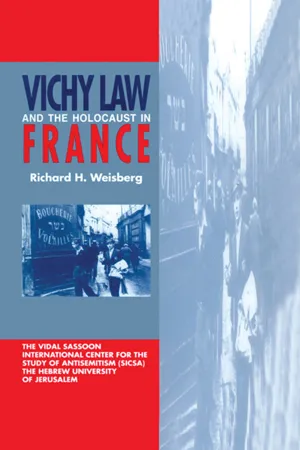
Vichy Law and the Holocaust in France
About this book
Chapter 1
Léon Blum, The “Stranger” at Riom: Legalized Ostracism and Vichy’s Political Trial
Il est bien l’étranger, le nomade asiatique, le négateur, le destructeur de toute race quin’est pas la sienne.
He is surely the outsider, the asiatic nomad, the negator, the annihilator of every race that is not his own.
Description of Léon Blum on 28 March 1942 in L’Alerte
I have chosen to begin this study with Léon Blum, one of twentieth century France’s most fascinating figures. A leading light in literary circles around the time of Proust and Valéry, Blum was also an accomplished lawyer and eventually one of the Third Republic’s foremost leaders. After World War II, Blum returned from imprisonment in Germany, again to become a key policymaker. He died a venerated man—indeed a uniquely admired politician and writer, whose lifelong Socialist ideals were upheld in such a way that few who differed with him on principle could manage to resent his politics.
In just a single period during this exemplary life did France itself (as opposed to his most extreme political opponents) come to detest and ostracize Leon Blum. Having abided him, sometimes grudgingly, having recognized his moral force in affairs ranging from the persecution of Dreyfus (which he passionately opposed) to the establishment of the forty-hour workweek (which he earnestly managed to bring about), and from the occupation of the Ruhr (opposed by Blum) to the firm alliance with beleaguered Poland (hailed by Blum in the tense atmosphere of prewar Paris), Vichy turned on him with legalistic ferocity in 1940 and attempted to silence him forever. The means to this end was a criminal indictment virtually tailor-made for Blum and several other leaders of the Third Republic. The charge was responsibility for the French defeat and betrayal of the duties of his office as Premier and Vice Premier during the prewar period.
The complainant, the authority that spoke for France as it moved to excise from the French polity Blum and everything he stood for, was the government of Vichy France. From its arrest of Blum in September 1940, to its formal indictment of him some thirteen months later, through its political trial of him in the town of Riom that began on 19 February 1942, until its transfer of Blum in March 1943 from the French prison at Bourassol to the concentration camp Buchenwald, Vichy’s treatment of Blum spans the years of its greatest power and—as I here argue—typifies the regime’s adoption of legalized racism on French soil.
In the year of that Riom trial, 1942, a novella appeared from the pen of a young French writer, himself a member of the Resistance. In the story, French law defines and banishes from its midst a man whose values it cannot tolerate. That classic tale, L’Étranger (The Stranger), does not explicitly mention the political and legal horrors of Vichy. Only much later, this same storyteller—Albert Camus—would explicitly associate the malaise that was Vichy with the eloquent professionalism of a lawyer.1 If, in The Stranger, the heterodox Meursault is convicted of being different, in Camus’ last story, La Chute (The Fall, 1956), the tables are turned and we are asked to sit in judgment of the successful lawyer Jean-Baptiste Clamence, he who in the depths of Vichy’s evil rationalizes himself into non-resistance. Like hundreds of French magistrates, lawyers, bureaucrats, and law professors during Vichy, Clamence uses his gifts of reason and eloquence to tolerate what he was trained as a lawyer to oppose.
Blum—the flesh and blood stranger—is the quintessential victim of Vichy law. And Clamence—the fictional lawyer—represents many lawyers during Vichy who participated articulately in the regime’s racial policies, participated because they lacked the professional and moral capacity to say no.2
Riom epitomizes the struggle for the French soul that went on in Vichy and that, in a sense, has been going on ever since. It also stands as a comparative constitutional model from which lawyers generally need to draw wisdom. For Riom came to pass under a government that thought of itself as controlled by constitutional principles very similar to those in systems like the English and American. Due process talk permeates the investigation and trial, but process, in a fairer sense, was due neither Léon Blum nor the Jews on French soil whose fate he sometimes seems to embody. Nor did he or his co-religionists count any more under the guaranties (still nominally present because still so theoretically dear to these descendants of 1789) of “equal protection.”
The paradox of Riom as a challenge to the French rhetorical allegiance to their constitutional heritage is furthered when we cast light upon the proponent of the government’s proceedings against Blum, Joseph Barthélemy. Universally admired and even revered as a leading prewar scholar of French administrative and constitutional law, Barthélemy was Vichy’s justice minister, and as such played the key role of antagonist to Blum’s embattled defense. No mere martinet and surely no zealot, Barthélemy was considered a voice of reason and even liberality.3 He could not be confused with the occasional virulent bigot attracted to the government. But he did enjoy power, and he was fiercely loyal to the aging but charismatic Pétain. Contemporaneous with the Riom proceedings, he had signed the comprehensive religious statute of 2 June 1941, broader in its terms and in its application than the Nazi models.4
Joseph Barthélemy micromanaged the proceedings against Blum and the other prewar leaders. He jots down the words “The Jew Blum” in his notebook as he listens to the defense, observing that “No Jew would be allowed to speak up against Hitler the way Blum does here against Pétain.”5 Later, upset that the defense has managed to score legal and even public relations victories (despite his carefully wrought censorship program) against the prosecutors, Barthélemy suspends the trial without releasing the defendants. He goes on to underwrite the infamous “Special section” courts that summarily try Communists, resistance fighters, and Jewish hostages;6 Barthélemy dies of tongue cancer awaiting his own trial after the Liberation. And some thirty-five years later, with the publication of his extensive memoirs, he posthumously provokes the debate about French legal values in the face of crisis and moral debasement.7
As Barthélemy and the defense lawyers sparred, the notion of French constitutional law itself became a player at Riom. Contemporaneous with the trial, an elaborate committee established by Vichy under Barthélemy’s leadership was actually drafting a new constitution that would cite all the traditional safeguards of equal protection and due process while it also considered Barthélemy’s suggestion that “race” be introduced to deprive unwanted outsiders of those very rights8. Meanwhile, a tiny minority of courageous French lawyers, including the Riom defense team, loudly invoked the still-existing rights established in 1789, rights that had been reiterated in the Constitution of 1875 that remained nominally in force to protect their clients until Vichy promulgated its own chartering document.
Constitutional arguments abounded at Riom, in the presence not only of government ministers but even of occasional German authorities, most of them down from occupied Paris and visiting the “free zone” controlled by Vichy. The fact that Blum himself, as well as his lawyers and those retained by the others, could raise a specific legalistic attack on the ex post facto laws under which they had been indicted, on the breach of separation of powers that had permitted Pétain to declare their guilt before the trial began, on the impediments to the production of evidence necessary to the defense but found in the Occupied Zone, and on violations of the basic rights of man confirmed by 150 years of French constitutional law—this fact indicates that no Vichy lawyer was forced to collaborate in the new system. For, if the imprisoned and indicted Blum and his fellow defendants could protest with such eloquence, surely their compatriots, influential Vichy lawyers, whom we will have occasion here to analyze by the dozens, had all their rhetorical options available to them. Defense counsel at Riom, who challenged on behalf of their clients the very bona fides of Pétain’s government, were treated with respect throughout the proceedings. (Barthélemy, zealously desiring Blum’s conviction, nonetheless lunched collegially over beef and wine with the defendant’s lawyers, whose skill and idealism had been turning the courthouse into a forum for ancient French ideals. Not one defense lawyer, including the Jewish litigator, Sam Spanien, was ever sanctioned or even professionally penalized for his Riom constitutional claims.)
Yet no Vichy lawyer or group ever directly protested against the regime’s religious laws and extensive persecution of Jews on French soil.9 This is yet another of Riom’s paradoxes: it reveals that lawyers could without significant risk protest fiercely against oppressive Vichy laws; it casts into a tragic light the profession’s pervasive willingness to accept and work with the language of racial exclusion.
So, Riom exposes much about Vichy law more generally. It is a tale of a proud legal system, self-consciously autonomous from the Germans, developing over four years its own peculiar blend of rationalized racism in a constitutional context. It is the story of lawyers, most of them trained to believe in equality and due process, precipitously—in a flash, as it were—using their skills to argue and apply antisemitic laws that exceeded in their scope of definition what the Germans demanded or indeed promulgated in the Third Reich. It is the story of selected and rare moments of courage within the legal profession. And, above all, it is the story of Vichy’s pervasive “Barthélémisme,” the ability of decent people to use their professional skills narrowly and perversely, to avoid myopically the central issues of their legal workday, and to employ low levels of generalization to produce high levels of grotesque and aberrational French legal rhetoric.
A. Morality and Law: the Justification for Riom
1. Constitutional Reform as an Exclusionary Process
Much has been written about the political and historical dimensions of Riom, and these are...
Table of contents
- Cover
- Title
- Copyright
- Dedication
- Contents
- Foreword
- Preface
- Introduction: On the Continuing Myth of Vichy
- 1. Léon Blum, The “Stranger” at Riom: Legalized Ostracism and Vichy’s Political Trial
- 2. The Basic Scheme of Ostracism
- 3. The Special Treatment of Jewish Legal Professionals
- 4. Barthélemy: A Catholic Prewar Liberal Is Called to Vichy
- 5. The Fight to Control the Legal Fate of Jews: Administrators versus Magistrates
- 6. Out-Naziing the Masters
- 7. Property Law
- 8. The Professional Lives of Private Lawyers
- 9. Reforming the Courts, Reforming the Law: Denationalization, Special Sections, et al.
- 10. Why Lawyers Underperformed: Xenophobia, Catholicism, and the Talmudic Outsider
- Selected Bibliography
- Appendix
- Index
Trusted by 375,005 students
Access to over 1.5 million titles for a fair monthly price.
Study more efficiently using our study tools.
Frequently asked questions
Yes, you can cancel anytime from the Subscription tab in your account settings on the Perlego website. Your subscription will stay active until the end of your current billing period. Learn how to cancel your subscription
No, books cannot be downloaded as external files, such as PDFs, for use outside of Perlego. However, you can download books within the Perlego app for offline reading on mobile or tablet. Learn how to download books offline
Perlego offers two plans: Essential and Complete
- Essential is ideal for learners and professionals who enjoy exploring a wide range of subjects. Access the Essential Library with 800,000+ trusted titles and best-sellers across business, personal growth, and the humanities. Includes unlimited reading time and Standard Read Aloud voice.
- Complete: Perfect for advanced learners and researchers needing full, unrestricted access. Unlock 1.5M+ books across hundreds of subjects, including academic and specialized titles. The Complete Plan also includes advanced features like Premium Read Aloud and Research Assistant.
We are an online textbook subscription service, where you can get access to an entire online library for less than the price of a single book per month. With over 1.5 million books across 990+ topics, we’ve got you covered! Learn about our mission
Look out for the read-aloud symbol on your next book to see if you can listen to it. The read-aloud tool reads text aloud for you, highlighting the text as it is being read. You can pause it, speed it up and slow it down. Learn more about Read Aloud
Yes! You can use the Perlego app on both iOS and Android devices to read anytime, anywhere — even offline. Perfect for commutes or when you’re on the go.
Please note we cannot support devices running on iOS 13 and Android 7 or earlier. Learn more about using the app
Please note we cannot support devices running on iOS 13 and Android 7 or earlier. Learn more about using the app
Yes, you can access Vichy Law and the Holocaust in France by Richard H. Weisberg in PDF and/or ePUB format, as well as other popular books in Law & Holocaust History. We have over 1.5 million books available in our catalogue for you to explore.