- 418 pages
- English
- ePUB (mobile friendly)
- Available on iOS & Android
eBook - ePub
About this book
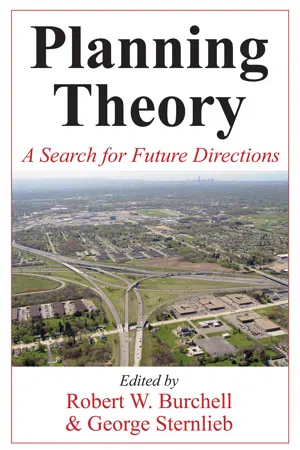
Theory and practice in city planning have never been known for their compatibility. The planner, dealing with stresses such as the personalities at work in a board meeting and coping with the realities of fund raising, political realities, and the like, can find little guidance in the theory of the trade. The issues of poverty groups, whether rural or urban, the provision of services, and the packaging of them are seemingly insuperable. The sheer frustration in the inability to deliver, which so many planners feel, can result in considerable impatience and a questioning of the relevance of theory.The editors argue that this state of affairs, though understandable, is unacceptable. While short-range meliorismwithout sense of perspective may be good for the practitioner's individual psyche, the cost may be borne by the long-run best interests of the groups to be served. The risks of a lack of perspective and the experiences generated by this phenomenon are too serious in their implications to permit the process to continue.In this new age of anxiety it is essential for both planners and theorists to understand their roles as well as provide guidance in shaping them. Burchell and Sternlieb have thus gathered here a variety of individuals, all of whom in their separate and distinct fashions are seasoned, both in practice and in theory. The book is divided into five sections: Physical Planning in Change, Social Planning in Change, Public Policy Planning in Change, Economic Planning in Change, and a final section detailing the roles of planners and who they are. These shared puzzlements and insights will prove useful to all practitioners and theorists in the planning field.
Information
Practical Demand for Analytic Methods
Introduction
The purpose of this paper is to examine the changing role of analytic methods as one of the urban planners skills. We will attempt to examine what kinds of technical methods are used, how they are changing, and the stimulus for these changes. We are interested in the role of methods in two areas—(1) planning practice, and (2) planning education. Are the methods taught in schools of planning appropriate, helpful and adequate, as well as responsive to practical needs? Or not?
We need first to define what is meant by methods. We mean analytic tools and skills, primarily quantitative—or at least analytically rigorous— that are used in the practical work of urban planners at city, regional, and state levels of government. Thus we include techniques of survey research; statistical data analysis; computer usage for analysis; models of the urban pattern used to study and forecast population, employment, income, land use, and transportation systems; as well as economic evaluation techniques for impact and cost-benefit analysis, and for the scheduling of implementation. In addition there are quantitative models and techniques applied to problems of housing, health, environmental quality, social services, and others that come under a variety of rubrics such as operations research, regional economic analysis, regional science, etc. We will use the terms model, technique, and method interchangeably to refer to this array of analytic tools.
The data we will examine in pursuing answers to our questions shall be from a number of surveys that have been conducted in the past several decades among practitioners, planning agencies, governments, and planning schools. These twenty studies are fisted in Exhibit 1 by author or analyst’s name, year of survey, units studied, sample size, and the general nature of the questions or variables focused on by the study. The data fall into two broad groups for our purposes. One set bears evidence on the relative importance of methods to the field of practice as a whole, and in the planning school’s curriculum. We shall examine these first. The other set bears more specifically on the usage of particular methods, their relative importance among one another, future needs as perceived by those who use these methods, and relative emphasis given various methods in planning education.
EXHIBIT 1 SURVEYS TREATING THE ROLE OF METHODS IN PLANNING PRACTICE AND EDUCATION
Date of | Units | Number | Variables | |
Survey/Analyst | Survey | Surveyed | of Units | Treated |
1. Adams | 1953 | Schools | 21 | Training offered |
2. Adams | 1953 | Agencies | 35 | Training needs |
3. Krueckeberg | 1963 | Agencies | 109 | Planning activities |
4. Hemmens | 1967 | Agencies | 26 | Model usage |
5. Cobb and Sweet | 1969 | Agencies | 91 | Model usage |
6. ICMA | 1970 | Cities | 844 | ADP usage |
7. Harman | 1971 | Agencies | 954 | Planning activities |
8. Schon, et al. | 1960-71 | Planners | 90 | Skills used |
9. ACIR | 1972 | Agencies | 289 | COG activities |
10. Gerecke | 1972 | Agencies | 52 | Canadian planning |
11. Jefferson | 1972 | Agencies | 108 | Methods: England and Wales |
12. Thorwood | 1972 | Cities | 268 | Planning and management |
13. Kaufman | 1973 | Planners | 5500 | Specializations |
14. Pack | 1973 | Agencies | 782 | Model usage |
15. ALP. | 1972-74 | Planners | 476 | Specializations |
16. Isserman | 1973-74 | Schools | 41 | Methods taught |
17. Isserman | 1974 | Planners | 84 | Methods used |
18. Susskind | 1974 | Schools | 63 | Graduate programs |
19. Pack and Pack | 1975 | Agencies | 30 | Model usage |
20. Logan | 1975 | Schools | 38 | Social planning courses |
We will move from a general discussion of the role of methods to a specific discussion of alternative methods. The final section of this paper will offer some interpretations of these findings—a conceptual scheme for visualizing how methods, practi...
Table of contents
- Cover Page
- Title Page
- Copyright Page
- Contents
- PREFACE
- INTRODUCTION: PLANNING THEORY IN THE 1980s–A SEARCH FOR FUTURE DIRECTIONS
- SECTION I: PHYSICAL PLANNING IN CHANGE-THE ROLE OF ENVIRONMENTAL PLANNING
- The Role of the Physical Urban Planner
- Ecological Planning: The Planner As Catalyst
- Planners as Architects of Built Environment—or Vice Versa
- Make No Big Plans . . . Planning in Cleveland in the 1970s
- SECTION II: SOCIAL PLANNING IN CHANGE-PRACTICAL APPLICATIONS OF SOCIAL SENSITIVITY
- Social Planning and Social Science: Historical Continuities and Comparative Discontinuities
- The Redistributive Function in Planning: Creating Greater Equity Among Citizens of Communities
- Social Planning and the Political Planner
- Politics, Planning, and Categories—Bridging the Gap
- Social Planning and the Mentally and Physically Handicapped: The Growing “Special Service” Populations
- SECTION III: PUBLIC POLICY PLANNING IN CHANGE-MACRO-PLANNING VERSUS LOCAL CONTROL
- Planning Behavior and Professional Policymaking Activity
- A Difference Paradigm for Planning
- Innovation, Flexible Response and Social Learning: A Problem in the Theory of Meta-Planning
- The Planner as Interventionist In Public Policy Issues
- Notes On An Expedition To Planland
- Planning—An Historical and Intellectual Perspective
- SECTION IV: ECONOMIC PLANNING IN CHANGE-NATIONAL PLANNING, DEMAND VERSUS SUPPLY EMPHASES
- On Planning the Ideology of Planning
- Planning In An Advanced Capitalist State
- The Comprehensive Planning of Location
- Economics in Urban Planning: Use, Skills and Supply
- SECTION V: WHAT ARE PLANNERS? WHAT DO PLANNERS DO? AND HOW ARE THEY PREPARED FOR THEIR TASKS?
- Three Crises of American Planning
- Seven Hills On the Way To the Mountain: The Role of Planning and Planners
- Practical Demand For Analytic Methods
- Planning Education: The Challenge and the Response
- BIBLIOGRAPHY
Trusted by 375,005 students
Access to over 1.5 million titles for a fair monthly price.
Study more efficiently using our study tools.
Frequently asked questions
Yes, you can cancel anytime from the Subscription tab in your account settings on the Perlego website. Your subscription will stay active until the end of your current billing period. Learn how to cancel your subscription
No, books cannot be downloaded as external files, such as PDFs, for use outside of Perlego. However, you can download books within the Perlego app for offline reading on mobile or tablet. Learn how to download books offline
Perlego offers two plans: Essential and Complete
- Essential is ideal for learners and professionals who enjoy exploring a wide range of subjects. Access the Essential Library with 800,000+ trusted titles and best-sellers across business, personal growth, and the humanities. Includes unlimited reading time and Standard Read Aloud voice.
- Complete: Perfect for advanced learners and researchers needing full, unrestricted access. Unlock 1.5M+ books across hundreds of subjects, including academic and specialized titles. The Complete Plan also includes advanced features like Premium Read Aloud and Research Assistant.
We are an online textbook subscription service, where you can get access to an entire online library for less than the price of a single book per month. With over 1.5 million books across 990+ topics, we’ve got you covered! Learn about our mission
Look out for the read-aloud symbol on your next book to see if you can listen to it. The read-aloud tool reads text aloud for you, highlighting the text as it is being read. You can pause it, speed it up and slow it down. Learn more about Read Aloud
Yes! You can use the Perlego app on both iOS and Android devices to read anytime, anywhere — even offline. Perfect for commutes or when you’re on the go.
Please note we cannot support devices running on iOS 13 and Android 7 or earlier. Learn more about using the app
Please note we cannot support devices running on iOS 13 and Android 7 or earlier. Learn more about using the app
Yes, you can access Planning Theory by Robert Burchell in PDF and/or ePUB format, as well as other popular books in Architecture & Urban Planning & Landscaping. We have over 1.5 million books available in our catalogue for you to explore.