- 272 pages
- English
- ePUB (mobile friendly)
- Available on iOS & Android
eBook - ePub
About this book
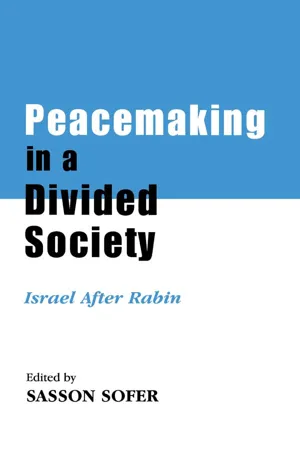
This is an interdisciplinary study of Israeli society in one of the defining moments in the history of Israel. The contributors discuss the critical aspects of the political order, economics, the military, the role of the media and legal reform that are shaping a new Israel.
Information
1 Israel in the World Order: Social and International Perspectives
As the century winds down and the state of Israel prepares to celebrate 50 years of independence, it is fair to say that triumph and perseverance characterize the course of its history. For the first time, Israel is a full and legitimate member of the international community Promising and unparalleled frontiers have opened to Israeli diplomacy, bringing an unprecedented expansion in external relations; the bonds of the Arab-Israeli conflict are loosening, though no sign of a decisive end to the conflict is apparent so far.
Israel faces these challenges as a critically divided society. New social forces have gained a pivotal political position, introducing fundamentalist beliefs and a vague historical vision, which usually hamper the emergence of the realism and pragmatism that a prudent diplomacy requires. Indeed, the prospects for reaching an end to the Arab-Israeli conflict, and for fashioning a new regional and international role for Israel, adaptable to the realities and norms of the post-Cold War era, remain obscure.
DIPLOMACY OF A DIVIDED SOCIETY
Diplomacy, in most cases, is socially bounded. More than in any past period, overlapping divisions—ethnic, religious, social, and political—have gained substantial sway over the formulation and conduct of Israeli foreign policy. Uncontrolled demographic fluctuations, the weakening of social solidarity, and an acute crisis of leadership have made the foundations of political legitimacy fragile. These factors, coupled with a crisis of national identity, have kept Israeli society distant from the universal trends that are shaping a new world order.1
The cleavages in Israeli society are deepening. Its income inequality and rate of poverty are the highest among Western societies. Ethnic, class, and generational inequalities, manifested in terms of education, occupation, and income, have persisted and sometimes widened.2
The secular-religious rift is, perhaps, the most fundamental one in Israeli society, and will remain so even after peace is achieved. The ultra-Orthodox cult of separateness, and the radical nationalism of a significant proportion of religious Zionists, have created an entrenched enclave with no desire to accommodate to a civil society based on equality, claiming privileges not accorded to any minority in a democracy.3 The secular-religious division may well determine Israel's national identity, its democratic fabric, the essence of its relationship with the Diaspora, and to a certain extent its international orientation and role in the Middle East. The recent tendency toward nationalism among the ultra-Orthodox constitutes one of the most dramatic changes in Israeli Jewish society, the full consequences of which we have not yet witnessed.
The right-left cleavage is no less complex. The Labor Party remains fully associated with the establishment and the peace process; the recent rise to power of the right looks like a revolt of the underprivileged, and of those threatened by modernity and progress. The right was stunned by the accelerating peace process, and even after electoral victory finds it difficult to adjust to the new political realities of the Middle East.
Israeli politics is undergoing radical changes. A new system of elections, where the Knesset and the prime minister are separately but simultaneously elected, has kept the situation unbalanced. A fragmented political body is in the making, with the roles of parliament, parties, and political leaders in a process of redefinition. Although the makeup of coalitions is still important, questions regarding the prime minister's role and his authority vis-à-vis the government, the Knesset, and his party have not been settled. A weaker party system will likely facilitate a stronger pressure-group system. Arabs, traditionally not included in the national discourse, are struggling for full equality, and will become more influential in Israeli politics.4
The divided nature of Israeli politics, the inconsistencies in political attitudes, and the rampant skepticism of the public are well reflected in all public surveys conducted in recent years, including the survey that the Leonard Davis Institute conducted in 1996, before and after the elections of that year.5
Issues related to foreign and defense policies, particularly those associated with the Arab-Israeli conflict, are dominant in determining political attitudes. There is solid support for peace, but also high skepticism about the prospects of achieving it. The public is divided between left and right, secular and religious, concerning the extent of territorial withdrawal, the establishment of a Palestinian state, and the very definitions of peace and of democratic norms.
Significantly, whereas an overwhelming majority wants the government to make all efforts to achieve peace, and a surprisingly solid majority wants Israel to be an integral part of the New Middle East, Israeli society is sharply divided on the question of whether territorial compromises will lead to peace. The same inconsistency is apparent in the tendency to support idealistic worldwide goals, such as universal human rights and arms control, whereas the same norms are not applied in regard to the Palestinians and Arab countries.6
The divisions in Israeli society are reflected in real or imaginary profiles of the two dominant parties, which may provide an explanation for political stagnation. The majority believes that the Likud Party is likely to be better at safeguarding the territories and fighting terror, and, at the same time, regards the Labor Party as better at securing democracy and achieving a true peace.7
These divisions in society have grave consequences for diplomacy. A divided political order places a heavy burden on the conduct of foreign affairs, and factional struggles make systematic planning or consensual national policy difficult to achieve. Any change of political hegemony also entails change at the conceptual and cognitive level, affecting the ways in which international reality is understood and analyzed. Israel's situation may well be termed a case of diplomatic discontinuity. A new ethnonational component has been introduced into Israel's governance and national policy, reflecting the widening cleavage between the nationalist right on the one hand and the Labor Party and its left-wing supporters on the other. Israel has, indeed, two distinct foreign policies with different regional and international perspectives.8
Israeli statesmen must deal, then, with a fragmented constituency, and encounter enormous difficulty in achieving solid support and legitimacy for a given policy, whether of the left or the right. The Israeli public is highly political, yet has no trust in politicians and no belief in its own ability to influence policy This public is marked by a narrow attitude toward international affairs, focusing almost entirely on war and peace in the Middle East and the future of the occupied territories; interest in global issues, such as international political economy, human rights, and environmental problems, is very limited.
Not surprisingly, from the beginning Israeli diplomacy inclined toward a fait accompli approach. When making crucial decisions, Israeli statesmen tend almost to ignore the public. Diplomatic achievements have never been made in the public domain. This is true of the Partition Plan of 1947, the Camp David accords, and the Oslo agreements: all were introduced as faits accomplis, the parties and the Knesset only being asked to approve formally what already had been agreed upon with foreign governments.9 In the case of the Oslo agreements, there was almost a flagrant neglect of the domestic front, leaving a significant proportion of the public out of touch with the peace process and its ultimate implications; peace did not speak for itself. Whatever the policy, it involves the diplomacy of a divided society, where a cynical and skeptical populace faces preoccupied and often manipulative politicians.
The Course of Israeli Diplomacy
Summing up a lifetime of diplomatic experience, Abba Eban wrote:
There is no doubt that the pervasive theme of Israel's performance is triumph. And yet the victorious state of Israel has more unresolved marks of interrogation hanging over it than most other political units in the modern world. Israel's structure, dimensions, boundaries, human composition, political regime, Jewish vocation and moral quality all became uncertain once the underlying principles of the early years were abandoned.10
As a small nation, a democracy, and the only Jewish state, Israel is a unique international actor. There has always been a certain exclu-siveness about its place in the world. Israel has difficulty maintaining a single international identity, wholly consistent either with its own national values or with world norms at large.11
A lack of strategic depth, numerical inferiority, and exposed frontiers have induced a sense of insecurity, not completely warranted by either the realities of world politics or the actual balance of power in the Middle East. A constant preoccupation with the Arab-Israeli conflict has resulted in a conspicuous discrepancy between the aspiration to meet universal norms and the necessity to resort to realpolitik vis-à-vis neighboring countries.
No major issues seem to be conclusively settled. Israel is one of the few states that are not formally affiliated with any regional bloc. Even the natural partnership with the Diaspora communities is destined for changes, and the alliance with the United States has yet to pass the tests of a longer period of history.
It is customary to blame Israeli diplomacy for many lapses and deficiencies, such as a lack of foresight and long-range planning, a susceptibility to impulse and crisis exigencies, a paucity of originality and inventiveness.12 In fact, Israeli diplomacy has scored some remarkable achievements. Most notable are the special relationship with the United States; the early, solid association with the European Community; the peripheral strategy involving Turkey, Iran, and Ethiopia; the peace settlements with Egypt and Jordan; and Israel's foreign aid and cooperation program in the Third World. Israel's diplomacy has always retained a streak of idealism.
All of the achievements came about despite the burden of domestic politics, and Israeli prime ministers' strong penchant for summitry, backstage diplomacy, and covert actions. Moreover, there is a sense prevalent ...
Table of contents
- Cover
- Half Title
- Cass Series: Israeli History, Politics And Society
- Title Page
- Copyright Page
- Table of Contents
- List of Tables
- List of Figures
- Notes on Contributors
- Introduction
- 1. Israel in the World Order: Social and International Perspectives
- 2. Peace Policy as Domestic and Foreign Policy: The Israeli Case
- 3. Voters' Attitudes on the Arab-Israeli Conflict and the 1996 Elections
- 4. The Israeli Right and the Peace Process
- 5. The Labor Party and the Peace Process
- 6. The Israeli Arabs and Israeli Foreign Policy: Minority Participation in Ethnonational Politics
- 7. Regional Conflict, Country Risk, and Foreign Direct Investment in the Middle East
- 8. The Peace Process and the Internationalization of Internal Legal Arrangements
- 9. The Role of the Media in Shaping Israeli Public Opinion
- 10. The Unique Approach to Military-Societal Relations in Israel and Its Impact on Foreign and Security Policy
- Index
Trusted by 375,005 students
Access to over 1.5 million titles for a fair monthly price.
Study more efficiently using our study tools.
Frequently asked questions
Yes, you can cancel anytime from the Subscription tab in your account settings on the Perlego website. Your subscription will stay active until the end of your current billing period. Learn how to cancel your subscription
No, books cannot be downloaded as external files, such as PDFs, for use outside of Perlego. However, you can download books within the Perlego app for offline reading on mobile or tablet. Learn how to download books offline
Perlego offers two plans: Essential and Complete
- Essential is ideal for learners and professionals who enjoy exploring a wide range of subjects. Access the Essential Library with 800,000+ trusted titles and best-sellers across business, personal growth, and the humanities. Includes unlimited reading time and Standard Read Aloud voice.
- Complete: Perfect for advanced learners and researchers needing full, unrestricted access. Unlock 1.5M+ books across hundreds of subjects, including academic and specialized titles. The Complete Plan also includes advanced features like Premium Read Aloud and Research Assistant.
We are an online textbook subscription service, where you can get access to an entire online library for less than the price of a single book per month. With over 1.5 million books across 990+ topics, we’ve got you covered! Learn about our mission
Look out for the read-aloud symbol on your next book to see if you can listen to it. The read-aloud tool reads text aloud for you, highlighting the text as it is being read. You can pause it, speed it up and slow it down. Learn more about Read Aloud
Yes! You can use the Perlego app on both iOS and Android devices to read anytime, anywhere — even offline. Perfect for commutes or when you’re on the go.
Please note we cannot support devices running on iOS 13 and Android 7 or earlier. Learn more about using the app
Please note we cannot support devices running on iOS 13 and Android 7 or earlier. Learn more about using the app
Yes, you can access Peacemaking in a Divided Society by Sasson Sofer in PDF and/or ePUB format, as well as other popular books in Politica e relazioni internazionali & Diplomazia e trattati. We have over 1.5 million books available in our catalogue for you to explore.