- 213 pages
- English
- ePUB (mobile friendly)
- Available on iOS & Android
eBook - ePub
About this book
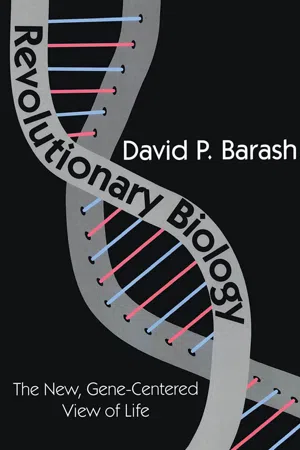
There is a revolution underway in biology. It is based on a new perception of bodies and genes, in which the former are the end product of the latter within the continuum of evolution. Twenty fi ve years after Richard Dawkins helped revolutionize our thinking about "selfi sh genes," it is time to reevaluate. Revolutionary Biology explains in simple, vivid terms what this exciting approach has to off er, and then applies its stunning insights to human beings. Th is novel perspective, galvanizes our understanding of how evolution works, what living things are all about and, not least, what it means to be human. Th e controversial disciplines of sociobiology and evolutionary psychology have generated startling insights into longstanding questions concerning the nature and purpose of families, altruism vs. selfi shness, and free will vs. biological determinism. Written by one of its foremost fi gures, Revolutionary Biology is a manifesto and educated layman's guide to this ongoing revolution.
Information
1
Revolutionary Biology: The Family Face
There is a revolution under way in biology. It is giving rise to a new vision of life in general, of human beings in particular, and a new way of understanding why people behave as they do. Fortunately, this revolution is altogether nonviolent, shedding light instead of blood. Like most revolutions, however, this one has generated a fair amount of soul-searching, as its participants find themselves looking afresh at things that had been taken for granted. (And like most revolutions, this one has also been bitterly resisted by many of those who remain committed to the old ways.)
The biological revolutionaries have begun to confront some fundamental questions that are important to us all. Such as: Why have children? Why love them? Why do fathers and mothers frequently disagree, not only about their own lives but even about their children? Why do parents and children also disagree so frequently? Why do children seem to want more than parents can give, and why do parents expect so much from their children? What about sibling rivalry? The Oedipus complex? Why is it that people can adopt and love children born to others, and yet, step-families are so difficult? Why care about relatives? Why treat them differently from strangers? Are people, or animals, naturally altruistic? Or is it normal to be selfish? Why do people love their country? Their football team? Can they act according to the Golden Rule? Should they?
More generally, are human beings basically altruistic and good, or selfish and bad? Why do people show such a complex and often troubling array of social and antisocial tendencies? Why, given that families are so important, are they often so difficult? Why are there fewer saints than sociopaths? Even “Why are we here?” and—believe it or not—”What is the meaning of life?”
Thanks to this biological revolution, it is also possible to see the rest of nature in a new, provocative, and useful way, while also acknowledging human beings to be on the one hand, organic creatures like any other, and yet, at the same time, special. Thanks to this biological revolution, we can, at last, begin to make sense of families, and in the process, make sense of ourselves.
The basis of this revolution is a new paradigm with an old pedigree, a grand theory of life—in fact, the grand theory of life—with scope as broad as its agenda: evolution. Right at the outset, you might hear some people grumbling that evolution is “only a theory.” Don’t believe it. Or rather, don’t be bamboozled. In particular, don’t mistake “theory” for “hypothesis.” In science, a hypothesis is a conjecture, an educated hunch that may or may not be true, and that is tested by research. A scientific theory, on the other hand, is a coherent body of principles tested many times over and used to explain a class of phenomena. Hypotheses, like informed guesses in general, come and go. Theories also come and go, but when—as in the case of evolutionary theory—they stick around, it is because they continue to be supported, besting their alternatives, until eventually they become the very substance of scientific knowledge.
“The theory of evolution” has weathered test after test, emerging from each challenge (and there have been many!) refined and strengthened. Thus, evolutionary theory is to biology what atomic theory is to chemistry, or number theory to mathematics, or gravitational theory to astronomy: as close to fact as science is likely to get. Evolutionary “theory” is the fundamental, unifying prism that focuses light on the meaning, structure, history, and dynamics of life on earth. This focus is intense, and can be inflammatory. But all recent developments in biological science and medicine are based on evolutionary theory, from advances in molecular biology to new understandings of infectious disease and progress in cancer prevention and treatment. As Charles Darwin first described it and subsequent researchers have filled in many of the blanks, evolution is a Rosetta Stone, the key to life on this planet—and, for all we know, wherever else it may appear.
It must be noted that in some ways this “revolution” is not all that new; in fact, it is becoming middle-aged. Following its Darwinian manifesto (nearly 150 years ago), even the major uprisings in revolutionary biology are more than twenty years old. But most scientific revolutions are not like the Russian Revolution or the Boston Tea Party, sudden conflagrations that are over quickly, even as their effects linger. Unlike a military or political coup that “only” involves a changing of the guard, scientific revolutions change something far more resistant: people’s minds. And so, most scientific revolutions take decades, and although they rarely involve violence, sometimes they do not succeed until the old guard passes away.
In the evolutionary revolution—at least when applied to human behavior—the battle is far from over. As a matter of fact, mainstream opinion in the social sciences (psychology, anthropology, sociology, and so forth) still clings to the dogma that human behavior is overwhelmingly a product of culture, learning, and social tradition. When most social scientists mention evolution at all, it is often misconstrued; to paraphrase Winston Churchill, never have so many said so much about something they understood so little.
It is sometimes said that one way to tell an optimist from a pessimist is to give the subject a shovel and put him or her in a room filled with horse manure. While the pessimist does nothing, the optimist digs vigorously, reasoning that with so much manure, there must be a horse nearby! Evolution and its misconceptions have generated many rooms-full of horse manure, but despite all the foolishness, revolutionary biologists are optimists. (Be warned: shoveling ahead!)
While some people still believe in various creation myths, from the Judeo-Christian story of Adam and Eve to the Hindu principle of reincarnation, most scientists take evolution for granted, not because it is unquestioned, but exactly the opposite: throughout decades of searching questions, evolution has continued to provide answers, thereby proving itself, over and over.
Scientific confidence in the “correctness” of evolution is all right so far as it goes, but it doesn’t go far enough. In particular, to see evolution as simply a historical process is to give it too little credit.
In the public mind, evolution is widely associated with dinosaurs, “cave-men,” dusty museum exhibits, and maybe something about embryos having gills and tails. But—especially as it is understood by the modern revolutionaries known as evolutionary psychologists, sociobiologists, or behavioral ecologists—evolution is much more immediate and its implications, downright dramatic. It isn’t dead, like the dinosaurs. It is alive and kicking, the driving force behind what people are and what they do, no less than where they came from. It is the dynamic stuff of human loves, hates, fears, and desires no less than of bones and other fossils. When we really understand evolution, then and only then will we really understand human beings.
This book, then, is about understanding ourselves, not so much how we came to be but what we have become, right now, today. We are not going to spend time on bones, internal chemicals, or brains, but rather on what makes human beings tick, how and why they act the way they do. That is where the imprint of evolution is most striking, and where modern revolutionary biology is most exciting.
Before we proceed, however, a major caveat is in order. Nothing, it seems, is as simple as most people might wish. Our minds crave simplicity; the universe responds with complexity. We look for either/ or, yes/no answers; the world gives us subtlety and ambiguity—this and that, yin and yang, interpenetrating and inseparable. If this is true for such “simple” things as the nature of an electron (particle and wave), then consider how much more true it is for complex things such as the nature of human nature (biological and cultural, genetic and learned).
Nothing in this book should be taken as arguing that human beings are “only” DNA made manifest, or that human behavior can be entirely understood as the outcome of pushy genes, struggling to get ahead. Human nature also includes complex symbolic thought, social learning and cultural tradition, as well as—on occasion—plain old-fashioned stubborn refusal to go along with experience, sometimes a cantankerous insistence on defying laws and rules, including even those that are supposedly “biological.” Human nature is just too fluid, too complicated, too difficult, to be captured entirely by any formulation, whether biological, philosophical, cultural, theological, or what-have-you. Homo sapiens is an ornery old bird, not readily captured in a single, simple net.
President Harry Truman once complained that he would give a lot to have a one-armed economist. It seems that whenever Truman sought advice, his economists would reply with their best guess, and then add “But on the other hand...” Because the insights of revolutionary biology are so new, and their promise is so great, this is pretty much a one-handed book. It is based on the premise that its brand of evolutionary thinking is worth pursuing, to see how far it will take us. But this does not mean that genecentered evolutionary theory has cornered the market on what makes human beings tick, what makes them special, or even, what makes them interesting. There is always another hand.
For an analogy, imagine someone had just discovered, for the first time, that heart disease is influenced by diet. (Let’s say that previously, everyone thought it was “purely genetic”) There would be great interest and enthusiasm in the new-found role of food in predisposing to heart disease. People would eagerly—and appropriately— investigate the details of saturated versus unsaturated fats, cholesterols of all sorts, the significance of proteins, minerals, overall calorie intake, and so forth. Books would be written, explaining the astounding new discovery that diet affects heart disease, even though the ghost of Harry Truman’s economists could still be heard: “But on the other hand ... there are additional causes of heart disease, those related to exercise, for example. Ditto for stress, genetic susceptibility factors, other pre-existing conditions such as rheumatic fever, etc.”
As this book unfolds, please do not mistake its one-handed approach—arrogant and blinkered as it may seem—for a fundamentalist’s certainty that there is only one avenue to truth. Rather, as we explore the implications, insights, and excitement of revolutionary, genecentered biology, see it as an attempt to follow a novel and promising path to discover how far it will take us, fully aware that there are other paths, other truths, other factors that ultimately must be taken into account if anything approaching a valid “explanation” for human beings and their behavior is ever to be achieved. Occasionally—all too rarely, for those committed to other interpretations—we’ll suggest alternative ways of explaining things, if only to restrain excessive enthusiasm for a biological approach which, although fruitful, is only one of many paths to understanding ourselves.
If it helps, keep in mind the story of the beloved rabbi who once listened, with great sympathy, as a man from his congregation complained bitterly about his wife. A few minutes later, the rabbi responded with equal sympathy to the wife’s complaints about the husband, telling each separately and sympathetically, “I understand. You’re absolutely right.” (In late twentieth-century terms, he could “feel their pain.”) Then, when both husband and wife were gone, the rabbi’s wife, who had been listening all the while, berated him: “First you said the man was right, then you said the woman was right. This is impossible. They can’t both be right!” The rabbi paused for a moment, and then replied calmly, “You know, you’re right too.”
The Gene in the Machine, or
The Invasion of the Body Snatchers Revisited
At the core of revolutionary biology is a new perception of the relationship of bodies and genes. In short, the basic idea is this: the chicken-and-egg problem is finally solved. The egg came first. Or, more to the point, the chicken is merely a servant of the egg, rather than the other way around. Samuel Butler was correct: the chicken is an egg’s way of making more eggs.
Not that bodies aren’t important. It is bodies that we see occupying the landscape, whether chicken bodies or human beings. Bodies, bodies everywhere. Bodies breathing, reproducing, fighting, sharing, arguing, running about or lying down, building buildings and writing novels, voting and emoting, making war and making love. Every person is carefully tucked into a body, occupying—or so we assume— neither more nor less than the exact boundaries of his or her own skin.
This may be a common-sense and even obvious perspective, but it can also be misleading. Consider, for example, that the best view in Warsaw, Poland, is from the top of the Ministry of Culture, a monument of Stalinesque architecture at its worst. Why, then, is the view so good? Because it is the only place in the city from which you cannot see the Ministry of Culture! Similarly, each of us looks out at the rest of the world from the private confines of our cozy little home and castle: our bodies, ourselves. The view is good, but not necessarily accurate.
It is very difficult for people to consider themselves as anything other than their bodies, taken as a whole. You may look, with detachment, at a sample of “your” red blood cells, wriggling on a microscope slide, at a dental x-ray, a chromosome enlargement, or an MRI of one part or another of your anatomy, all the while knowing that in some sense, it isn’t really and truly “you.”
From the perspective of evolution, who or what constitutes that individual you call yourself? And what does it mean to acknowledge that a lengthy process of natural selection has produced it? Taken at face value, insofar as every living thing is the product of evolution, it means that each individual “me” has somehow been squeezed and molded, pruned and pounded into shape by natural selection operating via evolution’s impact on our ancestors.
Correct, but only up to a point. Thus, everyone is indeed the product of evolution by natural selection. Biology’s revolution has shown, however, that the face who stares back from the mirror (just like the one who looks out at the world from that structural bastion we call a body) is only indirectly the handiwork of evolution. Rather, all bodies are the product of genes, and it is they—the genes—that are evolution’s legacy to every person, made corporeal in all those bodies that people today’s world. Your face, your body, your physical and biological self: all are the outer manifestations of your genes, after they have interacted with the food, the oxygen, the learning, the exercise, and the sum total of all the other experiences that eventually produced “you.” It is human genes—and hummingbird genes, and hyacinth genes, and so on—that have been picked and pruned, some doing well and others poorly, tumbling over each other, some leaping ahead and others dying out, mutating on occasion or remaining utterly unchanged, flowing along as best they can in a continuously meandering stream of DNA for millions of years, beginning with the origin of life and with no end in sight.
Each individual, on the other hand, is something else again, more like a temporary eddy in that living, surging river. Look at it this way: “you” are only as old as the time that has passed since your birth. In a sense, it wasn’t evolution that put you together so much as the laws of chance, which combined half of your mother’s genes with half of your father’s, then shook you gently with a hefty dose of experience and environment, then marinated the concoction in tincture of time.
In another sense, although chance determined which genetic cards you were dealt, it was evolution that produced those “cards” in the first place. The genes that carry the information needed for each cell and protein in your body were established in the eons that passed before you were born. Like playing cards, they have the potential to be reshuffled and reused, in different combinations, over and over again in a poker game that isn’t merely “all night,” but potentially for all time. You, by contrast, won’t last nearly so long.
Each individual is analogous to a “hand” of bridge, pinochle, gin rummy, hearts,...
Table of contents
- Cover Page
- Title Page
- Copyright Page
- Contents
- 1. Revolutionary Biology: The Family Face
- 2. Altruism: Theory and Animals
- 3. Human Altruism
- 4. Reciprocity: Doing unto Others
- 5. Parenting, Adoption, and Step-Parenting
- 6. Conflict between Parents and Offspring
- 7. To Whatever Abyss
- Index
Trusted by 375,005 students
Access to over 1.5 million titles for a fair monthly price.
Study more efficiently using our study tools.
Frequently asked questions
Yes, you can cancel anytime from the Subscription tab in your account settings on the Perlego website. Your subscription will stay active until the end of your current billing period. Learn how to cancel your subscription
No, books cannot be downloaded as external files, such as PDFs, for use outside of Perlego. However, you can download books within the Perlego app for offline reading on mobile or tablet. Learn how to download books offline
Perlego offers two plans: Essential and Complete
- Essential is ideal for learners and professionals who enjoy exploring a wide range of subjects. Access the Essential Library with 800,000+ trusted titles and best-sellers across business, personal growth, and the humanities. Includes unlimited reading time and Standard Read Aloud voice.
- Complete: Perfect for advanced learners and researchers needing full, unrestricted access. Unlock 1.5M+ books across hundreds of subjects, including academic and specialized titles. The Complete Plan also includes advanced features like Premium Read Aloud and Research Assistant.
We are an online textbook subscription service, where you can get access to an entire online library for less than the price of a single book per month. With over 1.5 million books across 990+ topics, we’ve got you covered! Learn about our mission
Look out for the read-aloud symbol on your next book to see if you can listen to it. The read-aloud tool reads text aloud for you, highlighting the text as it is being read. You can pause it, speed it up and slow it down. Learn more about Read Aloud
Yes! You can use the Perlego app on both iOS and Android devices to read anytime, anywhere — even offline. Perfect for commutes or when you’re on the go.
Please note we cannot support devices running on iOS 13 and Android 7 or earlier. Learn more about using the app
Please note we cannot support devices running on iOS 13 and Android 7 or earlier. Learn more about using the app
Yes, you can access Revolutionary Biology by David Barash in PDF and/or ePUB format, as well as other popular books in Biological Sciences & Evolutionary Psychology. We have over 1.5 million books available in our catalogue for you to explore.