- 357 pages
- English
- ePUB (mobile friendly)
- Available on iOS & Android
eBook - ePub
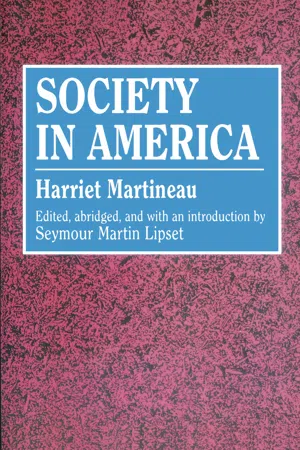
Society in America
About this book
Harriet Martineau brought to her observations the convictions of a vehement English liberal and an astonishingly modern sociological approach. In 1834 she wrote the first draft of How to Observe Manners and Morals--perhaps the earliest book on the methodology of social research. In abridging the 800-page original for the modern reader, Lipset has concentrated on Martineau's brilliant discussion of religious practices, social status, and childrearing; political apathy and the position of women, blacks, and immigrants; and the American's casual approach to indebtedness and his speculative wealth-or-ruin schemes.
Information
Harriet Martineau’s America
Seymour Martin Lipset
AMERICANS today have forgotten, if they ever knew, the meaning the United States once held for the world. To the nineteenth century European, America was a land of promises. To the penniless worker and peasant, it was the land to which they might someday emigrate. There, in a country without kings or nobility, they might live as free and equal men, with the actual possibility of gaining a decent economic and social position. To the intellectuals, the politically concerned, the rulers, and the rebels, America was both a reality and a symbol. It was a democratic republic permeated by equality in social relations. To the conservative and to the radical, it proved that such republics could survive.
This image of a new society brought thousands of “travelers,” men and women of middle- and upper-class background who came to observe how the new revolutionary system worked. The intellectuals returned home to inform their compatriots through articles and books about America. These writings, the “foreign-traveler” literature, have always commanded attention both in their home countries and in America.1
The foreign-traveler literature constitutes a treasure- trove for students of American society. In a sense, these works were the first massive effort to apply sociology’s conceptual framework to the study of a complex society. The problem that interested everyone, foreigners and natives alike, was not America’s political history, but its sociology. What were the factors involved in the development and operation of this unique social structure? The classic writings about European nations have been distinctly historical in character. England and France, for example, have been seen as products of their history. Men write of England from the Conquest to the present trying to explain the nation’s development in terms of particular historical events. The same is true for France. But the United States in a certain sense has been a country without a history, without great men. The open frontier, the absence of primogeniture, egalitarian social relations, a common school system, mass production, immigration, social mobility, a heterogeneous nonestablished church, and the like are the factors given predominance in explaining America’s evolution. The travelers’ books contain chapter headings that read like sections of contemporary anthropological treatises on exotic peoples, religion, the place of women, children, politics, land-tenure, and so forth. The Europeans came to America from societies that retained strong elements of a feudal caste-ridden past. They were constantly struck by the differences between comparable institutions at home and in America. Explicitly or implicitly they attempted to explain the causes and the consequences of these variations. For the most part these writers employed what has come to be known as the comparative approach in sociological analysis. They treated different societies and their components as units of analysis and generalized about causal relations within social systems. Alexis de Tocqueville, perhaps the most brilliant of them, credited the comparative method with the success of his Democracy in America.
In my work on America … though I seldom mention France, I did not write a page without thinking of her, and placing her as it were before me. … I believe that this perpetual silent reference to France was a principal cause of the book’s success.2
Methodological self-consciousness also characterized the work of Harriet Martineau, whose major treatise on American society is reprinted here. On shipboard in 1834, on her way to a two-year intensive study of American society, she wrote the first draft of what later became a volume of instructions to travelers seeking to study foreign cultures, How to Observe Manners and Morals.3 This volume is, perhaps, the first book on the methodology of social research in the then still unborn disciplines of sociology and anthropology. Martineau* realized that the study of social systems was a separate scientific discipline, and called it the “science of morals and manners.” As her most recent biographer has written, “for years she had been preaching sociology without the name.”4
In setting forth one of her first methodological principles, she stated: “The enlightened traveller, if he explores only one country, carries in his mind the image of all….” He must learn that “every prevalent virtue or vice is a result of the particular circumstances amidst which the society exists.”5
Perhaps the most surprising impression that emerges from a reading of Alexis de Tocqueville and Harriet Martineau, as well as of the myriad of other early nineteenth- century foreign travelers, is the congruence between their comments on American institutions and values and many of the recent major commentaries on American national character such as David Riesman’s The Lonely Crowd and William H. Whyte’s The Organization Man. As Riesman himself has commented, some of the major attributes that in his view define the key character traits of the midtwentieth century American, such as other-directedness (specifically extreme sensitivity to others), were also noted by these writers:
Yet in some respects this type [the other-directed man] is strikingly similar to the American, whom Tocqueville and other curious and astonished visitors from Europe, even before the Revolution, thought to be a new kind of man. Indeed, travelers’ reports on America impress us with their unanimity. The American is said to be shallower, freer with his money, friendlier, more uncertain of himself and his values, more demanding of approval than the European. It all adds up to a pattern which, without stretching matters too far, resembles the kind of character that a number of social scientists have seen as developing in contemporary, highly industrialized and bureaucratic America: Fromm’s “marketeer,” Mills’ “fixer,” Arnold Green’s “middle-class male child.”6
These similarities have been noted by historians as well. Henry Steele Commager, who has used much foreign- traveler literature in his publications, has pointed to these continuities in analyzing American culture:
We know in all outward matters America has changed profoundly in the century and a half since Independence, and that these changes have been continuous and complex; we are sometimes inclined to suppose that there have been comparable changes in the national character. This is not the conclusion to be drawn from the findings of these foreign observers. … To the visitors of the seventeen-seventies and the nineteen-forties, to Britons, Frenchmen, Germans, and Swedes, America meant much the same thing.7
A sociologist, Lee Coleman, also examined the writings dealing with “the American way” in four different periods— before the Civil War, from the Civil War to World War I, from the war to the Great Depression, and during the 1930’s—and compiled a list of traits mentioned by the various observers. He reported that “when the lists for each of the four time periods were compared, no important differences between the traits mentioned by modem observers and those writing in the earlier periods of American history were discovered.”8
Harriet Martineau’s Society in America is one of the most important of the early efforts to describe and account for these seemingly constant aspects of American society. A source of much controversy in both Britain and America, it played a major role in forming English opinion, particularly among the liberal left of her day. Charles Dickens, although not in this category, described it as the best book written on the United States. Based on a two-year stay from 1834–1836, it is replete with vivid descriptions of life at the time, analyses of various institutions and patterns of behavior, and a considerable amount of what even to her contemporaries was annoying moralizing about diverse subjects. A careful reading of Society in America reveals a relatively integrated analytic portrait of the America of Andrew Jackson’s day, one that offers much to those interested in the factors underlying the so-called American national character. Since the basic conceptual framework of the book is never explicitly laid out, I will try to do so here.
Society in America
At the center of Harriet Martineau’s study of American society was the assumption that the country’s basic moral values were a major factor in determining its institutional structure. Where the central value system and the institutional reality were in conflict the values engendered a strong force towards bringing the practices into line— though she recognized that changes in other institutions, particularly the economic and the political, could greatly affect the value system. In emphasizing the value system as a causal agent, Martineau was an early precursor of one of the major sociological orientations, an approach that attempts to analyze the effect of values on structure and change. Max Weber, perhaps the most influential in this line of inquiry, demonstrated the relationship between economic development and moral beliefs. He showed that a basic prerequisite to the rise of capitalism in Western Europe was the independent emergence of a particular religious ethos. The Calvinist ethic led men to behave in ways that facilitated the accumulation of investment capital and promoted a deep commitment to sustained work.9 Talcott Parsons, one of the foremost theorists in modem sociology, has elaborated on Weber’s approach, and made values the central component in his conceptual framework for the study of total social systems.10
Perhaps the most influential work on an American social problem, An American Dilemma, Gunnar Myrdal’s study of race relations, approached the analysis of American society in almost identical terms to those used by Harriet Martineau a century earlier. Myrdal, a Swedish sociologist and economist, assumed that the United States could be understood as reflecting “the ever-raging conflict between on one hand, the valuations preserved on the general plane which we shall call the ‘American Creed,’ where the American thinks, talks, and acts under the influence of high national and Christian precepts, and, on the other hand, the valuations on specific planes of individual and group living, where personal and local interests; economic, social and sexual jealousies; considerations of community prestige and conformity; group prejudice against particular persons or types of people; and all sorts of miscellaneous wants, impulses, and habits dominate his outlook.”11 And Myrdal sought to show how the belief in the “American Creed” of equality has served as a major force for actual changes in the position of the Negro.
Society in America also began with the assumption that the American Creed as set down in the Declaration of Independence, the belief in “human equality,” in the “obligation of human justice,” and in the right of the whole people to be self-governing, is the key to the understanding of the way in which American society has developed. Thus the student of America was obliged to specify the way in which the norms implicit in the core values determined the structure of institutions. He had also to note the sources of deviations from the values and the way in which the strains between basic values and institutional practices were handled. As we have seen, explicit in both Martineau’s approach and Myrdal’s is the assumption that such strains constitute a principal cause of social change. Both argued that those Americans who believed in equalitarian democracy in all spheres possessed a great weapon, since complete social equality and democracy are the country’s legitimate moral tradition.
The reality of equalitarianism in Jacksonian America impressed itself deeply on Harriet Martineau:
[I]n America … the English insolence of class to class, of individuals towards each other, is not even conceived of, except in the one highly disgraceful instance of people of colour. Nothing in American civilisation struck me so forcibly and so pleasureably as the invariable respect paid to man, as man. Perhaps no Englishman can become so fully aware, without going to America, of the atmosphere of insolence in which he dwells; of the taint of contempt which affects all the intercourses of his world.
Although Martineau was admittedly a biased observer, she wanted to believe that an egalitarian democracy could work—her reports on such behavior are abundantly reiterated by almost all foreign commentators, among them many conservatives and aristocrats.12 Thus, as if echoing her emphasis on the “insolence” of the English privileged towards those whom they regarded as their inferiors, the conservative Anthony Trollope complained in 1860 that in America “the man to whose service one is entitled answers one with determined insolence.”13
But equalitarianism in social relations did not mean the absence of hierarchy, or of competition. Rather, if anything, the very absence of fixed class lines placed pressure on all as the burden of success lay with the individual himself. As Martineau put it: “In a country where the whole course is open to every one; where in theory, everything must be obtained by merit, men have the strongest stimulus to exert their powers, and try what they can achieve.… [This social pressure] can lead to ill-considered enterprise. This is an evil sometimes to the individual, but not to society.” In this comment, she affirmed a similar generalization by Tocqueville that by destroying aristocracy, Americans “have opened the door to universal competition.”14
The emphasis on success intertwined with the absence of aristocratic norms not only may have destructive consequences for individuals by tempting them to try to succeed by illegitimate or untried means, but it may also lead other Americans to excuse immoral methods of attaining success.15 For example, she suggested that in America, bankrupts usually do not “pay their old debts when they rise again. This laxity is favoured by the circumstances of the community, which require the industry of all its members … [F]ew things are more disgraceful in American society than the carelessness with which speculators are allowed to game with other people’s funds, and, after ruining those who put trust in them, to lift up their heads in all places. …” A decade later, Charles Dickens was to make the same analysis of the behavior of Americans, pointing out that they cared not about the “merits of a broken speculation, or a bankruptcy, or of a successful scoundrel,” but rather saw pecuniary success as evidence of cleverness.16
This stress on equality also failed to eliminate the factors that pressed men to try to establish hereditary classes. And the very moral force that denied the legitimacy of hereditary privileged strata operated to create an upper...
Table of contents
- Cover Page
- Title Page
- Copyright
- Harriet Martineau’s America
- Contents
- Introduction
- I Politics
- II Parties
- III Apparatus of Government
- IV Morals of Politics
- V Economy
- VI Agriculture
- VII Morals of Economy
- VIII Civilisation
- IX Idea of Honour
- Women
- XI Children
- XII Sufferers
- XIII Utterance
- XIV Religion
- XV Spirit of Religion
- XVI Administration of Religion
- XVII Conclusion
Trusted by 375,005 students
Access to over 1.5 million titles for a fair monthly price.
Study more efficiently using our study tools.
Frequently asked questions
Yes, you can cancel anytime from the Subscription tab in your account settings on the Perlego website. Your subscription will stay active until the end of your current billing period. Learn how to cancel your subscription
No, books cannot be downloaded as external files, such as PDFs, for use outside of Perlego. However, you can download books within the Perlego app for offline reading on mobile or tablet. Learn how to download books offline
Perlego offers two plans: Essential and Complete
- Essential is ideal for learners and professionals who enjoy exploring a wide range of subjects. Access the Essential Library with 800,000+ trusted titles and best-sellers across business, personal growth, and the humanities. Includes unlimited reading time and Standard Read Aloud voice.
- Complete: Perfect for advanced learners and researchers needing full, unrestricted access. Unlock 1.5M+ books across hundreds of subjects, including academic and specialized titles. The Complete Plan also includes advanced features like Premium Read Aloud and Research Assistant.
We are an online textbook subscription service, where you can get access to an entire online library for less than the price of a single book per month. With over 1.5 million books across 990+ topics, we’ve got you covered! Learn about our mission
Look out for the read-aloud symbol on your next book to see if you can listen to it. The read-aloud tool reads text aloud for you, highlighting the text as it is being read. You can pause it, speed it up and slow it down. Learn more about Read Aloud
Yes! You can use the Perlego app on both iOS and Android devices to read anytime, anywhere — even offline. Perfect for commutes or when you’re on the go.
Please note we cannot support devices running on iOS 13 and Android 7 or earlier. Learn more about using the app
Please note we cannot support devices running on iOS 13 and Android 7 or earlier. Learn more about using the app
Yes, you can access Society in America by Harriet Martineau in PDF and/or ePUB format, as well as other popular books in Social Sciences & Sociology. We have over 1.5 million books available in our catalogue for you to explore.