Based on five organizational case studies, this book argues that community colleges face an identity crisis and must find ways of balancing the three traditional roles typically assumed by them: transfer, vocational, and community education.
To emphasize one at the expense of another is to fail to meet the diverse needs of students who look to the community college as a source of opportunity and social mobility. In addition, community colleges must create an organizational context in which opportunities exist for culturally diverse students to participate as full members in the educational process.
The study uses democratic educational strategies first suggested by John Dewey as a foundation for developing a critical multicultural view of community college education. The authors argue that critical multiculturalism moves beyond liberal views of cultural diversity and challenge academic institutions to take advantage of the varied experiences and perspectives that students from other cultures bring to education. The book includes a reference section following the final chapter and a name and subject index.
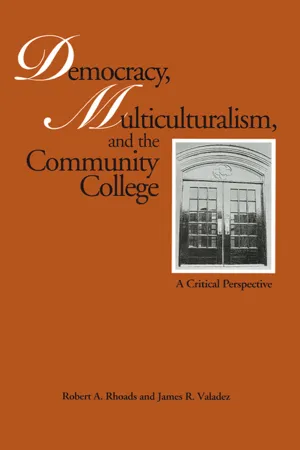
eBook - ePub
Democracy, Multiculturalism, and the Community College
A Critical Perspective
- 250 pages
- English
- ePUB (mobile friendly)
- Available on iOS & Android
eBook - ePub
Democracy, Multiculturalism, and the Community College
A Critical Perspective
About this book
Information
Democracy, Multiculturalism,
and the Community College
and the Community College
Chapter One
Multiculturalism and Border Knowledge in Higher Education
In this chapter, we expand upon our conception of multiculturalism and discuss what is sometimes described as critical multiculturalism. We relate critical multiculturalism to issues of culture and identity, which are vital to understanding the role of community college education. Our intent is to clarify a view of multiculturalism and the challenge it presents to authoritarian views of knowledge embraced most clearly in the idea of the canon. We introduce the notion of border knowledge and discuss its relationship to cultural diversity. Our discussion of border knowledge and the canon is linked to what has been termed the politics of identity.
This chapter provides the theoretical framework around which the remainder of this book is structured. Consequently, while the remaining chapters specifically focus on community colleges and community college issues, this chapter focuses on broader concerns within higher education in the United States. We see a need to situate discussions of community college education within an emerging theoretical wave led by feminism, critical theory, and postmodernism. In chapter 2 and subsequent case-study chapters, we refocus our analysis on the community college as we apply the theoretical perspective suggested here.
Campus Divisiveness or Cultural Diversity?
In debates about U.S. higher education a dualism is often posited between the traditions of past excellence and calls for greater access and equity. Idyllic images of professors and students framed by a shared language and culture, engaged in the pursuit of knowledge for knowledge’s sake, are contrasted with portraits of campus divisiveness and curricula resembling more an à la carte menu than any coherent educational philosophy. There is little doubt that cultural diversity has pulled at the fabric that has structured higher education in this country for quite a few years.
But professors and students engaged in deep philosophical discourse have been the exception and not the rule, and enduring images are often reflections of the “good old days” that never were. Campus divisiveness is nothing new. At Harvard and Yale between 1745 and 1771, students frequently protested “the manner by which education was imparted” in what has been described as the “war with the tutors” (Moore, 1978, p. 125). Student revolts in the early 1800s were commonplace as students rebelled against the authority of the “old-time” college and what many perceived as “political indoctrination” at the hands of federalist-leaning professors and clergy who sought to uphold “religion, morality, civilization, authority, and order” (Novak, 1977, p. 72). And there seems always to have been disruptions caused by student social clubs emerging with or without official institutional support (Horowitz, 1987). Frequently, student resistance has focused on the learning process, evidenced by Lyman Bagg’s (1871) discussion of how the more socially oriented students at Yale disliked the “grinds”—those students “digging and grinding for a stand [a good grade], existing all unconscious of the peculiar and delightful life about [them]” (p. 702). Clearly, students have for years found a multitude of ways to subvert the educational enterprise despite the best-laid plans of faculty and administrators.
Divisiveness is hardly new, but it has taken on a somewhat different tenor. Instead of complaints about upper-division students disrupting the lives of first-year students, or students forming allegiances against faculty, or the socials sabotaging the grinds, issues of race, gender, class, and sexual orientation have become central to what some see as fragmentation within today’s academy. Several recent developments support our point. In protest of a decision by the college s trustees to admit men, students at Mills College, a women’s college founded over a century ago, went on strike and effectively halted the school’s operations (McCurdy, 1990). “Their spirited exchanges and passionate commitment showed the world that what they appreciate first about women’s colleges is the empowerment they experience in institutions that place women students at the center of their educational mission” (Hartman, 1990, p. A40). At the University of California at Los Angeles, 99 students were arrested in demonstrations held to protest the university’s refusal to grant Chicano Studies full academic status. Chicano students believed achieving departmental standing was a step toward strengthening the identity of the Chicano community (McCurdy, 1993). At the University of California at Berkeley, a coalition of Asian-American, Black, Latino, American Indian, and lesbian, gay, and bisexual students demonstrated over the lack of minority students and faculty, as well as the need to establish a Gay Studies department (Fifty-six Protesters, 1990). African-American students at Pennsylvania State University organized a student takeover of the university’s communications tower. The demonstration was held to protest the university’s lack of commitment to improving the campus environment for African-American students (DeLoughry, 1989). And finally, African-American students at Rutgers University halted and then forced the postponement of a highly anticipated Atlantic Ten basketball game in protest of degrading statements about African Americans made by the Rutgers president.
Multiple interpretations exist as to the causes and outcomes of campus disharmony. For example, what appears in much of the higher education literature, often in the form of innuendo, is that cultural diversity is the major cause of both campus divisiveness as well as incoherent curricula. Open access and efforts to achieve equal opportunity often come under attack from conservative critics such as Dinesh D’Souza (1991) and Roger Kimball (1990), who see inclusionary practices as threats to the best traditions of U.S. higher education and as indications of how ideology has come to corrupt the academy. Another example comes from a recent meeting of the American Educational Research Association at which Sheldon Hackney, director of the National Endowment for the Humanities and former president of the University of Pennsylvania, talked about cultural diversity and the declining sense of a common national identity. Hackney spoke about how fragmentation within our culture has become a source of tension. He discussed the 1960s as the watershed period bridging our current detachment from common connections and civility. As evidence of today’s fragmentation and hostility, Hackney called upon studies that point to declining church attendance, decreased participation in Boy Scouts, and decreased interactions among neighbors. Implicit throughout his speech was the need to return to the spirit of the 1950s, which is often characterized as a period of strong family values and neighborliness despite the many Jim Crow laws and pervasiveness of patriarchy. One of the authors of this book suggested to Hackney that what he was describing as fragmentation and a declining sense of common identity may in fact be “democracy playing itself out” as marginalized peoples have finally achieved enough power to voice their concerns publicly. Yes, they have disrupted “neighborliness,” but it was a false sense of neighborliness obtained through the silencing of many voices and the suppression of democracy. Rhoads went on to say, “It seems odd to me that just when various minority groups have gained enough voice to point out the inequities inherent in our society, those in power now call for common ground.” Hackney’s response was something to the effect that “too much democracy can be a bad thing.” Bell hooks (1994b) speaks to this kind of reaction: “What we are witnessing today in our everyday life is not an eagerness on the part of neighbors and strangers to develop a world perspective but a return to narrow nationalism, isolationisms, and xenophobia. These shifts are usually explained in New Right and neoconservative terms as attempts to bring order to chaos, to return to an (idealized) past” (p. 28). Their fear, as hooks goes on to note, is that “any de-centering of Western civilizations, of the white male canon, is really an act of cultural genocide” (p. 32).
Hooks and others suggest a different interpretation than that offered by D’Souza, Kimball, and Hackney: The divisiveness witnessed on numerous campuses reflects what might be seen as a lack of institutional responsiveness. The principal reason postsecondary institutions have dragged their feet is because responding to cultural diversity through the implementation of a multicultural curriculum and organization threatens the canonical knowledge upon which the dominant forces in higher education are positioned. As the rug begins to be pulled out from under the feet of those who benefit from the elevated position of traditional knowledge, these same individuals resort to calls for a return to common ground. Their calls are intended to stabilize the resistance of those most silenced by hierarchical views of knowledge evident in the traditional canon.
The canon separates that which is deemed important from that which is not. The canon elevates certain aspects of a society’s culture over others. It both centers and marginalizes types, ways, and sources of understanding. It tells us that art situated in a museum is superior to street art; classical music is superior to rap; and the writings of Shakespeare and Chaucer are superior to the work of Bebe Moore Campbell and Rudolfo Anaya. The canon tells us that scientific knowledge is superior to spiritual or emotional understanding, and that knowledge produced by white European males is superior to the knowledge of women and people of color. In short, the hierarchical nature of the canon silences cultural diversity. Multiculturalism offers a response.
Multiculturalism and the Canonization of Knowledge
That which is selected to be part of the canon involves value judgments about the quality or aesthetics of specific works, ideas, ways of knowing, and forms of knowledge. For this reason, the canon should be understood as a form of ideology that suppresses border knowledge—knowledge that resides outside of the canon, outside of the cultural mainstream. Border knowledge is essentially a form of cultural capital unworthy of exchange in mainstream educational settings. Border knowledge, of course, most often is embraced by those situated on society’s margins. And because race, class, gender, sexual orientation, and age all contribute to marginality, it is hardly surprising that members of diverse cultural groups face the most serious challenges in negotiating college and university settings.
Although debates about the canon are oftentimes voiced in discussions of general education requirements at four-year colleges, we contend throughout this work that the canon—that which is deemed as appropriate knowledge to be attained by all educated people of a society—has major implications for how we structure community colleges. We need to be clear here. Community colleges are supposedly open-access institutions and, in an idealized sense, represent higher education’s commitment to democracy. As such, they attract a great diversity of students. Because of the border knowledge culturally diverse students bring with them, understanding the shortcomings of the canonization of knowledge is imperative to constructing democratic community colleges.
Furthermore, we argue that achieving greater equity in higher education is compatible with the goals of academic excellence. However, the manner in which excellence gets defined needs to be brought into question. This implies that the canon and traditional views of knowledge acquisition must be challenged. Our intent is to create conceptions of academic excellence around the ideals of multiculturalism.
Multiculturalism is a central topic in today’s debates about educational policy. To some, multiculturalism poses a threat to the best of what U.S. education has to offer—the values, beliefs, and traditions of Western civilization. For example, Diane Ravitch (1990) assails what she describes as particularistic multiculturalism for its criticism of a Eurocentric educational system and its attempt to “raise the self-esteem and academic achievement of children from racial and ethnic minority backgrounds” (p. 340). Ravitch argues that education in general and the curriculum in particular play an insignificant role in enhancing a student’s self-esteem. Instead, educators ought to instill common values amongst all students regardless of their cultural heritage.
To others, multiculturalism is a means to achieve greater tolerance for diverse peoples. By offering courses and educational experiences that expose students to a wide range of cultures and world-views, both the majority and the minority will gain from increased understanding of the other. The assumption is that with increased awareness will come greater toleration for difference. Estela Bensimon (1994) criticizes this view of multiculturalism and describes it as the human relations perspective: “The human relations vision downplays ‘differences’, because it is primarily concerned with the reduction of tension and conflict among different groups. Accordingly, curricular change that is framed in human relations terms will focus on the development of more accepting attitudes” (p. 13). This is the most common expression of multiculturalism on today’s college campuses and involves the study of topics related to various ethnic and racial groups, gender and sexual identity differences, international issues, non-Western cultures, and issues pertaining to the physically challenged (Gaff, 1992, p. 32).
“Multiculturalism without a transformative political agenda can just be another form of accommodation to the larger social order” (McLaren, 1995, p. 126). The human relations view of multiculturalism, which we term “mainstream multiculturalism,” fails to transform monocultural institutions into multicultural democratic communities because it situates cultural diversity as subject matter to be learned and not as ways of thinking and doing that fundamentally challenge Eurocentrically conceived institutions. As Patrick Hill (1991) maintains, “We would not have changed much if all we achieve is a sprinkling of multicultural courses in the departments.… Marginalization will be perpetuated … if new voices and perspectives are added while the priorities and core of the organization remain unchanged” (pp. 44–45). Mainstream multiculturalism has a limited impact because it is easily assimilated through its compart-mentalization within the curriculum.
Still others see multiculturalism as much more than learning about diverse cultures and cultural groups. In contrast to mainstream multiculturalism is critical multiculturalism, which combines the conditions of cultural diversity with the emancipatory vision of a critical educational practice borrowing from feminism, postmodernism, and critical theory. Critical multiculturalism seeks to transform educational institutions from monolithic centers of power to democratic constellations in which organizational structures reflect diverse cultures and perspectives. From this point of view, multiculturalism reaches into the depths of what educational institutions are with the hope of creating what ought to be. Bensimon (1994) elaborates: “We must recognize that the perspective of multiculturalism, the struggle to create a more democratic, pluralistic education system in this country, is part of the struggle to empower people.… Such an education seeks not to inform but to transform” (p. 7). Peter McLaren (1995) speaks of critical multiculturalism in the following manner:
I am developing the idea of critical multiculturalism from the perspective of a resistance post-structuralist approach to meaning, and emphasizing the role that language and representation play in the construction of meaning and identity. The post-structuralist insight that I am relying on is located within the larger context of postmodern social theory … and asserts that signs and significations are essentially unstable and shifting and can only be temporarily fixed, depending on how they are articulated within particular discursive and historical struggles. The perspective of what I am calling critical multiculturalism understands representations of race, class, and gender as the result of larger social struggles over signs and meanings, and in this way emphasizes not simply textual play or metaphorical displacement as a form of resistance but stresses the central task of transforming the social, cultural, and institutional relations in which meanings are generated, (p. 126)
For the remainder of this book, when we use the term multiculturalism, we imply a critical multicultural perspective akin to that described by Bensimon and McLaren.
Multiculturalism is often pitted against the canon, for good reason. The canon calls forth a common culture—a culture that we all share as members of the same society. And herein lies part of the problem. The cultural experiences of people residing in the United States are so diverse that common connections are not easily observed, nor are they easily achieved. Invoking a common culture, a canon, reinforces the cultural knowledge some possess, while at the same time indoctrinating others to this cultural knowledge. Critical multiculturalism encourages resistance against the superior-inferior dualism so prevalent in pedagogical treatments of culture. As McLaren (1995) maintains, critical multiculturalism examines identity and difference as radical politics positioned against romanticized visions of a common experience. For example, critical multiculturalism resists the superior status accorded to Western civilization, as well as to knowledge produced by the upper and middle classes, whites, and men.
What is at stake is respect for and celebration of cultural difference. The canon encourages homogenization of society through assimilation on the part of culturally diverse peoples. The canon is antidemocratic because it silences those on culture’s borders. Resistance to the canon is not the decline of higher education, as some conservatives might have us believe. Instead, resistance may be interpreted as a sign of rising democracy. Edmund Gordan and Maitrayee Bhattacharyya (1992) argue that “The need to celebrate uniqueness in our society, interestingly enough, is at issue not because it is necessarily a new phenomenon, but is due in part to the progress the society has made toward democratization” (p. 407). Democracy is rarely neat and clean. The cacophony that many conservatives and liberals hear ringing in their ears may in fact be progress toward greater inclusion and voice on the part of marginalized members of our society. In a democratic society, harmony is not to be achieved through silencing tactics.
Gordan and Bhattacharyya point out that increased resistance may be explained by various groups achieving greater voice throughout our society as small advances are made toward democratization. Additionally, resistance also may reflect the changing demographics of U.S. society. A growing population of minorities may in fact have reached a critical mass in which their voices can no longer effectively be silenced. Understanding the changing demographics therefore is important to our ability to comprehend the historical, political, and cultural implications of debates about multiculturalism and the canon.
Cultural Diversity and Higher Education
The ascendancy of multiculturalism, of course, parallels the changing demographics of U.S. society and those who participate in higher education. In light of changing demographics, multiculturalism, as a theoretical and political strategy, may be seen as a response supporting greater cultural diversity.
At no time in the history of U.S. higher education has the student population been as culturally diverse as it is today. For example, Elaine El-Khawas (1992) reports that during the academic year 1991–92, more than ha...
Table of contents
- Cover
- Half Title
- Title Page
- Copyright Page
- Table of Contents
- Series Editor’s Introduction
- Acknowledgments
- Introduction
- Chapter 1 Multiculturalism and Border Knowledge in Higher Education
- Chapter 2 The Many Faces of the Community College
- Chapter 3 Organizational Culture and Worker Identity
- Chapter 4 Education as Celebratory Socialization
- Chapter 5 Organizational Restructuring and Leadership
- Chapter 6 Cultural Capital and Border Knowledge
- Chapter 7 Organizational Multiplicity
- Chapter 8 Toward a Democratic Vision of the Community College
- References
- Index
Trusted by 375,005 students
Access to over 1.5 million titles for a fair monthly price.
Study more efficiently using our study tools.
Frequently asked questions
Yes, you can cancel anytime from the Subscription tab in your account settings on the Perlego website. Your subscription will stay active until the end of your current billing period. Learn how to cancel your subscription
No, books cannot be downloaded as external files, such as PDFs, for use outside of Perlego. However, you can download books within the Perlego app for offline reading on mobile or tablet. Learn how to download books offline
Perlego offers two plans: Essential and Complete
- Essential is ideal for learners and professionals who enjoy exploring a wide range of subjects. Access the Essential Library with 800,000+ trusted titles and best-sellers across business, personal growth, and the humanities. Includes unlimited reading time and Standard Read Aloud voice.
- Complete: Perfect for advanced learners and researchers needing full, unrestricted access. Unlock 1.5M+ books across hundreds of subjects, including academic and specialized titles. The Complete Plan also includes advanced features like Premium Read Aloud and Research Assistant.
We are an online textbook subscription service, where you can get access to an entire online library for less than the price of a single book per month. With over 1.5 million books across 990+ topics, we’ve got you covered! Learn about our mission
Look out for the read-aloud symbol on your next book to see if you can listen to it. The read-aloud tool reads text aloud for you, highlighting the text as it is being read. You can pause it, speed it up and slow it down. Learn more about Read Aloud
Yes! You can use the Perlego app on both iOS and Android devices to read anytime, anywhere — even offline. Perfect for commutes or when you’re on the go.
Please note we cannot support devices running on iOS 13 and Android 7 or earlier. Learn more about using the app
Please note we cannot support devices running on iOS 13 and Android 7 or earlier. Learn more about using the app
Yes, you can access Democracy, Multiculturalism, and the Community College by Robert A. Rhoads,James R. Valadez in PDF and/or ePUB format, as well as other popular books in Education & Education General. We have over 1.5 million books available in our catalogue for you to explore.