eBook - ePub
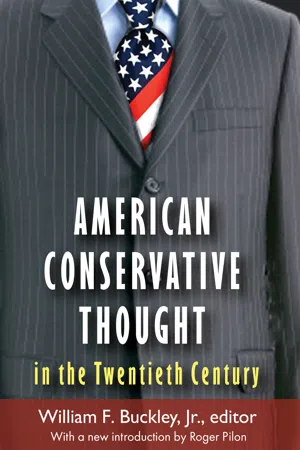
American Conservative Thought in the Twentieth Century
- 628 pages
- English
- ePUB (mobile friendly)
- Available on iOS & Android
eBook - ePub
American Conservative Thought in the Twentieth Century
About this book
If America has been an unsympathetic environment for conservatism, conservatism has, nevertheless, demonstrated an extraordinary tenacity in politics, literature, law, religion, economics, and social thought. Conservatism forms a dissent within the liberal tradition, and also deserves a hearing from any serious student of American history. William F. Buckley, Jr. brought this issue to the forefront in this outstanding collection featuring some of the greatest political thinkers of the twentieth century.This volume illuminates many aspects of the elusive 'conservatism' of which so much has been written, and helps to explain why it is that conservatism survives in politics, economics, social sciences, and the arts. Buckley has drawn from the works of renowned scholars and from those of relatively obscure figures, whose contributions he persuasively puts forward as deeply influential in the crystallization of modern conservative thought.This collection of essays begins by analyzing the history and background of American institutions. It then goes on to inspect strong American presumption in favor of the private sector and the nature of specific challenges to modern society, as well as the response of conservative thought and analysis to those challenges. Pluralists will welcome the approach in this book, and others will be excited by prestigious authors.
Information
Part One
The Historical and Intellectual Background
Garry Wills’s breathtaking essay, “The Convenient State,” marshals arguments against assigning to the state responsibilities it is metaphysically incapable of exercising—unless the state were to achieve such relations with the people as the people and their right-minded political philosophers (their friends) have eloquently warned against throughout deliberated time. “For the Christian,” Wills notes after surveying classical and early Christian thought (Wills’s Ph.D. degree, taken at Yale, was in the classics), “the state can no longer fill up man’s failings or aim at self-sufficiency and ideal justice. The earthly order must be identified as temporal, an area of trial and transition.”
“When ideal justice is set before the community as its political end,” he concludes, “the only efficient path towards that ever receding goal is the marshaling of force in the state.” Under the circumstances, “. . . the end of the state[should be] ... the orderly advancement and discipline of society as the necessary ground of human activity....[The] system of checks is worked out by each community,” Wills concludes, “but it is based on the general truth that the state’s role is to enforce equity and order, rather than justice and charity.”
Thus—precisely—the “convenient” state—the state with which Michael Oakeshott is comfortable (see below, p. 103). Mr. Wills’s essay was originally published as a part of a symposium edited by Frank S. Meyer entitled What Is Conservatism? Mr. Wills has written several books on disparate subjects (Roman Culture, Jack Ruby), teaches at Johns Hopkins University, and writes for Esquire magazine, National Review, and the scholarly journals.
John Courtney Murray was an aristocratic New Yorker who though a Jesuit priest is widely acknowledged as the principal apostle of the separation of church and state within a New World Catholic context. His special relevance here is as a noble advocate of the crucial role of society, which sets him up in opposition to the obdurate individualism of such as Albert Jay Nock and William Graham Sumner. Father Murray’s best-known essays were collected and published in 1960 in the volume We Hold These Truths. In making the case for “social freedom” and for the idea of the consensus, he reminds us that the earliest Americans rejected by anticipation the nineteenth-century notion of the “outlaw conscience” (“‘conscientia exlex, the conscience that knows no law higher than its own subjective imperatives”). “Part of the inner architecture of the American ideal of freedom has been,” Father Murray points out, “the profound conviction that only a virtuous people can be free. It is not an American belief,” he reminds Wilsonian liberals sharply, “that free government is inevitable, only that it is possible, and that its possibility can be realized only when the people as a whole are inwardly governed by the recognized imperatives of the universal moral law.” That is a conservative aperçu, plain and simple; and although it is ungentlemanly to argue against the co-optors who have so deeply desired to have Father Murray as one of their own for reasons (a) admirable (they liked and admired him for his emphasis on secular pluralism, which they took to signify a tacit acquiescence in philosophical relativism binding at all levels in civil society) and, (b) less than admirable (Whee! A Catholic priest who speaks like us!).
Although others (notably F. A. Hayek) have done it more meticulously, Father Murray’s eloquent repudiation of the French revolutionary tradition is quite good enough, flatly rejecting it as, if you can bear it, un-American: “In considerable part,” he writes of the Declaration of the Rights of Man, “the latter was a parchment-child of the Enlightenment, a top-of-the-brain concoction of a set of men who did not understand that a political community, like man himself, has roots in history and in nature. They believed that a state could be simply a work of art, a sort of absolute beginning, an artifact of which abstract human reason could be the sole artisan. Moreover, their exaggerated individualism had shut them off from a view of the organic nature of the human community; their social atomism would permit no institutions or associations intermediate between the individual and the state.” It has been said at greater length, but not, since Burke (see Hart below, p. 46), better.
L. Brent Bozell was driven to inquire into the origins of judicial review by what he deemed the excesses of the Supreme Court under the leadership of Earl Warren. He produced a little-noticed book, The Warren Revolution, excerpts from the first chapter of which are here reproduced. It is the finest recent statement I have seen on the idea of federalism, incorporating the traditional arguments against abstractionist government, and showing how the framers consciously understood themselves to be engaged in devising mechanisms that would mesh together, geared less to abstractionist paradigms than to real situations. The chapter is cut oif at the point where Mr. Bozell asks rhetorically, “Where as a practical matter do we go from here?” —the reason being that his answer is, essentially— nowhere. Mr. Bozell’s interest subsequently turned to essentially religious matters; indeed he now feels that his own book is irrelevant on the grounds that it does not ask what he deems to be the deeper question, namely, how does a society set out consciously to guide itself by the precepts of the natural law?1 He appears to have approached theocracy, but en route he devised a majestic statement of the altogether conservative disposition of the framers to launch a republic of separated powers, and Mr. Bozell was certainly not alone in the conviction that the Warren Court ushered in what might be called a new age in American politics; that, by the aggrandizement of its own role, it caused organic dislocations, and that it is not yet known what will be their consequences.
Mr. Frank Meyer’s essay, “What is Conservatism?”, is his own contribution to a symposium organized a few years ago under the title Left, Right and Center. He gives his own answer to the question he posed, tracing the contemporary efforts to fuse once more the objective moral order (the kind of thing Father Murray stresses) and the liberalism of the nineteenth century (which flowed into contemporary conservatism via such as William Graham Sumner and Albert Jay Nock) : to reunite what the nineteenth century sundered. Mr. Meyer goes so far as to reproduce the credo of a contemporary political society (the American Conservative Union), which he deems a thoroughly satisfactory statement of the principles of American conservatism. Mr. Meyer came to conservatism through the agony of communism (he is the author of the memorable, The Moulding of Communists) . He is thought by some to have emerged over-touched by ideological rigidity. In fact, close students of his journalism (he writes regularly for National Review, of which he is a senior editor), have remarked the diligence with which he pursues the fusionists’ dream of a conservatism that is both assertive in its commitment to individual freedom and yet aware of the mitigating roles of tradition and culture.
1See Triumph, III, No. 2 (February 1968), pp. 10-14.
1 The Convenient State
Garry Wills
The liberal and the conservative who would sort out their differences, for some constructive purpose, encounter from the outset an unusual problem: the very things that seem to unite them are a cause of confusion and deeper cleavage. Even when we of the West fall out, we select our weapons from the same armory; and, as (in the stock jibe) the same medieval God heard the prayers of opposed armies, so Plato and Aristotle seem to hover over the ranks of every possible faction in the civilization they helped to create. Even when men undermine our citadel, they do it with our engines; and, in greatest part, unconsciously. This brings the bitterness of fratricide into the dispute over our inheritance. The conservative claims guardianship over the storehouse of Western wisdom. The liberal contends that the genius of the West lies in its capacity for innovation, in a daring reliance on reason and a resiliency toward change.
Because these two forces share a vocabulary and, to some extent, a vision, the discovery that they are saying different things in the same words leads, on either side, to suspicion of betrayal; and the variations in meaning that the common vocabulary suffers seem to open an unbridgeable chasm. In no case is this so clear as in the allegiance of both sides to the principles of freedom and order; for neither party denies the necessity of some polarity and balance between the two. The liberal is traditionally considered the spokesman of freedom, the conservative of order. But, even aside from the shifting maneuvers these terms have lately performed, no one ever claimed that such a simplistic division was absolute. The most partisan liberal cannot, if he claims to speak responsibly, deny that conservatives are concerned with guaranteeing freedom. And the archest reactionary this side of insanity cannot claim that the liberal is not trying to construct a social order. In fact, as time wears on, the stress on principles ancillary to their professed ones makes liberals and conservatives seem to change places, so that liberals now champion a strong central government, and conservatives speak for economic and political individualism. Is the difference between these two, then, merely accidental at any moment because it is, in the long run, only a matter of degree, the conservative laying heavy emphasis on the prescriptive, the liberal on the spontaneous, elements in political life? Given the same set of ingredients, do the cooks simply vary their recipes? No; the shared language disguises, and so perpetuates, fundamental differences.
Freedom and order, justice and settled interests, progress and tradition . . . the words are used of different things in the different camps; and when these concepts cluster to form more complex groupings of ideas—republic, democracy, self-determination, aristocracy—the differences undergo a staggering multiplication. It is true that freedom and order will be correlates in any of the systems advanced. But this, again, impedes communication, since the varieties of meaning in the one word will exact an answering variation in the other. It is useless, therefore, to debate whether the emphasis should be on freedom or order, or to adjudicate between major political systems by discussing the degree of freedom desired, or the extent of order, as if these were constant substances varying only in quantity. The question should be what kind of order, what kind of freedom, is at issue. Our history is littered with defeated varieties of each virtue. To take an obvious case, there is the theocratic definition of freedom and order—principles which become, under this rubric, Virtue and Providence. In such a scheme, freedom is freedom to be virtuous, and order is the right to exact virtue from man as his proper attribute. At another extreme of our experience is anarchism, which (read the paradox how you will) is a system for avoiding system. It, too, has a principle of order—the removal and continued negation of political coercion—corresponding to its untrammeled freedom.
These systems are both unworkable, since virtue that is enforced is not virtue, and anarchy that is guaranteed against control is to that extent controlled. But their ignis fatuus has drawn men down tragic paths, and they will continue to beckon. The important thing is to see that there is no use distinguishing such schemes by degree, as having a different internal disposition of freedom and order. The anarchist does not err in exalting freedom over order, but in exalting the wrong kind of freedom and the wrong kind of order. It is his whole philosophical framework that is incorrectly established. He is right about the machinery of these correlates; he is only wrong about the world. To put it another way, the relation of freedom to order is a dynamic one that can manifest itself in any number of consistent programs; and a political system is therefore to be judged by its substance, not by its dynamics.
Thus Mill cripples his discourse from the start when he calls the treatise on liberty an attempt to adjudicate the ancient “struggle between Liberty and Authority,”—as if these were two things of perduring and permanent meaning, but with shifting relations, toward each other, of supremacy or subjection. The real difference, for instance, between the historically normative polities of ancient Greece and the “barbarians” was not simply one of liberty as opposed to tyranny. The ancient empires had a mystical sanction. Their art and customs show no awareness of the individualism that emerged in Hellas’ statues of man. Liberty, in such a society, has another meaning than it was to take on in the debates of the Hellenes. And in the primitive societies so thoroughly scrutinized by modern anthropologists, the instruments for educating and preserving the individual, under severe disadvantages, are the very disciplines for initiation into the political order on which all life depends. In such a world, the relation of freedom to order continues to exist, but as a drastically reduced version of the religious maxim, cut servire regnare. A similar paradox is worked out in the Marxist dialectic, and summarized, satirically, in Orwell’s “Freedom is slavery.” Far from being a game of the mind, this slogan expresses the only possible approach to freedom in the Marxist world; the Communist paradox has the same consistency as the Christian language used to describe a freedom heightened to indefectible obedience in the beatific vision. The only error is trying to acclimatize heaven to the intemperate regions of practical politics. Again, men are right about the relation of freedom to order, and only wrong about the world.
Since freedom and order are correlates, an absolutism at one pole leads to an absolutism at the other. The Marxist starts from order and asserts that “freedom is slavery.” The absolutists of individualism start at the other pole but end in the same contradiction. Even the most extreme libertarian must justify his position by an appeal to order. Mill, for instance, advocates a free market of ideas as the most infallible guide to certitude— enough talk automatically producing truth, triumphant over all pretenders and “self-evident.” Thus freedom becomes authority and arms itself with all the instruments the liberal state has taken to itself in order to advance man’s “self-evident” rights.
But if freedom always implies order in any consistent system, why has Western civilization made freedom a separate aim and motto, so that the boast of Greece was to have invented freedom, and a war of national liberation like America’s could float the banner “liberty or death?” The reason is that the Western tradition—as opposed to all others, even the most sophisticated Oriental disciplines—has exalted the individual person. This civilization, centered in the primacy of the private soul, brought a whole new ordering of society into human history. The difference is immediately apparent when Greek thought and art enter the world. Impersonal pattern, hieratic system, absorption in the eternity of the Ideal give way to the naked splendor and particularity of man; even the gods assumed those anthropomorphic forms still vital in Western imaginations. The Greek “idea” was first detached and delineated in the cult statues given various gods’ names, but in reality sharing one title: Man. No longer did man achieve his manhood by religio-political initiation into secrets of order. The individual reason became the test of reality with the Greeks, and this reason asserted itself by defying the order of magic and mystery. The state religion was secularized; it sloughed off its feral elements, boasting of this liberation under the symbol of battle with centaurs and other half-human powers. The individual reason, thus exalted, ventured on the distinctive Western achievements—systematic logic and science, a philosophy freed of superstition.
The discovery of the individual’s unique resources, the testing of the world against the private reason, forced the state into a new role. Formerly, man’s hard-won achievements had been stored up in the authority of the community, kept under sacred leadership and symbols. But the Greek mind freed itself from this total dependence on tradition, and man’s sights were set on the uncharted areas where no collective approach to mystery could lead him. The state took on a humbler function, keeping order among the individuals whose free quest gave late Greek cities their divided, spontaneous, almost anarchic individuality.
Thus freedom became an assertion of the individual’s right to pursue his own vision; and liberty became a prior demand for all human speculation or education. This demand did not lessen as the Hellenic world spread and was transmuted by Christianity. In fact, the Christian emphasis on the individual soul’s worth, and its other-worldly goal, deepened the cleavage between man and the religious state. The Christian recognizes a divided loyalty, giving to Caesar what is Caesar’s, but to God the inestimably vaster reaches of the soul that belong to God.
But if the state’s order is no longer, in the Greek world, coextensive with man’s attempt to order his private world, what role is government to play? Where does the supremacy of the private person find its frontier, or verge on other claims? How do the sacred areas of each man’s individuality meet and adjust to each other? It is this question that has put the problem of freedom at the center of Western political dispute. And, in a kind of slovenly philosophical shorthand, this problem has been cast as a search for the amount of freedom man is to enjoy. But the problem is that the Greek world introduced an entirely new conception of human life, one still novel today; a conception that runs into contradiction if pushed by a ruthless logic. The autonomy of the individual, the fight against tradition, seem to make government at worst a causeless evil, at best a necessary evil. But experience has taught that a “freedom” which travels down the road of anarchy is never seen again. Thus the problem of the Western world has been to find a new kind of order to act as foundation for its fugitive new kind of freedom. Many attempts at the solution of this problem have been short-lived, because they did not come to grips with the particular kind of freedom—with its almost impossible demands—that the West has chosen to pursue. The attempts which remain in the central line of Western experiment cluster into two main groups. These continuing schools of thought, or lines of approach, correspond in some degree with the popular division of political thinkers into liberal and conservative. In some degree, but not exactly; and the popular terms are no longer precise. It will be better, then, to give unequivocal if unfamiliar names to the two, calling them the Order of Justice and the Order of Convenience.
I. The Order of Justice
If the state is...
Table of contents
- Cover
- Title Page
- Copyright Page
- Dedication
- Table of Contents
- Introduction: Did you Ever See a Dream Walking?
- Introduction to the Transaction Edition
- Selected Bibliography
- Part One THE HISTORICAL AND INTELLECTUAL BACKGROUND
- Part Two THE LIMITATIONS OF THE STATE
- Part Three CONTEMPORARY CHALLENGES AND THE SOCIAL ORDER
- Part Four THE RELEVANCE OF SOCIAL SCIENCE
- Part Five THE SPIRITUAL CRISIS
- Index
Trusted by 375,005 students
Access to over 1.5 million titles for a fair monthly price.
Study more efficiently using our study tools.
Frequently asked questions
Yes, you can cancel anytime from the Subscription tab in your account settings on the Perlego website. Your subscription will stay active until the end of your current billing period. Learn how to cancel your subscription
No, books cannot be downloaded as external files, such as PDFs, for use outside of Perlego. However, you can download books within the Perlego app for offline reading on mobile or tablet. Learn how to download books offline
Perlego offers two plans: Essential and Complete
- Essential is ideal for learners and professionals who enjoy exploring a wide range of subjects. Access the Essential Library with 800,000+ trusted titles and best-sellers across business, personal growth, and the humanities. Includes unlimited reading time and Standard Read Aloud voice.
- Complete: Perfect for advanced learners and researchers needing full, unrestricted access. Unlock 1.5M+ books across hundreds of subjects, including academic and specialized titles. The Complete Plan also includes advanced features like Premium Read Aloud and Research Assistant.
We are an online textbook subscription service, where you can get access to an entire online library for less than the price of a single book per month. With over 1.5 million books across 990+ topics, we’ve got you covered! Learn about our mission
Look out for the read-aloud symbol on your next book to see if you can listen to it. The read-aloud tool reads text aloud for you, highlighting the text as it is being read. You can pause it, speed it up and slow it down. Learn more about Read Aloud
Yes! You can use the Perlego app on both iOS and Android devices to read anytime, anywhere — even offline. Perfect for commutes or when you’re on the go.
Please note we cannot support devices running on iOS 13 and Android 7 or earlier. Learn more about using the app
Please note we cannot support devices running on iOS 13 and Android 7 or earlier. Learn more about using the app
Yes, you can access American Conservative Thought in the Twentieth Century by William F. Buckley Jr.,Jr. Buckley in PDF and/or ePUB format, as well as other popular books in Politics & International Relations & North American History. We have over 1.5 million books available in our catalogue for you to explore.