- 239 pages
- English
- ePUB (mobile friendly)
- Available on iOS & Android
eBook - ePub
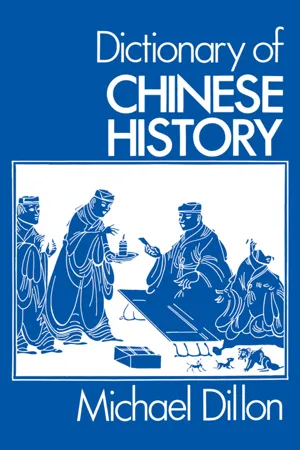
Dictionary of Chinese History
About this book
First Published in 1979. This title is intended as a guide to personalities, events, ideas and institutions in China from earliest times right up to the present day. The dictionary should be particularly useful to anyone interested in Chinese history for its own sake, or in contemporary China, where today's events are so often seen in terms of the past. It should also help anyone interested in comparing the experience of China with European or American history.
C
Cadres Party and government officials of all ranks in the People’s Republic and in the liberated areas before 1949. The development of a cadre (or body of cadres) has been one of the most important tasks in the consolidation of Communist control since 1949. Increasing the number of cadres who are women or from one of the minority nationalities has been a particular problem.
Cairo Declaration The outcome of the Cairo Conference held in November 1943 when Chiang K’ai-shek met Franklin D. Roosevelt and Winston Churchill to discuss the demand for the unconditional surrender of Japan and to lay down guidelines for post-war policies. A joint statement was issued on December 1 promising the eventual restoration to China of all territories lost to Japan, but this was later modified in the case of Manchuria by the Yalta Pact (qv) of 1945.
Cambaluc see Khanbaligh
Cantlie, Dr James Teacher of Sun Yat-sen and Dean of the College of Medicine for Chinese in Hong Kong. Dr. Cantlie advised Sun to flee to Japan in 1895 when the British authorities in Hong Kong complied with a Chinese government request to ban him for five years, and later arranged lodgings for him when he arrived in London in 1896. Here Sun Yat-sen was kidnapped and detained illegally in the Chinese legation. It was only when Dr. Cantlie brought the case to the attention of the Foreign Office and the London newspaper The Globe that Sun was eventually released.
Canton Commune A Communist-led insurrection that took place on December 11, 1927. In spite of the failure of the Autumn Harvest Rising (qv) and other insurrections, a hurried takeover was organised in Canton while Nationalist generals were at loggerheads. The rising had some trade union support but its main force was a rebelling Nationalist training regiment. A local soviet government and military command were set up in the public security offices, but on the same day a concerted Nationalist counter-attack was launched. On December 13 the Commune collapsed when the public security offices were captured. Chinese historians today see the Commune as an adventurist but heroic attempt to seize power. Its failure marked the effective end of the Communist movement in the towns and the turn to the peasantry.
Canton Coup Chiang K’ai-shek’s seizure of power in the KMT on March 20, 1926. Before the bloodless coup, the KMT was in disarray after the death of Sun Yat-sen, and Chiang K’ai-shek had a military but not a political power base. He consolidated his political power by moving his troops to arrest all pro-Communist and Communist elements in the KMT. Wang Ching-wei, the most important KMT left-winger, resigned, and Chiang K’ai-shek was formally declared head of the party, the Military Council, the Political Department, the arsenal and the military academies. He was now virtually dictator and was in a position to launch the National Revolutionary Army’s Northern Expedition (qv) to unify China.
Canton System Imperial China’s way of controlling trade with the West. In 1757 Canton, which had been opened to Western trade at the end of the 17th century, became the only port legally open for foreign trade and all business had to be carried out through a member of a small group of officially approved merchants, the Cohong (qv). Western traders objected strongly to this restriction and one of the most important results of the Treaty of Nanking (qv) signed in 1842 after the Opium War was the opening of other ports to foreign trade.
Capitalism, Sprouts of The question of the development of early capitalist forms of production. In the 1950s a controversy developed among historians over the periodisation (qv) of Chinese history and particularly about the extent of early forms of capitalism. Mao Tse-tung had stated that Chinese feudal society had contained within it the elements of capitalist organisation and would eventually have developed into a capitalist society even if there had been no foreign influence, and historians followed this up with a long series of exegetical articles examining the level of capitalist organisation in various periods. Some scholars found embryonic capitalism in the T’ang and Sung periods but most looked to the 16th century and particularly to the reigns of the Chia-ching and Wan-li emperors (qv), although there was considerable disagreement over the level of development of these ‘sprouts’.
Capitalist-roaders The derogatory term applied to supporters of Liu Shao-ch’i’s policies during the Cultural Revolution. It is an abbreviation for ‘top party persons in authority taking the capitalist road’. The ‘capitalist road’ was considered to include policies that advocated wage incentives and placed economic and technical priorities above political ones. See also Two Lines.
Cathay The name used for China by Marco Polo and by mediaeval Europeans in general. It probably derives from the word Khitai, a variant of the name of the Khitan (qv) people who ruled north China in the 10th century. The Russian word for China, Kitai, comes from the same word.
Catholicism, Roman Introduced into China as early as the 13th century during the Yuan dynasty by Franciscan monks sent by the Papal authorities on missions that were both diplomatic and evangelical. The first Roman Catholic outpost in Peking was established by John of Montecorvino (qv) in 1304 and many converts were baptised. Missions progressed during the late Yuan period, declined during the Ming dynasty but reappeared at its close when the Jesuit Matteo Ricci (qv) established himself at Peking in 1600. Jesuits (qv) remained influential at court till the early 18th century and made some converts. Roman Catholic missions increased along with those of other denominations during the 19th century and many missionaries became victims of militant Chinese nationalism during the Boxer Rebellion (qv).
C.C. Clique A right-wing faction within the KMT, named after its leaders Ch’en Li-fu and Ch’en Kuo-fu. The group was intransigently opposed to any collaboration with the CCP in the period after the Japanese surrender in 1945 and to the negotiations arranged by General Marshall.
CCP see Chinese Communist Party
Censorate An office of the Imperial government given the task of investigating official corruption, oppression or injustice and also controlling possible subversion. Individual investigators were appointed as early as 106 BC, but the system was institutionalised under the T’ang dynasty. The T’ang censorate had a controller, two assistants and three subdivisions: one responsible for official impeachment, one for inspecting palace procedures, and the third acting as an inspectorate. The Sung dynasty maintained the system, but added officers specially responsible for criticising the senior state officials. Under the Ming the principle remained the same in spite of some reorganisation and the Ch’ing rulers followed the Ming model. The power of the censorate derived from its direct access to the emperor and its ability to investigate officials of all ranks. Its importance enabled censors to criticise the palace or even the emperor himself.
Central Committee The main forum for debating policy issues within the CCP. The Central Committee has approximately two hundred members and during its infrequent plenary sessions discusses basic policy lines that have been decided on by the Politburo (qv) which is selected from the Central Committee. Reports from Politburo members involved in particular issues are followed by small group sessions and a final plenary session which may seek clarification or modification before agreeing on a final wording of the proposals under discussion. The Central Committee is composed of delegates from all provinces of China and plays a vital role in policy transmission and acceptance, but its size prevents it from taking detailed decisions. The Central Committee is elected after each party Congress (qv) and the full meetings are referred to as, for example, the Third Plenum of the Eighth Central Committee, that is the third full meeting of the Central Committee elected by the Eighth Party Congress in 1956.
Chaghadai Second son of Chinggis Khan and Khan of Chaghadai (Djaghatai) in Turkestan from 1227–1242 under the Mongol Empire.
Chahar Originally the name of one of the strongest tribes of Inner Mongolia, Chahar was the name given to the eastern part of the region when it was made a province by the Republican government as part of its divide-and-rule policy towards the Mongols after 1911. Chahar was occupied by the Japanese during 1937–45 and is now part of the Inner Mongolian Autonomous Region.
Champa Rice see Early Ripening Champa Rice
Ch’an Buddhism More familiar in its Japanese reading of Zen, Ch’an is a meditative sect of Buddhism, introduced, according to tradition, by Bodhidharma in the early 6th century. Its stress on enlightenment through intuition and anti-textual, anti-scholastic bias were close to the tradition of Taoism (qv) and this enabled it to become one of the strongest of the Buddhist sects in China. All Chinese Buddhism was eventually absorbed into either the Ch’an or the Pure Land sect (qv) and the two later merged, in the popular religion, into an indistinct mixture of beliefs.
Chan-kuo ts’e see Intrigues of the Warring States
Chang Ch’ien Military officer sent by the Han emperor Wu-ti in 139 BC to make an alliance with the Central Asian peoples known as Yüeh-chih against the Hsiung-nu (qqv). Chang Ch’ien was captured by the Hsiung-nu and after years in prison finally found the Yüeh-chih but was unable to secure an alliance. He returned to China in 126 BC with much detailed knowledge of Central Asia and the lands to the west. His second embassy to the Wu-sun of the Ili region of 115 BC was no more successful but further increased Chinese knowledge of the western frontiers.
Chang Ch’un-ch’iao Journalist who rose to be director of propaganda in the Shanghai Party Committee in the 1960s. He helped Chiang Ch’ing to promote revolutionary operas and films, became a member of the group that directed the Cultural Revolution and was the inspiration behind the short-lived Shanghai Commune (qv) of January 1967. He became chairman of the subsequent Shanghai Revolutionary Committee that was formed on February 24,1967 and towards the end of Mao’s life was one of the influential radical group which included Chiang Ch’ing, Yao Wen-yuan and Wang Hung-wen (qqv), was often called the Shanghai Mafia, and was later castigated as the Gang of Four (qv) by the new leadership of Hua Kuo-feng.
Chang Hsüeh-liang Known as the Young Marshal. He succeeded his father Chang Tso-lin (qv) as governor and warlord of Manchuria when the latter was killed by a bomb in 1928. He controlled the north-eastern provinces till he was ousted by the Japanese invasion of 1931. He had pledged allegiance to Chiang K’ai-shek’s government in 1928 and his armies fought with the Nationalists against Japan. In 1936 he arrested Chiang K’ai-shek in the famous Sian Incident (qv) to try and force him to end the civil war and organise co-ordinated resistance with the Communists against the Japanese. He released Chiang K’ai-shek after negotiations in which Chou En-lai played a vital role and was himself imprisoned by the Nationalist leader. He remained in prison on Taiwan till 1962.
Chang Kuo-t’ao (1897– ) Founder member of the CCP and important leader in its early days, Chang came from central Kiangsi, was involved in the 1911 Revolution and from 1916 attended Peking University where he came to know Ch’en Tu-hsiu, Li Ta-chao (qqv) and other radicals. He joined the May 4th demonstrations in 1919 and represented Peking Marxists at the first CCP Congress in Shanghai in 1921. He was active in the labour movement and in Comintern affairs, attending the Toilers of the East Congress in Moscow in 1922. An opponent of Communist participation in the KMT, he nevertheless became a member of the Nationalist central executive committee during the first United Front (qv). He spent more time in Moscow between 1928 and 1931 and on his return to China was sent to direct political work in the Communist base on the borders of Hupeh, Honan and Anhwei. His units evacuated Kiangsi ahead of the main Long March column and set up a small base area in north Szechwan, eventually arriving in Yenan with sadly depleted forces. Old differences with Mao Tse-tung who had replaced him as head of the CCP Organisation Bureau in 1924 had never healed, and Chang left the Yenan area in 1938 and was expelled from the CCP in the same year. He found refuge in Hankow, then the Nationalist capital, and moved with the government to Chungking where he took part in government and KMT affairs. In 1949 he moved to Hong Kong to spend most of his time working on his autobiography.
Chang Tso-lin (1873–1928) The Old Marshal and warlord of Manchuria from the 1911 Revolution until his death in a Kwantung Army (qv) bomb plot in 1928 when he was succeeded by his son Chang Hsueh-liang (qv). In 1924 Chang Tso-lin established himself in Peking and became notorious for a raid on the Soviet embassy in 1927 which resulted in the capture and execution of the communist leader Li Ta-chao.
Ch’ang-an Capital of China during the Han, Sui and T’ang dynasties (on the site of present-day Sian) and a rival to the city of Lo-yang (qv). Defensive walls were built around Ch’ang-an from 194 BC onwards, nine market-places were established in and around the town, and great palaces were built to house the Han emperors and their families. The court moved to Lo-yang after the interregnum of Wang Mang, but Ch’ang-an was again chosen as capital by the newly established Sui dynasty in 582, on a new site that was later developed by the T’ang emperor. The new Ch’ang-an was a systematically planned town on a grid pattern, with eleven streets running north to south and fourteen from east to west, a plan which facilitated the enforcement of curfews and the supervision of public places. This model was extensively copied both by other Chinese towns and by foreigners, notably the Japanese, who built the cities of Nara (in 710) and Hei-an (from 793 — modern Kyoto) on the design of Ch’ang-an.
Chao Kao Chief eunuch of the first Ch’in emperor. In 210 BC he conspired with Li Ssu (qv), the chief minister, to conceal the death of the First Emperor, Shih Huang-ti, until he had engineered the suicide of the heir apparent, and then put a young, weak son on the throne as Second Emperor (qv), whose confidant he became. He became Prime Minister, had Li Ssu put to death, and finally caused the Second Emperor to commit suicide.
Ch’en Dynasty (557–589) State based on Nanking during the period known as the Northern and Southern Dynasties. It was founded by Ch’en Pa-hsien but wiped out by the Sui Empire after thirty-two years.
Ch’en Ch’eng (1897–1965) Nationalist general who led important operations against the Communists in the encirclement campaigns (qv) of the early 1930s. He commanded the Wuhan Defence Area in the Sino-Japanese War and was commander-in-chief in the Manchurian theatre of the Civil War for a short period in 1947. He was governor of Taiwan at the time of the Nationalist evacuation of the mainland in 1949 and became vice-president of the Republic of China in 1954. Documents and publications captured by his men during the campaign against the Kiangsi Soviet provide an invaluable collection of source materials for research on the 1930–34 period and are known as the Ch’en Ch’eng Collection.
Ch’en Po-ta (1904– ) For many years served as private secretary, speech-writer and adviser to Mao Tse-tung. He was elected alternate member of the Politburo after the Eighth Party Congress in 1956, and became Director of the Central Committee’s Cultural Revolution Group (qv) in 1966 after having been Deputy Director of the Party’s theoretical journal. He was removed from the leadership in 1970 for his association with the May 16th Group (qv).
Ch’en Sheng Leader of one of the rebellions at the end of the Ch’in dynasty that led to its downfall and replacement by the Han. Ch’en Sheng, also known as Ch’en Sheh, was an ambitious farm labourer who led a group of conscripts to desert and revolt rather than face death for arriving late at the garrison. He made himself General and Wu Kuang his chief commander, and then set himself up as King of Ch’u. Ch’en Sheng was killed after only six months as king, but was regarded by the Han emperors as one of their predecessors.
Ch’en Tu-hsiu (1879–1942) Founder of the CCP and leader of the literary and cultural revolution that culminated in the May 4th Movement. Ch’en Tu-hsiu was editor of New Youth and Dean of the Peking University Faculty of Letters. He became a Marxist and organiser of the Shanghai group that formed the nucleus of the CCP. From 1921 to 1927 he led the Party, but in 1930 he was expelled and went on to form a Trotskyist opposition which he led till his arrest by the Nationalist government in 1932. He was imprisoned till 1937 and spent the rest of his life studying and writing. His most important writings from the early period were those in which he popularised the ideas of Western progress in his characters Mr. Democracy and Mr. Science, and launched powerful attacks on Confucianism and the social structure it espoused. His break with the CCP in 1930 came with his criticisms of the disastrous policies of alliance with the KMT and the ill-prepared uprisings that the Comintern had forced on the Communists. For a time he supported Trotsky’s view of a permanent revolution but later left political life entirely.
Ch’en Yi (1883–1950) Originally an officer in the army of the warlord Sun Ch’uan-fang, Ch’en Yi joined forces with Chiang K’ai-shek’s Nationalists after the Northern Expedition. He served as governor of Fukien from 1934 to 1941 and in 1945 was appointed to administer Taiwan where he was responsible for suppressing the Taiwan Uprising of 1947. He was governor of Chekiang in 1948–9, dismissed in 1949 after contacts with agents of th...
Table of contents
- Cover
- Half Title
- Title Page
- Copyright Page
- Table of Contents
- Preface
- Author’s Note
- Chronological Table of Dynasties
- A
- B
- C
- D
- E
- F
- G
- H
- I
- J
- K
- L
- M
- N
- O
- P
- Q
- R
- S
- T
- U
- V
- W
- X
- Y
- Z
Trusted by 375,005 students
Access to over 1.5 million titles for a fair monthly price.
Study more efficiently using our study tools.
Frequently asked questions
Yes, you can cancel anytime from the Subscription tab in your account settings on the Perlego website. Your subscription will stay active until the end of your current billing period. Learn how to cancel your subscription
No, books cannot be downloaded as external files, such as PDFs, for use outside of Perlego. However, you can download books within the Perlego app for offline reading on mobile or tablet. Learn how to download books offline
Perlego offers two plans: Essential and Complete
- Essential is ideal for learners and professionals who enjoy exploring a wide range of subjects. Access the Essential Library with 800,000+ trusted titles and best-sellers across business, personal growth, and the humanities. Includes unlimited reading time and Standard Read Aloud voice.
- Complete: Perfect for advanced learners and researchers needing full, unrestricted access. Unlock 1.5M+ books across hundreds of subjects, including academic and specialized titles. The Complete Plan also includes advanced features like Premium Read Aloud and Research Assistant.
We are an online textbook subscription service, where you can get access to an entire online library for less than the price of a single book per month. With over 1.5 million books across 990+ topics, we’ve got you covered! Learn about our mission
Look out for the read-aloud symbol on your next book to see if you can listen to it. The read-aloud tool reads text aloud for you, highlighting the text as it is being read. You can pause it, speed it up and slow it down. Learn more about Read Aloud
Yes! You can use the Perlego app on both iOS and Android devices to read anytime, anywhere — even offline. Perfect for commutes or when you’re on the go.
Please note we cannot support devices running on iOS 13 and Android 7 or earlier. Learn more about using the app
Please note we cannot support devices running on iOS 13 and Android 7 or earlier. Learn more about using the app
Yes, you can access Dictionary of Chinese History by Michael Dillon in PDF and/or ePUB format, as well as other popular books in History & Asian History. We have over 1.5 million books available in our catalogue for you to explore.