- 488 pages
- English
- ePUB (mobile friendly)
- Available on iOS & Android
eBook - ePub
About this book
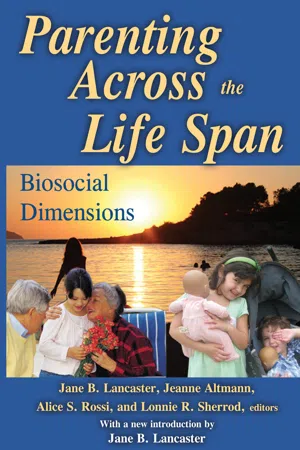
Research on parenting through the life course has developed around two separate approaches. Evolutionary biology provides fresh perspectives from life history theory using behavioral ecology and parental investment theory. At the same time, the social and behavioral sciences integrates research from long-term studies of individual development and from the collection of life histories.This path-breaking book advances evolutionary, life history research by integrating perspectives of these two approaches into a biosocial science of the life course. It examines parenthood as a commitment extending throughout life and focuses on the impact on parental and child behavior of changes in the timing, distribution, and intensity of parental investment. This perspective is particularly appropriate for research on parenting since the family is the universal human institution within which the bearing and rearing of children has been based and which transmits traditions, beliefs, and values to the young.
Information
1 Introduction
Jane B. Lancaster
Jeanne Altmann
Alice S. Rossi
Lonnie R. Sherrod
Jeanne Altmann
Alice S. Rossi
Lonnie R. Sherrod
The Biosocial Perspective
This volume is the second in a series sponsored by the Social Science Research Council’s Committee on Biosocial Perspectives on Parent Behavior and Offspring Development. The committee, formed in 1980, is a multidisciplinary group (including biological, behavioral, and social scientists) that seeks to promote an exchange of concepts, methods, and data across disciplines on a variety of substantive issues on which the group shares intellectual and policy concerns. The goals of the committee’s program are: to develop conceptualizations of social phenomena relying on biosocial science, to explore the interface between biological and social phenomena, and to advance our understanding of human social behavior. The first volume of this series, School-Age Pregnancy and Parenthood: Biosocial Dimensions, edited by J. Lancaster and B. Hamburg (Aldine, 1986), focuses on a particular segment of the life span and the challenges, problems, and opportunities inherent in parenthood during such an early phase of the reproductive years; there attention is focused on issues of timing during a specific transition period in the life span. The current volume achieves a broad sweep across the life span, examining parenthood as a commitment involving the entire life course. Of particular concern is the impact of modern changes in the timing, distribution, and intensity of commitment to parenthood on both parental and child behavior and experience throughout the life span.
Biosocial science is particularly relevant to research on human family systems and parenting behavior because the family is the universal social institution within which the bearing and care of children has been based and where cultural traditions, beliefs, and values have been transmitted to the young as individual actors fulfill their biological potential for reproduction, growth, and development. The biosocial perspective takes into account the biological substrate and the social environment as determinants of patterns of behavior, and pinpoints areas in which contemporary human parental behavior exhibits continuities with, and departures from, patterns evident throughout human history. Unless discontinuities in family behaviors and their overall costs and benefits are examined, we are not in a position to assess them objectively in terms of modern circumstances. The biosocial perspective, therefore, extends our understanding of parental behavior by sensitizing us to the variety of patterns among current practices as well as by highlighting the full range of parent-child patterns that have been represented in the evolutionary or historical past. Both the spectrum of options and the basis for making judgments about these options are expanded.
The term “biosocial” was selected to emphasize the functional unity of both biological and socioenvironmental factors. The mutual influences of these factors are more than additive; indeed, they are interrelated through reciprocal influences that can significantly alter the characteristics of each. The potential for change and variation in biological attributes is less well understood than is the potential for human learning and behavioral change. There has been a misleading tendency to perceive biological behaviors as being unlearned, independent of the environment and not readily susceptible to change. There also has been an expectation that there will be uniformity of response to a specific stimulus. For human beings, prior experience, motivation, and context will influence biological responses to all kinds of stimuli, whether they are pathogenic bacteria or social interactions. For example, the biosocial perspective is now being applied to physical health. Behavioral medicine is an emerging area of research and clinical practice (Hamburg, Elliott, and Parron, 1982). Recognition of the continuous, mutual, and inseparable interaction between biology and the social environment is one of the critical foundations of the biosocial perspective.
Armed with a commitment to a biosocial science perspective, 26 scientists from the disciplines of anthropology, sociology, psychiatry, human development, family studies, primatology, history, biology, psychology, psychobiology, and gerontology contributed chapters to this volume, discussing their own research and the knowledge of their respective disciplines about parenthood across the life span.
Approaches in the Biological and Social Sciences to Life-Span Research in Parent Behavior
By presenting and integrating recent research in the biological and social sciences regarding the life course of parenthood, this volume paves the way for a biosocial synthesis. The past decade has witnessed the independent maturation of two separate foci of science that deal with the life span. They represent a newly developed maturity in the data bases of both bodies of science regarding analytic approaches to issues of growth, maturation, development, and change through time. Until recent years these issues, particularly in regard to long-lived species, were most often approached through the synthesis of cross-sectional data into a projected trajectory of development (with the notable exception of growth studies in developmental psychology begun the 1920’s). However, beginning in the 1950’s and especially in the 1960’s, modern biological and behavioral science began investing enormous amounts of time, energy, and resources into following individuals, birth cohorts, and local populations of both animals and humans through long periods, many of which represented the length of a generation or even a life span. For the first time information on the actual observed processes of change and maturation through time were gathered so that cross-sectional data drawn from different cultures, different cohorts, or different individuals no longer had to be the exclusive basis on which to construct composites of growth and development (see Migdol and Sherrod, 1981; Verdonik and Sherrod, 1984).
In the biological sciences, long-term, naturalistic field studies provided an impetus for fresh perspectives on parenthood and the life span. New theoretical models transformed evolutionary biology as behavioral ecology advanced the concept of life history strategies and tactics and sociobiology modeled parental investment theory. These theoretical frameworks emphasize the intimate interaction of biology and social behavior and the sensitivity of each to fluctuation in social and environmental resources. Definitions of evolutionary adaptation and fitness could assess long-range strategies and trade-offs of short-term loss for long-term gain in reproductive tactics (Hamilton, 1966; Stearns, 1976; Calow, 1979; Western, 1979). The fit between reproductive strategies and environmental resources and the shaping of the life course to optimize reproductive success in a given environment became a major focus of theoretical exploration (Cole, 1954; MacArthur, 1962; Schaffer, 1974; Pianka, 1976; Kirkwood and Holliday, 1979; Horn and Rubenstein, 1984). At the same time, the field of sociobiology formulated inclusive fitness and parental investment theory (Hamilton, 1964; Maynard Smith, 1964; Trivers, 1972; Dawkins and Carlisle, 1976; Maynard Smith, 1977; Clutton-Brock and Albon, 1982; Hausfater and Hrdy, 1984; Trivers, 1985). Using cost/benefit analyses drawn from economics, it emphasized the limited amount of parental resources (time, energy, attention) to be apportioned by a parent to its offspring over the course of the life spans of both (Wasser, 1983; Wasser and Waterhouse, 1983; Betzig, Mulder, and Turke, in press; Clutton-Brock, in press). Reproductive success could be measured over the entire life span both in respect to steady output as well as peak performance (Hausfater, 1975; Altmann, Altmann, and Hausfater, in press). A common characteristic of all these theoretical advances was the formulation of a series of alternative propositions that lent themselves to empirical testing through the use of observational data from long-term field studies.
At the same time that evolutionary biology felt the impact of long-term studies in its developing theories of inclusive fitness, life history, and parental investment strategies, the social sciences began formulating new perspectives on the processes of growth, development, and aging for the individual, and transformation and change for groups and societies. Although such work was initially based on adult developmental psychology and the sociological analysis of aging, the perspectives that emerged incorporated the biological as well as the social and behavioral sciences. New data bases drawn from long-term studies of individuals, birth cohorts, and groups demanded that processes of development and change no longer be expressed entirely in terms of stages artificially derived from cross-sectional research; rather, development was seen as pluralistic and multidirectional (Baltes, 1978; Baltes and Brim, 1980, 1982, 1983, 1984). New studies released developmental psychology from an exclusive focus on infancy and childhood to include the entire life span (Baltes, Reese, and Lipsitt, 1980; Lamb and Sutton-Smith, 1982), and the capacity for lifelong plasticity was recognized (Lerner, 1984). Aging was looked at differently as continuous growth, development, accommodation, and adaptation were observed; it was no longer defined in terms of declining function and capacity beginning at the onset of maturity (Datan and Ginsberg, 1975; Riley, Hess, and Bond, 1983; Rossi, 1980, 1985). Once research from long-term studies of individual development and from the collection of life histories was integrated, a new body of theory emerged incorporating life-span trajectories, birth-cohort effects, and the full course of human life.
In short, both the biological and social sciences now reap the benefits of mature science, with the development of rich data bases from long-term studies so that development, change, and growth no longer need to be synthesized from short-term cross sections. Despite this promising convergence of methods and orientation, there has been little actual interaction between biological and social research on the life course. And most contact between the fields has emphasized issues of health and the micro-level biological bases of behavior. Nonetheless, life course perspectives emerging from the social sciences explicitly incorporate a biosocial orientation, and biosocial perspectives in the life sciences necessarily approach phenomena from the orientation of the full life span. The purpose of this book is to encourage researchers of the life span working independently in the biological, biosocial, and social sciences to integrate their perspectives into a biosocial science of the life course. Parenthood proved to be a promising focus because of its lifelong nature and because it raises particularly important biosocial issues.
Current Biosocial Issues in Life-Span Research
The biosocial approach is characterized by its comparative dimensions: cross-species (evolutionary and biological), cross-cultural, and cross-time (historical and developmental). These dimensions enrich research by encouraging sensitivity to biological/physiological, ecological/contextual, and social/historical issues. Because the development of a biosocial perspective for life-span research, which weds the theoretical advances in the biological and social sciences, is still in its infancy, there are a number of major issues to confront. Four unifying themes appear in the following pioneering essays: parenthood as a life-span commitment; the value of the concepts of inclusive fitness and parental investment strategies in explaining species’ patterns of parental behavior; the sensitivity of parental investment patterns to social and environmental context; and major evolutionary and historic change of the context in which human parental behavior is expressed. Together these themes underscore the need and utility of viewing current research on parenthood throughout the life span from a biosocial perspective.
Parenthood as a Life-Span Commitment
Past research on human parenthood tended to focus on the concerns of preadults and their relations to their parents, and, in fact, a major proportion of parenthood research is on mother-infant relations. However, as Altmann (this volume, Chapter 2) notes, the life history parameters of the higher primates (monkeys, apes, and humans), reveal a major commitment to rearing only a few costly, slowly developing young. Delayed timing in the onset of reproduction and the expansion of the infancy and juvenile periods of the life span place heavy burdens on the parent to foster its offspring from conception to reproductive maturity and even beyond.
In reality, parenthood is a lifetime commitment for many of the higher primates, and the fostering of an offspring may continue until the death of the parent. Conventional severance points of parent–offspring relations found in other animals, such as birth, weaning, or adolescence, represent shifts or transitions from one type of resource allocation or parental fostering in the higher primates to another. Birth as a marker of independence of the infant from the mother’s body is just one step toward independent physiological functioning. So too, weaning and even the assumption of adult status do not mark the end of parental investment, just a shift in form in the physiological and social dependency typical of higher primates (see Altmann, Chapter 2; Leon, Chapter 4; Lancaster and Lancaster, Chapter 7; this volume).
For most of the higher primates the burden of rearing costly, slowly developing offspring falls on the mother. For this reason, most monkey and ape females support only a single nutritionally dependent youngster at a time. Humans, however, by capturing the energy of the father in contributing to the food supply of the family, permitted the nutritional dependency of two and even three young at a time and allowed humans to evolve an unusual stage of the life course: the juvenile period throughout which the weaned youngster was fed by its adult parents (Lancaster and Lancaster, Chapter 7, this volume). Humans then, early in the evolution of the species, vastly expanded the commitment to parenthood for both sexes and extended the period of development during which offspring were fed by adults through adolescence.
The course of human history shows a further intensification and extension of parenthood and parental investment even after adulthood is reached by the young, as the resources and skills necessary for reproduction became less and less free for the taking. The chapters herein by Lancaster and Lancaster (Chapter 7), Draper and Harpending (Chapter 8), Weisner (Chapter 9), LeVine and White (Chapter 10), and Vinovskis (Chapter 11) indicate that parents in recent human history have found that rearing healthy, fit offspring is not enough; they also seek to assure their children access to scarce resources to support their own reproduction. As Rossi (Chapter 3) as well as Draper and Harpending (Chapter 8) argue in this volume, world history in the past two hundred years reveals a number of societies in which the burden on parents to provide resources to their adult young through either inheritance or sp...
Table of contents
- Cover Page
- Parenting Across the Life Span
- Copyright Page
- Contents
- Introduction to the AldineTransaction Edition
- Acknowledgments
- List of Contributors
- 1 Introduction
- I PARENTHOOD AND THE LIFE SPAN
- II BIOSOCIAL PERSPECTIVES AND PARENTAL INVESTMENT
- III HUMAN VARIATION THROUGH TIME AND SPACE: HISTORIC CHANGE IN HUMAN PARENTHOOD
- IV THE LIFE SPAN AND PARENTAL INVESTMENT IN MODERN SOCIETY
- Index
Trusted by 375,005 students
Access to over 1.5 million titles for a fair monthly price.
Study more efficiently using our study tools.
Frequently asked questions
Yes, you can cancel anytime from the Subscription tab in your account settings on the Perlego website. Your subscription will stay active until the end of your current billing period. Learn how to cancel your subscription
No, books cannot be downloaded as external files, such as PDFs, for use outside of Perlego. However, you can download books within the Perlego app for offline reading on mobile or tablet. Learn how to download books offline
Perlego offers two plans: Essential and Complete
- Essential is ideal for learners and professionals who enjoy exploring a wide range of subjects. Access the Essential Library with 800,000+ trusted titles and best-sellers across business, personal growth, and the humanities. Includes unlimited reading time and Standard Read Aloud voice.
- Complete: Perfect for advanced learners and researchers needing full, unrestricted access. Unlock 1.5M+ books across hundreds of subjects, including academic and specialized titles. The Complete Plan also includes advanced features like Premium Read Aloud and Research Assistant.
We are an online textbook subscription service, where you can get access to an entire online library for less than the price of a single book per month. With over 1.5 million books across 990+ topics, we’ve got you covered! Learn about our mission
Look out for the read-aloud symbol on your next book to see if you can listen to it. The read-aloud tool reads text aloud for you, highlighting the text as it is being read. You can pause it, speed it up and slow it down. Learn more about Read Aloud
Yes! You can use the Perlego app on both iOS and Android devices to read anytime, anywhere — even offline. Perfect for commutes or when you’re on the go.
Please note we cannot support devices running on iOS 13 and Android 7 or earlier. Learn more about using the app
Please note we cannot support devices running on iOS 13 and Android 7 or earlier. Learn more about using the app
Yes, you can access Parenting across the Life Span by Jeanne Altmann in PDF and/or ePUB format, as well as other popular books in Social Sciences & Anthropology. We have over 1.5 million books available in our catalogue for you to explore.