Just Imagine
Let your imagination wander. Think of the perfect Early Years service.
What does it look like? Can you see the faces of the children … and the staff? Are there any smells that gently touch your senses and add to this state of perfection? What noises and levels of noise do you hear? Can you picture yourself in the setting, what does it feel like?
Because You are Worth it – Why Bother to Make Plans?
The title of this section ‘Because you are worth it – Why bother to make plans?’ could be viewed as putting the answer before the question. The imaginary perfect service that you were invited to create and explore may not be achievable within present circumstances. However, with good planning and enough people believing in the same (or a similar) vision it will be more possible in the future.
Because you and the children and the staff are worth it, is why you as the manager of an Early Years service bother to make plans. These plans will encompass day-to-day tasks and activities. They will also paint a picture of how the service will change and develop over the next few years. Because you are worth it is the starting-point.
Because you are worth it you will take the time and effort to plan a service to meet or even exceed the needs of parents, children and staff.
Because you are worth it you will bother to make plans, even though you know they will have to change in the future.
Plans help us to do a better job.
Scenario Case Study
’It’s out of date as soon as it’s printed!’ declared Sonia. If it weren’t for the inspectors; she thought, there would be less need for writing any plans for her Early Years service. Perhaps all that was needed was a ‘things to do’ list, good job descriptions and team meetings. ‘Then we could all get on with working with the children.’
Everywhere you turn in the world of Early Years you are made aware of a need for planning. The need to plan the curriculum and activities for children is well accepted by all practitioners, but a manager’s need to plan for the future of the service may be less well accepted or understood.
As a manager you will find yourself in positions where you need to persuade people with the sense of your argument, lead people with the conviction of your belief, and justify action with a weight of evidence.
The process of planning can help you achieve all these. It can also help you to arrive at the correct course of action for your service by testing your own perception of what is going on. Planning also provides you with a focus on predicting the future.
The world of Early Years provision is as dynamic as any other sector of commerce or industry, in the private or public sector. In many situations you, as the Early Years manager, may be balancing pressures including:
- public sector accountability
- demonstrating the meeting of standards
- providing good value care and education
- projecting future demands and occupancy rates □ financial or investment predictions.
It’s not what you say you do, it’s the way that you do it
Activity 1.1
Ask yourself the question ‘What does my service exist for?’
Note some of your ideas. Try to think of at least five.
Comment
You may have generated a whole range of ideas about the purpose of your service. These could include – ‘We exist to …
- provide great childcare and education
- support parents with affordable and secure childcare
- make a profit (surplus) to enable us to continue providing a service
- make sure young children get the right start in life
- help prepare children and parents for school experiences/
The list you generated may be similar to some of these or demonstrate very different and unique thoughts.
Completing this activity should help you consider the fundamental purpose of your service and help you start to identify some of the important values that you hold about the provision offered.
Starting-Points
You can already demonstrate the skills of a planner. As an experienced Early Years practitioner you are able to:
- Identify aims
- Set objectives or goals
- Consider resources required
- Create activities to achieve goals
- Review progress
- Evaluate outcomes.
As a manager, however, it is worth spending time to consider the impact of your plans upon the practice of other people. Being effective and efficient are important for any manager. Being a manager in Early Years you will want the plan to be more than that – to be the best way of doing something.
Scenario Case Study
’We need to get ready for the Ofsted visit next month,’ Sheila reminded her team. ‘The Inspector will be looking at how much we have improved on our policies and procedures, as we were only just OK last time.’
’Don’t worry Sheila I’ll get that sorted. I’ve found this really useful website that I can download all the policy statements that you could want. Each one has an easy to follow procedure. Some even have methods for monitoring the effectiveness of the practice – with examples,’ enthused Robin.
’Mmm, tempting in some ways. But that isn’t really the way we do things, is it?’ questioned the worried manager.
Activity 1.2
Write down at least three reasons why Robin, in this scenario, might not be suggesting a good idea.
Value your values
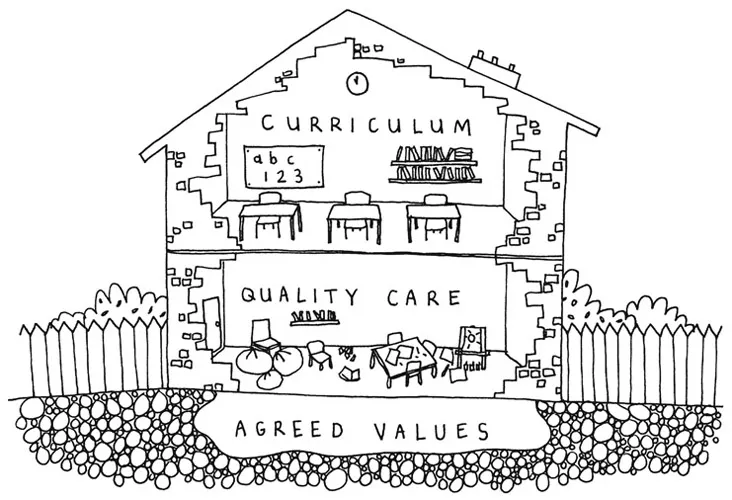
Before the planning starts, at any level, you have to have the foundations in place.
In terms of planning for the future of your Early Years service the foundations are your agreed values.
Once you are clear about these and have expressed them within your team and to parents and children, they become a framework in which to plan and operate. They also help you deal with situations that you have not predicted or events not planned.
There are many different ways that you can go about identifying your service’s values.
Activity 1.3
Imagine you are leading an activity to create a statement of your service’s values. This statement should clearly set out to other people what you put at the centre of your approach to Early Years provision and management.
Write down some alternative activities that you can think of to achieve this.
Comment
Ways in which this could be achieved include:
- The manager could write them.
- Team meeting ideas-storm or discussion.
- Using individual meetings, such as supervision, to ask staff for their top three values.
- Presenting a list of 20 or more value-based words, e.g. honesty, value, child-centred, efficient, caring, motivational, progressive, stable … And asking ...