The Reality of Aid 2000
An independent review of poverty reduction and development assistance
- 306 pages
- English
- ePUB (mobile friendly)
- Available on iOS & Android
The Reality of Aid 2000
An independent review of poverty reduction and development assistance
About this book
NOW IN ITS SEVENTH ANNUAL EDITION,
The Reality of Aid 2000 looks at how the performance of OECD donor countries on aid and development cooperation has matched up to the challenge of eliminating absolute poverty.
The report charts some improvements at the level of donor policy and rhetoric. But its stark conclusion is that the potential of aid to combat poverty is constantly undermined by governments, both North and South, who fail to address the extreme inequalities of income and the structural, social and political injustices that entrench people in poverty.
Part I of The Reality of Aid 2000 presents an overview of poverty in the current global context and an analysis of
recent trends in aid - looking particularly at basic education. In Part II, chapters by experts from NGOs in
OECD countries and the European Union show how donor aid administrations approach poverty - and highlight the weakness of political commitment in the North to the needs of the poor. Part III sets out Southern perspectives on development cooperation. Part IV provides 'at a glance' comparisons of donors' aid outlook and commitment to development cooperation in the 21st century, poverty eradication, gender and public support.
Throughout the book, information is presented in easily interpreted diagrams and graphs.
The Reality of Aid has established itself as a unique source of independent evaluation and comment on aid policies and development. It is indispensable for all in the field, whether in the official or voluntary sectors, providing a regular reality check on just how much the international community is doing to realise the achievable goal of eliminating poverty.
'Indispensable ... it gives you most of the hard facts you need to know about the major issues'
Nett-' Internationalist
'The most comprehensive and rigorous independent analysis of the aid and development policies of the world's wealthiest nations ... Essential reading'
Charity World
'The Reality of Aid remains an essential purchase by the libraries of development institutions and an invaluable reference for development practitioners'
Development & Change
'A reliable 'watchdog' for anyone interested in this important aspect of international relations'
ORBIT
'An accessible reference ... [it] encompasses many key issues and stimulates further research'
Commonwealth & Comparative Politics
Originally published in 1999

Frequently asked questions
- Essential is ideal for learners and professionals who enjoy exploring a wide range of subjects. Access the Essential Library with 800,000+ trusted titles and best-sellers across business, personal growth, and the humanities. Includes unlimited reading time and Standard Read Aloud voice.
- Complete: Perfect for advanced learners and researchers needing full, unrestricted access. Unlock 1.4M+ books across hundreds of subjects, including academic and specialized titles. The Complete Plan also includes advanced features like Premium Read Aloud and Research Assistant.
Please note we cannot support devices running on iOS 13 and Android 7 or earlier. Learn more about using the app.
Information
the Reality of Poverty

World aid at a glance
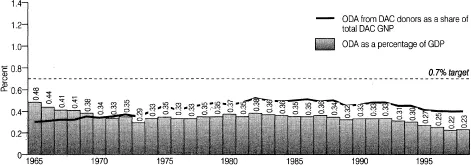
Percentage of national income spent on aid: a 30-year picture

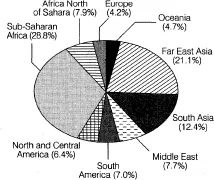
Where is DAC aid spent?

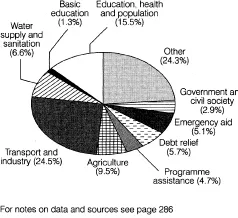
What is DAC aid spent on?

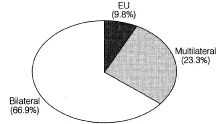
How much of DAC aid is spent through multilateral organisations?

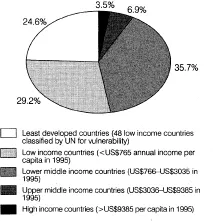
How much of DAC aid goes to the poorest countries?

| The donors gave | US$51,521 million in 19981 |
| that was | 0.23% of their total GNP |
| and | 0.59% of combined total government expenditure |
| which meant | US$63 per person in 1998 |
| In 1998 aid | rose by US$3,197 million, a real-terms rise of 8.9% |
| 8 donors | were less generous, reducing the proportion of GNP allocated to development assistance |
| 10 donors | were more generous |
| Private flows | amounted to US$100.2 billion in 1998, a decrease of US$142.3 billion over 1997, but still nearly twice the volume of ODA |
| Basic education | 1.44% combined bilateral ODA ā an average country effort of 2.1% |
| Basic health | 1.72% of bilateral ODA ā an average country effort of 2.9% |
| Population and | |
| reproductive health | 1.24% of bilateral ODA ā an average country effort of 0.8% |
| Just over half | of DAC ODA (50.7%) was spent in low income countries with an average per capita income of US$2 a day in 1997 |
| Just over a quarter | of DAC bilateral aid (26.5%) is given on the condition it is used only to purchase goods and services from the donor country. This excludes Technical Cooperation which is mostly tied to services from the donor and which amounted to 40% of... |
Table of contents
- Cover
- Title page
- Copyright page
- Contents
- List of boxes and tables
- Acknowledgement
- Foreword by Bin Enge
- The Reality of Aid Project
- Part I: The Reality of Aid versus the Reality of Poverty
- World aid at a glance
- The context of international development cooperation by Humberto Campodónico
- Trends towards the new millennium by Judith Randel and Tony German
- Trends in basic education by Anna Jellema
- Part II A Review of Aid Donors
- Australia by Garth Luke, ACFOA
- Canada by Brian Tomlinson, CCIC
- Japan by Akio Takayanagi, JANIC
- New Zealand by Pat Webster, CID
- Norway by Gunnar Garbo, NPA
- Switzerland by Richard Gerster, Swiss Coalition
- United States by Carol Lancaster, InterAction
- European Union by Mirjam van Reisen, Eurostep
- Austria by Karin Küblbƶck, and Michael Obrovsky ĆFSE
- Belgiumby Melanie Schellens, NCOS
- Denmark by Bibi Under, MS
- Finland by Folke Sundman and Mark Waller, KePa
- France by Olivier Blamangin, CRID
- Germany by Birgit Dederichs-Bain and Thomas Fues, DWHH and tdh
- Ireland by Michael OāBrien, Concern Worldwide
- Italy by JosƩ Luis Rhi-Sausi and Marco Zupi, Movimondo
- The Netherlands by Caroline Wildeman, NOVIB
- Portugal by Maria do CƩu Ferro, OIKOS
- Spain by Gonzalo Fanjul, Intermón
- Sweden by Svante Sandberg, Forum Syd
- United Kingdom by Mark Curtis and Anna Jefferys, ActionAid
- Part III Perspectives from the South on Development Cooperation
- Latin America: the economy and the environment collapse on the regionās poorest people by Humberto Campodónico, DESCO, and Mariano Valderrama, CEPES
- Latin America: cooperation and basic education by ALOP
- Africa: aid, debt and development by Twisema S Muyoya, MWENGO
- Uganda: poverty and basic education by Tumutegyereize Kennedy, Uganda Debt Network
- Zambia: trends in donor support to education by Allast Mwanza
- India: because the market tells them so by Binu S Thomas, ActionAid India
- Part IV Donors Compared At a Glance
- The outlook for aid
- Donor responses to international development goals and Shaping the 21st Century
- Donor government policies and poverty reduction
- Making sure that every aid dollar contributes to poverty eradication
- Measuring aid for poverty reduction
- Donor policies and actions on basic education
- Donor approaches to gender
- Political and public opinion in donor countries
- Government funding for information, public relations and development education
- Part V Reference Section
- Participating agencies
- Glossary
- Source notes
- Exchange rates