- 176 pages
- English
- ePUB (mobile friendly)
- Available on iOS & Android
eBook - ePub
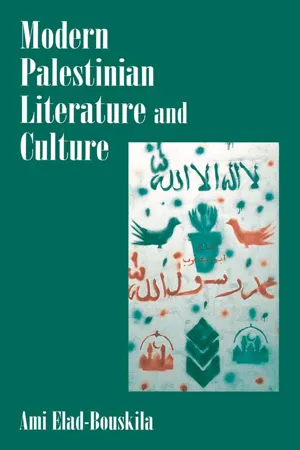
Modern Palestinian Literature and Culture
About this book
Studies of Palestinian society, economy, and politics are appearing with increasing frequency, but works in English about Palestinian literature, particularly that written in Israel, are still scarce. This book looks at this literature within the political and social context of Palestinian society, with a special focus on literature written during the Intifada "uprising" period (1987-93).
Information
1
The Quest for Identity
Three Issues in Israeli-Arab Literature
No nation or people seems entirely free of the struggle over problems of identity, both on the collective and the individual levels. The contemporary Arab world continues to grapple with issues of identity, the roots of this struggle harking back to Napoleon’s invasion of Egypt in 1798, bringing a renewed encounter between Arab and Western culture. Then the struggle was evoked by the intrusion of a European-Christian power into a predominantly Muslim-Arab world that had been immersed for quite some time in a technological, scientific and cultural malaise. The ensuing upheaval only deepened with the conquest of large parts of the Muslim-Arab world in the Mashriq and the Maghrib in the nineteenth and twentieth centuries. Thus the Arab world has undergone almost two centuries of soul-searching with regard to national, cultural, religious, social and economic identity. And Palestinian-Arab society has undergone a special kind of upheaval, as its century-long struggle with the Jewish community ended in defeat, leading to the establishment of the state of Israel and leaving all Palestinians without a state and some without a homeland. In the context of this search for national and individual identity, and the special situation of Palestinian society, the turbulent search for identity by the Israeli branch of the Palestinian community is unique.1
This chapter looks at three issues in the literature of Israeli Arabs that relate to their quest for identity in both Palestinian-Arab and Israeli-Jewish societies: (1) for whom do Israeli Arabs write? (2) where do they publish their work? and (3) what do they write about? The complexity of these issues is compounded by the fact that, with the establishment of the state of Israel in 1948, this society was transformed from majority to minority status.2
The identity of Palestinian literature, particularly that written in Israel, is problematic and complex. As noted in the Introduction, Palestinian literature has three branches. However, while Palestinian literature written in the various diasporas can be considered a ‘literature without a homeland’, that written in the occupied territories has a partial homeland but lacks a state, and that written in Israel is produced in historical Palestine that is now a country with a Jewish majority and a Palestinian minority. Thus, the identity of Palestinian literature written in Israel is controversial, and various writers and scholars, not surprisingly, refer to it differently: ‘Palestinian literature written by Israeli Arabs’, ‘the literature of Israeli Arabs’, ‘the literature of the 1948 Arabs’, ‘the literature of occupied Palestine’, and so on. These appellations reflect more than semantic issues; indeed, since 1967, not only have different scholars used different terms, but sometimes the same scholar uses different terms on different occasions, especially in light of the changes brought about by the intifāḍa in Israel and the Arab world.3 The Arabs themselves, especially Palestinians who live outside Israel and publish about this subject, are not tied down to any one formulation regarding what can loosely be referred to as ‘the literature of resistance’ [adab al-muqāwama].4
The bond among the three branches of contemporary Palestinian literature, including the contribution of Israeli Arabs to the ‘literature of resistance’, was strengthened in the early 1970s and came to the fore during the intifāḍa. The Palestinian uprising in the occupied territories vividly highlighted the links between Israeli Arabs and the other two branches, and also underscored the status of Israeli Arabs as a national and cultural minority that is subject to (or subjects itself to) rules of the game that the other two branches do not accept.
FOR WHOM DO ISRAELI ARABS WRITE?
The fundamental assumption of this chapter is that an examination of the above three questions can shed light on the basic orientation of Israeli Arabs. The question for whom Israeli Arabs write has, broadly speaking, two answers: some write in Arabic for Arabic-readers, and some write in both Arabic and Hebrew, the latter for a Hebrew-reading public (more about this in Chapter 2). Until 1967 writers in the first group wrote for the Arabic-reading audience inside Israel, which included Israeli Arabs as well as Jewish intellectuals who had recently immigrated to Israel from Arab countries, especially Iraq. However, the target audience of these Israeli-Arab writers has changed since 1967, particularly since the early 1970s, when the Arab states ‘discovered’ Israeli Arabs, dropped the unflattering labels that had been applied to them, and began to heap undeserved praise on their creations. Maḥmūd Darwīsh became a bitter opponent of this trend, expressed by the title of his article ‘Save us from this Cruel Love’.5 Two complementary processes began at this time: Arab cultural centres outside Israel began to publish Arab works written in Israel, sometimes even competing for the honour (as happened to Samīḥ al-Qāsim and Emile Ḥabībī, for example), while, on the other hand, Palestinian literature in Israel became directed not only toward the local audience but primarily toward those outside Israel. Thus, many Israeli-Arab writers began to publish in foreign newspapers and periodicals, and used publishers within the Arab world.6
The question for whom Israeli Arabs write assumed a new significance during the intifāḍa. This period has been of great importance for Israeli Arabs – as for other Palestinians and Israelis. The literature published during the intifāḍa reflects the social, political and cultural processes which the Palestinian people have been experiencing.7 In a series of Palestinian anthologies called Ibdā‘āt al-Ḥajar [the stone creations] published by the Association of Palestinian Writers in the Territories, which so far includes two volumes (in 1988 and 1989), works by Israeli Arabs appear. The first volume, for example, includes ‘al-Bū’ra’ [the focus] – a short story by Riyāḍ Baydas – and the poems ‘Risāla ilā Ghuzāt lā Yaqrā’un’ [a letter to occupiers who do not read] by Samīḥ al-Qāsim’ and ‘al-‘Unwān al-Jadīd’ [the new address] by Jamāl Q‘awār.8 An example of Palestinian literary activity outside the occupied territories, especially Cypriot writing, is the series Filasṭīn al-Thawra, which appeared in Nicosia under the auspices of the PLO. This series, which included eight volumes of poetry and prose as well as political tracts and articles about the intifāḍa itself, does not distinguish between the different branches of the Palestinian people, and quite a few pieces have been written by Israeli Arabs.9
The extensive literary activity of Israeli Arabs during the intifāḍa also found an outlet in Arab magazines and periodicals in Israel, especially the journal al-Jadīd and the literary supplement of the daily al-Ittiḥād, both of which belong to the Israeli Communist Party. At the same time, Arab writers from the West Bank and the Gaza Strip such as the poet and author As‘ad al-As‘ad (editor of the journal al-Kātib and former Secretary-General of the Association of Palestinian Writers in the Territories) publish in Israeli-Arab newspapers and periodicals, particularly al-Ittiḥād. In general, evidence of the close ties among the three branches and the blurring of boundaries between them can be found in the various anthologies published during the intifāḍa, particularly during the first two years, in Gaza and the West Bank, in Israel and in Cyprus. In the first volume of Ibdā‘āt al-Ḥajar, for example, appear poets from the territories such as al-Mutawakkil Ṭāha and ‘Abd al-Nāṣir Ṣāliḥ together with the Israeli-Arab poets Samīḥ al-Qāsim and Jamīl Q‘awār. And in the anthology Wahaj al-Fajr [the brilliance of dawn], published by the Association of Palestinian Writers in Israel, Israeli Arabs Zakī Darwīsh and Michel Ḥddād appear together with Palestinians from the territories al-Mutawakkil Ṭāha and Ḥanān ‘Awwād.10 Another indication of this activity during the intifāḍa is the large number of books published by the Association of Palestinian Writers in Israel and by private publishers, primarily in the Galilee and the Triangle (a region in central Israel heavily populated by Arabs).
WHERE DO ISRAELI-ARAB WRITERS PUBLISH?
The second question, where do Israeli-Arab writers publish their work, is directly connected to the question of who constitutes the target audience for these writers. The picture is quite clear: until the late 1960s and early 1970s, Palestinian writers in Israel wrote for Arabic-readers in Israel, both Arabs and Jews, and hence appeared in the journals and newspapers of the Israeli establishment, including the dailies al-Yawm and al-Anbā’, periodicals such as Ḥaqīqat al-Amr, Ṣadā al-Tarbiya, al-Hadaf, Liqā’-Mifgash and al-Sharq, as well as the publications of the Israeli Communist Party – al-Ittiḥād and al-Jadīd.11 Most of their books were printed by publishers sponsored or supported by the establishment, such as Dār al-Nashr al-‘Arabī [Arab publishing house] that published from the 1960s not only books by local writers and poets, but also major works of modern Arabic literature.12 There are, however, several exceptions to this: Israeli-Arab writers and poets who were published outside Israel in the Arab world, mainly Egypt (al-Hilāl, al-Majalla) and Lebanon (al-Adīb, al-Adāb). Among the most prominent of these are Tawfīq Zayyād, Samīḥ al-Qāsim, Maḥmūd Darwīsh (who left Israel in 1971), and Emile Ḥabībī (who won the Israel Prize for literature in 1992).
A significant change occurred in the late 1960s and early 1970s with regard to where Israeli-Arab writers published their work. Three factors contributed to this. The first was the 1967 war, which eliminated the barrier between Israeli Arabs and other Arabs, particularly Palestinians in the West Bank and Gaza. Emile Ḥabībī illustrates this in one chapter of his diary (published in al-Jadīd), describing how he found in West Bank bookstores not only books that he had never heard of, but an Arabic translation of Voltaire’s Candide, which influenced him when he wrote his acclaimed novel al-Mutashā’il.13 The second factor was the changed attitudes of Arabs outside Israel, who ‘discovered’ the Israeli Arab in the late 1960s, a trend strengthened as the PLO legitimized the Palestinian identity of Israeli Arabs. This legitimacy had an impact on intellectuals and writers in the Arab world, including journal editors, particularly in Egypt and Lebanon. Third, as a result of the two preceding factors, most Israeli-Arab writers who had previously written for periodicals of the Israeli establishment now abandoned them; hence, most of these periodicals ceased to appear by the late 1960s. Thus, both famous and less famous Israeli-Arab writers began to publish their work entirely in non-establishment periodicals in Israel or, increasingly, in the Arab countries.
The October War of 1973, the Lebanon War of 1982, and the intifāḍa that erupted in 1987 intensified the dynamic of change in Israeli-Palestinian literature, deepening the bond with Arab literature in general and with the two other branches of Palestinian literature in particular. This is reflected in the target audience, the venue of publication and the subject matter of Israeli-Arab literature. Much writing by Israeli Arabs now appears in periodicals of the major Arab cultural centres, both in Arab cities (Beirut, Cairo, Casablanca) and beyond (London, Paris, Nicosia). Thus a reciprocal process took place: Arab cultural centres took an increased interest in the writing of Israeli Arabs, and this impelled Israeli Arabs into prolific creativity. This process accelerated in the 1980s, especially with the start of the intifāḍa. In parallel, Israeli-Arab establishment periodicals – al-Sharq (1982) and al-Anbā’ (1985) – were dying out. Although Liqā’-Mifgash reappeared in a new incarnation in 1984, by the late 1980s and early 1990s it was in a moribund state. Although al-Ittiḥād and al-Jadīd continued to publish, new periodicals began to flourish, such as al-Aswār (1988), 48 (the periodical of the Association of Palestinian Writers in Israel – 1988), al-Thaqāfa (1992–93), Iḍā’āt (1993–), and Mashārif (1995–97).
This trend was particularly evident during the intifāḍa, with Palestinian writers from the diaspora and the occupied territories publishing their works in Israeli-Arab periodicals, while Israeli-Arab authors appeared in Palestinian periodicals in and out of the territories, publishing poetry, prose and various anthologies in the Arab world and beyond.14 Thus an interesting dialectic developed in which, on the one hand, the fences were falling between Palestinian writers in Israel and their kin in the diaspora and the territories; and, on the other hand, a nagging question could no longer be avoided: whether these citizens of Israel were Israelis against their will or by choice.
Although the intifāḍa blurred the boundaries between the three branches of the Palestinian people, it also heightened the sense of self of the Palestinians in Israel. The bond among the three branches is especially strong in the area of literary activity and publishing. Palestinians from the diaspora, such as the writer and scholar Afnān al-Qāsim in France, publish in al-Ittiḥād and al-Jadīd, which, as noted, belong to the Israeli Communist Party; and Palestinian poets and writers from Israel such as Emile Ḥabībī, Samīḥ al-Qāsim and Riyāḍ Baydas publish in Palestinian periodicals in the territories such as al-Kātib and in diaspora Palestinian periodicals such as al-Karmil and Filasṭīn al-Thawra. These relationships deepened during the period of the intifāḍa, involving not only periodicals but also anthologies published in the occupied territories, Israel and Cyprus. Thus, anthologies published in Israel contain prose and poetry written by Palestinians from the diaspora and the territories, while anthologies published in the territories and the diasporas contain writing by Israeli Arabs.15
WHAT DO ISRAELI ARABS WRITE ABOUT?
The third question under discussion is what do Israeli Arabs write about? One can broadly distinguish two main periods of Israeli-Arab literature: the first from 1948 until the late 1960s, and the second, from the late 1960s to the present. Before the establishment of the state of Israel, Palestinian literature dealt with two main subjects: the clash with the British colonial power and the generation gap in Palestinian society. Until the late 1960s, Israeli-Arab literature reflected the ideological identification of Israeli Arabs with the Arab world, especially support for Communist ideology (Emile Habībī, Tawfīq Zayyād, Samīḥ al-Qāsim, Maḥmūd Darwīsh); since the late...
Table of contents
- Cover
- Half Title
- Dedication
- Title Page
- Copyright Page
- Table of Contents
- Acknowledgements
- Introduction Palestinian Culture in the Middle East: Between Arabism, Westernism and Israelism
- 1. The Quest for Identity: Three Issues in Israeli-Arab Literature
- 2. The Other Face: The Language Choice of Arab Writers in Israel
- 3. Between Interlaced Worlds: Riyād Baydas and the Arabic Short Story in Israel
- 4. Stones for the Homeland: Palestinian Literature of the Intifāda (1987–90)
- 5. Danger, High Voltage: The Image of the Jew/Israeli in Palestinian Intifāda Literature (1987–90)
- 6. The Holiness of a City: Jerusalem in the Literature of the Intifāda (1987–90)
- Epilogue
- Bibliography
- Index
Trusted by 375,005 students
Access to over 1.5 million titles for a fair monthly price.
Study more efficiently using our study tools.
Frequently asked questions
Yes, you can cancel anytime from the Subscription tab in your account settings on the Perlego website. Your subscription will stay active until the end of your current billing period. Learn how to cancel your subscription
No, books cannot be downloaded as external files, such as PDFs, for use outside of Perlego. However, you can download books within the Perlego app for offline reading on mobile or tablet. Learn how to download books offline
Perlego offers two plans: Essential and Complete
- Essential is ideal for learners and professionals who enjoy exploring a wide range of subjects. Access the Essential Library with 800,000+ trusted titles and best-sellers across business, personal growth, and the humanities. Includes unlimited reading time and Standard Read Aloud voice.
- Complete: Perfect for advanced learners and researchers needing full, unrestricted access. Unlock 1.5M+ books across hundreds of subjects, including academic and specialized titles. The Complete Plan also includes advanced features like Premium Read Aloud and Research Assistant.
We are an online textbook subscription service, where you can get access to an entire online library for less than the price of a single book per month. With over 1.5 million books across 990+ topics, we’ve got you covered! Learn about our mission
Look out for the read-aloud symbol on your next book to see if you can listen to it. The read-aloud tool reads text aloud for you, highlighting the text as it is being read. You can pause it, speed it up and slow it down. Learn more about Read Aloud
Yes! You can use the Perlego app on both iOS and Android devices to read anytime, anywhere — even offline. Perfect for commutes or when you’re on the go.
Please note we cannot support devices running on iOS 13 and Android 7 or earlier. Learn more about using the app
Please note we cannot support devices running on iOS 13 and Android 7 or earlier. Learn more about using the app
Yes, you can access Modern Palestinian Literature and Culture by Ami Elad-Bouskila in PDF and/or ePUB format, as well as other popular books in Literature & Middle Eastern History. We have over 1.5 million books available in our catalogue for you to explore.