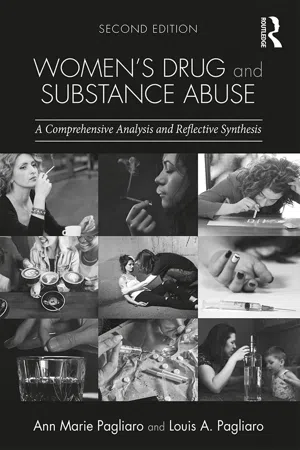
This newly revised and expanded edition of Women's Drug and Substance Abuse: A Comprehensive Analysis and Reflective Synthesis offers a unique analysis and synthesis of theory, empirical research, and clinical guidance for treating substance abuse among young, middle-aged, and older women of various racial and sociocultural backgrounds in the United States, 2000 to 2018. This text uses the most current research findings to examine the actions and effects of drugs, women's patterns of medical and personal use and abuse, and common mental disorders associated with drug use. The authors also present their own empirically-based assessment model as well as prevention and treatment approaches specifically designed for women. Also included in the text is a comprehensive, cross-referenced subject index. Clear, comprehensive, accessible, and fully referenced, this book will be an invaluable resource for students and for professionals in all health and social care disciplines. Women's Drug and Substance Abuse is the 18th clinical pharmacology text that the Pagliaros have written over the past 40 years and is the 6th that deals exclusively with drug and substance abuse.
eBook - ePub
Women's Drug and Substance Abuse
A Comprehensive Analysis and Reflective Synthesis
- 536 pages
- English
- ePUB (mobile friendly)
- Available on iOS & Android
eBook - ePub
Women's Drug and Substance Abuse
A Comprehensive Analysis and Reflective Synthesis
About this book
Information
1
Women’s Opiate Analgesic Abuse
The abuse of opiate analgesics has significantly increased among young, middle-aged, and older women, across the U.S., since the beginning of the new millennium. Although there are seven major licit prescription opiate analgesics that are mainly abused—buprenorphine, fentanyl,1 hydrocodone, hydromorphone, methadone, morphine, and oxycodone2—there is only one major illicit non-prescription opiate analgesic that is mainly abused—heroin. Medically prescribed primarily for the relief of moderate to severe pain, women generally abuse these opiate analgesics to achieve: (1) an intense feeling of euphoria; (2) an overall warm and pleasant feeling, or rush; or (3) a sleepy, dream-like state, commonly known as “being on-the-nod.” In addition, women, who are regular, long-term opiate analgesic users, also commonly use the opiate analgesics to: (4) prevent or self-manage the opiate analgesic withdrawal syndrome.
We begin with an overview and discussion of the basic pharmacology of the opiate analgesics with attention to their similarities and differences regarding:
1.Pharmacodynamics, or mechanisms of action
2.Dosage formulations and methods of use
3.Pharmacokinetics, or absorption, distribution, metabolism, and excretion
4.Undesired, or harmful, effects and toxicities3
We then present and discuss women’s medical and personal use and abuse of the opiate analgesics.
Pharmacology
The opiate analgesics comprise three subgroups, or families: (1) natural pure agonists; (2) synthetic pure agonists; and (3) synthetic mixed agonists/antagonists (see Table 1.1). The first, and original family, includes opium and its pure natural derivatives—codeine (Codeine Contin®)4 and morphine (MS Contin®). The second family includes several synthetic modifications of morphine, such as fentanyl (Actiq®), heroin (diacetylmorphine), methadone (Dolophine®), and oxycodone (OxyContin®). These synthetic modifications have chemical structures and pharmacologic actions that resemble their natural parent drug, morphine. The third family comprises the synthetic mixed agonists/antagonists—buprenorphine (Buprenex®), nalbuphine (Nubain®), and pentazocine (Talwin®).
Table 1.1Opiate Analgesics
| OPIATE ANALGESICS | ||
| Reasons for Women’s Personal Use/Abuse: To achieve dreams (pipe dreams); euphoria; pain relief; a warm rush; and a sleepy, dreamlike state (being on-the-nod). Also, used to prevent/self-manage the opiate analgesic withdrawal syndrome. | ||
| Generic Name | Trade or Brand Name(s)® | Common Street Name(s) |
| Pure agonists, natural | ||
Opium | — | Doda; Poppy |
Opium derivatives: | ||
Codeinea | Codeine Contin®; Ratio-Codeine® | Codies; Cough Syrup; School Boy; T3 |
Morphine | M.O.S.®; MS Contin® | Drug Store; Good Ole M; Hospital Heroin; Morph; MS |
Pure agonists, semi-synthetic and synthetic | ||
Fentanyl | Actiq®; Duragesic® | Fen; Murder 8; Perc-O-Pop |
Heroin | — | Black Tar; Brown; Capital H; Charley; Horse; Junk; Shit |
Hydrocodoneb | OxyContin® | Hyke; Tuss; Vikes |
Hydromorphone | Dilaudid® | Delaud; Dillies; Hillbilly |
Levorphanol | Levo-Dromoran® | — |
Meperidine | Demerol® | Dems; Mep |
Methadone | Dolophine® | Adolph; Dollies; Done; Wafer |
Oxycodonec | OxyContin® | Cotton; Oxycotton; Poor Man’s Heroin; Percs |
Oxymorphone | Numorphan® | — |
Propoxyphene | Darvon® | Footballs; Yellows |
Mixed agonists/antagonists, synthetic | ||
Buprenorphine | Buprenex® | Tems |
Butorphanol | Stadol® | — |
Nalbuphine | Nubain® | Nubian |
Pentazocine | Talwin® | Big T; Ts |
Tramadol | Ultram® | — |
N.B. Some brand/trade names for specific opiate analgesics are included in this table even though they may no longer be licitly manufactured or marketed in North America. These specific opiate analgesics may have been discontinued by the manufacturer because they were: (1) replaced with a generic version; or (2) officially withdrawn from the market by FDA regulation. These specific opiate analgesics remain available from other countries or illicit producers within North America and are easy to obtain by purchase over the Internet.
aCodeine is usually available as one of the ingredients of a multiple-ingredient product (e.g., Empirin #4 [codeine and aspirin]; Tylenol #3 [codeine and acetaminophen]).
bUsually available as one of the ingredients of a multiple ingredient product (e.g., Vicodin® [hydrocodone and acetaminophen]).
cAlso available in multi-ingredient combination products, such as Percocet® (oxycodone and acetaminophen).
Opium is prepared from the dried resin of the unripe seed pod of the poppy plant (Papaver somniferum)—the poppy that causes sleep. The crude resin, often called “poppy tears” (lachryma papaveris), is scrapped off the poppy pod, which was lanced soon after the flower petals began to fall to release the raw opium. The opium alkaloids5 are then extracted from the resin by various methods. Raw opium contains approximately 10% morphine by weight. Morphine is considered the standard against which all other opiate analgesics are compared regarding strength (i.e., potency) and therapeutic effectiveness (i.e., efficacy). The relative potencies of the various opiate analgesics—the average dosages that are required to generally provide equivalent pain relief, or equal efficacy—are listed in Table 1.2.
Table 1.2Average Dosages (i.e., Potency) of Opiate Analgesics Required to Achieve Equivalent Pain Relief (i.e., Efficacy)
| Opiate analgesic | Average dosage | |
| Generic Name (Trade or Brand Name®) | IM (mg) | PO (mg) |
Butorphanol (Stadol®) | 2 | — |
Codeine | 120 | 200 |
Fentanyl (Actiq®) | 0.2 | — |
Hydrocodone | — | 60 |
Hydromorphone (Dilaudid®) | 1.5 | 7.5 |
Levorphanol (Levo-Dromoran®) | 2 | 4 |
Meperidine (Demerol®) | 75 | 300 |
Methadone (Dolophine®) | 10 | 20 |
Morphine | 10 | 30 |
Nalbuphine (Nubain®) | 10 | — |
Oxycodone (OxyContin®) | 15 | 20 |
Oxymorphone (Numorphan®) | 1 | 15 |
Pentazocine (Talwin®) | 60 | 180 |
N.B. These are single, average dosage laboratory equivalents. Consequently, for women who use/abuse opiate analgesics, there may be significant inter-individual variability.
Pharmacologically, opiate analgesics have been traditionally referred to as narcotic analgesics reflecting their major therapeutic indication—to relieve pain. They also have been simply called, narcotics. Derived from the Greek word, narke, narcotic means a lack of feeling or sensation—a feeling of numbness. However, the general use of the term, narcotic, has caused much confusion because of its legal meaning.
Legally, the term, narcotic, is used to denote all the various drugs and substances of abuse that are listed under the U.S. and international Narcotic Acts and Laws. For example, cannabis, cocaine, heroin, and lysergic acid diethylamide (LSD), are all legally classified as narcotics. However, of the four drugs and substances of abuse listed in this example, only heroin is pharmacologically classified as a narcotic based upon its chemical structure and pharmacological action.
Adding to the confusion, the opiate analgesics are often referred to as opioids—a term that is also used to denote the: (1) opiate analgesic antagonist, naloxone (Narcan®); and (2) opiate analgesic-like substances that are naturally found in the body (i.e., endogenous opioid peptides). Thus, to minimize the confusion associated with the use of these various terms, we selected to use the term, opiate analgesic, throughout this book, for any “natural or synthetic drug or substance that exerts morphine-like actions upon the human brain and spinal cord.”
Pharmacodynamics: Mechanism of Action
The opiate analgesics have an interesting mechanism of action. Rather than raising the pain threshold to achieve analgesia and pain relief, they modify the brain’s interpretation of painful stimuli by depressing central nervous system (CNS) activity. Thus, the sensation of pain is still experienced, but it does not seem to “hurt so much.”
The endogenous opioid peptides were identified in the brain during the 1970s and were named dynorphins, endorphins, and enkephalins. Various opiate analgesic receptors also were discovered within the body and were extensively studied. Although the receptor classification system that evolved from this research remains incomplete, three major groups of opiate analgesic receptors were pharmacologically characterized and named delta, kappa, and mu.6 The highest concentrations of these receptors are found in the hypothalamus; limbic ...
Table of contents
- Cover
- Half Title
- Title Page
- Copyright Page
- Dedication
- Contents
- About the Authors
- Acknowledgments
- Preface and Introduction
- 1 Women’s Opiate Analgesic Abuse
- 2 Women’s Alcohol Abuse
- 3 Women’s Prescription Sedative-Hypnotic Abuse
- 4 Women’s Caffeine and Nicotine Abuse
- 5 Women’s Amphetamine and Cocaine Abuse
- 6 Women’s Psychodelic Abuse
- 7 Identifying Women’s Contemporaneous Diagnoses
- 8 Preventing and Treating Women’s Drug and Substance Abuse
- Index
Trusted by 375,005 students
Access to over 1.5 million titles for a fair monthly price.
Study more efficiently using our study tools.
Frequently asked questions
Yes, you can cancel anytime from the Subscription tab in your account settings on the Perlego website. Your subscription will stay active until the end of your current billing period. Learn how to cancel your subscription
No, books cannot be downloaded as external files, such as PDFs, for use outside of Perlego. However, you can download books within the Perlego app for offline reading on mobile or tablet. Learn how to download books offline
Perlego offers two plans: Essential and Complete
- Essential is ideal for learners and professionals who enjoy exploring a wide range of subjects. Access the Essential Library with 800,000+ trusted titles and best-sellers across business, personal growth, and the humanities. Includes unlimited reading time and Standard Read Aloud voice.
- Complete: Perfect for advanced learners and researchers needing full, unrestricted access. Unlock 1.5M+ books across hundreds of subjects, including academic and specialized titles. The Complete Plan also includes advanced features like Premium Read Aloud and Research Assistant.
We are an online textbook subscription service, where you can get access to an entire online library for less than the price of a single book per month. With over 1.5 million books across 990+ topics, we’ve got you covered! Learn about our mission
Look out for the read-aloud symbol on your next book to see if you can listen to it. The read-aloud tool reads text aloud for you, highlighting the text as it is being read. You can pause it, speed it up and slow it down. Learn more about Read Aloud
Yes! You can use the Perlego app on both iOS and Android devices to read anytime, anywhere — even offline. Perfect for commutes or when you’re on the go.
Please note we cannot support devices running on iOS 13 and Android 7 or earlier. Learn more about using the app
Please note we cannot support devices running on iOS 13 and Android 7 or earlier. Learn more about using the app
Yes, you can access Women's Drug and Substance Abuse by Ann Marie Pagliaro,Louis A. Pagliaro in PDF and/or ePUB format, as well as other popular books in Psychology & Clinical Psychology. We have over 1.5 million books available in our catalogue for you to explore.