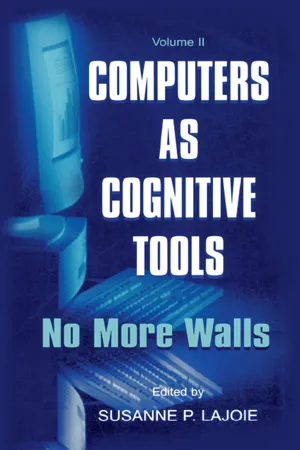
Since the publication of the first edition of Computers as Cognitive Tools in 1993, rapid changes have taken place in the uses of technology for educational purposes and in the theories underlying such uses. Changes in perspectives on thinking and learning are guiding the instructional design of computer-based learning environments.
Computers as Cognitive Tools, Volume II: No More Walls provides examples of state-of-the-art technology-based research in the field of education and training. These examples are theory-driven and reflect the learning paradigms that are currently in use in cognitive science. The learning theories, which consider the nature of individual learning, as well as how knowledge is constructed in social situations, include information processing, constructivism, and situativity. Contributors to this volume demonstrate some variability in their choice of guiding learning paradigms. This allows readers the opportunity to examine how such paradigms are operationalized and validated.
An array of instructional and assessment approaches are described, along with new techniques for automating the design and assessment process. New considerations are offered as possibilities for examining learning in distributed situations. A multitude of subject matter areas are covered, including scientific reasoning and inquiry in biology, physics, medicine, electricity, teacher education, programming, and hypermedia composition in the social sciences and ecology.
This volume reconsiders the initial "camp" analogy posited in 1993 edition of Computers as Cognitive Tools, and presents a mechanism for breaking camp to find new summits.
- 464 pages
- English
- ePUB (mobile friendly)
- Available on iOS & Android
eBook - ePub
About this book
Information
I
TECHNOLOGIES FOR SUPPORTING KNOWLEDGE BUILDING IN DISTRIBUTED LEARNING CONTEXTS
1
Modeling the Process, Not the Product, of Learning
Fabio N. Akhras and John A. Self
University of Leeds
The general definition of a model as something that an “observer” uses to understand the “object” modeled indicates that the notion of modeling permeates the computer-based learning system design activity. The disagreements have to do with who (systems, students, teachers, designers) does the modeling when, how, and about what. However, concerning the modeling carried out by a computer system, the “to model or not to model” question of Lajoie and Derry (1993) was interpreted entirely within the context of student modeling, which refers to techniques that “enable an instructional system to develop and update an understanding of the student and her performance on the system” (p. 2).
This chapter focuses on the nature of “the object” modeled by a computer-based learning system. So far, a “student model” has been regarded, naturally enough and almost by definition, as a “model of the student,” that is, of what she believes, misunderstands, or wants, for example. It has been generally assumed (by student model designers) that it is beneficial to seek the maximum fidelity of the student model, while acknowledging the practical difficulties in achieving this. In other words, it has been assumed that the object modeled is the student—that there really is some objective knowledge about the student that we may seek to represent.
This approach applies objectivism to student modeling, the philosophy of knowledge that holds that the world may be completely and correctly structured in terms of entities, properties, and relations and that rational thought consists of the manipulation of abstract symbols viewed as representing reality (Lakoff, 1987). Duffy and Jonassen (1992) have considered the implications of objectivism for instructional design. Typically system designers begin by trying to specify the “objective” knowledge-to-be-learned as precisely as possible as computational representations and then interpret the student’s knowledge with respect to such representations. The aim of the system might be to help learners acquire the entities, properties, and relations of this purportedly complete and correct representational structure.
In contrast, one of the basic assumptions of constructivist philosophies of knowledge is that knowledge cannot be objectively defined and statically represented. Instead, it is individually constructed from what learners do in their experiential worlds (Piaget & Garcia, 1991). Knowing, according to constructivism, is an adaptive process. By means of acting in a world, learners assimilate new concepts to their previously constructed cognitive structures or modify their cognitive structures to accommodate interpretations of the new experiences (von Glasersfeld, 1989).
It follows, according to this philosophy, that knowing and doing cannot be separated and that the activity and context of an experience become an integral part of the meaning of that experience (Bednar, Cunningham, Duffy, & Perry, 1992; Brown, Collins, & Duguid, 1989; Greeno, 1997). Moreover, further understanding may change the meaning of previously constructed knowledge about a domain, making it necessary that ideas be revisited many times so that they can be understood in the context of the other ideas that have been encountered in the meantime (Winn, 1993). Therefore, the focus is on the process by which knowledge is constructed rather than on a target domain knowledge to be acquired (Fosnot, 1996; Jonassen, 1992).
Constructivists would not represent target knowledge as some kind of fixed data structure and therefore could not represent the student’s knowledge as some approximation to it. For a constructivist, a student model (as usually understood) directly contradicts a basic tenet of the philosophy, and as a result, many reasons are put forward as to why a student model is philosophically, computationally, and educationally undesirable.
It is possible, however, that these views require a different interpretation of student modeling rather than no student modeling at all. Recent discussions of the nature of learning and knowledge concern the properties that a process of learning should have to be conducive to learning. This then leads to suggestions that designers should design systems that enable such desirable properties to hold.
The original rationale for needing student models was that individual students are so different that their needs cannot be anticipated at design time. Similarly, the properties of a process of learning cannot be fixed at design time; indeed, it would be self-contradictory for a constructivist to claim that designers can know such properties in advance. The perceived properties of a process of learning depend on what the student already believes and what she does while interacting with the system. Therefore, systems may need to be able to adapt to try to ensure that desirable properties hold. To enable such adaptations, a system needs to model the properties of the interactions between system and student.
In this chapter we present a formalism for defining the properties of a sequence of learning events (in our case, interactions with a computer-based learning system, such as a simulation). Given a sequence of learning events, with certain properties holding, a possible following event would lead to other properties holding. To the extent that educationalists agree that certain properties are more desirable than others (in that they are considered more likely to lead to learning), so the system may adapt itself to ensure that events that lead to those desirable properties are more likely to occur. We illustrate the general approach by an application to a system to support the learning of software engineering concepts.
The main contribution of this chapter is to provide a methodology for making precise the concepts of contemporary theories of learning and knowledge, which emphasize the context of learning and the fact that learning is a process extended in time. This leads to the development of a different view of the nature of and need for modeling in computer-based learning systems.
THE NATURE OF LEARNING
Learning is a multifaceted process. Many of the facets that cognitive psychologists and machine learning researchers study are, in fact, quite compatible with conventional student modeling techniques such as overlays, bug catalogues, and model tracing. These tend to concentrate on relatively small-grain, incremental, narrowly focused learning processes and hence to relate to the kind of moment-to-moment decision making that typical student models are intended to support. In this chapter, however, we focus on views of learning that, according to those who put them forward (e.g., Clancey, 1993; Sack, Soloway, & Weingrad, 1992), are inimical to the student modeling enterprise as it is usually understood. It is not our purpose to argue which view of learning is “right”—no doubt, there is something of merit in all of them—but to consider how certain views of learning, which have led others to decry modeling efforts, can be interpreted to provide a different view of modeling. Our aim is to broaden the notion of modeling so that it is not seen as inherently contradictory to those views of learning.
The defining axiom of constructivism—that students learn by constructing their own knowledge and that previously constructed knowledge influences the way new experiences are interpreted—is one that most learning theorists, whether overtly constructivist or not, would accept. The distinguishing properties of constructivism lie instead in three corollaries that are not so readily accepted:
• Learning occurs within a context that is itself part of what is learned (Brown et al., 1989; Greeno, 1997; Resnick, 1987).
• Knowing and doing cannot be separated (Piaget & Garcia, 1991; von Glasersfeld, 1995).
• Learning is a process that is extended over time (von Glasersfeld, 1989, 1995; Vygotsky, 1978; Winn, 1993).
These three concerns—context, activity, and time extension—are not directly or satisfactorily addressed by current modeling methodologies. Moreover, they cannot be addressed in a piecemeal fashion. Clearly, if knowledge is inseparable from action, then we need to recognize that actions occur in a context and take place over time. We need to integrate the psychological with the contextual, physical, and temporal factors. This move toward integrated theories has been discussed by Vosniadou (1996), who argues that we need to improve our understanding of how cognitive processes interact with environmental variables, and by Resnick (1996), who is concerned with developing “situated rationalism,” which joins two perspectives: one that focuses on learning as inherently social and another that emphasizes individual learning and cognitive development. The idea is to develop a theory that takes into consideration the social, cognitive, and physical dimensions of situations and how activity in one situation might prepare individuals to enter another.
Overall, the aim is to model the process of learning as one that happens over time, through interactions between cognitive structures and context and through activity. Before defining these terms clearly, we provide an outline of the argument in nontechnical terms.
SKETCH OF THE ARGUMENT
For ease of explanation, we confine ourselves to considering a single learner using a computer-based learning environment. (The methodology itself is not so confined, but it is outside the scope of this chapter to consider other contexts in detail.)
First, we need to describe the environmental contexts in which interactions occur. This requires describing the objects, relations, and properties of a situation. Then we need to consider the events that are possible in a situation—their preconditions and their effects. A series of events creates a sequence of situations that we call a “course of interaction.” As an example, a course of interaction may be said to possess the property of “pigheadedness” if it shows the learner performing exactly the same action over and over, generating identical situations.
Of the many properties that may be defined, some may be considered “better” than others. That is, learning theorists may have argued, or perhaps provided experimental evidence, that a course of interaction with a particular property is more likely to lead to learning than a course of interaction without that property. In fact, this is precisely what most learning th...
Table of contents
- Cover
- Half Title
- Title Page
- Copyright Page
- Table of Contents
- Preface
- Introduction: Breaking Camp to Find New Summits
- Part I: Technologies for Supporting Knowledge Building in Distributed Learning Contexts
- Part II: Cognitive Tools that Foster New Forms of Representation
- Part III: Epilogue
- Part IV: Discussion
- Author Index
- Subject Index
Trusted by 375,005 students
Access to over 1.5 million titles for a fair monthly price.
Study more efficiently using our study tools.
Frequently asked questions
Yes, you can cancel anytime from the Subscription tab in your account settings on the Perlego website. Your subscription will stay active until the end of your current billing period. Learn how to cancel your subscription
No, books cannot be downloaded as external files, such as PDFs, for use outside of Perlego. However, you can download books within the Perlego app for offline reading on mobile or tablet. Learn how to download books offline
Perlego offers two plans: Essential and Complete
- Essential is ideal for learners and professionals who enjoy exploring a wide range of subjects. Access the Essential Library with 800,000+ trusted titles and best-sellers across business, personal growth, and the humanities. Includes unlimited reading time and Standard Read Aloud voice.
- Complete: Perfect for advanced learners and researchers needing full, unrestricted access. Unlock 1.5M+ books across hundreds of subjects, including academic and specialized titles. The Complete Plan also includes advanced features like Premium Read Aloud and Research Assistant.
We are an online textbook subscription service, where you can get access to an entire online library for less than the price of a single book per month. With over 1.5 million books across 990+ topics, we’ve got you covered! Learn about our mission
Look out for the read-aloud symbol on your next book to see if you can listen to it. The read-aloud tool reads text aloud for you, highlighting the text as it is being read. You can pause it, speed it up and slow it down. Learn more about Read Aloud
Yes! You can use the Perlego app on both iOS and Android devices to read anytime, anywhere — even offline. Perfect for commutes or when you’re on the go.
Please note we cannot support devices running on iOS 13 and Android 7 or earlier. Learn more about using the app
Please note we cannot support devices running on iOS 13 and Android 7 or earlier. Learn more about using the app
Yes, you can access Computers As Cognitive Tools by Susanne P. Lajoie in PDF and/or ePUB format, as well as other popular books in Computer Science & Computer Science General. We have over 1.5 million books available in our catalogue for you to explore.