eBook - ePub
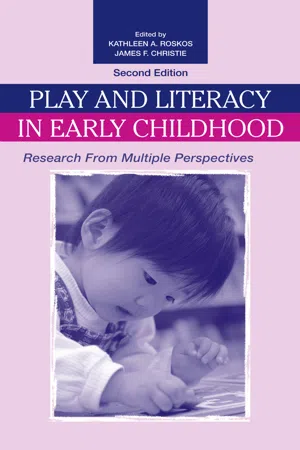
Play and Literacy in Early Childhood
Research From Multiple Perspectives
- 268 pages
- English
- ePUB (mobile friendly)
- Available on iOS & Android
eBook - ePub
About this book
This volume brings together studies, research syntheses, and critical commentaries that examine play-literacy relationships from cognitive, ecological, and cultural perspectives. The cognitive view focuses on mental processes that appear to link play and literacy activities; the ecological stance examines opportunities to engage in literacy-related play in specific environments; and the social-cultural position stresses the interface between the literacy and play cultures of home, community, and the school. Examining play from these diverse perspectives provides a multidimensional view that deepens understanding and opens up new avenues for research and educational practice. Each set of chapters is followed by a critical review by a distinguished play scholar. These commentaries' focus is to hold research on play and literacy up to scrutiny in terms of scientific significance, methodology, and utility for practice. A Foreword by Margaret Meek situates these studies in the context of current trends in literacy learning and instruction. Earlier studies on the role of play in early literacy acquisition provided considerable information about the types of reading and writing activities that children engage in during play and how this literacy play is affected by variables such as props, peers, and adults. However, they did not deal extensively, as this book does, with the functional significance of play in the literacy development of individual children. This volume pushes the study of play and literacy into new areas. It is indispensable reading for researchers and graduate students in the fields of early childhood education and early literacy development.
Information
PART
I
THE PLAYFUL MIND
CHAPTER
1
Pretend Play and Children’s Cognitive and Literacy Development: Sources of Evidence and Some Lessons From the Past
Peter K. Smith
Goldsmiths College, University of London
Goldsmiths College, University of London
The role of play in children’s development is not only controversial scientifically; it has also led to extreme positions at times in regards to policies regarding early education. On the one hand, advocates of the play ethos (to which I return later) have seen play as preeminently the child’s way of learning; free play was seen as most beneficial for children well into infant school, and direct instruction methods were seen as inappropriate. More recently, notably in the United States (Zigler & Bishop-Josef, 2004) and the United Kingdom (Hall, 2005), a desire to improve cognitive and literacy skills in young children, including those from disadvantaged backgrounds, has led to the opposite viewpoint, an emphasis on direct instruction and a neglect of play opportunities. In fact, many researchers, myself included, see both as extreme positions and would argue for a blended program (Christie & Roskos, 2006) in the early years.
However, what is the evidence to support this or any other position, regarding play and development? In this chapter I review the sources of evidence. After an initial broad overview, I focus mainly on pretend play and on cognitive and literacy development. I look at some main theories, including evolutionary perspectives, cross-cultural evidence, arguments by design, correlational evidence, and experimental evidence. In general I am not trying to review relevant studies in detail (this has been done in other reviews; e.g., Christie & Roskos, 2006; Smith, 2005; other chapters in this volume), but rather discussing the nature of the evidence and principles of study. Some important pitfalls in experimental studies were exposed during the 1970s and 1980s, and I revisit these. I end with some suggestions for further research in this area.
THE ROLE OF PLAY IN DEVELOPMENT
There is a range of legitimate views about the role of play in development. On the one hand, play has been held up as the child’s way of learning, and as essential to development. At the other extreme, play has been regarded as simply letting off excess energy, a time-wasting activity when there is nothing better to do. There is, of course, a range of intermediate positions.
The Play Ethos, and Other Metaphors of Play
I have earlier (Smith, 1988) described the play ethos as an uncritical and extreme assertion of the functional importance of play that has been very influential from around the 1920s to at least the 1980s if not the present day. The following quotes illustrate this point of view:
Play is indeed the child’ work, and the means whereby he grows and develops. Active play can be looked upon as a sign of mental health; and its absence, either of some inborn defect, or of mental illness. (Isaacs, 1929, p. 9)
The realisation that play is essential for normal development has slowly but surely permeated our cultural heritage. (Department of the Environment, 1973, p. 1)
Play is the elemental learning process by which humankind has developed … It is the very process of learning and development, and as such all that is learnt through it is of benefit to the child. (Welsh Assembly, 2002)
These quotes are from U.K. sources, but similar quotes can be found from the United States and from other Western sources. In a similar vein, Sutton-Smith (1997) described the play as progress rhetoric about play, which idealizes play and ignores any possible negative aspects of it.
This somewhat extreme view of the benefits of play may have come about as an overreaction to the alternative view that play is a largely superfluous activity. Although Spencer’s excess energy view of play has little scientific credibility these days, there are certainly views in many educational and government circles that instruction in cognitive and language skills are most important, even in the preschool and early school years. As a result, play has been rather marginalized in many preschool curricula, and play times have a lower priority in schools, with playgrounds being sold off and school recess breaks decreased or eliminated (Pellegrini & Blatchford, 2000; Zigler & Bishop-Josef, 2005).
A more balanced view is that play is indeed important for learning in early childhood, but it is not the only route to do so (Smith, 1982). The ubiquity of play in children and indeed most mammals; the rebound effects found after deprivation of play; and the design characteristics of play, whereby it provides many opportunities for learning, all argue for the developmental value of play experiences. It is very likely that play evolved precisely for this reason—as a relatively safe means of getting useful learning experiences in cognitive, social, and other domains.
However, play is obviously not the only way of learning. Children can learn through observation, trial and error, and direct instruction. Direct instruction or teaching is something particular to humans (compared to other species, apart from a few specialized examples; Galef, Whiskin, & Dewar, 2005), and can be a very efficient way of learning compared to the more haphazard experiences that play provides.
In this respect, play has perhaps two advantages and one major disadvantage, as far as human learning is concerned. One advantage of play is the intrinsic motivation and fun of playing; this is part of all usual definitions of play. Children enter into play voluntarily, and enjoy it—they do not (normally) have to be coerced into playing. As young children also do not normally have the conscious intrinsic desire to learn specific skills (e.g., that which might motivate an adult to learn a new language, for travel or for their work), the fun of play is most important. Too much forced instruction at a young age can lead to boredom and apathy. This links to the second advantage of play, its creativity. As Bruner (1972) eloquently argued, in play children can try out new combinations, new behaviors that might not be in any syllabus. Most of the time, of course, this does not lead to any great inventions! However, in smaller but more pervasive ways, it is arguable that free play helps inculcate a mindset in which a child feels free to explore, try new ideas, and not be limited too much by conventional constraints. In comparison, rote learning, for example, even if effective in imparting a fixed body of knowledge, such as a number system, or the words of a song or religious text, will lead to a different mindset, in which knowledge is prescribed and not to be questioned. Needless to say, there are important cultural differences and value judgments in contrasting these positions, but advocates of play would argue that creative thought is at a premium in the contemporary world.
The disadvantage of play is the other side of the coin to what we have discussed, its unplanned and haphazard nature. It can be seen as rather a shotgun approach to learning: An active child exposed to the environment will learn more than an inactive one, through whatever he or she encounters. In our earlier evolutionary history (and that of other mammals and playing species), direct instruction was rare or absent, and play was a necessary mechanism for learning. Mammals and especially humans need flexible behavior patterns, of which learning is an essential part, so play provided a vital general-purpose mechanism for facilitating such learning. However, as humans evolved, the cultural means of direct instruction—first through apprenticeship and observation of skilled activity, and then through writing, textbooks, face-to-face teaching—then play may be seen as a rather inefficient means of learning.
Thus, if we know what we need to learn, and want to learn it, direct instruction may well be the most effective method. However, remember the two provisos favoring play: (a) How certain are we that we know precisely what should be learned, and (b) are we motivated to learn? These provisos retain a notable place for play, most especially for younger children, where the motivational aspects are especially important.
It then becomes an empirical question whether some form of play or some form of instruction is more effective, for particular kinds of learning, at particular ages, and in particular cultures. Learning can be achieved by different routes, what some authors call equifinality. However, some routes may be more effective than others. The picture is complicated by the need to consider both free play (chosen by children, unconstrained by adults) and structured play (deliberately channeled by adults toward educational ends). First, however, let us look at the types of evidence available.
Types of Evidence
There are various types of evidence we might look at to ascertain the extent to which play experiences could be useful for learning (e.g., in cognitive development, or literacy development). Some types of evidence simply make a plausible case for play being helpful in learning. Some types of evidence are empirically based, either correlating play with learning outcomes, or directly contrasting play with other kinds of experience for their effectiveness in learning.
Making a Plausible Case for the Importance of Play in Learning
The Evolution of Play. A first source of evidence is the evolutionary history of play (Burghardt, 2005; Fagen, 1981; Power, 2000; Smith, 1982). We have already discussed how this makes a case for play as a general-purpose learning mechanism, for learning about the social and physical environment, and also for physical coordination and muscular strength, as much mammalian play is physical exercise play and play fighting and chasing. Children also play fight and chase, and may well develop some physical and social skills in doing so (Pellegrini, 2002), but readers of this book are probably more interested in object and pretend play, much more characteristic of human children, and much more likely to be involved in cognitive and literacy skills.
The Cross-Cultural Evidence of Play. A second source of evidence is how play varies in different societies, and in relation to children’s needs and outcomes. Focusing on pretend play, it is clear that this is very widely observed and in all kinds of societies (Eibl-Eibesfeldt, 1989). In hunter-gatherer people such as the Kalahari San, Konner (1972) observed children using sticks and pebbles to represent village huts and herding cows. In the Hadza of Tanzania, children make dolls out of rags and play at being predators (Blurton Jones, 1993). In a review, Gosso, Otta, Salum e Morais, Ribeiro, and Bussab (2005) not only describe pretend and fantasy play among South American Indian communities such as the Parakana, but state that “children of all forager groups studied exhibit fantasy play” (p. 233). Such play is generally tolerated by adults rather than encouraged, and is generally imitative of adult roles in such societies.
Among settled agricultural communities, pretend play is again generally present, but some reports at least suggest it can be at low frequency. Gaskins (1999) observed children up to 5 years of age in a Mayan village community in the Yucatan, Mexico, and found that although pretend play happened, it was rare. Not only was it not encouraged by adults, but adults often placed early work demands on children. Even young children may be asked to help in looking after even younger siblings, running errands, scaring birds away from crops, preparing food, selling food, and so on. Play in Kpelle children in Liberia has been described by Lancy (1996). Again such play is imitative of adult roles. For example, make-believe play at being a blacksmith involves the kinds of social roles (blacksmith, apprentice, client) and behavioral routines (fetching tools, lighting fire, hammering) that, in more complex forms, are seen in the adult behavior. Lancy believes that “make-believe play can provide opportunities for children to acquire adult work habits and to rehearse social scenes” (p. 89); this is a commonly held view in the anthropological literature.
However there is going to be a developmental trade-off between skills gained through play, with skills learned and contributions to subsistence actually made, through helping in the activity itself; in other words, between practicing for the future and contributing now. As children get older, the balance shifts. Bock’s (1995, 2005) work with mixed-economy communities in the Okavango Delta, Botswana, detail with precision the competing payoffs (for adults) of allowing children to gain some skills through play, and actually requiring them to help in subsistence activities. His most detailed analyses relate to play pounding of grain, an activity engaged in (in pretend context) by young girls. Parents may tolerate or encourage such play, or require girls to take part in actual subsistence activities, such as actually pounding grain, sifting it, and so on. From his data, the developmental crossover for girls’ play pounding is at 9 to 10 years.
An interesting cross-cultural comparison of play in four communities was reported by Morelli, Rogoff, and Angelillo (2003). They observed children aged around 2 to 3 years in the Efe of the Democratic Republic of the Congo, a traditionally hunter-gatherer (foraging) people, although they are now also doing some farming work; a Mayan agricultural town in San Pedro, Guatemala where people worked either at home (weaving, trading, carpentry) or as laborers or farmers; and two middle-class White American communities (in Massachusetts and Utah) where parents had a lot of formal schooling, and a majority were employed away from home.
The main differences found were between the Efe and San Pedro community children on the one hand, and the U.S. children on the other hand. Both the Efe and San Pedro children were seen some three to five times more often in emulation of work in play, imitative of adult work activities as discussed earlier (e.g., playing store, pretending to cut firewood, making tortillas out of dirt, pretending to shoot animals with a bow and arrow, or comforting a doll). Indeed, they had much more opportunity to observe adult work activities than children in the two U.S. communities. By contrast, the U.S. children were seen four to five times more often in play with an adult. They were also seen sometimes in scholastic play (literacy- or numeracy-related activity for fun; e.g., singing alphabet songs, reading a story), and some 10 times more often in conversations with adults on child-related topics (e.g., “Did you have a nice time playing on the swings?”).
In sum, the cross-cultural evidence points to several conclusions. First, pretend play is ubiquitous and thus is probably useful for children. This is consistent with the evolutionary view as mentioned earlier. Indeed Slaughter and Dombrowski (1989) suggested that “children’s social and pretend play appear to be biologically based, sustained as an evolutionary contribution to human psychological growth and development. Cultural factors regulate the amount and type of expression of these play forms” (p. 290). Second, there is some tension between skills children may acquire through play (mainly through imitating adult subsistence activities) and contributions they might actually make directly to subsistence. This tension seems less in foraging societies, but more pronounced in agricultural communities, where pretend play may be less valued (see also Smilansky, 1968). Finally, in contemporary societies, we have a situation where (apart from housework) adult subsistence activities are both less visible to children and also much more complex. Whereas a child play pounding grain may actually develop some useful skills for real pounding, it is unlikely that a child playing a doctor develops useful skills for being a real doctor to any similar extent.
However, in contemporary societies adults enter much more into children’s play. They encourage certain kinds of play, including pretend play; talk about play; and generally channel, structure, or coopt play toward more educational ends. These are examples of what MacDonald (1993) calls parental investment. This can be seen in a positive light, as increasing the skills dividends that pretend and sociodramatic play might provide. However, it is worth bearing in mind that parents’ interests are not identical with children’s interests, and when parents attempt to channel children into more educational forms of p...
Table of contents
- Cover Page
- Title Page
- Copyright Page
- Preface
- About the Authors
- PART I: The Playful Mind
- PART II: The Play–Literacy Instructional Environment
- PART III: The Play–Literacy Social Context
- Afterword
- Author Index
- Subject Index
Trusted by 375,005 students
Access to over 1.5 million titles for a fair monthly price.
Study more efficiently using our study tools.
Frequently asked questions
Yes, you can cancel anytime from the Subscription tab in your account settings on the Perlego website. Your subscription will stay active until the end of your current billing period. Learn how to cancel your subscription
No, books cannot be downloaded as external files, such as PDFs, for use outside of Perlego. However, you can download books within the Perlego app for offline reading on mobile or tablet. Learn how to download books offline
Perlego offers two plans: Essential and Complete
- Essential is ideal for learners and professionals who enjoy exploring a wide range of subjects. Access the Essential Library with 800,000+ trusted titles and best-sellers across business, personal growth, and the humanities. Includes unlimited reading time and Standard Read Aloud voice.
- Complete: Perfect for advanced learners and researchers needing full, unrestricted access. Unlock 1.5M+ books across hundreds of subjects, including academic and specialized titles. The Complete Plan also includes advanced features like Premium Read Aloud and Research Assistant.
We are an online textbook subscription service, where you can get access to an entire online library for less than the price of a single book per month. With over 1.5 million books across 990+ topics, we’ve got you covered! Learn about our mission
Look out for the read-aloud symbol on your next book to see if you can listen to it. The read-aloud tool reads text aloud for you, highlighting the text as it is being read. You can pause it, speed it up and slow it down. Learn more about Read Aloud
Yes! You can use the Perlego app on both iOS and Android devices to read anytime, anywhere — even offline. Perfect for commutes or when you’re on the go.
Please note we cannot support devices running on iOS 13 and Android 7 or earlier. Learn more about using the app
Please note we cannot support devices running on iOS 13 and Android 7 or earlier. Learn more about using the app
Yes, you can access Play and Literacy in Early Childhood by Kathleen A. Roskos in PDF and/or ePUB format, as well as other popular books in Education & Education General. We have over 1.5 million books available in our catalogue for you to explore.