eBook - ePub
Research Skills for Students
- 200 pages
- English
- ePUB (mobile friendly)
- Available on iOS & Android
eBook - ePub
Research Skills for Students
About this book
This fully photocopiable teaching resource provides tutors with a varied and lively range of learning activities and exercises to use with students to help equip them with the skills needed to plan for a research project in higher education.
Information
Part B: Planning a sample survey
Introduction
This part is aimed at anyone considering undertaking a sample survey who has little previous experience of doing so. It aims to improve your awareness of the things you can do, as well as highlighting some of the potential pitfalls and ways to avoid them, after which you should be able to plan and undertake a more effective sample survey.
Most of the key ingredients for performing a successful survey are covered, but with the emphasis on the basics. It should therefore provide enough detail for most undergraduate research. The use of statistical theory is deliberately avoided to keep the focus sharply on survey methodology, although part of the role that statistics plays in sample surveys is outlined for you to follow up where appropriate.
Objectives.
After working through the exercises in this part, you should be able to:
- explain, the meaning of some of the basic jargon used in sample surveys;
- distinguish between and describe some of the alternative approaches for conducting a sample survey;
- select an appropriate approach for conducting your survey;
- describe the benefits of and undertake a pilot survey;
- give examples of some of the common problems encountered with sample surveys, and tips to avoid them;
- plan and undertake a more effective sample survey.
How to proceed
It is assumed that you are hoping to undertake a sample survey. Some of the activities, therefore, relate to your own sample survey: if you do not have a survey in mind, then you can ignore these particular activities. Each chapter builds on the work of previous ones, and it would be best to study the part in this order, but at your own pace.

In Chapter 11, the Bibliography, are two additional sections:
- a pro forma of a survey plan, which is to be used as a working document and completed as you work through the activities. (You may wish to copy it out for rough work initially.)
- a number of survey examples, some of which are based on real surveys that have been conducted. These will be used in many of the activities as a basis for discussion.
3 Where should you start?
A typical approach
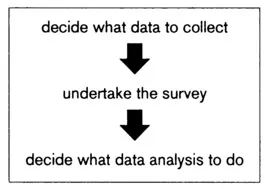
Below is a flow chart which shows a poor but all too common approach to undertaking a sample survey.
Problems with this typical approach
No initial thought is given to the aims of the survey. As a result, the information/data may not be appropriate (eg wrong data collected, or data collected on wrong subjects, or not enough data collected). Consequently, you may not be able to do the data analysis you would like.

Suppose we simply went ahead and only recorded the number of times each book in the sample was borrowed during the year. After conducting the survey we might wonder whether or not there are any differences in the loan rates between various degree courses. If we had not thought about recording the courses that the students borrowing the books were on (assuming of course this is available), we could not do this analysis.
A better approach
The flow chart below shows how it perhaps should be done.
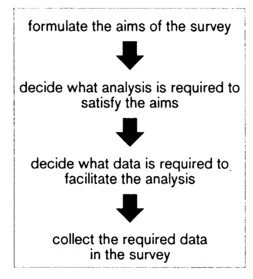
The key point is the order in which things should come. You should formulate the aims of your survey and decide what data analysis is needed right at the beginning.


You will see that each of the survey examples has an aim(s). Jot down the aim(s) of your survey, and perhaps make a note of the title and the location(s) of your survey.
If you haven't already thought of how you are going to analyse your data, you should do one of the following:
- Give the data analysis some thought and come back to this part later,
- Leave the decision over which data to collect until you have worked through this part, but still give it the thought it requires before you conduct the survey.
4 Sample survey jargon
Before we move on to look at methods of conducting your survey, we need to explain some basic jargon. This will allow us to talk more easily about sample surveys and allow you to thumb through some of the references given in Chapter 11, the Bibliography.
Some basic jargon
Subject (or element)
Either of these words is used to refer to whatever it is you are hoping to obtain information about or from.

Sample
This is the group of subjects from whom you actually intend to collect information, by interviewing, observing or measuring, etc.
Population
The population is the larger collection of all the subjects, from which your sample was drawn, that you wish to apply (statisticians use the word infer) your conclusions to.

For each of the survey examples, have a go at jotting down what you think the subject is. The first two have been done for you. See Appendix 1, page 55, for the solution.
| Survey example | Subject |
| A | Book |
| B | Person |

On your survey plan, state what the subject is for your own sample survey. Leave the population for now, as shortly we will see that this requires further thought.
Target population and study population
There are really two populations that exist within your survey, and understanding how they relate to each other is the key to obtaining a sample which is representative of the population
- The target population is the population from which you would like to obtain a sample and to which you would like to apply your conclusions.
- The study population simply consists of subjects whose characteristics are similar to those of the subjects in the sample. In other words, the sample is always representative of the study population.
A pictorial view of how the sample relates to the target and study populations.
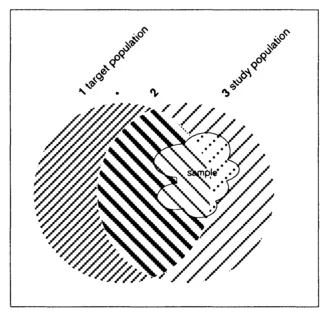
Notice how the sample is inside the s...
Table of contents
- Cover Page
- Title Page
- Copyright Page
- Contents
- A Research methods
- B Planning a sample survey
- C Questionnaire design
- D Research interviews
Trusted by 375,005 students
Access to over 1.5 million titles for a fair monthly price.
Study more efficiently using our study tools.
Frequently asked questions
Yes, you can cancel anytime from the Subscription tab in your account settings on the Perlego website. Your subscription will stay active until the end of your current billing period. Learn how to cancel your subscription
No, books cannot be downloaded as external files, such as PDFs, for use outside of Perlego. However, you can download books within the Perlego app for offline reading on mobile or tablet. Learn how to download books offline
Perlego offers two plans: Essential and Complete
- Essential is ideal for learners and professionals who enjoy exploring a wide range of subjects. Access the Essential Library with 800,000+ trusted titles and best-sellers across business, personal growth, and the humanities. Includes unlimited reading time and Standard Read Aloud voice.
- Complete: Perfect for advanced learners and researchers needing full, unrestricted access. Unlock 1.5M+ books across hundreds of subjects, including academic and specialized titles. The Complete Plan also includes advanced features like Premium Read Aloud and Research Assistant.
We are an online textbook subscription service, where you can get access to an entire online library for less than the price of a single book per month. With over 1.5 million books across 990+ topics, we’ve got you covered! Learn about our mission
Look out for the read-aloud symbol on your next book to see if you can listen to it. The read-aloud tool reads text aloud for you, highlighting the text as it is being read. You can pause it, speed it up and slow it down. Learn more about Read Aloud
Yes! You can use the Perlego app on both iOS and Android devices to read anytime, anywhere — even offline. Perfect for commutes or when you’re on the go.
Please note we cannot support devices running on iOS 13 and Android 7 or earlier. Learn more about using the app
Please note we cannot support devices running on iOS 13 and Android 7 or earlier. Learn more about using the app
Yes, you can access Research Skills for Students by Brian Allison,Anne Hilton,Tim O'Sullivan,Alun Owen,Arthur Rothwell in PDF and/or ePUB format, as well as other popular books in Didattica & Didattica generale. We have over 1.5 million books available in our catalogue for you to explore.