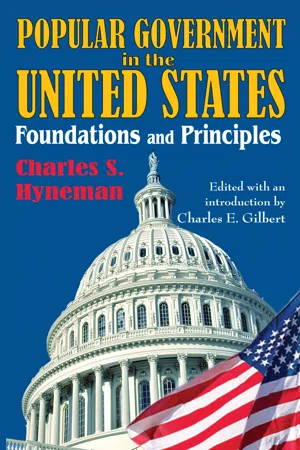
- 345 pages
- English
- ePUB (mobile friendly)
- Available on iOS & Android
eBook - ePub
About this book
Political theory consists in clarification of language and concepts, in description and analysis of institutions and behavior, and in appraisal and evaluation of political events. Hyneman's theory is not one of the behavioral or functional varieties that rely on special language and concepts drawn from other disciplines than political science. It emphasizes a central concern of both conventional and behavioral theory: the distribution of "power," or what proportion of people have influence over what aspects of government. He is also interested in how power is shared, divided, checked, and balanced.The main task of political theory, Hyneman thinks, is clarification of the values served by and sustaining American democracy. This task gives meaning and direction to analysis of the elements of democracy and to empirical research on the processes of democracy. In this sense political science is not "value-free"; it is most useful in pursuit of the implications of basic beliefs and ideals. These beliefs and ideals can be found in historical statements as well as inferred from institutions and behavior.Hyneman's emphasis on popular control, electoral politics, and equality of influence tends to challenge both of the "pluralist" and "ruling elite" schools-though it should be clear that he is not engaged in a scholastic debate. The freedom of his analysis, ranging from specific reference to the professional controversies of his day is one of its strengths and a probable source of originality. He connects it explicitly to the literature of political science at critical points, as it existed when originally published in 1968.
Information
I Democratic Ideals
Charles S. Hyneman
1. Democracy: Goals and Methods
Charles S. Hyneman
Democracy, democratic institutions, and democratic practices refer to a popular base; they presume purpose and effort by a substantial part of the population. This point needs no labored justification; all thoughtful writers and propagandists who use the words democracy and democratic relate them in some way to a general population. But exactly how institutions, practices, and states of mind must relate to the population in order to create a democratic regime is a point of sharp dispute.
In contemporary classifications of political systems, the words democracy and democratic are given one or another or an admixture of three principal meanings:
a. A regime in which those who compose the government (the officialdom) are under some compulsion to find out what the people want done and to do what they understand the people want done. Ordinarily compliance with public expectations is effected by popular selection and replacement of the officials who make the most important public policies and who have supervisory power over all other officials and employees of the government.
b. A regime in which the officialdom conscientiously seeks to satisfy the expectations and preferences of the people, but without an obligation to do so enforced by disciplinary action by the people. In this view, a regime is labeled democratic if it voluntarily gives the governed what they want or will be content with.
c. A regime in which the officialdom does what it believes is good for the people, regardless of whether the people do or do not like what they get. Benevolent despotism is an old name for this kind of government, and this conception of democratic government holds that benevolent despotisms are democratic.
I formulated these three statements to differentiate clearly three significantly different conceptions of democratic character. Actual governments, or political systems, cannot be classified with certainty according to these tests because of the near-impossibility of establishing cause and effect in human relationships. We cannot prove that an elected official made a particular decision because he wanted to be re-elected and believed that this decision was necessary to win votes. We can only infer that the acts of elected officials were made with a view to winning the approval of the electorate, basing the inference on the behavior we observe and the reasons officials give for their actions.
Definitions of democratic character that cannot be fitted with high confidence to actual situations nevertheless can be of great utility. They specify ideals toward which people can strive and they challenge thoughtful people to develop practical tests for determining how closely their political system approaches the ideal.
My concern throughout this study is with the first type of regime—a political system in which the people have effective means for expressing expectations and preferences and for inducing compliance with their demands. At many points my words may suggest that I count a government democratic if the people approve of its acts. On all such occasions the reader must understand that I refer to governmental action that responds to public wishes because of the presence of instruments that induce such response.
This is a good place at which to introduce some cautions about the meanings of words and phrases that will recur again and again. An essay that is broadly descriptive and provides elementary analysis must use words that are general rather than precise in meaning. I twice referred to “the people” in the preceding paragraph. But who are the people? Certainly infants who are still in mothers’ arms are irrelevant to a discussion of popular direction and control of government. The term “the people” will at no point be given a precise meaning in this book; sometimes the reference will be to those persons who make their wishes known, at other times to those persons who participate in political campaigns and elections, at still others to all persons who may be conscious that their interests are affected by government. What words ought one use when he wishes to speak of attitudes and behaviors of the people? On any election day some persons have clear perceptions of interest, have definite preferences, can express firm demands; other persons only vaguely perceive their interests, have expectations that they might abandon under scrutiny, or appear to be totally indifferent to what government does. It would encumber the pages that follow if I were to remind the reader of this variety in states of mind every time I speak of a popular response to acts of government. I must ask the reader to bear in mind that I may speak of popular preferences when I readily acknowledge the presence of expectations that have not been elevated to preference by rejection of alternatives. I shall hereafter say “popular demand,” “the public wishes,” “will of the people”—using these terms interchangeably and in no case intending to specify an exact state of mind. So also I shall speak of popular control of government when I am uncertain as to how many people exert influence and when the influence I refer to is either more than control or less than control. People suggest courses of action that their officials might pursue, they induce their officials to move one way rather than another, they press restraints on officials, and they deal out rewards and punishments. Perhaps at most points in this book when I speak of popular control of government I have in mind more of directionsetting than of coercing, rewarding, and punishing.
There is good reason for addressing my inquiry to the first conception of democratic character presented above—the view that a political system is democratic if public officials are under some compulsion to satisfy the people. Government in the United States, in its conception and development, is government of the people, by the people, and for the people. A study of its origins makes it clear that this political system rests on two main principles: (1) government is to be controlled by and to answer to the people; and (2) government’s power over the people is restricted in scope and restrained in method. The germ, but not a full statement, of these two principles is in the Declaration of Independence. There it is stated that all persons, equally, are made in such a way (so endowed by their Creator) as to require that they shall always enjoy certain conditions of living which the authors of the Declaration called inalienable rights; under any rightful form of government these rights are to be respected. Further, it is the function of government to make these rights or conditions of living secure, and to guarantee that this is the fruit of government, the just powers of any government are derived from the consent of the people. Finally, if any government does not meet these requirements—does not secure the inalienable rights, exercises powers which are not derived from the people and so are not just—it is appropriate and right for the people to terminate it and create a new government thought more likely to conform to the objectives which have been stated.
There is not, in the Declaration of Independence, any direct assertion that a rightful government will be controlled by and readily answerable to the people, or that, in order to enforce a due regard for the inalienable rights, limitations should be imposed upon the authority of government. These assertions, which I have offered as the two foundation principles of our political system, were to be announced shortly thereafter. The state constitutions that were formulated and declared effective during the decade of the Revolutionary War made clear the commitment of the American people to the two principles I have noted. Some of them made formal announcements that government rests upon the will of the people; all of them provided for an elective lawmaking body; and several of them contained elaborate statements of personal rights or claims to immunity from political control.
Scarcely more than a decade after independence from Great Britain was achieved the federal structure was invented and promulgated. The new Constitution, effective in 1789, placed in the national government important governing powers. With very few exceptions (notably diplomatic relations and treaty making) it declared these powers to be vested in Congress. Congress was to be an instrument of popular government. The House of Representatives was to be chosen directly by the people, and the Senators were to be chosen by state legislatures which were, at least partially, chosen by popular vote. Furthermore, the Constitution required the national government to see to it that every state maintain a republican form of government. That requirement, I think there can be no question, was intended to mean that every state government must answer to the people.
The Constitution also charged the new national government to have a proper regard for personal claims to freedom, but on this one of the two fundamental principles it was less than adequate in the view of many persons who displayed an active interest in constitution making. The Constitution specifically forbade the new Congress to pass any bills of attainder or ex post facto laws, and limited its power to curtail the rights that English citizens had long been able to enforce by the writ of habeas corpus. But the new national Constitution did not contain a statement of immunities from governmental power comparable in scope to those found in some of the state constitutions. The demands of those who thought an elaborate bill of rights to be necessary were largely satisfied by the adoption of the first ten amendments to the Constitution during the first three years of its operation.
The record of the adoption of the constitutional amendments that gave us a Bill of Rights is most instructive. It reveals sharp differences of opinion as to whether any guarantees against excess of power on the part of the national government were needed, and if needed what they ought to be. A study of what was said in the House of Representatives when the amendments were proposed—we have no record of what was said in the Senate—strongly supports a conclusion that most of the congressmen believed that the great battle for security of inalienable rights had been won when the principle of popular control of government was made effective. A view strongly pushed forward in Congress, and I think probably the view of most members of the House, was this: When a government is truly answerable to the people, declarations of personal immunity from acts of government are definitely of marginal value. If James Madison, who managed the campaign for adoption of the amendments, thought they were of more than marginal value, he did a poor job of saying so. *
The natural result of my historical report, up to this point, must be a conclusion that the American political system is dominated by a single principle: popular control of government; that if this principle is effectively secured, all the benefits envisaged by constitutional safeguards of personal freedom are also secured. If I based my judgment only on what was said in Congress during the first decades under the Constitution, I would reach that conclusion. Those men were talking only about the need or lack of need for guarantees against abuse of power by the national government. They did not discuss the need for safeguards against abuse of power by government where it had the greatest opportunity to encroach on the inalienable rights of individuals—the state governments. When one looks to experience in creating state governments he has to conclude, I think, that the idea of limited government, of safeguards of personal freedom, was companion to and not wholly subordinate to the idea of popular control of government.
The two fundamental principles that underlay the creation of this political system have continued to control its character. American political leaders and writers about American politics have consistently maintained that this is a government by the people, and a government committed to the security of individual rights. When crises press upon us, they are discussed in terms of “fundamental principles” such as division of authority (separation of powers, federal arrangement, local self-government) and rule of law (e.g., respect for the Constitution and independence of the judiciary). Support for these principles is marshalled in the name of the yet more fundamental principles of government by the people and individual liberty.
In this American experience, I contend, lies sufficient justification for the special view of democratic character that fixes the content and emphasis of this book. A book written by an American principally for an American audience may appropriately assume that government which perforce responds to popular demands and is sensitive to individual rights is democratic government, and that particular policies and practices that significantly contradict the principles of popular control and individual rights are departures from the democratic way in government and politics. No heed will be taken, hereafter, of contentions that the word democracy also applies to despotisms that, because of the generosity or superior wisdom of the rulers, voluntarily give the people what they want or forcibly impose upon the population what the rulers know to be good for them.
A reader who vigorously applauds the position just asserted may, however, have little or no sympathy with another bias pervading the pages that follow. This is the priority that I place on popular sovereignty, or the people’s ability to control their government. I find myself firmly attached to the view that I believe to have been persuasive with the architects of our political system. If I read them correctly, those men were predominantly of a mind that their first great task was to create a government that would have to respond to the wishes of the people. They believed that the accomplishment of this task was the first indispensable step toward the achievement of their other primary goal—a government that would heed individual claims to liberty, make an honest effort to resolve conflict among competing demands for exercise or quiescence of governmental power, and pursue a course of action that would enable men to live in dignity as individuals and in fruitful connections as a society.
Because of this conviction about priorities in political architecture, I will treat the ability of the people to control their government as the prime distinguishing characteristic of democratic government throughout this book. Proof that a government is controlled by the people is established by evidence that those who possess the authority of government are obliged to exercise that authority within limits acceptable to the people, or, failing to do so, are obliged to give up their authority. Later in this essay, the general perspective of democratic government as government by the people will be modified by observations about the securing of personal liberties in circumstances where a popularly controlled government may threaten to impair or deny them.
The ideal in democratic government is obligatory response to the wishes of the people. Popular government, popular control of government, government by the people are short terms for instrumentalities and practices designed to achieve this goal. We can estimate the closeness of approach to the ideal by finding answers for these three questions: (a) how much of the population shares, (b) in how much of the critical decision making, (c) with how much impact or influence? If practically everybody in this country were heard and his wishes heeded in the making of every important governmental decision, we would have a government as democratic as anyone could hope for. If, at the opposite extreme, one man made all decisions of importance, paying attention to nobody’s wishes but his own, we would have the ultimate in nondemocratic government.
Looking at it this way, it is hardly proper to say that a nation’s government is democratic or not democratic. Rather, one ought to say something like this: Country A has enough of the democratic quality in its government to suit me; but country X has so little of that same quality in its government that I shall not call it democratic. Perhaps this is just what we do in common speech. We conclude that Great Britain and the Scandinavian countries have provided a fair amount of popular control over their governments so we call them democracies. We conclude that Russia, China, and Yugoslavia have too little popular control so we say that those countries do not have democratic governments. There are even times when a thoughtful American citizen can say with good reason: there is too much response to popular demand in this area of public policy and I would be happier if we had a little less democracy in these matters right here in the United States.
The three questions that I proposed for estimating an approach to the democratic ideal direct attention to three main points of inquiry that must be pursued if one wishes to describe a political system in terms of its democratic character or evaluate a nation’s effort to manage its public affairs in a democratic manner. Specific tests could be formulated that would enable one to measure popular participation and so make it possible to place political systems on a set of scales showing how much of the population shares in how much of the critical decision making with how much impact on the outcome of decision making. But the formulation of tests and the process of measuring would be heavily beset by difficulties. It may be relatively easy to determine how many people take part in formal actions such as voting. But how is one to estimate the number of people who affect the conduct of government by inducing other persons to vote differently than they otherwise would have done? Can one hope to identify the persons who make their voices heard in appeals and pressures directed to public officials? Or can one hope to find out how much of the population makes an impact on the conduct of public policy by cooperating with public officials, clandestinely violating the law, or boldly marching in protest against a public policy and its enforcement?
The difficulties one would encounter in determining how many people share in control of government are small compared with those that would beset an effort to determine how much influence is exerted by those who seek to intervene in decisions. The number of persons who testify in a congressional hearing can be counted, but one cannot know how much weight the congressmen attach to their recommendations, or even whether the congressmen listen to them at all. One can fix the exact number of persons who march in the streets or lie down in the doorways of public buildings, but he cannot know how profoundly these demonstrations disturb the minds of officials who formulate the public policies.
Finally, we ought to recognize the unlikelihood of easy agreement in scaling the importance of decisions. The choice of a President will be a critical decision for you if you think only one candidate promises vigorous and enlightened leadership, but it may come to the tossing of a coin for me if I can see no significant difference between the candidates. Into which decisions may the common man intrude with reasonable expectation that the advice he offers will advance his personal interest? If widespread public demand is ignored in making tactical decisions in foreign relations, ought one enter this on the minus side of a democratic/non-democratic scale? If farsighted statesmen yield to shortsighted public demands, ought we mark up a victory for the democratic ideal? How one looks at these questions and many others of comparable perplexity will depend in good part on his view of the whole social environment in which government functions. If I believe the society is sufficiently pluralistic, I may think that unwisdom in government is corrected by countervailing forces that collectively advance the objectives of the population at large. In that case I shall attach small consequence to many governmental decisions that will be thought critical indeed by another man who thinks the society is monolithic in structure and that his only hope of protecting his own interests is to mobilize pressure on government immediately.
This brief catalog of obst...
Table of contents
- Cover Page
- Title Page
- Copyroght
- Dedication Page
- Preface
- Introduction
- Part I Democratic Ideals
- 1 Democracy: Goals and Methods
- 2 The Democratic Society
- Part II Popular Government
- 3 Two Systems of Demand and Response
- 4 The Citizen’s Role
- 5 The Right to Vote
- 6 The Citizen’s Education
- 7 Political Activity and Electoral Behavior
- Part III The Structure of Authority
- 8 The Elective Principle
- 9 The legislature and the Executive
- 10 Control of Administration
- Part IV Limited Government
- 11 Government by Law
- 12 Constitutional Guarantees
- 13 Free Speech and Subversion: An Historical Episode
- 14 Free Speech and Subversion: A Contemporary Solution
- Part V Democracy on Trial
- 15 The Negroes’ Challenge
- 16 Organized Protest and Resistance
- 17 Conclusion: On the Preservation of Democratic Foundations
- Other Writings of Charles S. Hyneman
- For Further Reading
- Index
Trusted by 375,005 students
Access to over 1.5 million titles for a fair monthly price.
Study more efficiently using our study tools.
Frequently asked questions
Yes, you can cancel anytime from the Subscription tab in your account settings on the Perlego website. Your subscription will stay active until the end of your current billing period. Learn how to cancel your subscription
No, books cannot be downloaded as external files, such as PDFs, for use outside of Perlego. However, you can download books within the Perlego app for offline reading on mobile or tablet. Learn how to download books offline
Perlego offers two plans: Essential and Complete
- Essential is ideal for learners and professionals who enjoy exploring a wide range of subjects. Access the Essential Library with 800,000+ trusted titles and best-sellers across business, personal growth, and the humanities. Includes unlimited reading time and Standard Read Aloud voice.
- Complete: Perfect for advanced learners and researchers needing full, unrestricted access. Unlock 1.5M+ books across hundreds of subjects, including academic and specialized titles. The Complete Plan also includes advanced features like Premium Read Aloud and Research Assistant.
We are an online textbook subscription service, where you can get access to an entire online library for less than the price of a single book per month. With over 1.5 million books across 990+ topics, we’ve got you covered! Learn about our mission
Look out for the read-aloud symbol on your next book to see if you can listen to it. The read-aloud tool reads text aloud for you, highlighting the text as it is being read. You can pause it, speed it up and slow it down. Learn more about Read Aloud
Yes! You can use the Perlego app on both iOS and Android devices to read anytime, anywhere — even offline. Perfect for commutes or when you’re on the go.
Please note we cannot support devices running on iOS 13 and Android 7 or earlier. Learn more about using the app
Please note we cannot support devices running on iOS 13 and Android 7 or earlier. Learn more about using the app
Yes, you can access Popular Government in the United States by Charles Hyneman in PDF and/or ePUB format, as well as other popular books in Politics & International Relations & American Government. We have over 1.5 million books available in our catalogue for you to explore.