- 330 pages
- English
- ePUB (mobile friendly)
- Available on iOS & Android
eBook - ePub
About this book
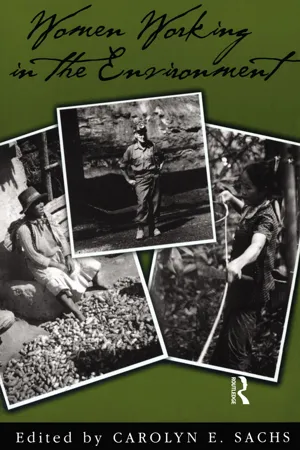
Based on theoretical insights from ecofeminism, women and development, and postmodernism, and the convincing empirical work of numerous scholars, this book is organized around five aspects of gender relationships with the environment: Part I-gender divisions of labor, Part 2-property rights, Part 3-knowledge and strategies for sustainability, Part 4-environmental and social movements, and Part 5- policy alternatives. Examining women's relationship with the environment using these five dimensions provides concrete, material examples of how women work with, control, know, and affect the environment and natural resources.
Trusted by 375,005 students
Access to over 1.5 million titles for a fair monthly price.
Study more efficiently using our study tools.
Information
Subtopic
Environment & Energy PolicyIndex
Social SciencesChapter 1
Introduction:
Connecting Women and the Environment
CAROLYN E. SACHS
Increasing global and local concern with environmental degradation has focused attention on people’s relationships with the environment. Ozone depletion, deforestation, decline in water availability and quality, land degradation, and pollution are among the environmental problems that affect and involve many people on the planet. Whereas many of the initial efforts to resolve environmental problems focused on technical and biological solutions, scholars and activists are increasingly looking to social causes and solutions for environmental problems. Feminist scholars have focused on whether women and men have different relationships with the environment and are concerned about the implications of these differences. Understanding the gendered nature of human relationships with the environment seems particularly critical for resolving environmental problems.
Theoretical discussions on women and the environment revolve around three major questions: (1) What are women’s relationships with nature? (2) What are the connections between the domination of women and the domination of nature? and (3) What role do women play in solving ecological problems? Ecofeminists initially raised many of these questions in the late 1970s and early 1980s and set the stage for the ensuing debates concerning women and the environment. Versions of these questions on the relationship between women and the environment have been addressed by several major threads in feminist theory, which will be discussed in this introduction: ecofeminism, women and development, and postmodern feminism. Then, this chapter introduces a framework for understanding women’s connections to the environment. This framework guides the organization of the book through considering gender divisions of labor, access and control over resources, knowledge and strategies for survival, participation in social movements, and policy concerns.
Ecofeminism
Ecofeminists and their critics are grappling with questions regarding women’s relationships with nature: How do these differ from men’s relationships to nature? To what extent are women more likely to be concerned and capable than men of solving environmental problems? and How can we end the domination of women and the environment? Feminist attempts to understand women’s connection to nature begin with critiques of Western science and philosophy’s assumptions concerning women’s relationships with nature. Western philosophy associates women with nature, based on dualistic epistemologies that juxtapose culture/nature, male/female, reason/emotion, and mind/body. Women are associated with nature, emotion, and body whereas men are associated with culture, reason, and mind. Symbolic and ideological constructions of women as “closer to nature” than men set the stage for the domination of women and nature. Within this framework, men are positioned outside and above nature and women (Keller, 1985). The early promoters of science, led by the writings of Francis Bacon, used these symbolic and metaphoric constructions of women and nature as legitimation for men’s control of nature and women’s bodies. As Griffin (1989) points out, women become symbols of nature and are thereby transformed into objects of degradation. Ecofeminists challenge these hierarchical dualisms of nature/culture, male/female, and emotion/reason. Rather than rejecting women’s association with nature, ecofeminists suggest this connection can be used as a vantage point for transforming the nature/culture distinc-tion, revising the conceptualization of nature, and resolving environmental problems (King, 1989).
Ecofeminism refers to a plurality of positions relating to the connections between women and nature. Two of the major tenets of ecofeminism hold that the domination of women and the domination of nature are intimately connected and that women are particularly suited to lead ecological movements to save the planet. Merchant (1992) distinguishes between liberal, cultural, social, and socialist ecofeminism. Each of these versions of ecofeminism are concerned with improving the relationship between humans and nature, but their approaches and strategies for change differ. Liberal ecofeminists attempt to work within existing structures of government by changing laws and regulations related to women and the environment and providing equity for women in the workplace. Cultural ecofeminists critique patriarchy and emphasize the symbolic and biological connections between women and nature. From their perspective, women’s bodies are closer to nature than men’s bodies due to menstruation, childbirth, and pregnancy. According to cultural ecofeminists, these biological processes are the source of women’s power and ecological activism. Social and socialist ecofeminists analyze the ways in which both patriarchy and capitalism contribute to men’s domination of women and nature. Both of these perspectives explore and analyze social justice issues. Central to much of ecofeminism is the belief that women share an environmental “ethic of care” based on their biology, labor, or social position.
Ecofeminism has been subject to often well-deserved critiques from feminists and others for upholding an essentialist claim that women’s nature is to nurture. Major criticism has been directed to ecofeminist assumptions that, due to their biology, women are closer to nature than men and are therefore privileged to think ecologically and positioned to be better caretakers of the earth. For many decades, feminists have battled “biology is destiny” arguments. The assumption that women are biologically inferior to men has often been used as a justification for the subordination of women. Ecofeminist attempts to change this relationship by emphasizing positive aspects of women’s biological connection to nature seem particularly dangerous to other feminists.
In light of these essentialist critiques, many ecofeminists have rethought and revised their earlier positions. Biehl (1991), who was once an advocate of social ecofeminism, rejects ecofeminism altogether and bitterly accuses other ecofeminists of carrying the women-nature metaphor too far by rejecting rationalism and worshipping goddesses. Merchant (1996) suggests that the cultural baggage attached to gendering nature is quite problematic for social movements in the West and calls for a “partnership ethic” between humans and nature that does not endow women with a special knowledge of nature or ability to care for nature. In contrast to other ecofeminists, Shiva (1994) does not back down to the essentialist charge. Rather, she suggests that the charge itself is based on the critics’ inability to transcend reductionist, dualistic epistemologies. Shiva replies that critics who suggest that she is essentializing women see difference as so “essential” that solidarity and commonality between women or between women and men seem impossible. Shiva insists that women acting together in ecological movements is not essentializing; there is not a divide between the environment and our bodies. Shiva’s work also led the way in considering Third World women’s connections to the environment.
Women, Environment, and Development
This approach to women and the environment emerges from scholars and practitioners working in the field of women and development. Beginning with the path-breaking work of Boserup (1970), many scholars working on women and development issues have critiqued the impact of Western development on Third World women’s lives. Western development efforts have increased women’s workload, decreased women’s access to resources, and contributed to the feminization of poverty. As a response to problematic development projects, current efforts by women and development activists focus on creating alternative grassroots strategies and/or transforming government policies to empower women (Leonard, 1989, 1995; Moser, 1993). With the recent international attention on global environmental problems, feminists quickly recognized Western development practices as simultaneously detrimental to women and the environment. As van den Hombergh (1993) explains, “Environmental degradation on the one hand, and the feminization of poverty on the other are caused by or reinforced by male-biased development, based on a model of exploitation of resources mainly for the prosperity of Northern countries and Southern elites” (p. 20).
Shiva’s (1989) work, Staying Alive: Women, Ecology and Development, forcefully connected the impact of development on women and the environment. Focusing on Indian women, she argues that ecological destruction and the marginalization of women have been the results of Western science and Western economic development paradigms. Rather than focus on women as passive victims of development, Shiva emphasizes that women’s struggles for survival lead the way in illustrating ways to resist ecological destruction. She argues that Indian women have been at the forefront of struggles to preserve land, water, and forests (Shiva, 1993). “Because of their location on the fringes, and their role in producing sustenance, women from Third World societies are often able to offer ecological insights that are deeper and richer than the technocratic recipes of international experts or the responses of men in their own societies” (Shiva, 1994, p. 1). Third World women’s “deeper” insights come from their participation in cultures that value the maintenance of life; in addition, the gender division of labor in these countries has forced women to provide subsistence for their families, while men seek profit-earning strategies. Thus, women’s involvement in the environmental movement starts with the daily work and activities in their lives and the threats to the health of their families.
Also using Indian women’s lives as the starting point for understanding the connection between women and the environment, Agarwal (1992) insists that men’s and women’s connections with the environment require a critique grounded in the concrete realities of their daily lives. However, from her perspective, ecofeminism fails to move beyond the symbolic and ideological associations of women and nature and falls into the trap of essentializing women. According to Agarwal, by remaining at the symbolic level, ecofeminists fail to account for differences between women by class, race, ethnicity, and national identity. Men’s and women’s relations with the environment must be understood in connection with the material reality of the division of labor, property, and power. Thus, Agarwal proposes a theoretical position she refers to as “feminist environmentalism” as an alternative to ecofeminism. Feminist environmentalism challenges notions about gender and the division of labor and resources between men and women, while also changing and transforming the appropriation of natural resources by the privileged. Agarwal’s insistence on concretizing and materially locating women’s relationships with the environment fuels arguments for closer studies of gendered relationships with the environment.
Recently, several scholars have critiqued the “women, environment, and development” perspective for narrowly focusing on women (Bradiotti et al., 1994; Leach, Joekes, and Green, 1995). Instead, they emphasize gender relations with the environment. From their perspective, grouping women together as a unitary category misrepresents women, makes men invisible, and clouds our understanding of human relationships with the environment (Leach, Joekes, and Green, 1995). These authors also critique dominant approaches that define women and nature as universally connected. Their critiques of ecofeminism and “women, environment, and development” approaches as universalizing and their subsequent calls for local and specific studies coincide with the move to postmodern approaches.
Postmodern Shift
Postmodernism represents another major theoretical shift that provides insights into understanding women’s relationship with the environment. Postmodern theorists offer several useful insights for understanding women’s relation with the environment, including the rejection of universalist claims, the focus on identity and difference, and the emphasis on local and subjugated knowledges.
The rejection of the search for universal truth and the profound questioning of the superiority of Western science and modernization lie at the heart of postmodernism. This rejection of universalism and critique of metanarratives open spaces for fresh understandings of human relationships with the environment. The postmodern focus on language and discourse provides tools for deconstructing processes, narratives, and con-cepts such as “women,” “nature,” “environment,” and “development.” Looking at these concepts through a lens that requires examination of how these terms are used to enhance the power of the privileged, one is able to critically evaluate assumptions concerning the connections between women, environment, and development. For example, Escobar (1995), Sachs (1993), and others have shown how “development” has become a powerful semantic term at the center of modern thought and behavior (Esteva, 1993). Development has served as the major guiding principle for the “mixture of generosity, bribery and oppression which has characterized the policies toward the South” (Sachs, 1993, p. 1). The concept of development simultaneously constructs “first world” countries at the height of an evolutionary scale of societies while portraying Third World countries as mired in poverty, hunger, overpopulation, environmental degradation, oppression of women, and traditional ways. This universal narrative of development is so pervasive that alternative scenarios for the Third World are difficult to envision.
The postmodern critique of modernist, universal metanarratives suggests a shift toward difference and identity politics. Within feminism, the shift from a unitary conception of women to an awareness of differences between women has given voice to African American women, Latinas, lesbians, and Third World women. Many of these women critiqued Western feminists for using the category “women” to represent all women, when in fact the “women” usually represented were white, upper middle class, heterosexual, and Northern. In understanding women’s connections with the environment, this emphasis on difference establishes a theoretical framework in which women’s relationships with the environment will differ by their class, racial, ethnic, sexual, and national identities. Rather than searching for the essential connections between “women” and “nature,” a more useful approach is to turn toward the concrete situations of women.
Said’s (1978) influential work on orientalism shows how colonial and postcolonial discourses have defined Third World people as the “other” in a move to perpetuate colonialist privilege while emphasizing the exotic and negative qualities of the “other.” As early as deBeauvoir, feminists have battled male attempts to define women as “other.” However, postmodern feminists such as Mohanty (1991) argue that feminists themselves have constructed Third World women as the “other.” Mohanty indicts Western feminists for portraying Third World women as homogeneously poor, illiterate, overburdened, and victimized in contrast to the “liberated” Western woman. In fact, much of the discourse on women and the environment in the Third World has emphasized women as either victims of environmental degradation or uneducated exploiters of natural resources. In this way, Western women and development planners position themselves as experts to help solve the problems of Third World women and blindly proceed as if Third World women and men lack skills and strategies for resolving their problems.
By contrast, postmodernism’s em...
Table of contents
- Cover
- Half Title
- Title Page
- Copyright Page
- Table of Contents
- Contributors
- Chapter 1 Introduction: Connecting Women and the Environment
- Part One Gender Divisions of Labor in Agriculture, Mining, and Fishing Communities
- Part Two Property Rights: Access to Land and Water
- Part Three Women’s Knowledge, Work, and Strategies for Sustainability
- Part Four The Gendering of Environmental and Social Movements
- Part Five Policy Alternatives
- Index
Frequently asked questions
Yes, you can cancel anytime from the Subscription tab in your account settings on the Perlego website. Your subscription will stay active until the end of your current billing period. Learn how to cancel your subscription
No, books cannot be downloaded as external files, such as PDFs, for use outside of Perlego. However, you can download books within the Perlego app for offline reading on mobile or tablet. Learn how to download books offline
Perlego offers two plans: Essential and Complete
- Essential is ideal for learners and professionals who enjoy exploring a wide range of subjects. Access the Essential Library with 800,000+ trusted titles and best-sellers across business, personal growth, and the humanities. Includes unlimited reading time and Standard Read Aloud voice.
- Complete: Perfect for advanced learners and researchers needing full, unrestricted access. Unlock 1.5M+ books across hundreds of subjects, including academic and specialized titles. The Complete Plan also includes advanced features like Premium Read Aloud and Research Assistant.
We are an online textbook subscription service, where you can get access to an entire online library for less than the price of a single book per month. With over 1.5 million books across 990+ topics, we’ve got you covered! Learn about our mission
Look out for the read-aloud symbol on your next book to see if you can listen to it. The read-aloud tool reads text aloud for you, highlighting the text as it is being read. You can pause it, speed it up and slow it down. Learn more about Read Aloud
Yes! You can use the Perlego app on both iOS and Android devices to read anytime, anywhere — even offline. Perfect for commutes or when you’re on the go.
Please note we cannot support devices running on iOS 13 and Android 7 or earlier. Learn more about using the app
Please note we cannot support devices running on iOS 13 and Android 7 or earlier. Learn more about using the app
Yes, you can access Women Working In The Environment by Carolyn E. Sachs in PDF and/or ePUB format, as well as other popular books in Social Sciences & Environment & Energy Policy. We have over 1.5 million books available in our catalogue for you to explore.