eBook - ePub
Implementation of Prevention Programs
A Special Issue of the journal of Educational and Psychological Consultation
- 176 pages
- English
- ePUB (mobile friendly)
- Available on iOS & Android
eBook - ePub
Implementation of Prevention Programs
A Special Issue of the journal of Educational and Psychological Consultation
About this book
This is Volume 11, Issue 1 2000 of 'Journal of Educational and Psychological Consultation' and this special issue journal looks at the implementation of prevention programs. This special issue represents several years of joint efforts between the Collaborative to Advance Social and Emotional Learning (CASEL) and the Society for Community Research and Action (SCRA) of the American Psychological Association. It includes articles on: supporting prevention as an integral aspect of school improvement; discussion of a theory of change approach; issues related to program diffusion that those working in rural communities face; problems that may be associated with full-service schools and integrated service delivery systems; ideas that can guide consultants in implementing programs in partnership with other stakeholders. and concludes with an article of implementing, and evaluating prevention programs.
Information
Topic
EducationSubtopic
Education GeneralMoving Prevention From the Fringes Into the Fabric of School Improvement
If prevention initiatives are to get beyond their current marginalized and fragmented status, they must be framed in a comprehensive context. This article places primary prevention at one end of a comprehensive continuum of interventions and explores the continuum in terms of a component for addressing barriers to development and learning. Such a component is conceptualized as primary and essential to successful school reform. Current concerns and emerging trends related to policy, research, practice, and training are highlighted, and general implications for systemic changes are suggested.
The term prevention conjures up a variety of reactions. Few would argue against the desirability of preventing educational and psychological problems. However, some leaders in the field have lamented that prevention initiatives are still too oriented to risk reduction, which often works against efforts to promote wellness as an invaluable mental health end in and of itself (e.g., Cowen, 1997). In schools, the orientation to reducing risk has led to an overemphasis on observed problems and on treating them as discrete entities. This contributes to de-emphasizing common underlying causes and their treatment. Such a state of affairs is both a result and an ongoing factor in perpetuating widespread fragmentation of prevention initiatives at all levels. A vicious cycle of unsatisfactory policy and practice has emerged. And, the cycle is likely to continue as long as policy priorities for prevention are so low that the enterprise remains a marginalized aspect of systemic reforms. These concerns are of major relevance to anyone interested in preventing problems on a large scale.
If prevention initiatives are to get beyond their current marginalized and fragmented status, they must be framed in a comprehensive context. With this in mind, we begin with a presentation that places primary prevention at one end of a comprehensive continuum of interventions. Then, the continuum is explored in terms of a component for addressing barriers to development and learning that is viewed as primary and essential to successful school reform. Throughout the article, implications are discussed with respect to policy, research, practice, and training.
Framing Prevention as One End of a Comprehensive, Multifaceted Continuum of Intervention
Prevention initiatives have many facets. At a school, approaches may be school wide with the intent of having an impact on all students; they may be limited to a classroom; they may target a specific group and a specific problem. Various strategies may be used to promote healthy development or address factors that interfere with positive functioning. Table 1 outlines some key categories that can aid in differentiating among school-oriented prevention efforts. As outlined, the term prevention encompasses discrete strategies and broad, multifaceted approaches.
Table 1
Outline Aid for Analyzing Key Facets of School-Oriented Prevention Efforts
Outline Aid for Analyzing Key Facets of School-Oriented Prevention Efforts
I. | Form of initiative. | ||
A. | Policy (federal, state, local). | ||
B. | Practice. | ||
C. | Capacity building. | ||
D. | Systemic change. | ||
II. | Context for practice. | ||
A. | Community wide. | ||
B. | School wide. | ||
C. | In classroom as part of regular program. | ||
D. | An “add-on” program in or outside the regular class. | ||
E. | Part of “clinical” services. | ||
III. | Stage of prevention. | ||
A. | Primary. | ||
B. | Secondary. | ||
C. | Tertiary. | ||
IV. | Focus. | ||
A. | Focal point of intervention. | ||
1. | Environment(s). | ||
2. | Person(s). | ||
3. | Both. | ||
B. | Intended range of impact. | ||
1. | A broad-band intervention. | ||
2. | For one or more specific targets. | ||
C. | Breadth of approach. | ||
1. | Directed at a categorical problem. | ||
2. | Multifaceted. | ||
D. | General area of concern. | ||
1. | Addressing barriers to development, learning, and positive functioning. | ||
2. | Promoting healthy development. | ||
E. | Domain. | ||
1. | Knowledge. | ||
2. | Skills. | ||
3. | Attitudes. | ||
F. | Strategy. | ||
1. | Instruction.a | ||
2. | Behavior modification. | ||
3. | Enhancing expectations and opportunities for positive behavior. | ||
4. | Counseling/therapy. | ||
5. | Physical health programs and services. | ||
6. | Social support. | ||
7. | Social services. | ||
8. | Student to student support and socialization. | ||
9. | School-home-community partnerships. | ||
10. | Enhancing security and policing measures. | ||
11. | Multiple strategies. | ||
12. | Comprehensive, school-wide approaches. | ||
V. | Level of schooling/student development. | ||
A. | Elementary/middle/high school. | ||
B. | Specific grade, age, or stage of development. | ||
VI. | Degree of integration with other interventions. | ||
A. | Isolated. | ||
B. | Coordinated with others. | ||
C. | Systematically integrated. | ||
VII. | Stage of intervention development. | ||
A. | Formative. | ||
B. | Fully developed, but unevaluated. | ||
C. | Empirically supported. | ||
VIII. | Scope of implementation. | ||
A. | Limited project. | ||
1. | At one site. | ||
2. | At several sites. | ||
B. | Systemic change initiative. | ||
1. | Still at pilot demonstration stage. | ||
2. | Being phased in—at a few sites. | ||
3. | Being phased in—at many sites. | ||
4. | All sites involved. | ||
IX. | Approach to evaluation. | ||
A. | Focused only on accountability demands. | ||
B. | Formative program evaluation. | ||
C. | Summative program evaluation. | ||
1. | Of efficacy. | ||
2. | Of effectiveness when replicated under natural conditions. | ||
3. | Cost-effectiveness analyses. | ||
D. | Designed as evaluation research. | ||
Note. When the emphasis is on curriculum to prevent psychosocial problems (violence, substance abuse, delinquency, pregnancy, eating disorders, learning problems, etc.) and/or promote healthy socioemotional development and effective functioning, the content focus may be on
• Assets-building (including strengthening academics, developing protective factors, expanding areas of competence and self-discipline).
• Socioemotional development (e.g., understanding self and others, enhancing positive feelings toward self and others, cognitive and interpersonal problemsolving, social skills, emotional “intelligence”).
• Building character (e.g., values).
• Physical development (e.g., diet/nutrition, sports/recreation).
• Fostering abilities (e.g., one or more of the multiple “intelligences,” enrichment).
• Fostering hope (e.g., positive expectations for the future; perceptions of self-determination).
• Resistance education.
• Stress reduction.
• Symptom reduction.
aContent focus of curricular approaches.
Policy-oriented discussions increasingly recognize the importance of multifaceted approaches to account for social, economic, political, and cultural factors that can interfere with or promote development, learning, and teaching (Center for Mental Health in Schools, 1996, 1997; Dryfoos, 1998; Schorr, 1997). For purposes of analyzing the state of the art and making recommendations, major policies and practices for addressing such factors can be grouped into five areas. The areas are:
1. Measures to abate inequities or restricted opportunities.
2. Primary prevention and early age interventions.
3. Identification and amelioration of learning, behavior, emotional, and health problems as early as is feasible.
4. Ongoing amelioration of mild to moderate learning, behavior, emotional, and health problems.
5. Ongoing treatment of and support for chronic or severe or pervasive problems.
As illustrated in Figure 1, the range of interventions can be further appreciated by viewing them on a continuum ranging from primary prevention (including a focus on wellness or competence enhancement), through approaches for treating problems early-after-onset, and extending on to narrowly focused treatments for severe or chronic problems.1 Such a continuum provides a template for assessing the degree to which the package of community and school programs serving local geographic or catchment areas is comprehensive, multifaceted, and integrated. It encompasses the concepts of primary, secondary, and tertiary prevention. It is intended to incorporate a holistic and developmental emphasis that envelops individuals, families, and the contexts in which they live, work, and play. The examples offered in Figure 1 reflect a basic assumption that many problems are not discrete, and therefore, interventions that address root causes can minimize the trend to develop separate programs for every observed problem. Another assumption is that the least restrictive and nonintrusive forms of intervention required to appropriately address problems and accommodate diversity should be used.
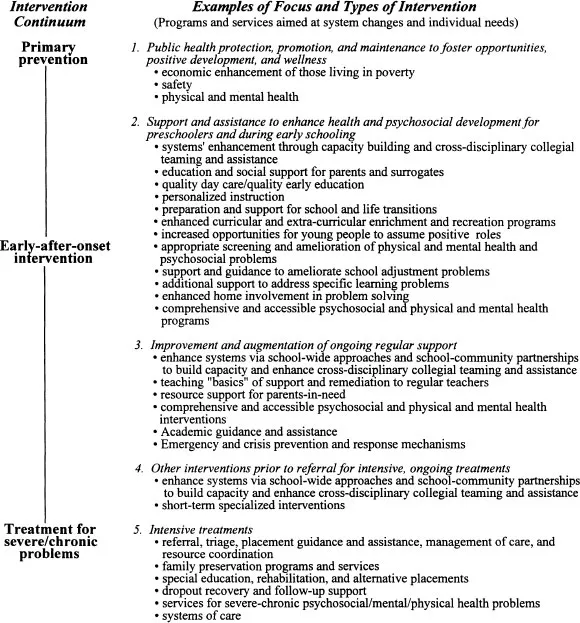
Figure 1 From primary prevention to treatment of serious problems: A continuum of community-school programs. From Learning problems and learning disabilites: Moving forward (p. 279) by H. S. Adelman & L. Taylor, 1993, Pacific Grove, CA: Brooks/Cole. Copyright 1993 by Wadsworth Publishing, a division of Thomson Learning. Fax: (800)730–2215. Adapted with permission.
The range of programs cited in Figure 1 are seen as integrally related, and it seems likely that the impact of each can be exponentially increased through coordination and integration. Such connections may involve horizontal and vertical restructuring of programs and services (a) within jurisdictions, school districts, and community agencies (e.g., among departments, divisions, units) and (b) between jurisdictions, school and community agencies, public and private sectors, among clusters of schools, and among community agencies. Ultimately, such a continuum should be developed into systems of prevention, systems of early intervention, and sys...
Table of contents
- Cover
- Table of Contents
- Increasing Implementation Success in Prevention Programs
- The Role of the Collaborative to Advance Social and Emotional Learning (CASEL) in Supporting the Implementation of Quality School-Based Prevention Programs
- Moving Prevention From the Fringes Into the Fabric of School Improvement
- Implementation and Diffusion of the Rainbows Program in Rural Communities: Implications for School-Based Prevention Programming
- Building Full-Service Schools: Lessons Learned in the Development of Interagency Collaboratives
- You Can Get There From Here: Using a Theory of Change Approach to Plan Urban Education Reform
- Partnerships for Implementing School and Community Prevention Programs
- Building an Intervention: A Theoretical and Practical Infrastructure for Planning, Implementing, and Evaluating a Metropolitan-Wide School-To-Career Initiative
Trusted by 375,005 students
Access to over 1.5 million titles for a fair monthly price.
Study more efficiently using our study tools.
Frequently asked questions
Yes, you can cancel anytime from the Subscription tab in your account settings on the Perlego website. Your subscription will stay active until the end of your current billing period. Learn how to cancel your subscription
No, books cannot be downloaded as external files, such as PDFs, for use outside of Perlego. However, you can download books within the Perlego app for offline reading on mobile or tablet. Learn how to download books offline
Perlego offers two plans: Essential and Complete
- Essential is ideal for learners and professionals who enjoy exploring a wide range of subjects. Access the Essential Library with 800,000+ trusted titles and best-sellers across business, personal growth, and the humanities. Includes unlimited reading time and Standard Read Aloud voice.
- Complete: Perfect for advanced learners and researchers needing full, unrestricted access. Unlock 1.5M+ books across hundreds of subjects, including academic and specialized titles. The Complete Plan also includes advanced features like Premium Read Aloud and Research Assistant.
We are an online textbook subscription service, where you can get access to an entire online library for less than the price of a single book per month. With over 1.5 million books across 990+ topics, we’ve got you covered! Learn about our mission
Look out for the read-aloud symbol on your next book to see if you can listen to it. The read-aloud tool reads text aloud for you, highlighting the text as it is being read. You can pause it, speed it up and slow it down. Learn more about Read Aloud
Yes! You can use the Perlego app on both iOS and Android devices to read anytime, anywhere — even offline. Perfect for commutes or when you’re on the go.
Please note we cannot support devices running on iOS 13 and Android 7 or earlier. Learn more about using the app
Please note we cannot support devices running on iOS 13 and Android 7 or earlier. Learn more about using the app
Yes, you can access Implementation of Prevention Programs by Joseph E. Zins, Maurice J. Elias, Mark T. Greenberg, Marsha Kline Pruett, Joseph E. Zins,Maurice J. Elias,Mark T. Greenberg,Marsha Kline Pruett in PDF and/or ePUB format, as well as other popular books in Education & Education General. We have over 1.5 million books available in our catalogue for you to explore.