What's the Buzz? is an internationally renowned series of programmes designed to help children and young people develop social and emotional awareness. Now available in a revised second edition, What's the Buzz for Primary Students is a sixteen-lesson programme targeting everyday social challenges faced by primary aged children, such as peer pressure and bullying style behaviours; competition and handling disappointment; feelings and wellbeing and self-awareness. Each lesson is designed around the SAFE criteria (Sequenced; Active; Focused; Explicit) and includes:
A new and beautifully illustrated 'Archie' story, in which the popular character faces a new and relatable social challenge
A series of lively and exciting games and activity suggestions
Role-plays and discussion points so that children can put their skills into practice in a supportive environment
Having already proven to appeal to teachers and support staff, counsellors and psychologists worldwide, this resource is suitable for anybody looking to enrich the social lives of children. Resources and training modules to support this book can be found on the website www.whatsthebuzz.net.au.
Key social and emotional principles (learning intention)
The skills required to successfully greet and farewell others are intricate, layered, personal and critical. Consequently, meeting people isn’t as easy as it appears on the surface, but when it’s done with warmth and poise it can enrich a first encounter or friendship. This makes explicitly teaching young people how to offer a friendly greeting and goodbye a valuable lesson.
Materials required for this lesson
Name tags
Chairs arranged in a social circle for students to sit on
Whiteboard/butcher’s paper/screen and markers
Create a simple outline of the lesson on the whiteboard/butcher’s paper/screen for students to follow
Display the ‘What’s the Buzz?’ GROUP VALUES (located in the introduction or www.whatsthebuzz.net.au/main-menu/content-whats-the-buzz-for-primary-students)
Organise ‘thumbs up’ and reminder cards, or similar, to strengthen responsive behaviours (located in the introduction or www.whatsthebuzz.net.au/main-menu/content-whats-the-buzz-for-primary-students)
Have Archie’s story ready to read to students. This can be done directly from this lesson. Or, for a small registration fee, you can download the 16 Archie stories as you want them. Each story contains text, audio in the form of the authors reading to your students, and two large illustrations in full colour that will fill your screen. Access is available from: www.whatsthebuzz.net.au/main-menu/content-whats-the-buzz-for-primary-students
One small soft, medium-sized ball for the game ‘Some things about me’ in ‘The Buzz’
Prepare handouts for parents(s):
– One copy of this lesson for each parent to read
– One copy of After the Buzz, social thinking ideas for parents and caregivers to send home (located at the end of the lesson ready to photocopy or www.whatsthebuzz.net.au/main-menu/content-whats-the-buzz-for-primary-students)
Explanation
From a global perspective, greetings vary. A friendly greeting for Tibetans is sticking their tongues out at each other. In New Zealand, a Maori greeting is through touching noses. Ethiopian men touch shoulders, and in the Democratic Republic of Congo, males touch foreheads. In many Asian countries, people bow to each other when meeting. As well, there are light kisses on the cheek, hugging, back slapping, fist bumps, high fives and curtsying. Apparently, as part of the behavioural reforms in Victorian times, public kissing became socially improper. In its place a fashionable handshake emerged and gained popularity. This kept men and women at a respectful distance and helped avoid the old habit of kissing. The handshake has a fascinating history: www.history.com/news/what-is-the-origin-of-the-handshake
History of the handshake – www.youtube.com/watch?v=oLqxJH0l_2o
The History of the Handshake – www.youtube.com/watch?v=aiigsZkNkkI
Within our own culture the idea of warmly greeting another appears straightforward. Yet, the truth is that a successful greeting contains a finely balanced set of discerning skills with the potential to engage another, or instantly switch them off.
It is not only shy or inexperienced young people who show difficulty with greeting others. We’ve all experienced meeting someone who does not engage eye contact, hangs their head, is stooped and offers little more than a mumble. This awkwardness is infectious and leaves both parties struggling for a positive greeting. On the other hand, most of us have a memory of being enthusiastically greeted by a dominating handshake that continued for too long or actually hurt! Most can also recall a person who stood uncomfortably close and asked too many questions too quickly without seeming to care about the answers. Equally, there is an art to finish off an interaction and leave in a friendly way. Quite a few end their interactions abruptly, leaving their friend or friends at a loss as to why they suddenly disappeared.
Lesson 1
1.What’s the Buzz?
Actively greet students as they enter. Provide chairs in a social circle for them to sit on and have a brief lesson plan on the whiteboard/butcher’s paper/screen for students to see. As students are settling, hand out prepared name tags. Quickly explain the GROUP VALUES and deliver ‘thumbs up’ feedback cards to students to immediately highlight their thoughtful behaviour.
GROUP VALUES
Be friendly
Ask for help
Help others
Do your best
Let’s begin
What’s the Buzz? introduces students to the lesson’s topic and the new set of skills to be learned. To do this, ask for a volunteer to role-play a greeting with you. It is best to have secretly rehearsed this together prior to the lesson. Their task is to approach you, give a genuinely friendly greeting and engage in a little conversation. Your task is to do this poorly. Do the role-play inside the social circle so all can see. Call, “action” and let the 30-second role-play commence.
Following the role-play, ask the group how they felt you did. Accept one piece of negative feedback at a time. Then, comment on the fact that the skills to meet people, as well as those skills needed to say goodbye, are critical because they make or break relationships.
Before reading Archie’s story, pose these questions:
Think about how Joanna’s greeting made Archie feel.
Was it appropriate, or was she making a statement?
Did it affect their relationship, positively or negatively?
Why didn’t she do the same greeting to Tobias or others?
Might Tobias feel jealous?
Begin reading.
Archie’s story: “Slow down, Archie!”
08 Lauren Eldrige-Murray
This image can be downloaded from http://www.whatsthebuzz.net.au/main-menu/content-whats-the-buzz-for-primary-students and will fill your screen in colour. There is also the option to have the authors read to students.
Archie arrived early at Joanna’s birthday party. You might remember Joanna from earlier on when they were much younger. Archie tried to say goodbye to her and on that day, she turned, walked away and didn’t return a word to him. He was upset because he liked her, so he tried again. No luck, Joanna rushed away with her head down. Archie was upset. Later, he discovered Joanna was shy and just couldn’t face saying goodbye to someone she thought the world of.
So much had changed over the last five years. Joanna was more confident. She had become close friends with Tobias, Oliver, Millie, Marco, Daisy, Raif and with Archie, of course.
As soon as Archie knocked on the front door, it swung open. Joanna’s dad said, “Hi, Archie, I’m so pleased you made it to Joanna’s birthday party. You mean the world to her.” Archie couldn’t help but notice that his smile was enormous, and so was his hand that wrapped around Archie’s. His handshake felt strong and welcoming.
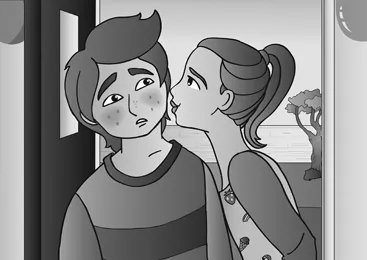
Joanna raced towards Archie as he walked in. She gently hugged and kissed him on the cheek and in the friendliest of tones said, “thanks for coming Archie. You’re here so now everything is perfect!” He was surprised. No one, except his mum and his aunties, had ever been so happy to see him that they kissed him!
There was another knock at the door and Joanna turned away to greet Tobias. She gave him a high-5 and thanked him for coming. Tobias, Archie’s closest friend, walked towards him and they chatted away as everyone started to arrive. Archie quickly whispered to Tobias that Joanna had just kissed him, and it was awesome and that she’d never done it before. Then he asked, “what do you think it means?” He was feeling delightfully overwhelmed.
In Tobias’ typical style he calmed Archie by saying, “Hey, slow down, Arch. Joanna does like you a lot. Way more than she likes anyone else, but she doesn’t want to marry you!” Archie didn’t say a word. Instead, he smiled at Tobias, put his arm around him and appreciated his honesty.
“Okay, I’ve got a plan,” said Tobias. “While we stand here and eat all this food, let’s keep an eye on Joanna and check out how many kisses and hugs she throws around to others. Okay?”
Archie smiled. “You’re on!”
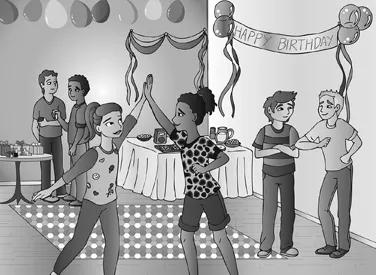
Over the next few minutes a stream of guests travelled through the front door to meet Joanna. She met everyone with a smile, kind words, a hug, high five or gentle fist bump, but there were no kisses given away to anyone else. Today, the only kiss went to Archie and he felt on top of the world.
‘Imagine that,’ he thought to himself, ‘maybe Joanna likes me as much as I like her. Maybe it’s love!’
Suddenly, he caught Tobias who was shaking his head at him. Tobias had always been able to read Archie’s thoughts. It was weird but happened all the time. Tobias grinned and said, ‘Remember, slow down, Archie!’
09 Lauren Eldrige-Murray
This image can be downloaded from http://www.whatsthebuzz.net.au/main-menu/content-whats-the-buzz-for-primary-students and will fill your screen in colour. There is also the option to have the authors read to students.
Pose your questions to the group:
How did Joanna’s greeting make Archie feel? Was it appropriate?
Did it affect their relationship, positively or negatively?
Why didn’t sh...
Table of contents
Cover
Half Title
Title
Copyright
Contents
What’s the Buzz? for Primary Students
List of photocopiable and online resources
A quick guide to the games
About the authors
Acknowledgements
Introduction
Lesson 1: Meeting people and exiting
Lesson 2: Seeking attention
Lesson 3: Peer pressure: when to follow and when to go your own way
Lesson 4: Being friendly
Lesson 5: Competition: winning and losing with style
Lesson 6: Feelings: yours, mine and everyone’s
Lesson 7: Feelings and the warning signs
Lesson 8: Feelings and thinking positively
Lesson 9: Feelings and wellbeing
Lesson 10: Empathy
Lesson 11: Anxiety – name it and work with it
Lesson 12: Handling disappointment
Lesson 13: Bullying and bullying-styled behaviours: dealing with them
Lesson 14: The connecting ART of conversation
Lesson 15: Self-awareness: building emotional intelligence and identity
Lesson 16: The value of giving encouraging feedback
Trusted by 375,005 students
Access to over 1.5 million titles for a fair monthly price.
Study more efficiently using our study tools.
Frequently asked questions
Yes, you can cancel anytime from the Subscription tab in your account settings on the Perlego website. Your subscription will stay active until the end of your current billing period. Learn how to cancel your subscription
No, books cannot be downloaded as external files, such as PDFs, for use outside of Perlego. However, you can download books within the Perlego app for offline reading on mobile or tablet. Learn how to download books offline
Perlego offers two plans: Essential and Complete
Essential is ideal for learners and professionals who enjoy exploring a wide range of subjects. Access the Essential Library with 800,000+ trusted titles and best-sellers across business, personal growth, and the humanities. Includes unlimited reading time and Standard Read Aloud voice.
Complete: Perfect for advanced learners and researchers needing full, unrestricted access. Unlock 1.5M+ books across hundreds of subjects, including academic and specialized titles. The Complete Plan also includes advanced features like Premium Read Aloud and Research Assistant.
Both plans are available with monthly, semester, or annual billing cycles.
We are an online textbook subscription service, where you can get access to an entire online library for less than the price of a single book per month. With over 1.5 million books across 990+ topics, we’ve got you covered! Learn about our mission
Look out for the read-aloud symbol on your next book to see if you can listen to it. The read-aloud tool reads text aloud for you, highlighting the text as it is being read. You can pause it, speed it up and slow it down. Learn more about Read Aloud
Yes! You can use the Perlego app on both iOS and Android devices to read anytime, anywhere — even offline. Perfect for commutes or when you’re on the go. Please note we cannot support devices running on iOS 13 and Android 7 or earlier. Learn more about using the app
Yes, you can access What's the Buzz? for Primary Students by Mark Le Messurier,Madhavi Nawana Parker in PDF and/or ePUB format, as well as other popular books in Education & Behavioural Management. We have over 1.5 million books available in our catalogue for you to explore.