eBook - ePub
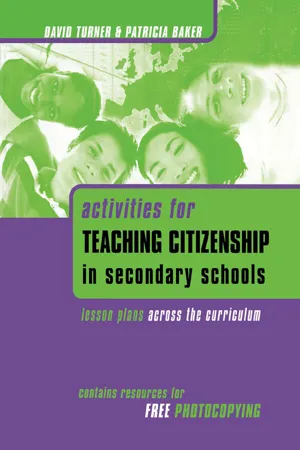
Activities for Teaching Citizenship in Secondary Schools
Lesson Plans Across the Curriculum
- 225 pages
- English
- ePUB (mobile friendly)
- Available on iOS & Android
eBook - ePub
Activities for Teaching Citizenship in Secondary Schools
Lesson Plans Across the Curriculum
About this book
A resource for teachers wishing to develop citizenship in their teaching activities. It provides activities for use in teaching, and includes lesson plans, photocopiable work sheets and guides to further resources.
Information
PART 1
BACKGROUND INFORMATION
In this part we set out to provide information about citizenship and its introduction as a curriculum subject into the school, and to provide some thoughts on generic methods that can be used across th e curriculum.
Chapter 1 describes citizenship and provides relevant extracts from the government document on the subject. Chapter 2 addresses some management issues and gives some thoughts about how to go about implementing its teaching. Chapter 3 looks at useful generic methods of teaching that can be used anywhere in the curriculum to support learning about citizenship.
| CHAPTER | 1 |
WHAT IS CITIZENSHIP?
This chapter sets out the citizenship requirements upon which the rest of the book is based. It is, therefore, written in a rather different style from the rest of the book which is intended to be a practical, dip-in resource for the teacher. This chapter, by contrast, is necessarily based closely on the concise definition of citizenship used by the DfEE in the National Curriculum. We make no apology for this; it is essential to understand the requirement before trying to teach pupils something about their roles and duties as citizens. The full document can be obtained from the National Curriculum Web site on www.nc.uk.net
Background
The report of the Advisory Group on Education for Citizenship and the Teaching of Democracy was delivered in September 1998. It recommended that the teaching of citizenship and democracy become a statutory requirement on schools. It identified three principal dimensions: participation in democracy, the responsibilities and rights of a citizen and the value of community activity. The acceptance of this report by government has led to the development of a detailed citizenship curriculum for schools. This becomes mandatory in September 2002.
Citizenship and the National Curriculum
In their forward to Citizenship: The National Curriculum for England, published in 1999, the Right Honourable David Blunkett, Secretary of State for Education and Employment and Sir William Stubbs, Chairman of the Qualifications and Curriculum Authority, refer to the equality of opportunity that underpins the school curriculum and of a commitment to valuing ourselves, our families and other relationships, the wider groups to which we belong, the diversity in our society and the environment in which we live.
The National Curriculum determines what should be taught in our schools and sets attainment targets for learning so that everyone has a shared understanding of the skills and knowledge that pupils should gain from their time in school. From September 2002 the curriculum will include citizenship. The aim is to provide pupils with an understanding of their roles and responsibilities as citizens in a modern democracy and so help them to deal with difficult moral and social questions that arise in their lives and in society.
Citizenship teaching, along with personal, social and health education (PSHE), is intended to give pupils the knowledge, skills and understanding to play an effective role in society at local, national and international levels. It should promote their spiritual, moral, social and cultural development and help them to live confident, healthy, independent lives, as individuals, parents, workers and members of society.
The programmes of study set out what pupils should be taught and the attainment targets set out the expected standards of pupils' performance. Programmes of study for Key Stages 3 and 4 are reproduced below.
In both cases citizenship teaching should ensure that knowledge and under-standing about becoming informed citizens are acquired and applied when developing skills of enquiry and communication, and participation and responsible action.
PROGRAMME OF STUDY FOR CITIZENSHIP AT KEY STAGE 3
KNOWLEDGE AND UNDERSTANDING ABOUT BECOMING INFORMED CITIZENS
Pupils should be taught about:
■ the legal and human rights and responsibilities underpinning society, basic aspects of the criminal justice system, and how both relate to young people;
■ the diversity of national, regional, religious and ethnic identities in the United Kingdom and the need for mutual respect and understanding;
■ central and local government, the public services they offer and how they are financed, and the opportunities to contribute;
■ the key characteristics of parliamentary and other forms of government;
■ the electoral system and the importance of voting;
■ the work of community-based, national and international voluntary groups;
■ the importance of resolving conflict fairly;
■ the significance of the media in society;
■ the world as a global community, and the political, economic, environmental and social implications of this, and the role of the European Union, the Commonwealth and the United Nations.
DEVELOPING SKILLS OF ENQUIRY AND COMMUNICATION
Pupils should be taught to:
■ think about topical political, spiritual, moral, social and cultural issues, problems and events by analysing information and its sources, including ICT-based sources;
■ justify orally and in writing a personal opinion about such issues, problems or events;
■ contribute to group and exploratory class discussions, and take part in debates.
DEVELOPING SKILLS OF PARTICIPATION AND RESPONSIBLE ACTION
Pupils should be taught to:
■ use their imagination to consider other people's experiences and be able to think about, express and explain views that are not their own;
■ negotiate, decide and take part responsibly in both school and community-based activities;
■ reflect on the process of participating.
PROGRAMME OF STUDY FOR CITIZENSHIP AT KEY STAGE 4
KNOWLEDGE AND UNDERSTANDING ABOUT BECOMING INFORMED CITIZENS
Pupils should be taught about:
■ the legal and human rights and responsibilities underpinning society and how they relate to citizens, including the role and operation of the criminal and civil justice systems;
■ the origins and implications of the diverse national, regional, religious and ethnic identities in the United Kingdom and the need for mutual respect and understanding;
■ the work of parliament, government and the courts in making and shaping the law;
■ the importance of playing an active part in democratic and electoral processes;
■ how the economy functions, including the role of business and financial services;
■ the opportunities for individuals and voluntary groups to bring about social change locally, nationally, in Europe and internationally;
■ the importance of a free press, and the media's role in society, including the Internet, in providing information and affecting opinion;
■ the rights and responsibilities of consumers, employers and employees;
■ the United Kingdom's relations in Europe, including the European Union, and relations with the Commonwealth and the United Nations;
■ the wider issues and challenges of global interdependence and responsibility, including sustainable development and Local Agenda 21.
DEVELOPING SKILLS OF ENQUIRY AND COMMUNICATION
Pupils should be taught to:
■ research a topical political, spiritual, moral, social or cultural issue, problem or event by analysing information from different sources, including ICT-based sources, showing an awareness of the use and abuse of statistics;
■ express, justify and defend orally and in writing a personal opinion about such issue, problems or events;
■ contribute to group and exploratory class discussions, and take part in formal debates.
DEVELOPING SKILLS OF PARTICIPATION AND RESPONSIBLE ACTION
Pupils should be taught to:
■ use their imagination to consider other people's experiences and be able to think about, express, explain and critically evaluate views that are not their own;
■ negotiate, decide and take part responsibly in school and community-based activities;
■ reflect on the process of participating.
Attainment Targets
The types and range of performance that pupils should be able to demonstra...
Table of contents
- Cover
- Title Page
- Copyright Page
- Table of Contents
- Acknowledgements
- Preface
- How to use this Book
- Part 1 Background information
- Part 2 Teaching citizenship in subject lessons
- References
- Useful Contacts and Web Sites
- Index
Trusted by 375,005 students
Access to over 1.5 million titles for a fair monthly price.
Study more efficiently using our study tools.
Frequently asked questions
Yes, you can cancel anytime from the Subscription tab in your account settings on the Perlego website. Your subscription will stay active until the end of your current billing period. Learn how to cancel your subscription
No, books cannot be downloaded as external files, such as PDFs, for use outside of Perlego. However, you can download books within the Perlego app for offline reading on mobile or tablet. Learn how to download books offline
Perlego offers two plans: Essential and Complete
- Essential is ideal for learners and professionals who enjoy exploring a wide range of subjects. Access the Essential Library with 800,000+ trusted titles and best-sellers across business, personal growth, and the humanities. Includes unlimited reading time and Standard Read Aloud voice.
- Complete: Perfect for advanced learners and researchers needing full, unrestricted access. Unlock 1.5M+ books across hundreds of subjects, including academic and specialized titles. The Complete Plan also includes advanced features like Premium Read Aloud and Research Assistant.
We are an online textbook subscription service, where you can get access to an entire online library for less than the price of a single book per month. With over 1.5 million books across 990+ topics, we’ve got you covered! Learn about our mission
Look out for the read-aloud symbol on your next book to see if you can listen to it. The read-aloud tool reads text aloud for you, highlighting the text as it is being read. You can pause it, speed it up and slow it down. Learn more about Read Aloud
Yes! You can use the Perlego app on both iOS and Android devices to read anytime, anywhere — even offline. Perfect for commutes or when you’re on the go.
Please note we cannot support devices running on iOS 13 and Android 7 or earlier. Learn more about using the app
Please note we cannot support devices running on iOS 13 and Android 7 or earlier. Learn more about using the app
Yes, you can access Activities for Teaching Citizenship in Secondary Schools by Patricia Baker,David Turner,Baker, Patricia,Turner, David in PDF and/or ePUB format, as well as other popular books in Pedagogía & Educación general. We have over 1.5 million books available in our catalogue for you to explore.