eBook - ePub
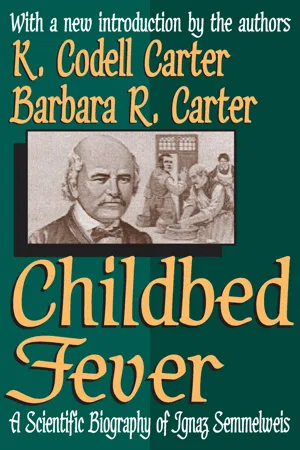
Childbed Fever
A Scientific Biography of Ignaz Semmelweis
- 142 pages
- English
- ePUB (mobile friendly)
- Available on iOS & Android
eBook - ePub
About this book
The life and work of Ignaz Semmelweis is among the most engaging and moving stories in the history of science. Childbed Fever makes the Semmelweis story available to a general audience, while placing his life, and his discovery, in the context of his times. In 1846 Vienna, as what would now be called a head resident of obstetrics, Semmelweis confronted the terrible reality of childbed fever, which killed prodigious numbers of women throughout Europe and America. In May 1847 Semmelweis was struck by the realization that, in his clinic, these women had probably been infected by the decaying remains of human tissue. He believed that infection occurred because medical personnel did not wash their hands thoroughly after conducting autopsies in the morgue. He immediately began requiring everyone working in his clinic to wash their hands in a chlorine solution. The mortality rate fell to about one percent. While everyone at the time rejected his account of the cause of the disease because his theory was fundamentally inconsistent with existing medical beliefs about how diseases were transmitted, in time Semmelweis was proven to be correct. His work led to the adoption of a new way of thinking about disease, thus helping to create an entirely new theory - the etiological standpoint - that still dominates medicine today.
Information
1
Vienna's General Hospital
In the late eighteenth century, the Austrian Hapsburgs ruled an empire that included most of central Europe. It was a time of relative peace and prosperity. After two hundred years of intermittent struggle, Hapsburg armies had finally dislodged the Ottoman Turks from Hungary and were gradually driving them south through the Balkans. Austrian baroque architecture culminated in the rebuilding of the Danube monasteries at Melk, St. Florian, Göttweig, and Kremsmünster; Haydn and Mozart were composing in Vienna; the Enlightenment was under way. Joseph II, the most progressive and rationalistic of all the Hapsburg rulers, turned his attention to domestic problems.
At the end of the eighteenth century, about 250,000 people lived in Vienna. Contemporaries estimated that the population included between two thousand and ten thousand prostitutes and between five hundred and four thousand kept mistresses.1 Many more thousands of single women barely survived as hod carriers, day laborers, seamstresses, cooks, chambermaids, and washerwomen. In a city never accused of moral austerity, the consequences were abortion and illegitimacy. Unwed mothers accounted for half of the live births2—almost twice the rate of present-day America. Poverty forced most of these women to undergo delivery in the maternity facilities of the Viennese charity hospitals, where conditions were far from satisfactory. Some charity facilities were open to the public, and the unmarried mothers were exposed to scorn and ridicule from passersby.3 Once out of the hospitals, many indigent women were unable to support their babies, but few charitable institutions would accept and care for the newborn. This led to abandonment and infanticide—practices judged to be both immoral and contrary to the interests of the state. Joseph II attacked these problems by constructing a new hospital that provided free and humane medical care for the indigent.
During joseph II's reign, the center of Vienna was still enclosed by enormous medieval walls although the fortifications were obsolete and the city was spreading beyond them in all directions. Not far outside the walls, on the northwest edge of the city, was a rambling, one-hundred-year-old poorhouse that was the principal residence for Vienna's orphans, invalids, aged, and infirm. In less than three years, from planning to completion, the poorhouse was rebuilt and expanded into the Viennese General Hospital. The first patients were admitted in August 1784.
The General Hospital, which remains in service today, is a short walk from the center of Vienna and is now surrounded by gray office buildings and apartment houses. However, drawings and paintings made soon after its construction show that it was originally encircled by farms and gardens. Less than a mile north of the hospital, the countryside rises toward Leopoldsberg and Kahlenberg—hills overlooking the city that, since Roman times, have been covered with vineyards and the celebrated Vienna Woods.
The General Hospital occupies a system of buildings that surrounds a dozen large rectangular courtyards arranged like an irregular checkerboard. The courtyards contain gardens, shady trees, walks, and occasional statues of prominent persons who have been associated with Viennese medicine. The hospital buildings are two and three stories high and are contiguous so that personnel can pass from one building to another without going outside. The buildings are narrow enough that some of the larger rooms overlook courtyards on two sides. Originally, the entire complex was divided in half by an imaginary axis extending straight ahead—almost due north—from the main entrance: the right side of the complex was for women, and the left for men.
The hospital was built to accommodate two thousand patients, and it began operations with a staff of only 20 physicians and 140 attendants.4 Attendants worked twenty-four-hour shifts and while on duty slept in the same rooms as their patients.
There were three classes of accommodations: one for the indigent, who paid nothing for their care; and two classes for paying patients, in which better service was provided depending on the amount the patient was prepared to pay. Wealthy patients staying in first-class accommodations had private rooms and could be accompanied and served by their own domestic help. Charity patients occupied large rooms, most of which held about twenty beds; and these patients were expected to perform most of the ordinary housekeeping tasks for themselves.
The insane were located in a separate building called the “Fools' Tower.” It more nearly resembles a fortress than a hospital facility. The building is round and five stories high; it has only one entrance. Each floor has twenty-eight cells evenly spaced around the outside wall. Each cell has one narrow window secured originally by iron bars. The circular core of the building contains facilities for attendants, round passageways on each floor providing access to the cells, and a central stairway that connects all five floors. In the eighteenth century, entering or leaving the Fools' Tower required passing through a series of heavy oak doors, each guarded by an attendant.
The idea of constructing large charity hospitals was not unique to the Hapsburgs. During the late eighteenth century, hospitals similar to the Viennese General Hospital were constructed in major cities throughout Europe. In comparison to other European institutions, however, conditions in Vienna's General Hospital were quite favorable. In 1828, the Hôtel-Dieu in Paris had 1,219 beds, of which 406 were three feet wide and 733 were four feet four inches wide. In the early nineteenth century, the number of patients in the Hôtel-Dieu ranged from two thousand to five thousand; and contemporary observers noted that there were often four, five, or even six patients in a bed.5 In the maternity clinic at the Hôtel-Dieu, there were generally three or four patients in each bed. The pregnant and the recently delivered, the diseased and the healthy, prostitutes and married women—all were mixed together indiscriminately in the same beds. By contrast, in the Viennese General Hospital, one patient to a bed was always the rule.
What are diseases? One way to answer this question is by identifying groups of symptoms. Particular diseases can then be distinguished and characterized in terms of these symptoms. This is how diseases were generally thought of in the early nineteenth century. Mumps was a swelling in the throat, and hydrophobia (rabies) an inability to swallow, and phthisis (tuberculosis) a coughing up of blood and pus.
If several cases of a disease occurred at the same time and in the same general area, the disease was said to be “epidemic.” The occurrence of an epidemic suggested that the victims may have been subjected to some noxious atmospheric influence. On the other hand, if only a few persons contracted a particular disease, the cases were called “sporadic.” Sporadic cases were usually ascribed to some cause that was more or less unique to the patient; these could include heredity or even previous diseases, such as smallpox or syphilis, as well as various occupational hazards or kinds of behavior. For example, in 1825 one British physician identified the following possible causes of sporadic phthisis:
hereditary disposition; … certain diseases, such as catarrh, pneumonic inflammation, hoemoptoe, syphilis, scrofula, smallpox, and measles; particular employments exposing artificers to dust, such as needle-pointers, stone cutters, millers, etc.; or to the fumes of metals or minerals under a confined and unwholesome air; violent passions, exertions, or affections of the mind, as grief, disappointment, anxiety, or close application to study, without using proper exercise; playing much on wind instruments; frequent and excessive debaucheries, late watching, and drinking freely of strong liquors: great evacuations, as diarrhea, diabetes, excessive venery, fluor albus, immoderate discharge of the menstrual flux, and the continuing to suckle too long under a debilitated state; and, lastly, the application of cold, either by too quick a change of apparel, keeping on wet clothes, lying in damp beds, or exposing the body too suddenly to cool air when heated by exercise; in short, by any thing that gives a considerable check to the perspiration.6
Most deviations from normal life were regarded as possible causes for sporadic disease. No one entertained the idea that every case of any given disease could be due to one specific cause.
In the early nineteenth century, medical treatment was mostly the same as it had been for centuries. Physicians thought of themselves as part of a continuous and ancient tradition of medical practitioners that extended back to the ancient Romans and Greeks. And indeed most of the techniques in common use had been employed by Greek and Roman physicians more than two thousand years earlier.
Disease was often associated with fever and inflammation, and increased body heat was also observed in robust patients who ate too much. Partly because excess heat seemed to be involved both in overeating and in illness, fever and inflammation were often attacked by trying to remove the excess heat that seemed to result from the immoderate consumption of rich foods. This approach was called the “antiphlogistic regimen”; it included dietary restrictions, the use of laxatives and emetics, blistering, the application of cooling lotions, and especially bloodletting. Bu contrast, in other cases, disease seemed to arise because the patient was weak and undernourished or overworked. These cases required the opposite approach. Physicians tried to strengthen the patient by administering tonics and alcohol, by ensuring the consumption of nourishing foods, and by prescribing rest. This strategy was called “supportive treatment.”
These commonsense ideas about disease created a practical dilemma. Many of the patients treated in the charity hospitals were undernourished and yet at the same time feverish. Fever called for the antiphlogistic regimen. But malnourished charity patients were often too weak to withstand bloodletting and seemed to require supportive treatment. The usual solution was a compromise: physicians applied supportive treatment until the patient seemed strong enough to withstand antiphlogistic measures. Then red towels were brought out, and blood was drawn. Medical writers often warned that the proper therapy could be selected only by carefully considering the details of each individual case.
Physicians believed illness more often resulted from excessive consumption than from deficiency, and the antiphlogistic regimen was more common than was supportive treatment. Bloodletting was used to treat almost every disease. One British medical text recommended bloodletting for acne, asthma, cancer, cholera, coma, convulsions, diabetes, epilepsy, gangrene, gout, herpes, indigestion, insanity, jaundice, leprosy, ophthalmia, plague, pneumonia, scurvy, smallpox, stroke, tetanus, tuberculosis, and for some one hundred other diseases. Bloodletting was even used to treat most forms of hemorrhaging such as nosebleed, excessive menstruation, or hemorrhoidal bleeding. Before surgery or at the onset of childbirth, blood was removed to prevent inflammation. Before amputation it was customary to remove a quantity of blood equal to the amount believed to circulate in the limb that was to be removed.
To treat or to prevent general or systemic symptoms like fever, blood was drawn by opening major veins or arteries. It was judged most effective to bleed patients while they were sitting upright or standing erect, and blood was often removed until the patient fainted. To treat or to prevent local inflammation, blood was removed locally by abrading or cutting the skin or by applying leeches.
When a leech is applied to some body surface, it punctures the skin with a small tooth and secretes chemicals that prevent blood coagulation. It then consumes about half an ounce of blood and drops off. The application of leeches seemed to be an ideal way to combat inflammation. Leeches were applied to any accessible inflamed body surface, including the interior of the mouth and throat, the vagina, and the rectum. Physicians often reported the simultaneous use of fifty or more leeches on a given patient, and leeches were often used together with other techniques for removing blood. Since leeches were used repeatedly and in the treatment of various diseases, it was possible for the leeches themselves to convey disease. Cases were sometimes reported in which leeches seemed to have communicated syphilis by being used first on persons who had the disease and later on other persons.7 When leeches were placed in the mouth, they sometimes worked their way down the throat until they blocked the air passage and the patient suffocated.
Leeches became especially popular in the early nineteenth century. Through the 1830s the French imported about forty million leeches a year for medical purposes, and in the next decade, England imported six million leeches a year from France alone.8 Through the early decades of the century, hundreds of millions of leeches were used by physicians throughout Europe.
One typical course of medical treatment began on 13 July 1824. At nine P.M., a French sergeant was stabbed through the chest while engaged in single combat; within minutes he fainted from loss of blood. He was moved to a local hospital where he was immediately bled twenty ounces to prevent inflammation. During the night he was bled another twenty-four ounces. The chief surgeon arrived early the next morning and bled the patient another ten ounces; during the next fourteen hours he was bled five more times. In the first twenty-four hours of treatment, medical attendants intentionally removed more than half of this patient's normal supply of about ten pints of blood. Bleedings continued over the next several days. By 29 July the wound had become inflamed. The physician applied thirty-two leeches to the most sensitive part of the wound. Over the next three days there were more bleedings and a total of forty more leeches. The sergeant recovered and was discharged on 3 October. His physician wrote that “by the large quantity of blood lost, amounting to 170 ounces [nearly eleven pints], besides that drawn by the application of leeches [perhaps another two pints], the life of the patient was preserved.”9 By ninteenth-century standards, thirteen pints of blood taken over the space of a month was a large but not an exceptional quantity. The medical literature of the period contains many similar accounts—some successful, some not.
In addition to the antiphlogistic regimen and supportive treatment, physicians prescribed numerous medications. Three especially popular drugs were mercury (usually in a compound called “calomel”), antimony (usually called “emetic tartar”), and arsenic. All three were toxic and were prescribed in potentially lethal doses. Especially in treating life-threatening diseases, physicians believed that administering drugs or removing blood could be effective only when performed on a scale that would itself endanger the life of the patient; such procedures were called “heroic therapies.”
Surgical treatment was especially perilous to patients. There was no effective anesthetic; patients were simply tied down, a small block of wood was placed between their teeth, and the surgeon began cutting. The pain and shock of surgical procedures were often fatal. At the time, no one saw any reason for sterile operating conditions. Surgeons usually worked wearing blood-stained aprons over their ordinary street clothing. Blood encrusted clothing was regarded as a sign of the wide experience of the surgeon. Between operations, instruments were merely rinsed in tap water or not cleaned at all. Some surgeons were offended at the suggestion that they should wash their hands prior to surgery; they felt that their social status as gentlemen was inconsistent with the idea that their hands could be unclean. Surgical incisions were usually packed with common lint and then bandaged. However, at Vienna's General Hospital, the preferred treatment was to cover the incision with wet sponges and then rinse it frequently with cold tap water. As we now know, both procedures were conducive to infection. Not surprisingly, less than half of all surgical patients survived.
After surgery, patients risked catching various diseases. Among the most common was surgical fever—pain, inflammation, and a high temperature. Many patients contracted erysipelas, a painful inflammation that spread rapidly through the skin and subcutaneous tissues. Another problem was blood poisoning, in which the victim's blood seemed itself to degenerate; blood poisoning was classified either as septicemia or as pyemia depending on the amount and kind of pus that appeared in the blood. There was also hospital gangrene, a particularly loathsome disorder in which all the tissues slowly but inevitably decomposed while giv...
Table of contents
- Cover Page
- Half title
- Title Page
- Copyright Page
- Contents
- Transaction Introduction
- Preface
- 1. Vienna's General Hospital
- 2. Childbed Fever
- 3. Semmelweis's Discovery
- 4. Resorption Fever
- 5. Mayrhofer's Discovery
- 6. Puerperal Infection
- Postscript
- Selected Bibliography
- Index
Trusted by 375,005 students
Access to over 1.5 million titles for a fair monthly price.
Study more efficiently using our study tools.
Frequently asked questions
Yes, you can cancel anytime from the Subscription tab in your account settings on the Perlego website. Your subscription will stay active until the end of your current billing period. Learn how to cancel your subscription
No, books cannot be downloaded as external files, such as PDFs, for use outside of Perlego. However, you can download books within the Perlego app for offline reading on mobile or tablet. Learn how to download books offline
Perlego offers two plans: Essential and Complete
- Essential is ideal for learners and professionals who enjoy exploring a wide range of subjects. Access the Essential Library with 800,000+ trusted titles and best-sellers across business, personal growth, and the humanities. Includes unlimited reading time and Standard Read Aloud voice.
- Complete: Perfect for advanced learners and researchers needing full, unrestricted access. Unlock 1.5M+ books across hundreds of subjects, including academic and specialized titles. The Complete Plan also includes advanced features like Premium Read Aloud and Research Assistant.
We are an online textbook subscription service, where you can get access to an entire online library for less than the price of a single book per month. With over 1.5 million books across 990+ topics, we’ve got you covered! Learn about our mission
Look out for the read-aloud symbol on your next book to see if you can listen to it. The read-aloud tool reads text aloud for you, highlighting the text as it is being read. You can pause it, speed it up and slow it down. Learn more about Read Aloud
Yes! You can use the Perlego app on both iOS and Android devices to read anytime, anywhere — even offline. Perfect for commutes or when you’re on the go.
Please note we cannot support devices running on iOS 13 and Android 7 or earlier. Learn more about using the app
Please note we cannot support devices running on iOS 13 and Android 7 or earlier. Learn more about using the app
Yes, you can access Childbed Fever by K. Codell Carter,Barbara R. Carter in PDF and/or ePUB format, as well as other popular books in Medicine & Medicine Biographies. We have over 1.5 million books available in our catalogue for you to explore.