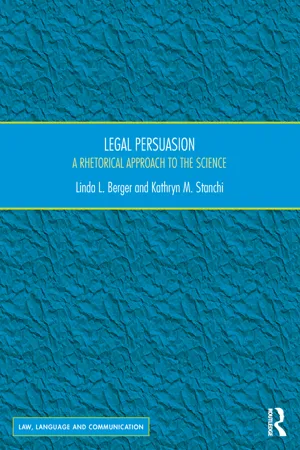
This book develops a central theme: legal persuasion results from making and breaking mental connections. This concept of making connections inspired the authors to take a rhetorical approach to the science of legal persuasion. That singular approach resulted in the integration of research from cognitive science with classical and contemporary rhetorical theory, and the application of these two disciplines to the real-life practice of persuasion. The combination of rhetorical analysis and cognitive science yields a new way of seeing and understanding legal persuasion, one that promises theoretical and practical gains. The work has three main functions. First, it brings together the leading models of persuasion from cognitive science and rhetorical theory, blurring boundaries and leveraging connections between the often-separate spheres of science and rhetoric. Second, it illustrates this persuasive synthesis by working through concrete examples of persuasion, demonstrating how to apply this new approach to the taking apart and the putting together of effective legal arguments. In this way, the book demonstrates the advantages of a deeper and more nuanced understanding of persuasion. Third, the volume assesses and explains why, how, and when certain persuasive methods and techniques are more effective than others. The book is designed to appeal to scholars in law, rhetoric, persuasion science, and psychology; to students learning the practice of law; and to judges and practicing lawyers who engage in persuasion.
- 170 pages
- English
- ePUB (mobile friendly)
- Available on iOS & Android
eBook - ePub

Part I
Introduction
1
Making Connections
Making connections is the critical concept that unites persuasion science with rhetorical theory and the real-life practice of persuasion. Connections are critical because most things in life are ambiguous: what we read, hear, and see is open to interpretation. When we sit in a restaurant and a person with a pad and pencil approaches us, we expect that he wants to take our order rather than wanting to interview us, take a bet on a horse race, or draw our picture. (Winter 2003). Our expectation is based on the connections our brain made between the individual we observed and the setting, the timing, the individual’s dress, our past experiences, and a host of other factors. When the same waiter asks us if we want to hear what’s fresh, we expect him to describe today’s best offerings from the menu rather than the air, the water, or the flowers. Our scripts for eating in a restaurant, acquired through experience, set up our usual expectations.
Still, because both words and observations hold out the potential for alternatives to be considered, they are open to interpretation, and that openness makes persuasion possible. Sometimes the advocate will want the decision maker to assume that the person with the pad and pencil is a waiter, but sometimes lawyers must persuade us that our initial view, our first impression, is mistaken or incomplete. By attempting to influence the decision maker to keep searching for clues, or to go back to search for alternative scenarios, lawyers can influence their audiences to make certain mental connections and to turn away from others.
In the chapters that follow, we explain and illustrate how lawyers can make the right choices to influence connections. For example, we explore the reasons why lawyers might decide to use one rather than another metaphor or analogy as well as how lawyers should select an especially appropriate storyline or characterization, fit their arguments into a comfortable organizational structure, or choose specific words and phrases for particular purposes.
To persuade an audience member is to help her connect the pieces of the puzzle in order to see a particular picture. If, for example, a lawyer wishes to argue that driving while intoxicated is a “violent felony,” the lawyer may initially confront a problem of “connection.”1 People have schema or stock images of what a “violent felony” is, and for most of us, those schemas do not include drunk driving. The lawyer’s job is to lead the reader to connect the “violent” results of drunk driving with the relatively passive action of driving a vehicle. The lawyer must also weaken the associations the reader may have between “violent felony” and stereotypical violent crimes such as assault or murder.
As this example shows, the connections in our minds are formed by common cultural understandings as well as by our personal experiences. Many of our cultural understandings and personal experiences have been with us for a long time, and they are well settled in our minds. For most situations, we must choose from among a number of possible connections stored in memory. If the advocate is to succeed in reinforcing the more favorable connections and in severing the less favorable ones, she must engage in advocacy that is vivid and memorable enough to replace the lived experience.
It is easy to say that persuasive advocacy should function as a virtual lived experience for the reader. But how can the advocate guide the reader so that the experience unfolds in that way? That is the question this book seeks to answer.
The advocate’s first job is to make connections with the members of her audience. Both persuasion science and rhetorical theory suggest that one thing will in fact lead to another: agreement on premises will lead to agreement on conclusions; agreement on a first, small step will encourage agreement on later, bigger ones. Thus, when legal persuasion is effective, an initial link, a recognized commonality, will lead to a series of subsequent connections: between individuals and categories, legal problems and their settings, argument opportunities and timing, initial arguments and next steps, turning points and resolutions. Even breaking connections depends on making connections. To sever connections, the advocate guides audience members to see alternative cues that link the current situation with perspective-shifting images, stories, or analogies.
The cognitive science view of thinking lends itself to the idea that we see, interpret, and talk about new information and concepts through the filters and frames we have already constructed, that we go through a process of comparing new things to the things we already know: What is this like? Into what category does it fit? Is it so unusual that we need to create a new category? After we compare, we argue about the comparisons, either with ourselves or with others: Is this new thing more like this option or more like that one? How is it like this? How is it like that? What difference does our choice make?
The purpose of the book is not only to explore how persuasion works, but also and more practically to examine how to construct legal arguments that will effectively connect with particular audiences in specific situations. By taking a rhetorical approach to persuasion, we have integrated research findings from cognitive science with classical and contemporary rhetorical theory, and we have then applied both to the taking apart and the putting together of effective legal arguments. The combination of rhetorical analysis and cognitive science yields a new way of seeing and understanding legal persuasion, one that promises theoretical and practical benefits.
First, the book brings together the leading models of persuasion from cognitive science and rhetorical theory. In the process, it blurs the boundaries and leverages the connections between the often-separate spheres of science and rhetoric. Second, the book illustrates persuasive synthesis by working through concrete examples of persuasion from real-life legal contexts. Finally, the book assesses and explains why, how, and when certain persuasive methods and techniques are more effective than others. This assessment and explanation is based not only on our study of rhetorical concepts and persuasion research but also on our testing of what we have found by working through in-depth analyses of actual legal arguments.
The rhetorical approach
Many of the commonplace strategies and techniques used by today’s legal advocates derive from Aristotle’s Rhetoric. First, of course, Aristotle described the well-known modes for inventing persuasive arguments: ethos, logos, pathos, and kairos. (Corbett and Connors 1998). As a mode of invention, ethos suggests that the advocate consider arguments based on the knowledge, experience, credibility, integrity, or trustworthiness of the speaker. Ethos may emerge from the character of the advocate herself, from the character of another actor within the argument, or from the sources used in the argument.
Pathos suggests arguments based on building common ground between listener and speaker, or listener and third-party actor. Common ground may emerge from shared emotions, values, beliefs, ideologies, or anything else of substance. Logos suggests arguments based on the syllogism or the syllogistic form, including arguments based on enthymemes and analogous cases. As we will discuss later in the book, more flexible argument frames based on metaphor, analogy, and story also draw on the persuasive power of packaging, that is, the audience’s inclination to accept an argument that is delivered in a familiar and recognizable organizational package. Kairos suggests that the advocate constructing arguments take into account the appropriateness of timing and setting. For example, the “right moment” for an argument is when social conditions make the argument compelling despite its lack of precedential support, as in the Brown v. Board of Education (1954) decision that separate but equal schools are inherently unequal.
In addition to these modes of invention centered on different kinds of persuasive appeals, Aristotle categorized a still-helpful laundry list of topics for argument. Applying the “topoi,” or the step- by- step process of invention outlined by classical rhetoricians, can be helpful to advocates when they are reading an opinion to examine how the arguments were constructed or generating arguments in support of a given position. As Aristotle pointed out, some topics for argument are inevitable in certain situations. In legal reasoning, advocates know in advance that they must make certain moves: arguing that a particular situation falls within the language of a statute or rule (plain meaning or legislative intent), that this situation is analogous or distinguishable on the facts or the reasoning from a precedent case, or that applying the rule to this situation would further or undermine the policies underlying the rule.
In classical rhetoric, once arguments had been invented, selected, and arranged, the writer or speaker selected a fitting “style” and put them into words. (More contemporary rhetoricians view the whole question of word choices and writing style as an integral part of the blended construction of persuasive arguments.) Classical rhetoricians identified a number of figures of speech, including schemes and tropes. Schemes are a deviation from the ordinary pattern of words, and tropes are a deviation from the ordinary meaning of a word. Many of these style techniques are used to complement and implicitly support other persuasive approaches. For example, the schemes of balance, such as parallelism and antithesis, draw on some of the same psychological influences as priming and syllogistic organization while schemes of unusual or inverted word order, such as anastrophe (inversion of the natural or usual word order), parenthesis, and apposition may contribute to arguments designed to break connections with the status quo.
As for contemporary rhetoric, a grasp of each individual rhetorical situation gives the advocate a way to analyze the opposing arguments and the underlying precedent that is essential to crafting responsive arguments. (Bitzer 1968). The key to rhetorical situation analysis is to precisely identify the trigger or the prompt for the advocacy. Different prompts evoke different audiences and impose different constraints on the rhetorical response. In Bitzer’s term, a rhetorical situation is marked by an imperfection or problem that encourages the speaker or writer to construct an appropriate argument designed to persuade the relevant audience, that is, an audience with the ability to resolve the problem. For example, in Walker v. City of Birmingham (1967), the lawsuit that challenged an injunction against the 1963 Easter civil rights march in Birmingham, Alabama, the justices had very different views of the “imperfection” that called for a rhetorical response.
In Walker, Birmingham had denied a parade permit to the civil rights marchers, including the Rev. Dr. Martin Luther King, and then the city obtained an injunction forbidding the marchers from proceeding without a permit. The marchers violated the injunction by marching anyway and were arrested. The Supreme Court was asked to decide that the injunction violated the Constitution. For Justice Stewart, the problem was the marchers’ disobedience of an injunction; for Justice Brennan, the problem was the unconstitutional city ordinance under which the injunction was issued. Thus, Justice Stewart described one incident that occurred during the Easter Sunday civil rights march as menacing: “Some 300 or 400 people from among the onlookers followed in a crowd that occupied the entire width of the street and overflowed onto the sidewalks. Violence occurred.” (Walker 1967). Justice Brennan characterized the same incident as much less disruptive: “The participants in both parades were in every way orderly; the only episode of violence, according to a police inspector, was rock throwing by three onlookers.” (Walker 1967).
At the core of most modern rhetorical theories of persuasion is Kenneth Burke’s concept of identification. (Burke 1969). In Burke’s concept, identification is both literal and figurative, the sharing of something of substance between speaker and listener. Burke suggested that individuals form their identities through physical objects, work, family, friends, activities, beliefs, and values; they mentally share “substance” with the people and the things with whom they associate; and they mentally separate themselves from other people and things. The shared substances forge identification, and persuasion results: “You persuade a man only insofar as you can talk his language by speech, gesture, tonality, order, image, attitude, idea, identifying your ways with his.” (Burke 1969). According to Burke, identification can work in several ways: as a means to an end (we have the same interests); through antithesis (we have the same enemies); and through identification at an unconscious level (we have the same unspoken values).
When it comes to what the classical rhetoricians referred to as style, we assume that the lawyer’s writing style, word choices, tone, and mechanics will be designed to meet the needs of her audience and situation. Persuasive arguments will be accurate enough not to mislead (though often depicted from a particular perspective); they will be as brief (or as extended) and as clear (or as nuanced) as fits the audience, situation, and purpose. We also assume that “readability” matters, that is, that all other things being equal, the brief that is more easily read and understood, that helps the reader see where the writer is going, and that keeps the reader on track will be more effective than briefs that are hard to understand. Research mostly backs up this assumption. (Spencer and Feldman 2016). And this assumption makes sense from both rhetorical and persuasion science vantage points. Readability enhances the speaker’s credibility (ethos), speaks to the listener’s values and interests (pathos), and contributes to our intuitive sense that an argument is logical and valid (logos) because it hangs together.
The science of persuasion
Scientific research into persuasion and human decision making spans a number of fields, and the findings that support much of the guidance provided in this book emerge from cognitive and social psychology. Psychological studies of judicial and juror decision making have proliferated over the last two decades, but little of the persuasion science research has specifically addressed legal persuasion or legal audiences. Nonetheless, the findings provide guidance that helps advocates make more thoughtful decisions under differing circumstances. In addition to better understanding the communication process that leads to persuasion, the science of persuasion has provided concepts and labels that will allow us in this book to identify specific approaches and techniques and to illustrate their use in particular legal documents. (Stanchi 2006).
Contemporary persuasion science has been traced to the studies undertaken by psychologist Carl Hovland when President Franklin D. Roosevelt asked him during World War II to study how to effectively persuade soldiers to engage in continuing battle. (Hovland et al. 1953). The following decades of research led to Richard Petty and John Cacioppo producing an integrated model of persuasion. This model was...
Table of contents
- Cover
- Title
- Copyright
- Dedication
- CONTENTS
- Preface
- Acknowledgments
- PART I Introduction
- PART II Setting: audience, timing, and location
- PART III Invention: stories, metaphors, and analogies
- PART IV Arrangement: organization and connection
- PART V Connecting through tone
- PART VI Conclusion
- Index
Trusted by 375,005 students
Access to over 1.5 million titles for a fair monthly price.
Study more efficiently using our study tools.
Frequently asked questions
Yes, you can cancel anytime from the Subscription tab in your account settings on the Perlego website. Your subscription will stay active until the end of your current billing period. Learn how to cancel your subscription
No, books cannot be downloaded as external files, such as PDFs, for use outside of Perlego. However, you can download books within the Perlego app for offline reading on mobile or tablet. Learn how to download books offline
Perlego offers two plans: Essential and Complete
- Essential is ideal for learners and professionals who enjoy exploring a wide range of subjects. Access the Essential Library with 800,000+ trusted titles and best-sellers across business, personal growth, and the humanities. Includes unlimited reading time and Standard Read Aloud voice.
- Complete: Perfect for advanced learners and researchers needing full, unrestricted access. Unlock 1.5M+ books across hundreds of subjects, including academic and specialized titles. The Complete Plan also includes advanced features like Premium Read Aloud and Research Assistant.
We are an online textbook subscription service, where you can get access to an entire online library for less than the price of a single book per month. With over 1.5 million books across 990+ topics, we’ve got you covered! Learn about our mission
Look out for the read-aloud symbol on your next book to see if you can listen to it. The read-aloud tool reads text aloud for you, highlighting the text as it is being read. You can pause it, speed it up and slow it down. Learn more about Read Aloud
Yes! You can use the Perlego app on both iOS and Android devices to read anytime, anywhere — even offline. Perfect for commutes or when you’re on the go.
Please note we cannot support devices running on iOS 13 and Android 7 or earlier. Learn more about using the app
Please note we cannot support devices running on iOS 13 and Android 7 or earlier. Learn more about using the app
Yes, you can access Legal Persuasion by Linda L. Berger,Kathryn M. Stanchi in PDF and/or ePUB format, as well as other popular books in Law & Rhetoric. We have over 1.5 million books available in our catalogue for you to explore.