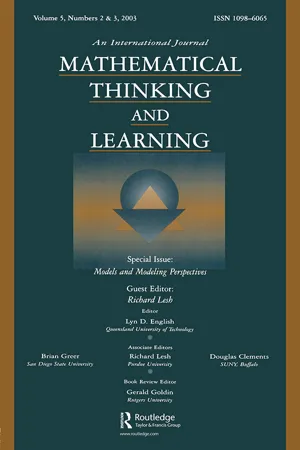
This special issue of Mathematical Thinking and Learning describes models and modeling perspectives toward mathematics problem solving, learning, and teaching. The concern is not only the mature forms of models and modeling in communities of scientists and mathematicians, but also the need to initiate students in these forms of thought. The contributions of this issue suggest a variety of ways that students (children through adults) can be introduced to highly productive forms of modeling practices. Collectively, they illustrate how modeling activities often lead to remarkable mathematical achievements by students formerly judged to be too young or too lacking in ability for such sophisticated and powerful forms of mathematical thinking. The papers also illustrate how modeling activities often create productive interdisciplinary niches for mathematical thinking, learning, and problem solving that involve simulations of similar situations that occur when mathematics is useful beyond school.
eBook - ePub
Models and Modeling Perspectives
A Special Double Issue of mathematical Thinking and Learning
- 128 pages
- English
- ePUB (mobile friendly)
- Available on iOS & Android
eBook - ePub
Models and Modeling Perspectives
A Special Double Issue of mathematical Thinking and Learning
About this book
Information
Structuring Error and Experimental Variation as Distribution in the Fourth Grade
Curriculum and Instruction
The University of Texas at Austin
The University of Texas at Austin
Department of Teaching and Learning
Peabody College, Vanderbilt University
Peabody College, Vanderbilt University
Humans appear to have an inborn propensity to classify and generalize, activities that are fundamental to our understanding of the world (Medin, 1989). Yet, however one describes objects and events, their variability is at least as important as their similarity. In Full House, Stephen Jay Gould neatly drove home this point with his choice of a chapter subhead: “Variability as Universal Reality” (1996, p. 38). Gould (1996) further noted that modeling natural systems often entails accounting for their variability.
An example now widely familiar from both the popular and professional press (e.g., Weiner, 1994) is the account of how seemingly tiny variations in beak morphology led to dramatic changes in the proportions of different kinds of Galapagos finches as the environment fluctuated over relatively brief periods of time. Understanding variability within and between organisms and species is at the core of grasping a big idea like “diversity” (NRC, 1996). Yet, given its centrality, variability is given very short shrift in school instruction. Students are given few, if any conceptual tools to reason about variability, and even if they are, the tools are rudimentary, at best. Typically, these tools consist only of brief exposure to a few statistics (e.g., for calculating the mean or standard deviation), with little focus on the more encompassing sweep of data modeling. That is, stusdents do not typically participate in contexts that allow them to develop questions, consider qualities of measures and attritubutes relevant to a question, and then go on to structure data and make inference about their questions.
Our initial consideration of this problem suggested that distribution could afford an organizing conceptual structure for thinking about variability located within a more general context of data modeling. Moreover, we conjectured that characteristics of distribution, like center and spread, could be made accessible and meaningful to elementary school students if we began with measurement contexts where these characteristics can be readily interpreted as indicators of a “true” measure (center) and the process of measure (spread), respectively (Lehrer, Schauble, Strom, & Pligge, 2001). Our conjecture was that with good instruction, students could put these ideas to use as resources for experiment, a form of explanation that characterizes many sciences.
Accordingly, here we report an 8-week teaching and learning study of elementary school students’ thinking about distribution, including their evolving concepts of characteristics of distribution, like center, spread, and symmetry. The research was conducted with an intact class of fourth-grade students and their teacher, Mark Rohlfing. The context for these investigations was a series of tasks and tools aimed at helping students consider error as distributed and as potentially arising from multiple sources. For students to come to view variability as distribution, and not simply as a collection of differences among measurements, we introduced distribution as a means of displaying and structuring variation among their observations of the “same” event.
This introduction drew from the historical ontogeny of distribution, which suggests that reasoning about error variation may provide a reasonable grounding for instruction (Konold & Pollatsek, 2002; Porter, 1986; Stigler, 1986), and from our previous research with fifth-grade students who were modeling density of various substances (Lehrer & Schauble, 2000; Lehrer et al., 2001). In our previous research, students obtained repeated measurements of weights and volumes of a collection of objects, and discovered that measurements varied from person-to-person and also, by method of estimation. For example, students found the volumes of spheres with water displacement, the volume of cylinders as a product of height and an estimate of the area of the base, and the volume of rectangular prisms as a product of lengths. Differences in the relative precision of these estimates were readily apparent to students (e.g., measures obtained by water displacement were much more variable than those obtained by product of lengths). Also evident were differences in measurements across measurers (e.g., one student’s estimate of 1/3 of a unit of area might be taken as 1/2 of a unit by a different student). Students estimated true values of each object’s weight and volume in light of variation by recourse to an invented procedure analogous to a trimmed mean (extreme values were eliminated and the mean of the remaining measures was found as the “best guess” about its value). In summary, this previous research suggested that contexts of measurement afforded ready interpretation of the center of a distribution as an indicator of the value of an attribute and variation as an indicator of measurement process. However, we did not engage students in examining the structure of variation (e.g., its potential symmetry), nor did we investigate sources of variation other than person and instrument.
Consequently, in this 8-week teaching study, we engaged students in making a broader scope of attribution about potential sources and mechanisms that might produce variability in light of the processes involved in measuring. Several items were measured; they were selected for their potential for highlighting these ideas about variability and structure. Students measured first, the lengths of the school’s flagpole and a pencil, and later, the height of model rockets at the apex of their flight. Multiple sources of random error were identified and investigated. To distinguish between random and systematic variation, students conducted experiments on the design of the rockets (rounded vs. pointed nose cones). The goal of these investigations was to determine whether the differences between the resulting distributions in heights of the rockets were consistent with random variation, or instead, if the difference could be attributed to the shape of the nose cone. During their investigations students identified and discussed several potential contributions to measurement variability (including different procedures for measuring, precision of different measurement tools, and trial by trial variability). The expectation that there was a “true” measure served to organize students’ interpretations of the variability that they observed (in contrast to the interpretation of inherent variability, for example, in the heights of people, a shift that has historically been difficult to make—see Porter, 1986).
Without tools for reasoning about distribution and variability, students find it impossible to pass beyond mere caricatures of inquiry, which at present, dominate much of the current practice in science instruction. Consider, for example, a hypothetical investigation about model rocket design. Students launch several rockets that have rounded nose cones and measure the height of each rocket at the apex of its flight. Next they measure the launch heights of a second group of rockets with pointed nose cones. The children find, not surprisingly, that the heights are not identical. Yet, what do these results mean? How different must the results be to permit a confident conclusion that the nose cone shape matters?
Much current science instruction fails to push beyond simple comparison of outcomes. If the numbers are different, the treatments are presumed to differ, a conclusion, or course, that no practicing scientist would endorse. Because most students do not have the tools for understanding ideas about sampling, distribution, or variability, teachers have little recourse, but to stick closely to “investigations” of very robust phenomena that are already well understood. The usual result is that students spend their time “investigating” a question posed by the teacher (or the textbook), following procedures that are defined in advance. This kind of enterprise shares some surface features with the “inquiry” valued in the science standards, but not its underlying motivation or epistemology. For example, students rarely participate in the development, evaluation, and revision of questions about phenomena that interest them personally. Nor do they puzzle through the challenges of instrumentation, what Pickering (1995) described as achieving a “mechanic grip” on the world—for example, by deciding how to parse the world into measurable attributes and then coming to agreement about best ways of measuring them. Many teachers pursue “canned” investigations not for lack of enthusiasm for this kind of genuine inquiry, but because encouraging students to develop and investigate their own questions requires that they have the requisite tools for interpreting the results.
In the study we report here, teachers and students worked with researchers to engage in coordinated cycles of (a) planning and implementing instruction to put these tools in place, and (b) studying the forms of student thinking—both resources and barriers—that emerged in the classroom. Although presented here as separate phases, these two forms of activity were, in fact, concurrent and coordinated. The development of student thinking was conducted in the context of particular forms of instruction; and in turn, instructional planning was continually guided by and locally contingent on what we (teacher and researchers) were learning about student thinking.
Method
Participants
Participants were 22 fourth grade students (12 boys, 10 girls) from an intact fourth grade class in a public elementary school located in the Midwest. The students and their teacher were part of a school-wide reform initiative aimed at changing teaching and learning of mathematics and science (for details on this initiative, see Lehrer & Schauble, 2000). The teacher had 11 years of teaching experience at the time of this study. However, neither the students nor the teacher had any previous experience with the forms of mathematics and science pursued in this study.
Procedure
The 22 students participating in the research met as a class with their teacher and the first author, with occasional interactions with the second author, over an 8-week period (19 sessions, April through May 1999) in blocks of time ranging from 50–90 min. During each session, students worked in groups of 4–5 at large round tables in the classroom. The teacher often moved from whole group to small group to individual instruction, along with variations on these configurations. This cycle of varying participatory structure, which was part of the preexisting classroom culture, was retained throughout the course of the study. However, most of what we report occurred in the context of whole-group discussions. The major sources of data were field notes, transcribed audiotapes of student interviews, videotapes, as well as the inscriptions of data that the students and teacher created and manipulated throughout...
Table of contents
- Cover
- Copyright Page
- Table of Contents
- Models and Modeling Perspectives on the Development of Students and Teachers
- Structuring Error and Experimental Variation as Distribution in the Fourth Grade
- Problem Solving, Modeling, and Local Conceptual Development
- Using a Modeling Approach to Analyze the Ways in Which Teachers Consider New Ways to Teach Mathematics
- Beyond Constructivism
Trusted by 375,005 students
Access to over 1.5 million titles for a fair monthly price.
Study more efficiently using our study tools.
Frequently asked questions
Yes, you can cancel anytime from the Subscription tab in your account settings on the Perlego website. Your subscription will stay active until the end of your current billing period. Learn how to cancel your subscription
No, books cannot be downloaded as external files, such as PDFs, for use outside of Perlego. However, you can download books within the Perlego app for offline reading on mobile or tablet. Learn how to download books offline
Perlego offers two plans: Essential and Complete
- Essential is ideal for learners and professionals who enjoy exploring a wide range of subjects. Access the Essential Library with 800,000+ trusted titles and best-sellers across business, personal growth, and the humanities. Includes unlimited reading time and Standard Read Aloud voice.
- Complete: Perfect for advanced learners and researchers needing full, unrestricted access. Unlock 1.5M+ books across hundreds of subjects, including academic and specialized titles. The Complete Plan also includes advanced features like Premium Read Aloud and Research Assistant.
We are an online textbook subscription service, where you can get access to an entire online library for less than the price of a single book per month. With over 1.5 million books across 990+ topics, we’ve got you covered! Learn about our mission
Look out for the read-aloud symbol on your next book to see if you can listen to it. The read-aloud tool reads text aloud for you, highlighting the text as it is being read. You can pause it, speed it up and slow it down. Learn more about Read Aloud
Yes! You can use the Perlego app on both iOS and Android devices to read anytime, anywhere — even offline. Perfect for commutes or when you’re on the go.
Please note we cannot support devices running on iOS 13 and Android 7 or earlier. Learn more about using the app
Please note we cannot support devices running on iOS 13 and Android 7 or earlier. Learn more about using the app
Yes, you can access Models and Modeling Perspectives by Richard A. Lesh in PDF and/or ePUB format, as well as other popular books in Education & Education General. We have over 1.5 million books available in our catalogue for you to explore.