eBook - ePub
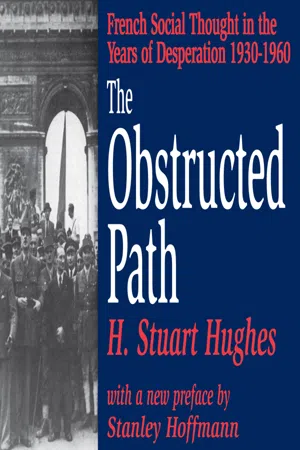
The Obstructed Path
French Social Thought in the Years of Desperation 1930-1960
- 317 pages
- English
- ePUB (mobile friendly)
- Available on iOS & Android
eBook - ePub
About this book
The years of political and social despair in France-from the great depression through the Nazi occupation, Resistance, and liberation, to the Algerian War-forced French intellectuals to rethink the values of their culture. Their faltering attempts to break out of a psychological impasse are the subject of this thoughtful and compassionate book by a distinguished American historian. In this first treatment of contemporary French thought to bridge philosophy, literature, and social science and to show its relation to comparable thinking in Germany, Britain, and the United States. Hughes also assesses the work of other writers in terms of their emotional biography and role in society.Hughes found those who struggled to find meaning and purpose amid chaos to be among the most brilliant minds of their century. They included the social historians Bloch and Febvre; the Catholic philosophers Maritain and Marcel; the proponents of heroism Martin du Gard, Bernanos, Saint-Exupery, Malraux, and DeGaulle; and the phenomenologists Sartre and Merleau-Ponty. They also included the strangely assorted trio of Camus, Teilhard de Chardin, and Levi-Strauss, who showed the way to a wider cultural community. Yet in nearly every case these scholars achieved something quite different from what they set out to do. For this self-questioning generation, the interchange between history and anthropology became most compelling and of greatest interest to the world outside.The Obstructed Path blends H. Stuart Hughes' concern for the many ways in which historians define and practice their craft, his lifelong interest in literature, his fascination with the influence of Marx and Freud, and his empathy with the varieties of Christian thought. It also demonstrates his delicate grasp of singular personalities such as Bernanos, Merleau-Ponty, Jean-Paul Sartre and Levi-Strauss. His profound insight into the flaws of many elaborate philosophical constructions, and into t
CHAPTER
1

Introduction: The Obstructed Path
IN HIS NOVEL Le Grand Meaulnes, Alain-Fournier speaks of a search for an “ancient obstructed path, the path to which the weary prince could find no entrance. It is found at last at the most forlorn hour of the morning, when you have long since forgotten that eleven or twelve is about to strike. … And suddenly, as one thrusts aside bushes and brier, … it appears in sight as a long shadowy avenue, with at its end a small round patch of light.”1
The words are from 1913—but the sentiment might have been expressed with equal fervor at almost any time over the next forty years of French cultural history. In itself no more than a literary metaphor, it may serve to forecast the insecurities of the decades ahead. The motif of an “obstructed path,” of blind alleys and blocked vistas, of faltering and stalemate, and of an increasingly desperate search for a way out, pervades the thinking of Frenchmen of all types and intellectual interests through nearly a half century following the outbreak of the First World War. It is as though Alain-Fournier had divined, one year before the conflict, the lifelong obsession of his contemporaries who, more fortunate than he, were to survive the terrible year 1914: the sense of one’s world as a dark tunnel, beset with vague threats and of uncertain exit.
Besides the wound of the war itself—more grievous in France than elsewhere, since here the loss of youth was irreparable—the four years of bloodshed prompted a wider questioning of traditional French values. Yet this came only slowly: the delayed-action effect that postponed to the 1930’s France’s social and political examination of conscience was also apparent in the cultural sphere. An Indian summer of glory bedazzled Frenchmen and foreigners alike with an image of primacy that was already threatened on all sides. On the international scene, the first flush of illusion was quickly over: the ambiguous outcome of the Ruhr occupation and the electoral victory of the Left in 1924 marked the beginnings of abdication as a great power and a turning inward of the national energies. But from the narrower standpoint of the assumptions on which social and political life rested, the next half decade remained one of substantial self-satisfaction and self-esteem. It took the great depression and the advent of Hitler to shake the French loose from their inherited securities.
So much is familiar to any student of the period. What is less readily apparent is the extent to which this delayed realization of the war’s effect had its parallel—indeed, was reinforced—by a corresponding overestimate of France’s cultural situation. The military and diplomatic illusions of the years 1919–1924—the conviction that the French had regained the leadership of Europe and were once more the grande nation to which others would defer—appeared confirmed by the general esteem which France’s artists and writers enjoyed. In painting, the prestige of the school of Paris remained unchallenged; in literature, such writers as Proust and Gide and Valéry had suddenly come into their own as the precursors of the avant-garde; in philosophy, Henri Bergson seemed without a rival. Subsequently, from the middle of the decade on, as the French withdrew from foreign commitments to the cultivation of their own garden, the nation’s sense of cultural primacy became, if anything, still more pronounced. For an assertion of artistic or philosophical pre-eminence served as psychic compensation for the relinquishment of an active international role. The rest of the civilized world might no longer follow France’s diplomatic leadership, but it continued to pay tribute to its creative achievements. Paris might have lost its position as the hub of international doings, but it still ranked as the cultural capital of the West.
Even the more perceptive French were usually unaware of the extent to which their country’s artistic and literary primacy rested on an accumulation of past glories. While they realized perfectly well—perhaps overestimated—the benefits they enjoyed from a classical tradition extending in unbroken, orderly succession from the seventeenth century, they did not appreciate how close they were to that tradition’s end. By 1930, the original avant-garde experiments had spent their force. Proust was dead, and Gide and Valéry beyond the period of their greatest creativity and influence. With this passing of masters, the perspective on them began to be subtly altered. Their works now figured less as the great innovations of the early twentieth century than as contemporary classics. And as the 1930’s passed, and writers of similar scope failed to appear, people began to suspect that theirs might be the last generation for which the classical tradition would be a living reality.
In France, classicism had greater continuity than in other comparable European countries; it also pervaded the national culture more completely. In England, the classical tradition was associated with particular phases of literary history—and those not necessarily the most tenacious or influential. In Germany, it meant the legacy of one great era of achievement whose products had subsequently been embalmed by the schools and the official purveyors of ethical values—and which in the process had become more and more remote from actual behavior. Neither among the English nor among the Germans did the classical tradition prompt the dominant style of thought. England had no single “official” philosopher; Germany had Kant, but by the twentieth century the Kantian tradition had been interpreted so variously as to remain only the vaguest point of reference—and besides, few pedagogues aimed to teach children to write like Kant. In France, in contrast, Descartes had for nearly three centuries supplied a ready-made style of thought and of expression; here Cartesianism suffused the intellectual atmosphere so thoroughly that much of the time it went unnoticed. The French not only possessed an official philosopher; they had in the Cartesian tradition a pass-key that did service for literature and social thought alike. Across the Rhine, “high” culture might go one way and social science quite another—with both of them for the most part irrelevant to the country’s public life. In France, all these endeavors shared a common ancestor and found in Cartesian categories the guide to the orderly style of thought and the felicity of expression which had long been assumed to constitute the special excellences of the Gallic mind.
By the 1930’s, this ancient confidence was flagging. Or at the very least a few Frenchmen of particular discernment were beginning to discover the fragility of their country’s cultural prestige abroad. Claude Lévi-Strauss has related how on his arrival in Brazil toward the middle of the decade he found the products of French social science still enjoying almost universal esteem. But the names held in highest honor were of a generation that had passed or was passing; their successors had become the generalizers or popularizers of earlier discoveries. The national talent had been canalized toward synthesis and ready explanation; it excelled in exposing with clarity and grace the larger outlines of theories, which was all that the general public wanted or needed to know.2 In broader terms, the French were maintaining a cult of the spoken and written word which might impress the remoter reaches of the Latin world but which was becoming outmoded elsewhere; in France people still tended to assume that an elegant verbal solution to a problem would suffice to settle it Such was the special vulnerability of the French classical tradition as the second quarter of the twentieth century began.
So it seems to us in retrospect: with the experience of a further generation behind us, we find confirmation for the contemporary suspicions that classicism had reached its end. In this perspective, authors like Proust and Valéry rank as the last of the French classicists (to whom some might add Albert Camus in the role of a dutiful grandson). And we can see the next generation as an era in which one writer after another strove to break the classic mold—not so much in technical experimentation (for that had been the work of the previous quarter century) as in the moral assumptions on which their work was based. The classical tradition had assumed a common psychology and a common standard of artistic excellence; even at its end, when it enlarged the criteria of conscious time, when it discovered the inconsequence of personal motivation or made room for the sexual deviant within the circle of a recognized humanity, it did so with a universal aim and in accordance with a rigorous canon of literary craftsmanship. By the 1930’s and 1940’s such a purist definition of the writer’s aim seemed dated; indeed, the métier as such came under question as ethically insufficient for an apocalyptic era.
Hence the literature of engagement: this also is an old story. In the present context, what is significant is that in the literary as in the political and social field the real reckoning with the First World War arrived a decade late. The end of the classical tradition—and with it the ebbing of the flood of innovation, in the novel, in painting, in music, that the years immediately preceding the war had witnessed—came accompanied and reinforced by the great depression and the fascist onslaught. The result was a crisis of confidence on all sides. Just as the grave malfunctioning of France’s economic and administrative machinery was becoming generally apparent, the foundations of pride in the country’s cultural tradition were beginning to be sapped. The years of political and social despair were also years of aesthetic and moral rethinking. What wonder that the prewar era figured in retrospect as the belle époque—that nostalgia for a time of facile pleasures and national confidence should have had its parallel in regret over a waning of cultural self-assurance.
It was to be another generation before both types of confidence were regained. After the Second World War, as in the aftermath of the First, the full social and moral effect of the military ordeal was a long time on the way. Not until the mid-1950’s were the tempos and manners of a new kind of society in general evidence. And it was about the same time that the signs of innovation in intellectual and aesthetic interests became widespread. Hence for cultural study, the conventional division of contemporary French history into an interwar and a post-Second World War period makes little sense. The more natural order is to continue the effects of the pre-1914 currents down to the late 1920’s, and then to delimit another era—the years of desperation—from the 1930’s to the early 1960’s. It is this latter era that now needs to be defined.
With the liberation of Paris from Nazi occupation and the end of the Second World War, France seemed once more to have become the cultural center of Europe. The old primacy had apparently been regained—one could even say that it had been reinforced by the almost total abdication of Germany. In the late 1940’s, Paris was the focus of general curiosity and attention: the existential philosophy of Jean-Paul Sartre figured as the most discussed intellectual movement in the Western world. Superficially the situation looked much as it had been following the First World War, with the cultural pilgrims returning to France as numerous and as eager as before. But this time their worship at the shrine had a crucial difference: in the 1920’s the Parisian novelties had been in evidence for more than a decade—they were extensions before a wider audience of what had previously been the concern of coteries; after 1944, foreigners came to Paris on true voyages of discovery—they wanted to find out what the French had been up to during their years of enforced isolation.
What the Englishman or American discovered often disconcerted him. For it was both novel and curiously familiar; it was both new and at the same time very old. In literature and philosophy, the merging of previously antagonistic systems and a calculated crudity in diction might shock or amuse. But the elements that went into the process were familiar enough. Marxism and phenomenology were far from new—it was only their marriage that came as a surprise. Likewise the modes of thought of men like Sartre and Merleau-Ponty were not as strange as they at first seemed—whether Cartesian or Hegelian or a combination of the two, their antecedents had been the common property of the European educated public long before the occupation of 1940 had cut off the French from intellectual circulation.
Had their imposed isolation been only four years long? This was what the foreign observer began to wonder as he noticed a perplexing provincialism in French cultural responses. Perhaps the separation of France from a wider intellectual exchange had started a good deal earlier, as early as the beginning of the 1930’s. It was then that French concentration on indigenous values had assumed a character of prickly defensiveness. In the military sphere, it came to be called the complex of the Maginot Line. From the intellectual standpoint, it bore no such clear label. Yet the phenomenon was obvious enough: as the French had gradually found themselves outclassed in arms, bereft of economic expedients, ideologically tom asunder, and diplomatically beleaguered, their assertions of cultural superiority had quite naturally become more insistent. And this cultural pride was one of the intangible forces that sustained them through the long ordeal of military occupation. Those who knew the French on the morrow of victory can recall the patronizing tone they frequently took toward their American or British liberators—a tone brought to a perfection of unruffled assurance in the greatest literary classic of the Second World War, the memoirs of General de Gaulle.
After 1933, the French had been more and more alone. The only great nation of the Western European continent that resisted a fascist takeover had paid the price in an increasing isolation of its intellectuals from a wider exchange of ideas. What had earlier been the misfortune of Italy and Germany and Austria by the mid-century had revealed an unsuspected positive aspect. It would be absurd, of course, to suggest that the exile or death of so many Italian or German writers during the years of fascist tyranny had been in any sense a cultural gain; on the contrary, this sort of persecution impoverished the cultural life of their nations—and in a fashion which in the German case seemed almost irremediable. But such a vast displacement of intellectual personnel could not fail to confer a number of side benefits. In the case of the emigration of the 1930’s and 1940’s the chief gain was a breaking down of the provincialism of national cultural frontiers. The fact that so many German and Austrian writers (and to a lesser extent Italians) passed a decade or more in Britain or the United States was of immeasurable value to both sides in the exchange. The universe of discourse of the Anglo-Saxon and the Central European worlds were for the first time brought into close contact, and each was enriched in the process. Indeed, this near-symbiosis of two widely contrasting traditions appears in retrospect as the most important intellectual event of the era.
There was no reason for the French to emigrate before 1940. After then it was too late—and besides, there was the deep-seated prejudice, going back to the 1790’s, against the whole idea of self-exile. So the French stayed at home. Only a handful of leading writers such as Jacques Maritain and Antoine de Saint-Exupéry lived for any length of time in the United States. Thus the French shared scarcely at all in the great exchange of ideas going on in Britain and America. Their own tradition—which they had always assumed to be the central one—was suddenly cut off from the world outside.
We are back to the theme of confinement, of breaking out of an impasse. Let us turn now to define this process of turning inward in the specific field of social thought.
For the Americans and the émigrés from Central Europe, the masters of twentieth-century social thought were Sigmund Freud and Max Weber. Neither of these was honored in France as he had been in Germany before 1933 and subsequently in the United States. The French were far from being ignorant of what Freud and Weber had taught. But their application of Freudian doctrine was largely confined to imaginative literature or semi-intellectual conversation—the clinical practice of psychoanalysis was far less widespread in France than in Central Europe or America—and it was only a rare French scholar, like the young Raymond Aron, who had fully digested Weber’s criteria for a methodology of social science.
The reasons for the French resistance to Freud are not far to seek. Psychoanalysis has always prospered less in a predominantly Catholic milieu than among Protestants or Jews; in this respect Italy in the interwar years was even more resistant than France. But among the French there was a special reason for reluctance to take up Freudianism and for dismay at the appearance of a discipline that claimed to have made a science of introspection. France was, after all, the classic home of the examination of conscience. For three and a half centuries since Montaigne a succession of French moralistes had been subjecting human motivation to a scrutiny that was both precise and disabused. Into this traditional national preserve the foreigner ventured only at his peril; even Freud had experienced his first glimmerings of insight in the hospital of a Frenchman, Charcot. What had a people that had produced Stendhal to learn further about the evasions and prevarications of the human heart? There was presumption in the claim of a mere physician from Vienna that he could reduce to a system what the classics of French literature had left on the l...
Table of contents
- Cover
- Title Page
- Copyright Page
- Dedication
- Table of Contents
- Preface To The Transaction Edition
- Preface
- Chapter 1. Introduction: The Obstructed Path
- Chapter 2. The Historians and the Social Order
- Chapter 3. The Catholics and the Human Condition
- Chapter 4. The Quest for Heroism
- Chapter 5. The Marriage of Phenomenology and Marxism
- Chapter 6. The Way Out
- Index
Trusted by 375,005 students
Access to over 1.5 million titles for a fair monthly price.
Study more efficiently using our study tools.
Frequently asked questions
Yes, you can cancel anytime from the Subscription tab in your account settings on the Perlego website. Your subscription will stay active until the end of your current billing period. Learn how to cancel your subscription
No, books cannot be downloaded as external files, such as PDFs, for use outside of Perlego. However, you can download books within the Perlego app for offline reading on mobile or tablet. Learn how to download books offline
Perlego offers two plans: Essential and Complete
- Essential is ideal for learners and professionals who enjoy exploring a wide range of subjects. Access the Essential Library with 800,000+ trusted titles and best-sellers across business, personal growth, and the humanities. Includes unlimited reading time and Standard Read Aloud voice.
- Complete: Perfect for advanced learners and researchers needing full, unrestricted access. Unlock 1.5M+ books across hundreds of subjects, including academic and specialized titles. The Complete Plan also includes advanced features like Premium Read Aloud and Research Assistant.
We are an online textbook subscription service, where you can get access to an entire online library for less than the price of a single book per month. With over 1.5 million books across 990+ topics, we’ve got you covered! Learn about our mission
Look out for the read-aloud symbol on your next book to see if you can listen to it. The read-aloud tool reads text aloud for you, highlighting the text as it is being read. You can pause it, speed it up and slow it down. Learn more about Read Aloud
Yes! You can use the Perlego app on both iOS and Android devices to read anytime, anywhere — even offline. Perfect for commutes or when you’re on the go.
Please note we cannot support devices running on iOS 13 and Android 7 or earlier. Learn more about using the app
Please note we cannot support devices running on iOS 13 and Android 7 or earlier. Learn more about using the app
Yes, you can access The Obstructed Path by H. Stuart Hughes in PDF and/or ePUB format, as well as other popular books in History & European History. We have over 1.5 million books available in our catalogue for you to explore.