Available as a single volume or as part of the 10 volume set Supreme Court in American Society
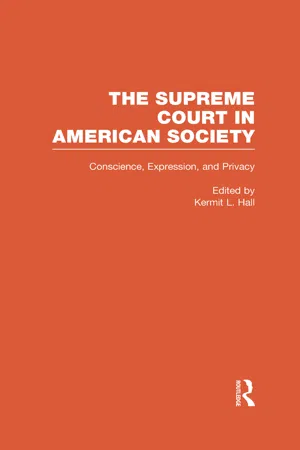
- 434 pages
- English
- ePUB (mobile friendly)
- Available on iOS & Android
eBook - ePub
ESSAY
THE JURISPRUDENCE OF PRIVACY IN A SPLINTERED SUPREME COURT
DAVID M. SMOLIN*
The United States Supreme Court’s dramatic decision in Planned Parenthood v. Casey1 underscores and exacerbates deep divisions within the Court and the nation regarding abortion, implied fundamental rights, and the role of the judiciary in a constitutional republic. Indeed, the opposition and controversy engendered by Roe v. Wade2 and efforts to overrule Roe were a major theme of the opinions. The joint opinion of Justices Kennedy, O’Connor, and Souter referred six times to the controversy created by Roe3 In the end, the joint opinion relied upon this controversy as a reason for reaffirming the “central holding” of Roe.4 Justice Scalia’s dissent, on behalf of all four dissenters, underscored Roe’s extreme divisiveness by repeatedly comparing both Roe and the Casey joint opinion to Dred Scott v. Sandford.5 The Casey joint opinion, joined by Justices Blackmun and Stevens, claimed that the Roe Court, and implicitly the Casey majority, were “callpng on] the contending sides of a national controversy to end their national division by accepting a common mandate rooted in the Constitution.”6
No one seemed to be listening. Ironically, the loudest howls of protest seemed to emerge from the abortion-rights community, which, ever since the submission of the certiorari petition, had seemed committed to declaring defeat in Casey.7 Despite Justice Blackmun’s articulated judgment that the heart of Roe had been reaffirmed,8 the abortion rights political and legislative strategy apparently mandated loud declarations that Roe had been effectively overruled.9 Pro-life responses were more mixed. Advocates were predictably upset over the Court’s asserted reaffirmation of Roe but were pleased that the Court had upheld most of the statutes.10 There was, of course, no sign that pro-life advocates had finally “accepted” Roe as a “common mandate rooted in the Constitution.”
The Supreme Court came within one vote of an expUcit overruling of Roe v. Wade. On the other hand, the acceptance of much of Roe by three Reagan-Bush appointees suggests the possibility that a modified form of Roe will remain indefinitely. Underlying these uncertainties are important questions about the doctrines of substantive due process and privacy.11 Would the overruling of Roe signal the wholesale abandonment of the doctrines of substantive due process and privacy? Is the partial reaffirmation of Roe a signal that the Court will extend privacy to adult consensual sexuality and overrule Bowers v. Hardwick?12 What are the legitimate jurisprudential roots of privacy? How can the doctrine of implied fundamental rights be made consistent with the limited role of the judiciary in a constitutional republic? Is Roe v. Wade merely a logical extension of the Court’s previous privacy cases? What kinds of philosophical, jurisprudential, or ideological presuppositions are represented in the Justices’ various views of privacy?
The following analysis will not settle these questions to the satisfaction of all. Hopefully, however, the philosophical, ideological, and historical analysis of the various views of privacy and liberty will clarify what is at stake in this continuing jurisprudential controversy.
I. Three Theories of Privacy
A. Introductory Considerations
The current case law on privacy presents many uncertainties and paradoxes. It is difficult to reconcile Justice White’s majority opinion in Bowers v. Hardwick13 with Justice Blackmun’s majority opinion in Roe v. Wade.14 The Court has protected the use of contraceptives by the unmarried15 and by minors16 without according the same protection to the underlying sexual acts.17 Some privacy claims, such as those pertaining to parental rights and midwifery, have been rejected by the judiciary and virtually ignored by the Supreme Court18 despite Supreme Court language suggesting that they lie at the heart of privacy.19 The current uncertainties regarding the future of Roe add yet another imponderable to an already confused picture.
The uncertainties and paradoxes of privacy appear to result from an underlying struggle between three theories of privacy. One group of Justices, historically including Douglas, Brennan, Blackmun, Marshall, and Stevens, has viewed privacy as protecting the value of individual autonomy.20 A second group of Justices, historically including Black and Rehnquist, would have preferred to reject the view that certain unenumerated substantive due process rights are fundamental. These Justices would limit substantive due process review to the minimal requirement that all legislation be rationally related to a legitimate governmental interest. Some would eliminate substantive due process completely. Either path leads to the elimination of fundamental privacy rights.21 Finally, a third group of Justices, including Justice White and the second Justice Harlan, views the privacy right primarily as a way of protecting the traditional family from governmental interference.22
The following sections will examine these three theories of privacy. First, I will analyze privacy as individual autonomy. This view is held by what is traditionally characterized as the liberal wing of the Court and was recently partially endorsed by Justices O’Connor, Kennedy, and Souter. The liberal wing of the Court has made its views of privacy rather clear. Thus, if Justices Blackmun, Brennan, Marshall, and Stevens had been able to consistently command a majority, privacy would clearly include a broad abortion right,23 a broad right of adults to engage in consensual sexual acts,24 and a broad right to die.25 The ability of these Justices to win the votes of the swing Justices enabled the liberal wing to secure a broad abortion right from Roe in 1973 through the apex of the abortion right in Thorn-burgh v. American College of Obstetricians & Gynecologists26 in 1986. On the other hand, the inability of this group of Justices to consistently command a majority led to the anomaly of Bowers v. Hardwick in 1986.27 As these Justices retired and as the Reagan and Bush administrations appointed new Justices, Roe appeared increasingly anomalous. However, the joint opinion in Casey suggests at least partial adherence of Justices Kennedy, Souter, and O’Connor to privacy-as-autonomy, raising the question of whether Bowers could be overruled.
This article will demonstrate that privacy-as-autonomy has been shaped by a number of values beyond the mere embrace of individual choice. The fatal flaw in analyzing privacy under Roe is that the judiciary used the Constitution to promote a very particular and ideological set of extra-constitutional values. If Roe were overruled in the ways proposed by Chief Justice Rehnquist and Justice Scalia, it might precipitate a conflict between no-privacy theorists and those, whom I term “family sphere theorists,” who want to use the privacy right to protect the traditional family. The fate of privacy would then depend upon the resolution of this conflict.
I will suggest that the true roots of privacy are found in certain implicit constitutional understandings about the relationship between government and the family. I will also suggest that the unfortunate misuse of privacy by autonomy theorists should not be used as a basis to eliminate these implicit understandings from our constitutional framework. Privacy, properly understood, is as necessary to the process of representative government and the management of social conflict as are textual rights such as free speech. Thus, the post-Roe era of privacy would hopefully involve the flowering, rather than the decay, of the doctrine of privacy.
B. Privacy as Individual Autonomy
1. The Cheerful Existentialism of Privacy-as-Autonomy
A prestigious group of legal scholars and a significant number of Supreme Court Justices have viewed the right of privacy as a vehicle for furthering the value of individual autonomy.28 The term “individual autonomy” deserves careful definition. The term “individual” refers to individualism, which is defined literally as either “a doctrine that the interests of the individual are or ought to be ethically paramount,” or “the conception that all values, rights, and duties originate in individuals.”29 In legal discourse individualism produces a tendency to reduce associations and groups, such as families, religious communities, and nations, to mere collections of self-interested individuals, with a corollary habit of analyzing issues of constitutional law and political theory in terms of the struggle of the individual against the state.30 The term autonomy is literally defined as “the quality or state of being self-governing.”31 The term derives from the Greek “auto” for self and “nomos” for law, so that it can be literally defined as being a law for, or unto, oneself.32 “Individual autonomy” thereby refers to the individual as the self-governing source of law or rights.
The term autonomy more broadly connotes a view, derived perhaps from a cheerful interpretation of Sartre’s existentiaHsm, that human beings create and define themselves through their choices and acts; the relevant slogan is that “existence precedes essence.”33 Human beings, in other words, are not limited or defined by any binding or higher authority, whether it be God or nature.34 This view is coupled with an interpretation of John Stuart Mill’s theory of liberty which views the power of the state as limited to the prevention of harm to the person or property of others, thereby eliminating the authority of the state to legislate based on morality.35
The existence of these strands of “individual autonomy” in the case law and legal literature is easily documented. Justice Blackmun’s eloquent dissent in Bowers v. Hardwick, which represented the views of four Justices, in itself reflects all of these themes....
Table of contents
- Cover
- Title Page
- Copyright Page
- Contents
- Series Introduction
- Volume Introduction
- Civil Liberties and the American Supreme Court
- History, Tradition, the Supreme Court, and the First Amendment
- The First Amendment: A Comparison of Nineteenth and Twentieth Century Supreme Court Interpretations
- Skokie Revisited: Hate Group Speech and the First Amendment
- The Wages of Crying Wolf: A Comment on Roe v. Wade
- Frank Murphy, the Thornhill Decision, and Picketing as Free Speech
- Speech and the First Amendment: Public Speech and Libel Litigation: Are They Compatible?
- “Near v. Minnesota in the Context of Historical Developments
- Racist Speech, Democracy, and the First Amendment
- Justice Oliver Wendell Holmes, Jr., Zechariah Chafee, Jr., and the Clear and Present Danger Test for Free Speech: The First Year, 1919
- The Jurisprudence of Privacy in a Splintered Supreme Court
- Acknowledgments
Trusted by 375,005 students
Access to over 1.5 million titles for a fair monthly price.
Study more efficiently using our study tools.
Frequently asked questions
Yes, you can cancel anytime from the Subscription tab in your account settings on the Perlego website. Your subscription will stay active until the end of your current billing period. Learn how to cancel your subscription
No, books cannot be downloaded as external files, such as PDFs, for use outside of Perlego. However, you can download books within the Perlego app for offline reading on mobile or tablet. Learn how to download books offline
Perlego offers two plans: Essential and Complete
- Essential is ideal for learners and professionals who enjoy exploring a wide range of subjects. Access the Essential Library with 800,000+ trusted titles and best-sellers across business, personal growth, and the humanities. Includes unlimited reading time and Standard Read Aloud voice.
- Complete: Perfect for advanced learners and researchers needing full, unrestricted access. Unlock 1.5M+ books across hundreds of subjects, including academic and specialized titles. The Complete Plan also includes advanced features like Premium Read Aloud and Research Assistant.
We are an online textbook subscription service, where you can get access to an entire online library for less than the price of a single book per month. With over 1.5 million books across 990+ topics, we’ve got you covered! Learn about our mission
Look out for the read-aloud symbol on your next book to see if you can listen to it. The read-aloud tool reads text aloud for you, highlighting the text as it is being read. You can pause it, speed it up and slow it down. Learn more about Read Aloud
Yes! You can use the Perlego app on both iOS and Android devices to read anytime, anywhere — even offline. Perfect for commutes or when you’re on the go.
Please note we cannot support devices running on iOS 13 and Android 7 or earlier. Learn more about using the app
Please note we cannot support devices running on iOS 13 and Android 7 or earlier. Learn more about using the app
Yes, you can access Conscience, Expression, and Privacy by Kermit L. Hall in PDF and/or ePUB format, as well as other popular books in Law & Jurisprudence. We have over 1.5 million books available in our catalogue for you to explore.