eBook - ePub
Parent-Teacher Partnership
Practical Approaches to Meet Special Educational Needs
- 90 pages
- English
- ePUB (mobile friendly)
- Available on iOS & Android
eBook - ePub
Parent-Teacher Partnership
Practical Approaches to Meet Special Educational Needs
About this book
Aims to help in developing working partnerships to meet special educational needs. The book defines what it means to practice and how to achieve it, asking How can parent-teacher partnership become a reality for all concerned and why is there resistance to it?.
Information
Chapter 1
What is Parent–Teacher Partnership?
The relationships between parents of children with special educational needs and the school which their child is attending has a crucial bearing on the child’s educational progress and the effectiveness of any school based action.
School based arrangements should ensure that assessment reflects a sound and comprehensive knowledge of a child and his or her responses to a variety of carefully planned and recorded actions which take account of the wishes, feelings and knowledge of parents at all stages.
Children’s progress will be diminished if their parents are not seen as partners in the educational process with unique knowledge and information to impart.
Professional help can seldom be wholly effective unless it builds upon parents’ capacity to be involved and unless professionals take account of what they say and treat their views and anxieties as intrinsically important.
(DFEE 1994a, 2:28)
Parent-teacher partnership to meet special educational needs is an elaboration and extension of existing whole-school practice in this area.
Partnership implies:
- 1) Mutual Respect
- 2) Complementary Expertise
- 3) A willingness to learn from each other
(Armstrong 1996, p. 18)
Beyond exhortation and rhetoric
Parent-teacher partnership has risen in importance over the last two decades and much has been written about it. We are slowly moving away from writing about the subject as if it ‘would be a good thing’ and then adding a mix of rhetoric and exhortation in the hope it would ‘get things moving’. As the Code of Practice notes, ‘Most schools already have effective working relationships with parents, including the parents of children with special needs’ (DFEE 1994a, 2:28). However, it would be unrealistic and a little too idealistic to believe that parent-teacher partnership is just about to blossom. The partnership is developmental and begins time after time when a new child joins the school or a cause for concern is raised in relation to a child. The building of a partnership depends upon a mutual commitment to common priorities. Because resources are finite, special educational needs have to be met through the efficient use of resources.
If there is no common commitment to or even acknowledgement of these priorities by parents, schools or LEAs, then parent-teacher partnership will be built upon shaky foundations. Recent legislation means that there is more likely to be a conflict of interests between all these parties and this has been implicitly recognised by the DFEE through its GEST funding of LEA-based parent partnership schemes in order to cope with sources of potential conflict.
The knowledge, views and experience of parents are vital. Effective assessment and provision will be secured when there is the greatest possible degree of partnership between parents, and their children, and the schools, LEAs and other agencies.
(DFEE 1994a, 1:2)
If progress is to be made towards parent-teacher partnership then all involved need to be ‘frank and open’ to make clear the boundaries and expectations that underpin it.
This book is a realistic but positive attempt to move all partners beyond rhetoric and exhortation towards a practical understanding of needs and roles. It does not offer a recipe or even a set of recipes that ensure success. More appropriately, it aims to provide a road map towards successful partnership with signposts to some key destinations and warnings about possible blind alleys.
Where has parent-teacher partnership come from?
In order to understand where conflicts of interests may arise within parent-teacher partnership it is important to understand how the concept has developed and why differing priorities make parent-teacher partnership mean different things to different people.
The legacy of Plowden
The Plowden report (CACE 1967) on primary education in the 1960s recognised the important effect of positive parental attitudes upon educational performance and sought to encourage parental cooperation through a series of recommendations which included:
- (I) All schools should have a programme for contact with children’s homes to include:
- (a) a regular system for the head and class teacher to meet parents before the child enters
- (b) arrangements for more formal private talks preferably twice a year
- (c) open days to be held at times chosen to enable parents to attend
- (d) parents to be given booklets prepared by the schools to inform them in their choice of children’s school and as to how they are being educated
- (e) written reports on children to be made at least once a year; the child’s work should be seen by parents
- (f) special efforts to make contact with parents who do not visit schools.
(CACE1967)
The basic groundwork for partnership was thus set and thirty years later schools are still grappling with item f). The concept of partnership was in the context of schools being a resource for the community. A school could have a role to play in improving the lot of a community and it was the professional’s job to improve identification with the goals of education through increased involvement of parents.
Plowden’s concept of partnership with parents was underpinned by the notion of professionals exercising their specialist knowledge on behalf, and in support, of the best interests of children and their families …
It was not concerned with transferring power to parents. Professionals were disinterested, humanitarian and rational.
(Armstrong 1995)
This view of professionals being objective and working first and foremost to meet the needs of the child is still current. For example some large LEAs have provision allocation meetings which examine assessments of need by professionals but do not include those professionals in that meeting in order to achieve some degree of objectivity. Many educational psychologists and SEN case workers will deny that often LEA decisions are subjective. They may deny valuing the efficient use of resources rather than the needs of the child.
In relation to special educational needs, Plowden went on to stress the important role of the parent, but that role was solely concerned with ‘coming to terms’ with their child’s special needs.
Teamwork is necessary between all concerned and, in this connection, we must stress the vital role of the parent… they will be, at least, worried about it and they may feel acute distress, bewilderment, resentment or even shame. They will almost certainly need help, first in accepting that their child is not like other children and then in understanding his needs … all our evidence emphasises the need to advise and support the parents and to associate them as much as possible with the education of their child.
If it is necessary for a child to go to a special school, or still more, to a training centre, parents need to be helped to accept and understand the decision, and they should always be consulted well before it is made.
(CACE 1967,843)
Remember this was thirty years ago. The key terms ‘associate’ and ‘consult’ would have been open to interpretation by the LEA, as are the newer terms that have replaced them.
Much progress has been made in recognising that while a child may have certain special educational needs which he or she shares with no other in the school, there are many common needs that the child shares with others in a school (e.g. Norwich 1996). These include the need to have success, to be part of a social group and to be respected as an individual.
The legacy of Warnock
The Warnock Report (DES 1978) on special educational needs set the scene for the 1981 Education Act and ‘gave official legitimacy to the principal of parent-professional partnership in special education’ (Armstrong 1996). However, in practice this was based on a model of involvement rather than partnership as there was no equal access to information. The term disclosure of information was used.
We have insisted throughout this report that the successful education of children with special educational needs is dependent upon the full involvement of their parents: indeed, unless the parents are seen as equal partners in the educational process the purpose of our report will be frustrated.
(DES 1978)
Assessments should be seen as a partnership between teachers, other professionals and parents in a joint endeavour to discover and understand the nature of the difficulties and needs of individual children. Close relations should be established and maintained with parents and can only be helped by frankness and openness on all sides.
(DES 1978)
In 1985 Warnock clarified what she meant:
In educational matters, parents cannot be equals to teachers if teachers are to be regarded as professionals. Even though educating a child is a joint enterprise involving both home and school, parents should realise that they cannot have the last word. It is a question of collaboration not partnership.
More positively the Warnock Report suggested that there was a need for a ‘Named Person’ to act as a knowledgeable but independent guide to parents seeking or being given a statement of special educational needs for their child. However, this was not included in the 1981 Education Act but it eventually found its way into the Code of Practice in 1994.
Warnock also weakened the link between the description of a child’s needs and the location of consequent provision to meet those needs. The purpose of the statement did not have to be placement in one of a number of special schools each catering for a different cluster of needs. Thus there are decisions to be made as to what degree of provision is to be made and where that provision should be located.
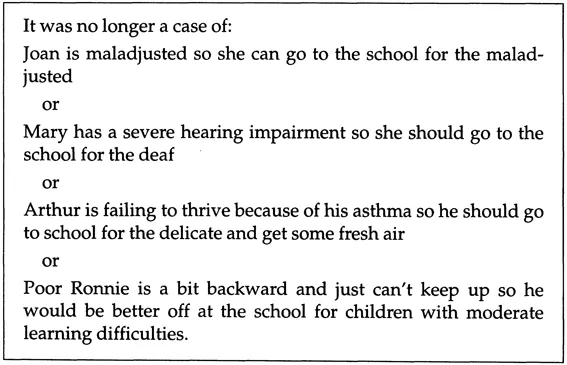
Mainstream schools began to respond to the challenge of including children with special needs and many LEAs started to adopt policies to support the integration of children with special needs.
The Warnock Report and the consequent 1981 Education Act had...
Table of contents
- Cover
- Title
- Copyright
- Contents
- The Authors
- Introduction
- 1 What is Parent-Teacher Partnership?
- 2 Why Parent-Teacher Partnership is Important
- 3 Barriers to Partnership: From the Other Side of the Fence
- Appendix 1 Institutional Development Materials
- Appendix 2 Development Activities
- Glossary
- Organisations
- Packages
- References
Trusted by 375,005 students
Access to over 1.5 million titles for a fair monthly price.
Study more efficiently using our study tools.
Frequently asked questions
Yes, you can cancel anytime from the Subscription tab in your account settings on the Perlego website. Your subscription will stay active until the end of your current billing period. Learn how to cancel your subscription
No, books cannot be downloaded as external files, such as PDFs, for use outside of Perlego. However, you can download books within the Perlego app for offline reading on mobile or tablet. Learn how to download books offline
Perlego offers two plans: Essential and Complete
- Essential is ideal for learners and professionals who enjoy exploring a wide range of subjects. Access the Essential Library with 800,000+ trusted titles and best-sellers across business, personal growth, and the humanities. Includes unlimited reading time and Standard Read Aloud voice.
- Complete: Perfect for advanced learners and researchers needing full, unrestricted access. Unlock 1.5M+ books across hundreds of subjects, including academic and specialized titles. The Complete Plan also includes advanced features like Premium Read Aloud and Research Assistant.
We are an online textbook subscription service, where you can get access to an entire online library for less than the price of a single book per month. With over 1.5 million books across 990+ topics, we’ve got you covered! Learn about our mission
Look out for the read-aloud symbol on your next book to see if you can listen to it. The read-aloud tool reads text aloud for you, highlighting the text as it is being read. You can pause it, speed it up and slow it down. Learn more about Read Aloud
Yes! You can use the Perlego app on both iOS and Android devices to read anytime, anywhere — even offline. Perfect for commutes or when you’re on the go.
Please note we cannot support devices running on iOS 13 and Android 7 or earlier. Learn more about using the app
Please note we cannot support devices running on iOS 13 and Android 7 or earlier. Learn more about using the app
Yes, you can access Parent-Teacher Partnership by Mike Blamires,Joanna Blamires,Chris Robertson in PDF and/or ePUB format, as well as other popular books in Education & Education General. We have over 1.5 million books available in our catalogue for you to explore.