- 171 pages
- English
- ePUB (mobile friendly)
- Available on iOS & Android
eBook - ePub
About this book
First Published in 2000. The topic area of this book is amongst the priority items on this Government's agenda and is a key part of social policy and strategies across government departments to enhance the quality of life for children and families.
Information
Relating principles to practice
Chapter 8
Supporting parents through parenting programmes
Introduction
This chapter gives an account of support that was offered to parents and carers of young children through parenting skills programmes and workshops within an urban, inner city area, the London Borough of Newham in the East End of London. Due to the nature of funding which predominantly came through the City Challenge project the programmes were delivered in the Stratford end of Newham as this fell within the City Challenge boundaries. Also explored in the chapter is the background to Newham, details of the programme model, delivery and the benefits reaped by participants involved in the programmes/workshops.
The author has been involved in running a number of the parenting skills programmes both in English and other community languages in Newham as described in this chapter and is currently devising programmes for parents of young adolescents.
Background
London Borough of Newham is an inner London borough which is characterised by its cultural diversity. There are about 105 different languages spoken by the residents of Newham.
Newham is also acknowledged to be one of the most deprived areas in the country, with high levels of unemployment, poverty, a transitional population and significant levels of social deprivation and underachievement.
It is now a recognised fact both nationally and internationally (OECD 1997) by education based and research organisations that involving parents in education generally, and in the progress of their children specifically, can be a significant factor in raising educational achievement among children. It is also acknowledged that raising of parental achievement is necessary if the aims of economic regeneration are to be met and the underlying obstacles of poverty, poor housing, health and family break-up are to be overcome.
Newham has a long history of encouraging parental involvement in education and was the first authority to have parent representatives on the Education Committee, now contained in the 1998 Education Act. In 1992 the Education Committee adopted a policy on ‘Parents as Partners in Education’ The policy was the result of a wide-ranging consultation exercise involving parents, schools and other parent workers working within education.
Since the development of the policy much has been done to develop and encourage parental involvement in Newham schools (Wolfendale 1996a). Many of the initiatives fall within the three main areas identified within the policy:
- raising levels of achievement by young people;
- raising levels of parents’ personal achievement and involvement.
- promoting community education and equal opportunities;
The most recent development was the launch of the Learning Community Strategy in January 1997 which mainly focuses on raising educational achievement of the whole community. The strategy aims to develop a learning community, which values education for children, young people, adults and as a lifelong process for all.
The main objectives to be met through the strategy are to:
- raise expectations among young people and adults;
- secure active support for strategies designed to raise levels of achievement of children, young people and adults;
- maximise parental and wider community involvement in young people’s education;
- increase motivation of and participation by children in the education and learning process;
- build a partnership to promote the learning community strategy.
It has been possible to develop parental involvement initiatives in the LEA schools over the years through the availability of funding through the Adult Literacy and Basic Skills Unit (ALBSU), Section 11, Urban Aid, London Dockland Development Corporation (LDDC), Grants for Education, Support and Training 19 and 20 (GEST 19, GEST 20), City Challenge and the Education Department’s Main Grants programme.
The recent changes in the funding of the post 16 education have put increasing pressures on the local authority. These have limited LEAs being able to respond to the learning needs of parents other than in preparation for work or to a limited extent in their roles as parents. The extent to which parents have educational opportunities themselves is important for several reasons:
- the home learning atmosphere is often linked to parents’ personal experience of learning, either as a child or as an adult;
- the level of parental achievement is linked to the economic attainment of the family;
- the level of children’s attainment is linked to both the home learning atmosphere, parents’ personal experience and the family’s level of economic well-being.
Newham LEA has and still is pioneering a considerable amount of work in the field of involving parents in supporting their children’s learning, but little was available around parenting skills programmes. Therefore, in 1995 a further bid was made to extend the already successful City Challenge — Action for Achievement project to incorporate support and training on parenting skills for parents and carers, which the rest of this chapter focuses on.
Extension project – parenting programmes
In June 1995, I was appointed to lead the extension project. Having worked closely with parents in Newham schools for 13 years in the capacity of an Outreach/Science teacher, Raising Achievement Coordinator and a Deputy Head of House, and also having interacted with the local community during this time, I was aware of the parenting issues that needed addressing for both the British and the ethnic minority parents. Being able to speak four of the local community languages and through my links having easy access to speakers of other community languages, I welcomed this opportunity to organise, devise and run parenting programmes not only in English but also in other community languages.
The extension project aimed to provide a programme for parents to raise their awareness of the personal, social, psychological, emotional, developmental and educational needs of young children, with emphasis on increasing parental confidence and self-esteem.
Keeping the extension project’s aim in mind some initial time was spent researching the availability of parenting programmes, both locally and nationally, setting up initial meetings with schools, nurseries, health visiting team, local community centres and voluntary organisations in the City Challenge area, liaising with crèche workers and the borough’s under 8’s inspection and registration team, visiting local play groups and publicising the programme.
In September 1995, the first set of pilot programmes was launched at three primary schools and one nursery school in the City Challenge area in Stratford. Initially programmes like Parent Link and Caring Start that were already available on the market were used as pilots to see if they met the needs and demands of Newham parents. Family Service Unit (FSU) of Barking and Dagenham was also contacted for the initial delivery as the coordinator had previously run some programmes in Newham.
- Parent Link (The Parent Network) aims to provide support and education to make the day-to-day ups and downs of family life as easy and rewarding as possible.
- Caring Start (High/Scope) aims to enhance the child’s self-esteem, confidence, self-control and self discipline through activities and support from adults who interact with the child to promote physical, intellectual and social development.
All three programmes had elements in them which enhanced parental confidence and self-esteem and focused on the needs and wants of young children, but it was felt there still was a need to create programmes that were tailored to the needs of Newham’s diverse community. While the courses relevant to Newham’s community were being developed, the demand for parenting programmes was growing at a great speed. Parents, grandparents and carers from various ethnic communities were also requesting similar programmes to be run in their own community languages. These requests enabled us to pilot the courses devised for Newham’s parents and modify each one so that it identified with the particular community that we were trying to reach.
Participants
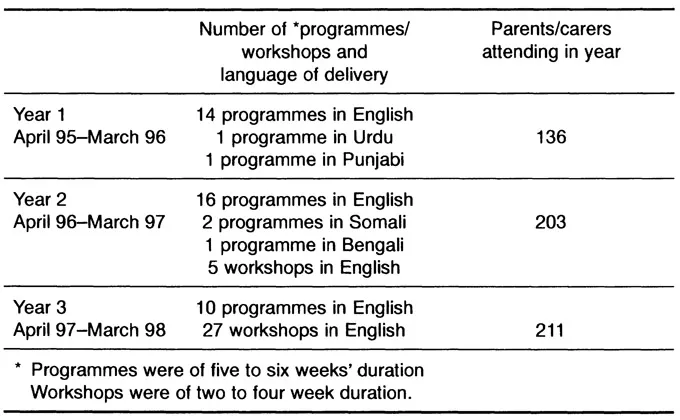
To date, 550 parents/carers have participated in the programme/workshops and participants represented most of Newham’s major ethnic minority communities. The key workers (City Challenge coordinator and myself) being able to speak four of the local community languages and having had vast experience of working with ethnic minority groups, hence also being able to access and train workers from other minority groups made it possible to deliver the programmes in Urdu, Hindi, Punjabi, Bengali and Somali. Male carers, although far fewer in number than female carers, also accessed the programme. The programme has also attracted parents and carers with special needs (for example dyslexic, blind and partially deaf). (See Table 8.1.)
Links with other agencies
The extension project has collaborated successfully with a range of voluntary and statutory organisations in Newham in the delivery of the programmes. Good working links have been developed with other agencies like Social Services, Early Years Unit, Newham Community Health Service Trust, Community Education Service, Stratford Development Partnership, Community Centres, Children Centres, Advice Arcade, Play Groups and Mother and Toddler Groups to enhance, access and promote the project.
Table 8.1
Programme model
The project developed a model using a programme of five or six weeks duration, which ran parallel with the school term time, and was accompanied by a crèche. Such a model not only enabled parents to attend the parenting skills programme in peace, but made them feel valued as individuals and gave them a sense of satisfaction, as they saw it as time out for themselves without any disturbance or bother from the children.
Comments made by parents on time out for themselves:
The programme was really enjoyable. It was nice to have an afternoon to myself, talking and listening to other parents in similar circumstances.’
‘I have not been in contact with women of my age group in a long time. This programme gave me the opportunity to do so and to be away from the kids.’
‘It gave me a nice break from my three-and-a-half-year-old. I got to meet other women living in my area and talked about how we each cope with our children and our feelings.’
‘It gave us an opportunity to meet other people, share experiences and relax.’
‘It was very helpful as it gave us time to talk together about our own positive qualities and that of our children.’
Evaluation
All the parenting programmes were evaluated on a weekly basis and after a period of about six to eight weeks after completion of the programme by running a post-programme Focus Group of the participating parents. The comments made by the parents on the evaluation sheets indicate that they not only enjoyed the programmes but also benefited from them.
Comments made by parents who have been on the programmes
This course has given me a real boost, I feel more positive about myself and about how I’m bringing up the children.’
‘It gives me a sense that I’m not fighting and losing the battle on my own, that there are others in the same situation.’
‘I have learned about the mixed messages we give our children.’
‘I try and keep calm and think before reacting. I try and remember to praise good behaviour and try to ignore bad behaviour.’
‘My husband made sure he reminded me about the parent classes today because he is also learning from my notes and what I share with him.’
‘I was able to share experiences and ideas, it gave me some time away from the children and to think about new ideas.’
‘To know that I’m not alone, other parents face the same problems.’
‘It helped me realise that each child is unique and has different needs.’
‘It was very informative – A good approach to looking at alternative ways of dealing with children and their behaviour as well as our own.’
‘The programme is very good, especially for mothers. I congratulate the authority that introduced it.’
‘It tackles all those well-known problems like surviving a trip to the supermarket, eating problems, temper tantrums and more.’
‘Planning together and good delegation helps both the children and myself.’
‘I have learnt to keep calm, count to ten and sit down and talk to my children.’
‘The programme makes you realise that children are like us and have feelings and we have to respect them.’
The programmes have not only made parents/carers more informed about the development of their children and affected the way they act as parents/carers but also helped them to build up their confidence, raise their self-esteem, develop further in training, education, work and in their contribution to community. For example:
- One parent who participated in the programme that was offered in a community language now helps in a nursery class.
- Another who previously required substantial help and support from school now works as a dinner lady, has taken on playground dut...
Table of contents
- Cover
- Title
- Copyright
- Contents
- Preface
- Biographical details of contributors
- Section One: Review and overview of developments
- Section Two: Themes of parental identity and contexts for parenting
- Section Three: Relating principles to practice
- Index
Trusted by 375,005 students
Access to over 1.5 million titles for a fair monthly price.
Study more efficiently using our study tools.
Frequently asked questions
Yes, you can cancel anytime from the Subscription tab in your account settings on the Perlego website. Your subscription will stay active until the end of your current billing period. Learn how to cancel your subscription
No, books cannot be downloaded as external files, such as PDFs, for use outside of Perlego. However, you can download books within the Perlego app for offline reading on mobile or tablet. Learn how to download books offline
Perlego offers two plans: Essential and Complete
- Essential is ideal for learners and professionals who enjoy exploring a wide range of subjects. Access the Essential Library with 800,000+ trusted titles and best-sellers across business, personal growth, and the humanities. Includes unlimited reading time and Standard Read Aloud voice.
- Complete: Perfect for advanced learners and researchers needing full, unrestricted access. Unlock 1.5M+ books across hundreds of subjects, including academic and specialized titles. The Complete Plan also includes advanced features like Premium Read Aloud and Research Assistant.
We are an online textbook subscription service, where you can get access to an entire online library for less than the price of a single book per month. With over 1.5 million books across 990+ topics, we’ve got you covered! Learn about our mission
Look out for the read-aloud symbol on your next book to see if you can listen to it. The read-aloud tool reads text aloud for you, highlighting the text as it is being read. You can pause it, speed it up and slow it down. Learn more about Read Aloud
Yes! You can use the Perlego app on both iOS and Android devices to read anytime, anywhere — even offline. Perfect for commutes or when you’re on the go.
Please note we cannot support devices running on iOS 13 and Android 7 or earlier. Learn more about using the app
Please note we cannot support devices running on iOS 13 and Android 7 or earlier. Learn more about using the app
Yes, you can access Parenting Education and Support by Sheila Wolfendale,Hetty Einzig in PDF and/or ePUB format, as well as other popular books in Education & Education General. We have over 1.5 million books available in our catalogue for you to explore.